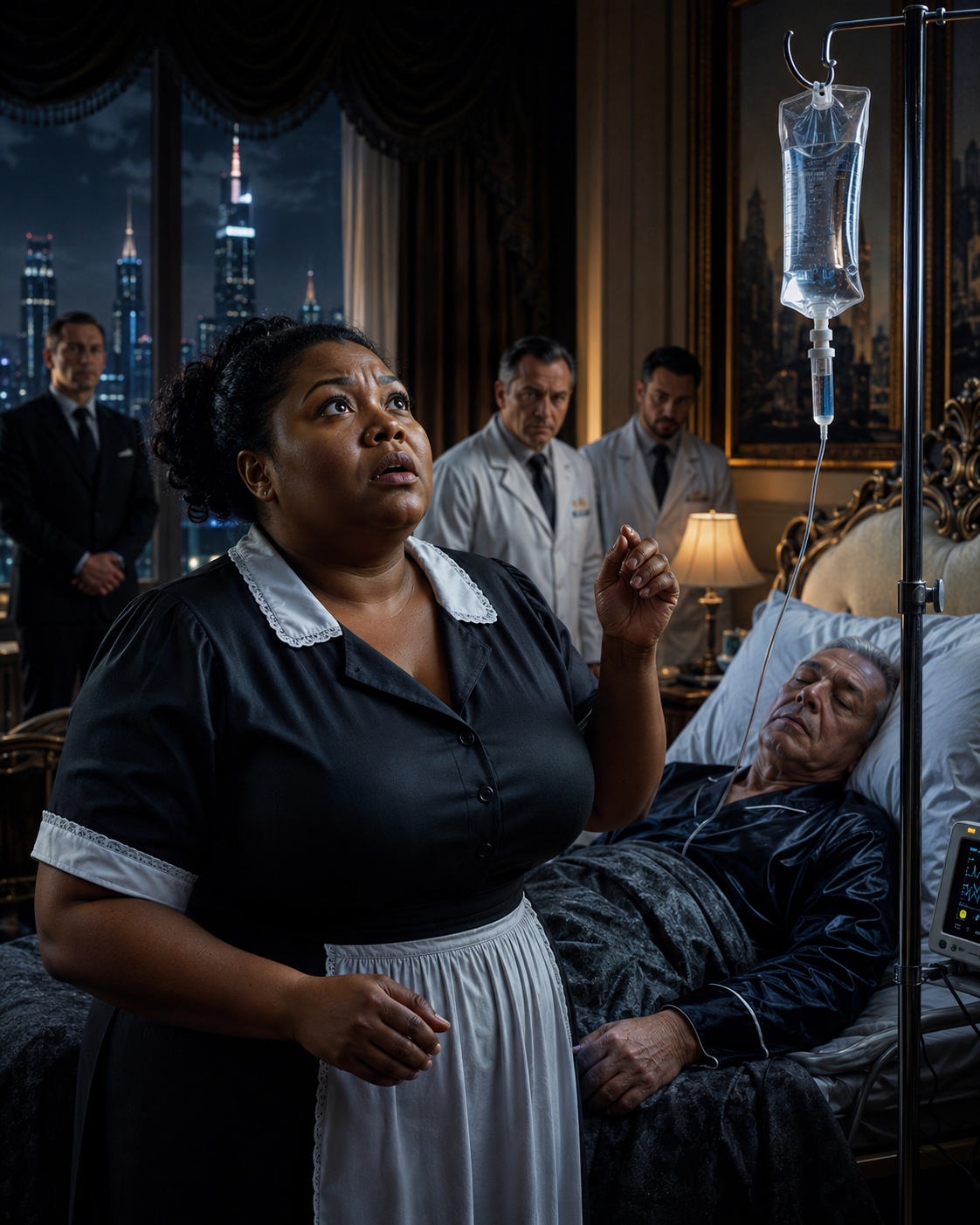
Twelve Specialists Had Already Given Up on the Chicago Boss—Until the Maid Nobody Respected Noticed What Was Hanging Above His Bed

“Stop looking at his heart,” Mara whispered. “Look at what you’re putting into him.”

The room went still.

For three days, twelve specialists had moved in and out of Cassian Vale’s private bedroom like priests attending a dying king. Cardiologists, neurologists, infectious-disease experts, emergency consultants, kidney doctors, men and women with spotless coats and expensive watches. They had checked his blood, scanned his organs, argued over his pressure, his breathing, his failing rhythm, his collapsing strength.

And all of them had missed the one thing hanging above his bed.

Dr. Julian Rourke turned slowly from the monitor.

He was the kind of physician rich men trusted because he never looked impressed by wealth. Silver hair, narrow shoulders, cold hands, colder voice. He had spoken to senators, judges, billionaires, and grieving wives without once raising his tone.

Now he looked at the maid by the linen cart as if she had interrupted surgery to complain about dust.

“This is not the time,” he said, “for household guesses.”

Mara Wells tightened both hands around the clean towels stacked against her chest. The towels had been her excuse to stay in the room. Nobody paid attention to a woman carrying laundry. Nobody ever had.

That was why she noticed things.

Cassian Vale lay beneath white sheets in the center of the enormous master bedroom. The most feared man in Chicago looked smaller than he should have. His face was gray under the lamplight. Tubes ran from machines into his arms. His breathing came shallow and uneven, as if each inhale had to be negotiated with death.

Around him, the doctors had gathered in a half-circle of failure.

Dr. Rourke had just said the words everyone had been waiting for.

“There is nothing more we can do.”

Nolan Pierce, Cassian’s trusted deputy, stood near the foot of the bed in a black suit, his hands folded in front of him. His expression was tragic, polished, nearly perfect.

Too perfect.

“Doctor,” Nolan said softly, “are you saying he won’t survive the night?”

Mara looked at Nolan then.

Not because he had asked the question.

Because he had asked it too calmly.

The others in the room lowered their eyes. Cassian’s men shifted uneasily near the walls. The housekeeper crossed herself. One of the younger doctors pretended to read a chart so he would not have to look at the dying man.

Mara looked up.

Above Cassian’s bed, an IV bag hung from the metal stand. It was half full, clear liquid trembling faintly every time the machine clicked. The second bag behind it, almost hidden by the pole and shadow, had been turned with its label facing the wall.

Mara had changed linens in sickrooms for years. She had cleaned after hospice nurses. She had cared for her own father when illness had reduced him to a man who could not lift a spoon. She knew how tubes should hang, how bags should be sealed, how liquid should drip.

Something about that second bag was wrong.

Not wrong enough for a doctor rushing toward theories.

Wrong enough for a maid who had learned that survival often lived in small details.

“Please,” she said.

Dr. Rourke exhaled sharply. “Miss Wells, step outside.”

Mara did not move.

Nolan’s eyes flicked toward her, and for half a second she saw irritation under the grief.

That was the moment she became certain.

“Look at the upper seam,” she said.

A younger doctor frowned. “What?”

“The back bag,” Mara said. “Where it faces the wall.”

Nobody moved.

Nolan gave a soft, wounded laugh. “This poor woman is upset. She has worked for Mr. Vale for years. She doesn’t understand what is happening.”

Mara looked straight at him.

“I understand enough to know that bag wasn’t hanging that way this morning.”

The room shifted.

Dr. Rourke’s expression did not change, but his eyes moved to the IV stand.

Nolan took one step forward.

“Doctor, surely you’re not going to entertain—”

“Quiet,” Dr. Rourke said.

The word was not loud.

It did not need to be.

He crossed to the bed, pulled gloves from the tray, and turned the hidden bag carefully toward the light.

For a second, nothing happened.

Then his face changed.

It was a tiny change. A tightening at the mouth. A narrowing of the eyes. The kind of change men like Nolan usually missed because they watched for fear, not realization.

Dr. Rourke leaned closer.

There, just below the upper seam, was a mark so small it looked like a flaw in the plastic.

A pinprick.

No bigger than a freckle.

A faint cloudy smear clung near it.

Dr. Rourke stopped breathing for one second.

Mara heard it.

So did Nolan.

“What is it?” one of the doctors asked.

Rourke did not answer immediately. He checked the tubing, the connector, the secondary line. Then he turned to the nurse standing beside the monitor.

“Replace every bag in this room. Now. Sealed supply only. Opened in front of me.”

Nolan’s face hardened.

“Is there a problem?”

Rourke looked at him. “There may be contamination.”

“Contamination?” Nolan repeated, too smoothly. “From where?”

Mara said nothing.

The doctor’s voice became clipped and fast. “I want toxicology expanded. Not routine screens. Broadened panel. Environmental agents. Line contamination. Anything introduced through infusion.”

Another doctor went pale.

Nolan’s gaze slid to Mara.

She suddenly felt every pound of her body, every ache in her knees, every year she had spent being laughed at in kitchens and hallways. She had been called slow, heavy, invisible, useful only when floors needed scrubbing and trays needed carrying.

But invisible people hear the truth before important people do.

Because no one bothers to hide it from them.

Three nights earlier, Mara had been polishing the brass handles outside Cassian’s study when she heard Nolan speaking on the phone.

“By Friday,” he had said. “No, not a bullet. Not a scene. He fades. They’ll call it age, stress, whatever rich doctors call it when they don’t know what happened.”

Mara had frozen with the rag in her hand.

At the time, she had told herself she misunderstood. In Cassian Vale’s world, dangerous words floated through the air like smoke. Men spoke in code. Threats were business. Death was sometimes only metaphor.

But later that same evening, Nolan had snapped at a delivery man near the service entrance for bringing a sealed box to the wrong door. The label had been turned away, but Mara remembered the bitter chemical smell when Nolan opened it. Not strong. Not obvious. Just enough to pull her backward through time.

Her father had worked in an old storage facility before the accident that ruined his lungs. After that, Mara never forgot certain smells.

Metal.

Garlic.

Rot under plastic.

Now, in Cassian Vale’s bedroom, she smelled a ghost of it again.

Dr. Rourke moved quickly, his arrogance stripped down to duty.

“Who had access to this line?” he asked.

The nurse looked terrified. “Medical staff only. And Mr. Pierce. He asked to sit with him when the family conference began.”

Every eye moved to Nolan.

Nolan did not flinch.

“I am his second,” he said. “I have sat beside him in war rooms, courtrooms, funeral homes, and hospital rooms. You think I need permission to stand by his bed?”

“No,” Mara said softly. “You needed privacy.”

Nolan’s head turned.

The room chilled.

For the first time since she had worked at the Vale estate, every powerful man in the room looked directly at Mara Wells.

Nolan smiled.

It was a beautiful smile. Calm. Expensive. Dead.

“Mara,” he said, almost kindly, “you are tired.”

“I am,” she replied. “But not confused.”

Dr. Rourke lifted the compromised bag away from the pole and handed it to a nurse. “Seal it. Nobody touches it except me.”

Nolan stepped closer. “You are making a very serious accusation.”

“I haven’t accused anyone yet,” Rourke said.

“But you are letting the maid direct the room.”

“No,” the doctor replied. “I am letting the evidence direct the room.”

Mara watched Nolan’s jaw tighten.

Then Cassian Vale’s monitor gave a harsh alarm.

The conversation shattered.

The room became motion.

Doctors surged forward. Machines beeped faster. Someone called for medication. Someone else adjusted oxygen. Rourke shouted instructions, and for the first time, none of the specialists argued. They had a new enemy now. Not a mystery illness. Not age. Not fate.

An attack.

Mara backed into the corner, pressing herself against the wall beside the heavy velvet drapes.

She should have left.

Servants left when the room became important.

But Cassian’s hand twitched against the sheet, and Mara remembered the night he had found her crying behind the garage six years earlier.

Back then, she had been sleeping in her car after her landlord raised the rent and her brother took what little money she had saved. She had been newly hired, still ashamed of how grateful she was for leftover soup.

Cassian Vale had opened the back door at two in the morning, seen her in the cold, and said nothing for almost a full minute.

Then he had asked, “Do you steal?”

“No.”

“Do you lie?”

“When I’m scared.”

He had grunted at that.

“Honest answer.”

The next morning, there was an envelope in the staff kitchen with three months of rent in cash and a note in Cassian’s blunt handwriting:

Pay it forward when you can. Until then, keep my house honest.

He never mentioned it again.

He had done terrible things. Everyone knew that. Men did not become kings in Chicago by being gentle. But that one decent thing had kept Mara from disappearing.

So she stayed.

For the next hour, the bedroom turned into a battlefield without weapons.

Fresh lines were placed. Every supply was checked twice. Dr. Rourke called Dr. Selene Marsh, a toxicology specialist who had refused Cassian’s case earlier because she did not work for “men who made widows professionally.” When Rourke told her what Mara had found, she arrived in twenty-seven minutes with wet hair, no makeup, and a face like thunder.

She did not ask who Cassian was.

She asked what had entered his body.

Rourke handed her the sealed bag.

Dr. Marsh examined it beneath a lamp, then looked at Mara.

“You saw this?”

“Yes.”

“You touched it?”

“No.”

“You smelled anything?”

Mara hesitated.

Nolan was still in the room.

Dr. Marsh noticed the hesitation.

“Out,” she said.

Nolan blinked. “Excuse me?”

“This is now a controlled medical environment,” Dr. Marsh said. “Everyone without clinical purpose leaves.”

“I am his—”

“You are a man in an expensive suit standing between me and my patient,” she snapped. “That is not a medical role. Leave.”

Nobody had spoken to Nolan Pierce that way in years.

His eyes went flat.

Cassian’s guards looked between him and the doctors, uncertain which authority mattered more while their boss lay unconscious.

Dr. Rourke turned to them. “If you want him alive, clear the room.”

That did it.

The guards escorted Nolan out.

The second the door closed, Mara spoke.

“There was a delivery three nights ago. Nolan took it himself. It had that smell. Not strong. But I knew it.”

Dr. Marsh’s face sharpened. “What kind of smell?”

Mara described it carefully, refusing to embellish, refusing to sound dramatic. She knew the danger of being a poor woman in a rich room. If she sounded emotional, they would call her hysterical. If she sounded uncertain, they would call her useless.

So she sounded exact.

Dr. Marsh listened without interrupting.

When Mara finished, the doctor looked at Rourke.

“This could explain the collapse,” she said. “Not all of it, but enough. If it entered through the line, routine labs could have chased the wrong shadows.”

“Can you reverse it?” Mara asked.

Dr. Marsh looked at Cassian, then at the machines, then at the bag sealed on the table.

“We can try to keep him alive while his body fights it,” she said. “But if the person responsible is close, we cannot let him know we changed course.”

Mara thought of Nolan downstairs, already arranging his grieving face for the men he had summoned.

“He already knows enough,” she said. “He saw you take the bag.”

Dr. Rourke cursed under his breath.

Dr. Marsh looked at Mara again.

“What else have you noticed?”

No doctor had ever asked Mara that before.

For a moment, she could not answer.

Then years of silence broke open.

“Nolan moved the family meeting from tomorrow morning to tonight. He told the kitchen to prepare coffee for twelve men before anyone said Mr. Vale was dying. He asked the west gate guard to leave early. He changed the hallway camera schedule because he said the wires were being serviced, but the service company never signed in. And he told Mr. Vale’s driver not to come until dawn.”

Rourke stared at her.

Dr. Marsh said quietly, “You kept all of that in your head?”

Mara shrugged. “People like me don’t get offices. We keep records where we can.”

The room went silent again, but it was different now.

This time, no one was dismissing her.

This time, the silence meant they were afraid.

Downstairs, the Vale estate filled with black coats and low voices.

Men arrived from Cicero, Bridgeport, Milwaukee, and the North Shore. Old captains with tired eyes. Young lieutenants hungry for a chair closer to power. Lawyers who never admitted they were lawyers. Cousins who had built their lives orbiting Cassian Vale’s name.

Nolan greeted them beneath the chandelier with grave dignity.

“My friends,” he said, “prepare yourselves. The doctors do not expect him to last the night.”

The men bowed their heads.

Some mourned.

Some calculated.

One or two did both.

Upstairs, Cassian Vale refused to die.

It did not happen dramatically.

There was no sudden miracle. No heroic gasp. No cinematic return from the edge.

It happened in small numbers.

A pressure reading held steady.

A rhythm stopped slipping.

A blood result came back less terrible than expected.

His breathing deepened by fractions.

Dr. Marsh watched the monitor like a gambler watching the final card turn.

Dr. Rourke stood beside her, sleeves rolled up, hair no longer perfect.

Mara sat on a wooden chair near the linen closet, hands clasped, feet aching, eyes fixed on Cassian’s face.

At 1:18 in the morning, his fingers moved.

At 1:31, his eyelids trembled.

At 1:44, Cassian Vale opened his eyes.

For a second, he looked like an old man dragged from a storm.

Then awareness returned.

His gaze moved slowly across the room.

Dr. Marsh.

Dr. Rourke.

The machines.

The sealed medical bag on the far table.

Mara.

His eyes stopped there.

His voice came out as a ruined whisper.

“Why is my maid sitting like a widow?”

Mara laughed once, and it broke into a sob before she could stop it.

“Because you scared us, sir.”

Cassian swallowed. Pain creased his face.

“Did I?”

Dr. Rourke leaned close. “Mr. Vale, you were deliberately harmed. We believe someone tampered with your medical line.”

Cassian’s eyes did not widen.

That was the frightening part.

He did not look shocked.

He looked tired.

“Nolan,” he whispered.

No one answered.

That was answer enough.

From the hallway came the sound of footsteps.

Then a knock.

Nolan’s voice followed, soft through the door.

“Doctor? Everyone is gathered. If Mr. Vale can hear us, the men would like to say goodbye.”

Mara saw Cassian change.

He was still pale. Still weak. Still bound to tubes and machines. But something ancient and dangerous returned behind his eyes. Not cruelty. Not rage.

Command.

“Open it,” he said.

Dr. Marsh stepped forward. “You are in no condition for confrontation.”

Cassian turned his head slightly.

“Doctor,” he rasped, “I have spent three days dying in my own house. I would like to be present for the funeral speech.”

Rourke hesitated.

Then he unlocked the door.

Nolan entered first, head bowed, one hand over his heart.

Behind him stood half a dozen of Cassian’s most powerful men.

“Brothers,” Nolan began, his voice thick with practiced sorrow, “we stand tonight at the bedside of a man who built—”

He stopped.

Cassian Vale was awake.

Not sitting fully. Not strong. Not restored.

But awake.

His eyes were open, and they were fixed on Nolan Pierce.

The hallway behind Nolan went silent.

Cassian’s mouth curved faintly.

“You rehearsed that.”

Nolan’s face emptied, then filled again with relief so false it almost looked painful.

“Cassian,” he breathed. “Thank God.”

“No,” Cassian whispered. “Thank Mara.”

Nolan’s gaze snapped to her.

There it was.

The hatred.

Bare, hot, uncontrolled.

Every man in the doorway saw it.

Mara did not step back.

Cassian noticed.

So did Nolan.

“So,” Cassian said, each word costing him breath, “tell me why the maid knew more about my death than my second-in-command.”

Nolan recovered quickly. “You’re drugged. You’re confused. These doctors are panicked, and she—”

“She saw the puncture,” Rourke said.

Dr. Marsh lifted the sealed bag without moving closer. “She saw what trained physicians missed because we were looking inside the body, and she looked at what was entering it.”

Nolan laughed. “This is insane.”

Mara spoke then.

Her voice was quiet, but it carried.

“You moved the cameras. You took the late delivery. You asked Mr. Caruso if Milwaukee would support you if Mr. Vale died before morning. You told the kitchen to prepare for twelve men before the doctors gave a final report.”

One of the men in the hall, a broad-shouldered captain named Victor Caruso, looked up sharply.

Cassian’s eyes moved to him.

“Did he ask you that?”

Caruso’s silence answered first.

Then he nodded once.

“Yes.”

Another man in the doorway spoke. “He asked me too.”

“And me,” said a third.

Nolan’s polished grief cracked.

“You’re going to believe servants and frightened old men?” he snapped. “Look at him. He’s finished. Whether tonight or next month, he’s finished. You all know it.”

Cassian listened without blinking.

Mara had seen that look before.

It was the look he gave dust on a white shelf. A stain on marble. A lie told too often.

Something that would be removed.

But when Cassian spoke, his voice was quieter than anyone expected.

“You were measuring my chair,” he said, “before the body was cold.”

Nolan’s hand twitched.

Mara noticed because she had spent a lifetime watching hands. Hands that reached, hands that struck, hands that stole tips from tables, hands that signed checks, hands that pointed blame.

This hand moved toward his jacket.

“No,” she said sharply.

Two guards seized Nolan before he could do anything more than turn.

A small object slipped from inside his coat and hit the carpet.

No one moved toward it except the guard, who kicked it away and pinned Nolan harder against the wall.

Nolan began to struggle.

“You need me!” he shouted. “You think these men are loyal? They’re loyal to oxygen. They’re loyal to whoever is breathing!”

Cassian closed his eyes briefly.

When he opened them, something had settled in him.

Not mercy.

Something harder.

Clarity.

“Maybe,” he said. “But they were not stupid enough to try killing me while Mara Wells was in the room.”

Nolan twisted his head toward her.

“She is nobody.”

The words entered the room and died there.

Cassian’s eyes darkened.

“That,” he whispered, “was the mistake that ruined you.”

Everyone waited for the old order.

Men like Cassian did not call police. They did not give statements. They did not trust courts. In his world, justice usually happened in rooms with no windows and no paperwork.

But Cassian Vale had been close enough to death to see the shape of his own life.

He looked at Dr. Marsh.

“Call the sheriff.”

The room froze.

Nolan stopped struggling.

Cassian continued, breath by breath.

“Call the federal contact in the locked folder in my study. Tell them Nolan Pierce tampered with my medical treatment and attempted to kill me. Tell them my doctors preserved evidence. Tell them I will give a statement when I am able.”

Caruso stared. “Boss?”

Cassian turned his head toward the men in the doorway.

“You came here to learn who would lead if I died,” he said. “Here is what you learn instead. No throne is worth poisoning a sick man in his bed. No empire survives when cowards inherit it. Nolan wanted daylight? Give him daylight. Give him judges. Give him cameras. Give him a courtroom where he can explain how a maid destroyed his perfect plan.”

Nolan’s face went gray.

“You’ll expose yourself.”

Cassian leaned back, exhausted.

“Not all of me,” he said. “Just enough of you.”

Before dawn, Nolan Pierce left the Vale estate in handcuffs under a sky the color of wet stone.

Reporters gathered at the gate by sunrise. They were told there had been criminal tampering by a trusted associate during a private medical crisis. They did not learn the full truth. They did not learn about the tiny puncture in the hidden bag, or the smell Mara remembered from childhood, or the way twelve experts had stared at monitors while the answer hung above the bed.

But the house knew.

The doctors knew.

The men knew.

And Cassian knew.

Recovery was not elegant.

Cassian hated weakness more than he had hated most enemies. He hated the walker. He hated broth. He hated being told when to sleep. He hated the physical therapist who congratulated him for crossing a room as though he had conquered Europe.

But he did not hate being alive.

Mara visited him every afternoon at the private medical facility after her shift, though Cassian repeatedly told her she no longer had a shift.

“You fired me?” she asked the first time.

“I promoted you.”

“To what?”

“I don’t know yet.”

“That is not a job title.”

“It is if I say it with enough confidence.”

She brought him the dark wool cardigan he liked, the sandalwood soap from his bathroom, and books he pretended not to read. He complained about every one of them, then asked for the next.

On the fourth week, Cassian’s daughter arrived.

Her name was Claire Vale, and she had not stepped inside her father’s house in eleven years.

She came to the hospital in a camel coat, her hair pulled back, her face composed in the way people compose themselves when they are afraid grief will embarrass them. She looked like Cassian around the eyes and like someone else entirely around the mouth.

Mara was in the hallway when Claire stepped out of the elevator.

“You’re Mara Wells,” Claire said.

“Yes, ma’am.”

“My father says you saved his life.”

Mara looked down at the coffee cup in her hands.

“I noticed something.”

Claire’s expression softened in a way that made her suddenly look younger.

“Sometimes that’s the difference.”

They stood together outside Cassian’s room, both listening to him argue with a nurse about soup.

Claire folded her arms.

“My father has hurt people.”

“I know.”

“He has done things I still cannot forgive.”

“I know that too.”

“Then why save him?”

Mara looked through the glass panel in the door. Cassian was scowling at a spoon as if it had personally betrayed him.

“Because dying should not be the only way a man stops doing harm,” she said. “If he is breathing, he still has choices left.”

Claire studied her.

“And you believe he’ll make better ones?”

“No,” Mara said honestly. “I believe he has no excuse not to try.”

Inside the room, Cassian had gone quiet.

He had heard.

He did not open his eyes.

He did not speak.

But from that day forward, something in him shifted.

Not all at once. Men like Cassian Vale do not become saints because they survive betrayal. A brush with death does not wash blood from the past. But it can make a man look at the furniture of his life and finally see the dust.

Three months later, Chicago newspapers reported that Vale Consolidated was restructuring.

Two clubs were sold.

Three silent partnerships vanished.

Several dangerous men found themselves cut off from money they had assumed would always flow.

Legal teams appeared. Accountants appeared. Auditors appeared. Claire took formal control of the legitimate side of the business after two brutal arguments and one shattered glass.

Cassian called it housekeeping.

Claire called it overdue.

Mara called it “better than nothing,” which made Cassian laugh for the first time in weeks.

“You’re a cruel woman,” he told her from his study chair, cane resting beside him.

“I learned from the best.”

“I was never cruel to you.”

“You made me polish silver before Thanksgiving dinner with a toothbrush.”

“Standards matter.”

“So does dignity.”

He looked at her for a long moment.

“Yes,” he said. “It does.”

Mara expected a reward.

People in houses like Cassian’s always expected rewards to be simple: money, jewelry, an apartment, a car. Things that made the rich feel generous and the poor feel purchased.

Cassian surprised her by asking one question.

“What do you want?”

Mara almost laughed because the question felt too large.

No one had asked her that in years.

She had wanted things once. Before medical bills. Before rent notices. Before jobs where supervisors spoke to her slowly because of her size and uniform. Before she learned to make herself useful instead of hopeful.

“I don’t know,” she said.

“Think.”

“I’m too old to start over.”

“That is not an answer.”

“It feels like one.”

Cassian tapped his cane against the floor.

“I was sixty-two when I learned my maid was smarter than twelve specialists. Age is clearly not the problem.”

Mara looked away, embarrassed by the warmth rising in her face.

“I wanted to work in medicine,” she admitted. “A long time ago. Nursing, maybe. Something where noticing things mattered.”

Cassian nodded as if she had told him a business plan.

“Then do that.”

“It isn’t that simple.”

“Nothing worthwhile is.”

With Claire’s help, Mara applied to a nursing program in Chicago.

Dr. Rourke wrote a recommendation letter so formal and powerful that the admissions office called to confirm it was real.

Dr. Marsh arranged for Mara to shadow in a toxicology unit.

Cassian tried to pay her tuition anonymously.

Mara found out.

She marched into his study furious enough that two guards stepped aside without being asked.

“I am not charity,” she said.

Cassian looked up from his desk.

“No,” he replied. “You are an investment.”

“In what?”

“In the first person in every room who remembers to look up.”

Mara tried not to cry.

Failed.

Then made him agree the tuition would be a loan.

He agreed.

Claire later told Mara the repayment schedule required one dollar per year for the next two hundred years.

One year after the night Cassian nearly died, the Vale estate hosted a dinner.

Not the old kind.

No whispered threats in corners. No men checking jackets. No business disguised as dessert.

This dinner was for the people who had kept Cassian alive and the people he had finally stopped pushing away.

Claire came.

Dr. Marsh came.

Dr. Rourke came.

Victor Caruso came, quieter now, learning the strange discomfort of loyalty without fear.

The house staff came as guests.

Mara arrived in a navy dress she had chosen herself after rejecting every outfit that made her feel like she should apologize for taking up space. Her hair was pinned back. Her shoes were comfortable. Her knees still hurt sometimes, but less than they used to. In her purse was a folded exam score from anatomy class, high enough that she carried it like a secret medal.

When she entered the dining room, conversations paused.

A year earlier, that pause would have meant mockery.

Now it meant respect.

Cassian stood with effort, one hand on his cane. Several people moved instinctively to help him.

He glared until they stopped.

Then he raised his glass.

“I built this house badly,” he said.

No one breathed.

Cassian continued.

“I built it on fear and called that loyalty. I built it on silence and called that order. I believed power meant being the most dangerous man in the room.”

His eyes found Mara.

“Then I nearly died in my own bed, surrounded by experts, and the person who saved me was the woman everyone had trained themselves not to see.”

Mara looked down, face burning.

Cassian’s voice roughened.

“Mara Wells saw the smallest mark in the room. She saw betrayal where others saw routine. She spoke when silence would have been safer. She saved my life. More than that, she forced me to live long enough to ask whether my life was still worth saving.”

The room remained still.

Cassian turned toward her fully.

“You told my daughter that as long as a man is breathing, he still has choices. I am breathing because of you. So tonight, I choose gratitude. I choose repair where repair is possible. And I choose to make sure no person in this house is ever treated as invisible again.”

Claire raised her glass first.

“To Mara,” she said.

One by one, the others followed.

Mara wanted to disappear.

She did not.

She stood inside the attention and let herself be seen.

Later, after dinner, she found Cassian alone near the tall windows overlooking the lake. Snow moved softly through the dark beyond the glass.

“You embarrassed me,” she said.

“Yes,” he replied. “But with dignity.”

She laughed.

He looked almost pleased with himself.

After a moment, he asked, “Are you happy, Mara?”

The question hit harder than she expected.

She thought of hospital corridors where she now walked with a student badge clipped to her sweater. She thought of Claire texting her study reminders. She thought of Dr. Marsh sending her articles with notes in the margins. She thought of the staff eating at the main table. She thought of the woman she had been behind the garage, trying to make herself small enough to survive.

“I’m getting there,” she said.

Cassian nodded.

“Good.”

“What about you?”

He looked out at the snow.

“I am not forgiven,” he said. “But I am not finished.”

Mara stood beside him, their reflections caught together in the dark window: the old boss with a cane, the former maid becoming a nurse, two people the world had misjudged in different ways.

Behind them, the estate no longer sounded like a fortress.

It sounded like a house learning how to breathe.

A year before, twelve specialists had looked at Cassian Vale and seen a dying man.

Nolan Pierce had looked at him and seen an empty throne.

The men had looked at Mara and seen a servant.

The world had looked at the estate and seen power.

Only Mara had looked up.

She saw the hidden mark.

She saw the pattern.

She saw the betrayal.

And because she noticed what everyone else ignored, a man lived long enough to change, a daughter came home before it was too late, and a woman who had spent half her life being overlooked finally stepped into the center of her own story.

Not as a maid.

Not as a joke.

Not as someone’s charity.

But as Mara Wells.

The woman who saved the most feared man in Chicago by seeing the smallest thing above his bed.

Twelve Specialists Had Already Given Up on the Chicago Boss—Until the Maid Nobody Respected Noticed What Was Hanging Above His Bed
Her husband cruelly shamed her for her body – the incredible transformation of the Hollywood star!