If you notice that people around you feel uncomfortable because of the age gap, ask them why. Many people judge such relationships based on generalised stereotypes, but that doesn’t mean your relationship has to fit a mould either. Help your friends and family understand why you’ve chosen this particular person. You don’t necessarily need to win their approval, but talking about your relationship can help them see the bigger picture.
It’s important that your partner is on your side during this process. They probably understand the awkwardness you’re facing too, so support each other when answering awkward questions from friends or dealing with relatives’ suspicions.
Don’t be afraid to discuss stereotypes with your partner
A couple with an age gap walks happily down the street with coffee in hand.
People usually have preconceptions about age-gap relationships due to a perceived power imbalance, the potential for fantasy, or an apparent mismatch in maturity levels. When it comes to power, people often recall the myth of the young woman who dates a man twice her age and supposedly has ‘father issues’. Sometimes those around them draw conclusions about the financial side of the relationship, for example, assuming that if a woman dates an older man, he must be her ‘sugar daddy’.

Your situation may resemble one of these examples more closely than you’d like. It’s normal to feel uncomfortable about this, and you might even start to wonder whether certain stereotypes apply to your relationship. Instead of avoiding the obvious topic, it’s better to discuss it openly with your partner and ease any internal tension. Here are a few questions you can ask if you have any doubts:
- Does my age play a role in your attraction to me?
- Do you think our age difference affects our relationship in any way?
- Do you feel comfortable spending time with my friends?
- Do you ever feel awkward or embarrassed about dating someone my age?
- Are we prepared to face the stereotypes about why people think we’re together?
- How do you think we should best talk to friends and family if they disapprove of our relationship?
- Do you see this as something casual, or do you see a long-term future with me?
Focus on your own worth
If you’re wondering whether to continue the relationship solely because of the age gap, take a step back. Don’t let the criticism and judgement of those around you be the only reason you walk away from a romantic connection. After all, if you’ve met someone you really like, it’s worth giving the relationship a chance and seeing where it leads — provided there’s a genuinely healthy dynamic between you.
At the same time, it’s important to treat yourself with kindness and build a romantic relationship based on trust. When you’re confident in your own worth, other people’s opinions start to matter far less.
Labadi, who is herself married to a man 18 years her senior, advises focusing on the strengths of the relationship. “It’s important to understand why this relationship works. Someone else’s approval won’t make your bond any stronger,” says Labadi. Lively and Reynolds could worry about what others think, or they could bake biscuits, have film nights and probably tease each other online. You deserve to enjoy your relationship too.
Can relationships with an age gap last?
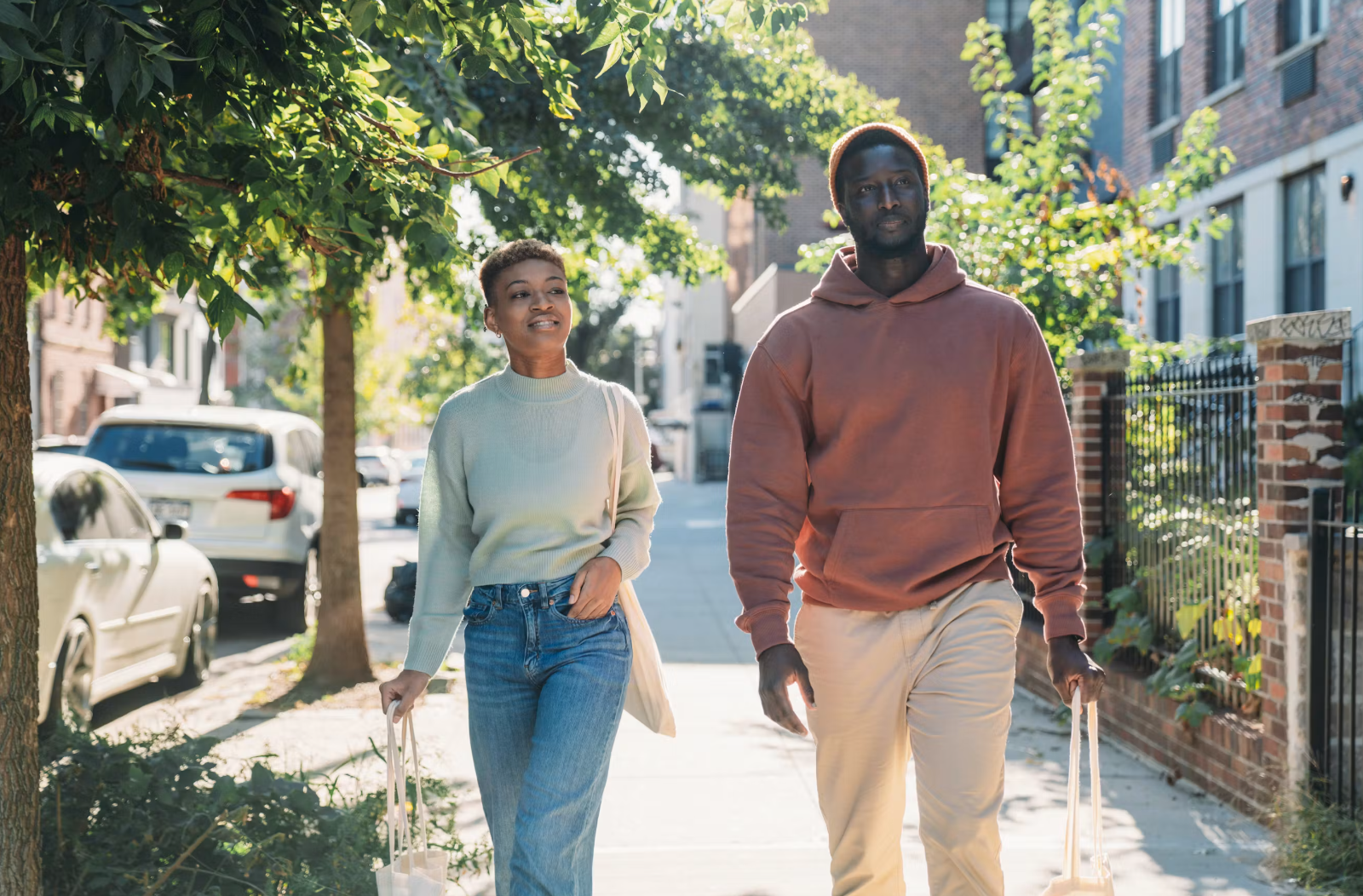
A couple with an age gap happily stroll on a sunny day.
Research does not provide a single definitive answer as to what the ideal age gap is for a relationship, or how it relates to a couple’s long-term success. In fact, the evidence is mixed.
A 2019 study published in the Journal of Population Economics found that couples with an age difference of one to three years reported high levels of relationship satisfaction. The study also noted that the greater the age difference — for example, six to ten years — the higher the likelihood of dissatisfaction increasing. However, a 2016 study published in the Galen Medicine Journal showed that if the age difference between partners is less than 10 years, rather than more than 10 years, relationship satisfaction may, on the contrary, be higher.
These findings might suggest that relationships between people of roughly the same age are more likely to be successful, but there are important nuances here. In both studies, the authors emphasise that a couple’s success is linked not so much to the fact that the partners were born around the same time, but rather to similar values, levels of maturity, future goals and lifestyles.
Relationships with someone of a different age can present certain challenges, but, according to Hill, honesty and communication can help overcome them. ‘If both people feel happy, loved, secure and able to communicate well, there is no need to treat such a relationship any differently from any other,’ she says.
Remember: do what’s best for you
Even if you’re confident in your relationship despite the age gap, people will still have something to say. At times like these, it’s important to remember that their comments usually say less about your relationship and more about their own preconceptions about love and dating. To cope with this noise, it’s important to understand yourself and your desires well, so you can maintain inner stability. Reflect on your personal values so that, when someone questions your relationship, you can resist giving in to self-doubt and external pressure.
Age-gap relationships can certainly be long-lasting, but this requires effort from both partners. Being a couple means communicating openly, speaking honestly about your expectations, and constantly investing in the relationship. No one but yourselves can answer whether this is the right relationship. If you are in an age-gap relationship and both of you are willing to learn, grow and move forward together, why not see where it might lead?
Ultimately, the heart wants what it wants. Don’t deprive yourselves of a valuable experience just to conform to social pressure. As Labadi says: ‘If the relationship is good, it will last. If two people feel a connection, their hearts are open, they like each other, they grow together, they know how to resolve conflicts and they value the relationship, such a union will last as long as they themselves wish.’