The old Kade ranch became a working place once more, though Elena insisted on adding a commercial kitchen bigger than Ronan thought any kitchen had a right to be. She opened a bakery and refuge for women traveling through the mountains with no money, no safety, and no one waiting for them.
The sign above the door read: First Cry House.
Inside, every woman received warm food, a bed, legal contacts, medical care, and no questions she was not ready to answer.
Elena funded it with Harland money.
She considered that poetic.
Theo grew into a sturdy boy with Jasper’s crescent mark, Elena’s smile, and Ronan’s habit of standing with his feet planted like a tree. When he was six, he asked why he had two fathers.
Elena’s hands stilled over bread dough.
Ronan looked up from repairing a chair.
The question had been coming. They had prepared for it and still were not ready.
Ronan set the chair aside.
“Because love gave you one father who brought you into the world,” he said, “and another who was lucky enough to help raise you.”
Theo considered this.
“Was Daddy Jasper brave?”
Elena’s eyes filled.
“Yes,” she said. “Very.”
“Are you brave?” Theo asked Ronan.
Ronan thought about the storm, the courtroom, the years before truth.
“Sometimes.”
Theo looked at Elena.
“Is Mom brave?”
Ronan answered before she could.
“Always.”
Theo nodded as if this confirmed something obvious.
“I’ll be brave like Mom, smart like Daddy Jasper, and grumpy like you.”
Elena laughed until she had to sit down.
Ronan sighed.
“That seems fair.”
On Theo’s tenth birthday, Elena took him to the courthouse archive and showed him part of Jasper’s letter.
Not all.
Enough.
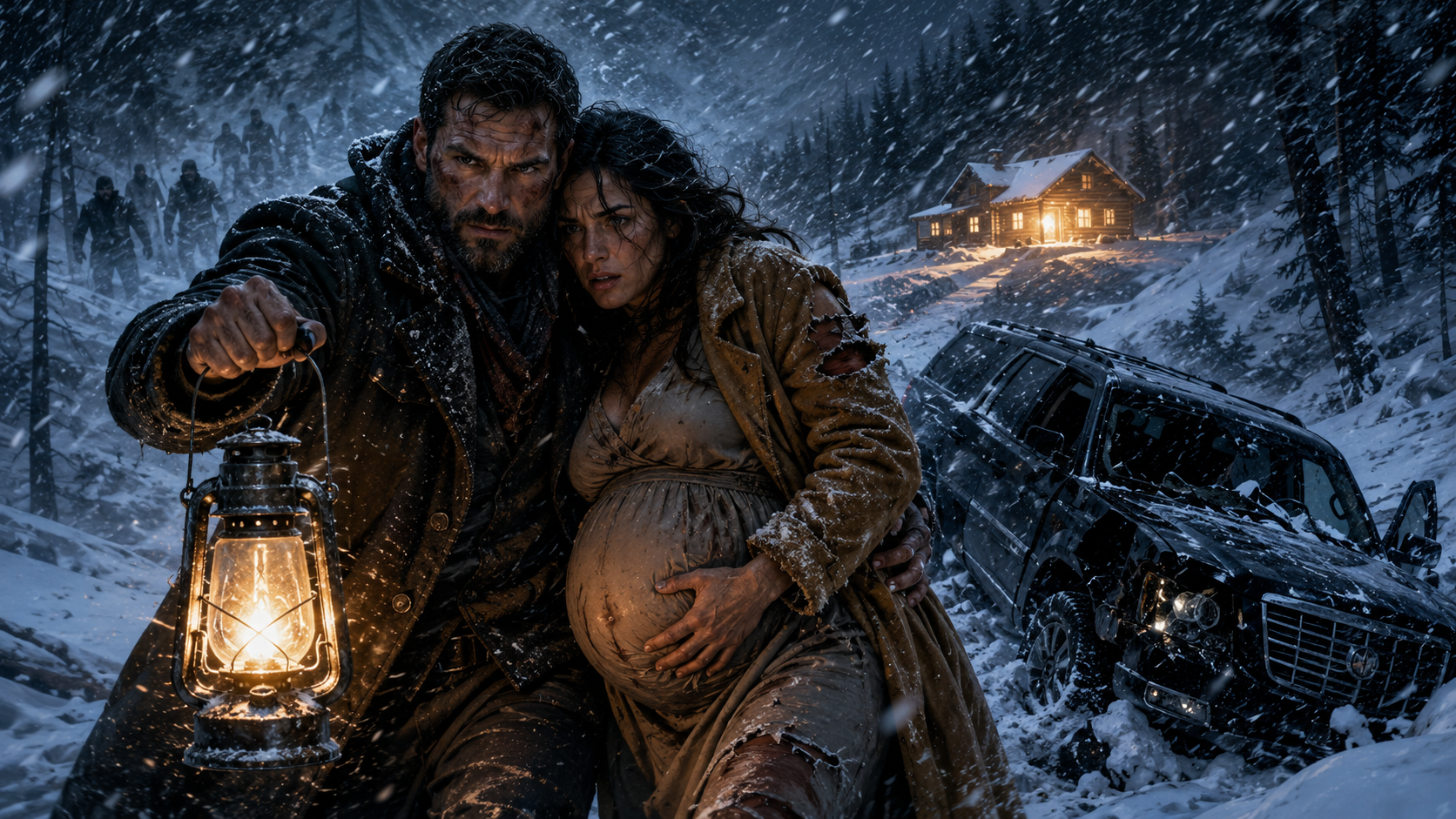
Then Ronan took him to the ridge above the old wreck site. The SUV was long gone. The road had been repaired. Wildflowers grew where blood had once darkened the snowmelt.
Theo stood quietly beside him.
“This is where I was born?”
“No,” Ronan said. “You were born in my cabin.”
“But this is where Mom almost died?”
“Yes.”
“And you found her because she screamed?”
Ronan looked across the pines.
“Yes.”
Theo was quiet for a long time.
Then he said, “Good thing she was loud.”
Ronan smiled.
“The best thing.”
Years later, when the story became local legend, people told it dramatically.
They said a mountain man found a billionaire’s curvy widow giving birth alone in a storm.
They said the baby’s first cry exposed the men who wanted him gone.
They said the Harland empire fell because one newborn refused to stay silent.
All of that was true.
But Elena knew the deeper truth.
The cry did not create Theo’s worth.
It revealed the ugliness of those who denied it.
The inheritance did not create Elena’s strength.
It gave the world paperwork for what had already been true.
And Ronan had not saved her because she was helpless.
He had answered because she called.
On the twenty-fifth anniversary of the storm, Elena woke before dawn and found Ronan’s side of the bed empty.
She found him outside near the old barn, standing beside a wooden sign he had mounted facing the ridge. His hair had gone silver at the temples. His shoulders were still broad. His hands were still rough. He still looked like a man the mountain had made and mercy had softened.
“What are you doing?” she asked.
He stepped aside.
The sign was carved from pine, the letters burned deep and careful.
Here, a woman refused silence.
Here, a child took his first breath.
Here, a lonely man learned that home can arrive screaming.
Elena read it twice.
Then her eyes blurred.
“You made this?”
“Took four tries.”
“You spelled everything right?”
“Don’t ruin the moment.”
She laughed and cried at the same time.
Ronan shifted, still uneasy with tears after all these years.
“I thought about mentioning the inheritance,” he said. “Or the trial. Or Celeste.”
“No.” Elena touched the carved words. “This is better.”
“You sure?”
She turned to him.
“The money was never the miracle.”
He looked toward the house, where grown Theo had arrived the night before with his wife and baby daughter, where light was beginning to glow in the kitchen, where the family they had built was waking into another ordinary, impossible day.
“What was?” Ronan asked.
Elena slipped her hand into his.
“That someone heard me,” she said. “And came.”
Ronan’s eyes shone.
“I would come again.”
“I know.”
From the house, Theo shouted, “Mom! Dad! The baby’s crying and Ada says breakfast is burning!”
Ronan sighed.
“Some traditions never die.”
Elena smiled toward the sunrise.
The mountains that had once carried her scream now carried her family’s laughter. The road that had almost ended her life had become the path home. The body she once believed took up too much room had held a child, survived a dynasty, built a refuge, loved two good men in different ways, and grown old without asking permission.
She leaned into Ronan’s side.
“Come on, mountain man,” she said. “Let’s go save breakfast.”
He kissed her temple.
“I already saved what mattered.”
“No,” Elena said, squeezing his hand. “You helped me save it myself.”
Together, they walked back toward the house, toward the crying baby, the burning toast, the clear creek, the loud family, and the life that had begun with one scream in the trees and one furious first breath that refused to be silenced.