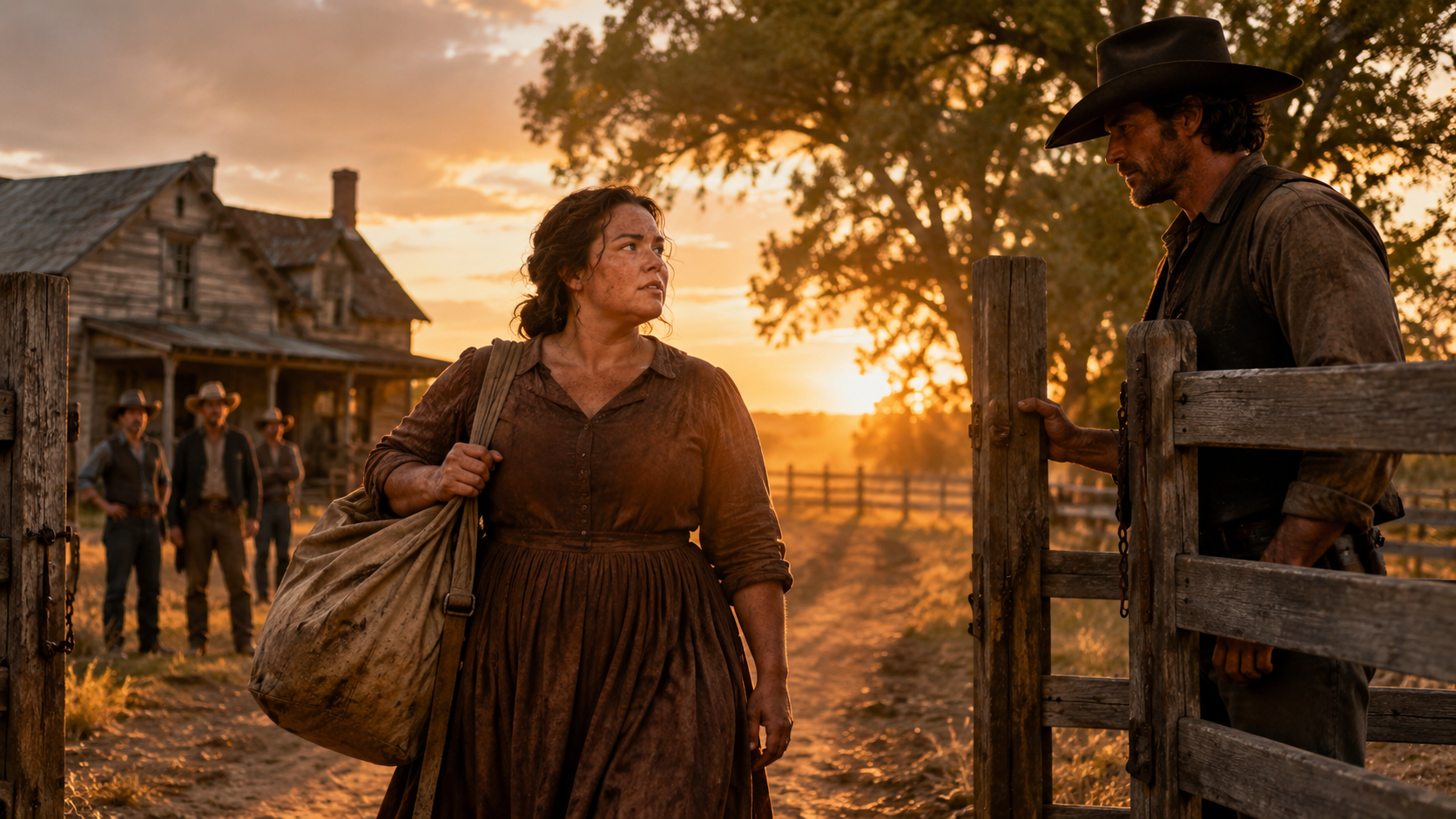
Then the porch boards creaked as Mrs. Finch retreated.
Elsie waited until the wagon rolled away before she opened the door.
Gideon stood outside, hat in hand.
“You all right?”
“I’m angry.”
“That was not my question.”
“It is my answer.”
His eyes moved once to the mark on her cheek.
“Crowe works fast.”
“He has never believed in earning slowly what he can steal quickly.”
“He wants the complaint to poison trade. Labor. Credit. Reputation. By the time it fails, damage will have already eaten.”
Elsie understood.
“He wants your ranch weakened.”
“He wants Black Creek water.”
“And now I am the match he means to strike.”
Gideon put his hat back on.
“You are not leaving.”
“I did not ask.”
“You were thinking it.”
“I was considering whether removing the match might spare the barn.”
“If I let Asa Crowe choose who works in my kitchen, I deserve to lose every acre I own.”
She looked at him then, truly looked.
He was not merely kind. Pride stood in him, yes. Land. Name. House. Memory. But beneath that was something rarer.
Anger on behalf of someone else.
“All right,” she said. “I’ll stay.”
“Good.”
“But if trouble comes to your men—”
“My men are grown. They can decide before supper whether they are cowards.”
That evening, a boy delivered a letter.
Elsie opened it alone on the porch step.
Miss Rowan,
Your father’s outstanding debt remains unpaid. Deliver the Rowan recipe chest and all papers hidden inside it by Friday sunset, or my complaint against Black Creek Ranch will proceed. You know what your father signed. You know what the law will say.
A. Crowe
Elsie read it twice.
Then she folded it and put it in her pocket.
She served supper without a word. Beef stew. Corn cakes. Pickled beans. The men ate quietly, watching her the way people watch a darkening sky.
After dishes, she knocked on Gideon’s study door.
“Come in.”
He sat behind a desk covered in ledgers. Lamplight made his face look older.
Elsie placed the letter in front of him.
He read it once.
Then again.
“Recipe chest?”
“My mother’s.”
“What is in it?”
“Recipes.”
His eyes lifted.
“And?”
“Letters. Land records. A map of old wells. Maybe proof. Maybe nothing.”
“Where is it?”
“I won’t tell you.”
His expression changed.
“Because you distrust me?”
“Because if you do not know, no one can force you to say.”
For a long moment, only the lamp hissed.
Then Gideon leaned back.
“That is either wisdom or an insult.”
“It can be both.”
This time, the smile reached the corner of his mouth.
“Crowe forged your father’s debt?”
“Yes.”
“Can you prove it?”
“Not alone.”
“Then you are not alone.”
Elsie looked down at the letter.
“He took my farm. He used my father’s sickness against him. He made the town laugh while I walked with everything I owned in my arms. You may stand with me, Mr. Hale, but you will not stand in front of me.”
Gideon was silent for a long time.
Then he nodded once.
“Beside you, then.”
Help arrived the next morning wearing black lace gloves and an expression sharp enough to cut rope.
The carriage stopped in front of the kitchen door, and a small woman climbed down without waiting for assistance. She carried a leather case under one arm and a cane in the other, though she seemed more likely to strike the earth with it than lean on it.
Gideon stepped onto the porch.
“Mrs. Marietta Quill.”
The old woman ignored him and looked straight at Elsie.
“Thomas Rowan’s daughter.”
“Yes, ma’am.”
“Your mother once told me I had the warmth of a locked pantry.”
Elsie blinked.
“She said that?”
“In my own parlor.” Marietta sniffed. “I disliked her for five years. Then I realized she had been generous. I was worse than a locked pantry. At least a pantry contains something useful.”
Silas, standing behind Gideon, whispered, “I’ve missed her.”
Marietta opened her leather case and removed a stack of papers.
“Asa Crowe threatened your father outside my grain office nine years ago. I wrote down every word because I enjoyed collecting ugly truths about ugly men. I had the statement witnessed. I did nothing with it because I was comfortable, rich, and cowardly.”
Elsie’s throat tightened.
“Why bring it now?”
“Because Adelaide Finch came into my store yesterday and said she had passed you on the bridge and had not stopped. She said it as gossip. I heard it as judgment.”
Marietta placed the papers on the kitchen table.
“One sworn statement from me. One copy of the note Crowe claims your father signed. One confession from Peter Lyle, former clerk, admitting he copied your father’s mark after the stroke ruined his writing hand.”
Elsie sat down because her knees forgot their duty.
“Peter confessed?”
“He did. Apparently shame ages poorly when fed in secret.”
Gideon picked up the papers, reading with a face that hardened line by line.