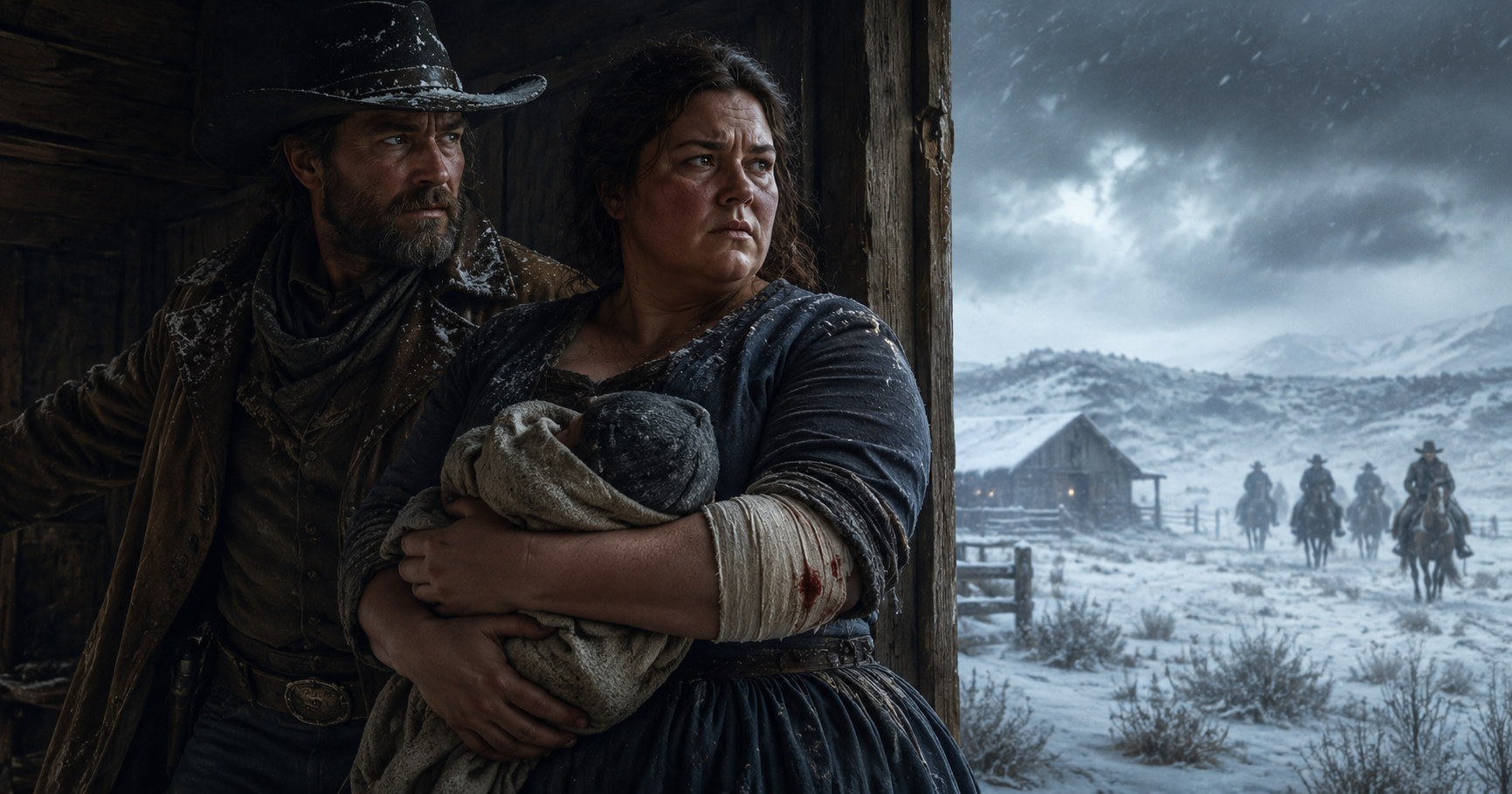
Harlan Reed had buried his wife before sunrise, but the earth was too frozen to take her gently.
He had used a pickaxe first, then a shovel, then his own hands when the blade struck roots under the snow. By the time he laid Clara beneath the cottonwood, his knuckles were split and his coat was stiff with frost. He did not cry. Grief had gone past tears and become something harder, quieter, more useful. It filled his chest like a stone.
Inside the cabin, his infant son was crying again.
Harlan stood over the grave a moment longer, staring at the mound beneath the gray morning sky.
“I’m sorry,” he said, though he did not know if he meant sorry for failing to save her, sorry for being alive, or sorry for the child screaming in a house where no mother waited.
The wind answered for her.
By noon, the baby’s cries had turned thin.
Thomas was three weeks old, red-faced and hungry, his fists opening and closing against nothing. Harlan had tried goat’s milk. He had warmed it, cooled it, strained it through cloth, prayed over it like a fool. The boy took a little, then choked, then screamed until his voice broke.
Harlan had served as a surgeon in the war. He had held men together with thread and whiskey. He had cut bullets out by lantern light. He had watched boys die calling for mothers who were not there.
None of that had prepared him for the helpless rage of a hungry newborn.
He paced the cabin with Thomas against his shoulder while the fire sank low.
“Hush,” he whispered. “Please, boy. Please.”
The baby did not hush.
Outside, the storm thickened. Snow blew sideways across the yard and erased the path to the barn. The mountains vanished behind a wall of white. Somewhere beyond that white world were other houses, other people, women who knew what babies needed. But the nearest neighbor was twelve miles down a road that no horse could take tonight.
Harlan looked at the empty rocker near the hearth.
Clara’s shawl still hung over the back.
He had not moved it.
The knock came after dark.
It was not a proper knock. Not the firm rap of a rider. Not the careless pound of a drunk hand.
It was one weak scrape against the door.
Harlan froze.
Thomas whimpered in his arms.
The scrape came again.
Harlan laid the baby in the cradle, took the rifle from above the mantel, and crossed the room without a sound. He set his back to the wall beside the door.
“Who’s there?”
For a moment, only the storm answered.
Then a woman’s voice came through the wood.
“Please.”
It was so faint he nearly thought he had imagined it.
Harlan lifted the latch with the rifle ready.
The woman fell inward.
She hit the floor on her knees, one arm wrapped around a bundle beneath her coat. Snow clung to her hair, her shoulders, the torn hem of her dress. She was broad and heavyset, built like a woman the world had tried to shame into shrinking and failed. Blood darkened one sleeve. Her face was gray with cold.
But the bundle in her arms moved.
A baby.
Harlan stared.
The woman looked up at him with eyes too fierce for a dying person.
“Don’t close the door,” she whispered. “If they find tracks ending here, they’ll burn you with us inside.”
Then she collapsed.
Harlan moved before he thought. He kicked the door shut, dropped the rifle within reach, and rolled the woman gently onto her back. The baby under her coat began to fuss, alive and warm against her body.
Thomas screamed from the cradle.
The stranger’s eyes opened at the sound.
Her gaze moved to the cradle, then to Harlan.
“Yours?”
“Yes.”
“Mother?”
Harlan could not answer.
That was answer enough.
The woman swallowed, then tried to sit up and failed. Her wounded arm shook. Still, she opened her coat and pulled her own baby closer with one hand.
“Bring him.”
Harlan stared at her.
“You’re bleeding.”
“And he’s starving. Bring him.”
There are moments when a man’s pride dies because survival gives it no room.
Harlan brought his son.
The woman took Thomas as if she had known him since birth. She placed him at her breast beside her own little girl, closed her eyes against the pain, and let both babies feed.
Thomas stopped crying.
The silence struck Harlan harder than the storm.
For three weeks, his house had been a place of hunger, fever, death, and prayer. Now, in the middle of it, this half-frozen stranger sat on his floor with blood running down her arm, feeding his son as if she had walked out of the blizzard for that single purpose.
Harlan knelt beside her.
“What’s your name?”
She looked at him for a long moment, measuring what truth might cost.
“Mara.”
“Mara what?”
“Tonight, just Mara.”
Her jaw tightened.
“Do you have whiskey?”
Harlan nodded.
“Needle?”
“Yes.”
“Thread?”
“Yes.”
“Then either stitch me or watch me make a mess on your floor.”
He almost smiled.
Almost.
“What happened?”
Mara looked down at the two babies nursing against her.
“My husband found out I was leaving.”
Harlan’s hand stilled.
“Did he shoot you?”
“No.” Her mouth twisted. “He told another man to do it. Men like Dorian Voss prefer clean gloves.”
The name changed the air in the room.
Dorian Voss.
Harlan knew that name. Every rancher in western Wyoming knew it. Voss owned cattle, judges, sheriffs, banks, and enough men with guns to make all of those things look legal. People called him a gentleman because he wore polished boots and spoke softly before ruining lives.
Harlan had another name for him.
Coward.
Mara saw recognition in his face.
“You know him.”
“I know of him.”
“Then you know he’ll come.”
Harlan poured whiskey into a tin cup. “For you?”
“For the wound. I need my head clear.”
“You should be in bed.”
“I should be in a house where my daughter is safe. We don’t always get what we should.”
The little girl against her chest made a tiny sound.
Mara bent her head and kissed the baby’s dark hair.
“This is Anna.”
Harlan looked at his son, finally quiet.
“Thomas.”
“Good strong name.”
“It was his grandfather’s.”
“Then his grandfather owes me a thank-you.”
This time, Harlan did smile.
It disappeared when he cut away the torn sleeve.
The bullet had passed shallow but ugly, grazing flesh, leaving a wound that would fever if not cleaned. Mara watched his face.
“Don’t soften it for me.”
“I wasn’t planning to.”
“Good.”
He poured whiskey over the wound.
Mara’s body went rigid. Her fingers curled around the edge of the chair, but she did not cry out. Both babies startled. She hummed low in her throat until they settled again.
Harlan cleaned the wound. Packed it. Stitched it.
Mara stared at the fire the whole time.
Only when he tied the final knot did her breath break.
“If I don’t wake,” she said, “there’s a letter sewn into Anna’s blanket. Take her east to Sister Agnes in Cheyenne. Tell her Mara Blackwood kept her promise as long as she could.”
“You’ll wake.”
“If I don’t.”
“You’ll wake.”
Her eyes moved to his.
“You sound like a man who thinks orders work on death.”
Harlan looked toward Clara’s shawl on the chair.
“No,” he said. “I sound like a man who learned they don’t.”
Something in Mara’s face softened.
Then sleep took her.
The babies slept too, both full for the first time in what felt like forever.
Harlan did not sleep.
He sat through the night with the rifle across his knees and watched the firelight move over the stranger’s face. Mara Blackwood was not beautiful in the polished way men praised in parlors. She was windburned, large, bruised, strong-boned, and exhausted. Her hair had come loose from its pins. Her dress was torn. Her boots were cracked from walking through frozen country.
But in Harlan’s cabin, with his son breathing milk-warm beside her and her own child tucked under her good arm, she looked like a miracle that had dragged itself across the snow and refused to die at the door.
Near dawn, Thomas stirred.
Without waking, Mara shifted him closer and soothed him with a low murmur.
Harlan turned his face away.
He had thought his heart was finished.
Not broken. Finished.
Buried under the cottonwood with Clara.
But something moved inside him, painful and unwanted, like blood returning to a numb hand.
At sunrise, Mara opened her eyes.
“Am I dead?”
“No.”
“You sure?”
“You’re already arguing.”
A faint smile touched her mouth.
Then she saw Thomas asleep against her and Anna curled beside him.
“Your boy eats like he’s mad at the world.”
“He has reason.”
“So do we all.”
Her gaze sharpened.
“How far is the road to Laramie?”
“Too far in this storm.”
“Good.”
“That won’t stop Voss forever.”
“No,” she said. “It will only make him angrier.”
Harlan handed her coffee.
She took it with her good hand.
“Why did you run now?”
Mara stared into the cup.
For a while, he thought she would not answer.
Then she said, “Because three nights ago Dorian held my daughter up in front of his friends and said a child from a woman my size would grow into a broodmare, not a lady.”
Harlan’s jaw tightened.
“He said he could raise her better if I wasn’t around to teach her shame.” Mara’s voice went flat. “Then he looked at me and laughed. ‘Too heavy to run, Mara. Too slow to hide. Too plain to be missed.’”
The cup trembled once in her hand.
“After he slept, I took Anna and left.”
“Alone?”
“My sister helped me.”
“Where is she?”
Mara looked toward the window.
The storm had begun to lift, leaving white silence beyond the glass.
“I don’t know.”
Harlan understood the shape of that answer and did not press.
By midmorning, Mara insisted on standing.
She lasted three seconds.
Harlan caught her before she hit the floor.
“I can work,” she snapped.
“You can sit.”
“I can cook. Mend. keep accounts. Dress hides. Handle a team. Bargain with thieves. Shoot a pistol at twenty paces. I can do more than sit in your chair taking charity.”
“This isn’t charity.”
“What is it, then?”
“My son needs milk. Your daughter needs a roof. I need someone in this house who knows how to keep a baby alive. Sounds like business.”
She studied him.
“You’d make a bargain with a runaway wife?”
“I’d make a bargain with the woman who saved my boy.”
Her face changed in a way he could not name.
Then she looked down.
“People will talk.”
“People talk because silence asks too much of them.”
“That’s easy to say when you are not the woman they talk about.”
Harlan leaned against the table.
“In this house, you don’t apologize for taking up space.”
Mara went still.
The words landed like a blow, not because they were cruel, but because they were not.
She looked away quickly.
“Don’t say kind things unless you mean to stand behind them.”
“I do.”
“You don’t know what that costs.”
“I know what cowardice costs.”
Before she could answer, a rider appeared on the southern road.
A black speck against white hills.
Mara saw him first.
Her face drained.
“Lock the door.”
Harlan reached for the rifle.
“Who is it?”
“Jonas Creed.”
“A lawman?”
“A paid smile with a badge.”
The rider came slowly, as if visiting for supper. His coat was black, too clean for the trail. A silver badge shone on his chest. He stopped at the gate, removed his hat, and walked to the porch.
Harlan lifted the rifle.
Mara caught his wrist.
“No.”
“He’s armed.”
“He wants you to show fear first. Let me speak.”
“You can barely stand.”
“That is exactly why he’ll expect me to fold.”
She pulled herself upright and moved to the door.
Harlan took both babies into the bedroom and stood just behind the wall with his pistol drawn.
The knock came gentle and polite.
“Mrs. Voss,” a man called. “Your husband is worried sick.”
Mara’s voice answered from the other side of the door.
“No Mrs. Voss here.”
A pause.
“Forgive me. I was told to look for Mara Voss, wife of Mr. Dorian Voss of Ash Creek.”
“Then you were told poorly. I am Mara Black, widow, hired to nurse Mr. Reed’s motherless child.”
The lie was calm as church bells.
“May I step inside, Mrs. Black? Only to warm my hands.”
“No.”
“That seems unneighborly.”
“So does hunting a woman through a blizzard.”
Silence.
Then Jonas laughed softly.
“There’s a reward.”
“For what?”
“For the safe return of Mr. Voss’s wife and infant daughter.”
Mara said nothing.
Jonas continued, “It is a crime to hide another man’s property.”
“If a woman and child are property,” Mara said, “then the crime began before they reached this door.”
Harlan tightened his grip on the pistol.
Jonas’s voice lost its smile.
“Careful.”
“No,” Mara said. “I tried careful. It nearly killed me.”
The porch went quiet.
At last, Jonas said, “He’ll come himself.”
“I expected he might.”
“He won’t be alone.”
“Men like him never are.”
Jonas left.
Mara stood at the door until the hoofbeats faded.
Then her strength broke.
Harlan caught her as she sagged.
“He knows,” she whispered.
“Yes.”
“He’ll come before dark.”
“Then we prepare before dark.”
By afternoon, the cabin no longer looked like a home.
It looked like a last stand.
Harlan boarded the windows but left narrow sight lines between planks. He loaded two rifles, a shotgun, and Clara’s old revolver. Mara sat at the table with Anna asleep in a drawer lined with blankets and Thomas pressed against her, drawing a map in flour dust with one finger.
“Dorian likes patience,” she said. “He’ll send fear first, then law, then money, then bullets.”
“Jonas was fear and law.”
“Money may come next.”
“I don’t need his money.”
“No,” she said. “But other men do.”
Harlan nailed another board over the window.
“Who rides with him?”
“Jonas. A gunman named Pike Harrow. Another named Ellis Dane. And maybe my brother-in-law.”
Harlan turned.
“Your sister’s husband?”
Mara nodded.
“Gideon married my sister Ruth because Dorian arranged it. He smiles when Dorian smiles. Hits when Dorian tells him to. Ruth helped me run. If Gideon found out—”
She did not finish.
Harlan drove the nail too hard and split the wood.
Mara noticed.
“You’ve killed men.”
“Yes.”
“How many?”
“Enough that I don’t count.”
“Does it trouble you?”
“Every day.”
She looked down at Thomas, whose tiny hand had wrapped around one of her fingers.
“I used to dream of killing Dorian,” she said. “Then Anna was born. After that, I only dreamed of getting far enough away that she would never learn to lower her eyes when a man entered the room.”
Harlan looked at her then.
Really looked.
Not at the wound. Not at the size she had been mocked for. Not at the fear she hid under sharp words.
He looked at the woman who had crossed Wyoming in a storm with a baby inside her coat and a bullet in her arm because her daughter deserved a different morning.
“She won’t,” he said.
Mara blinked quickly.
Before she could answer, something moved beyond the yard.
Not hoofbeats.
A dragging step.
Harlan lifted the rifle.
Mara went rigid.
“No.”
Another step.
A mule emerged from the thinning snow with a rider slumped over its neck. The rider slid sideways and fell near the woodpile.
Harlan moved toward the door.
Mara grabbed his sleeve.
“It could be bait.”
“It could be someone dying.”
“That’s why bait works.”
The rider lifted her face.
A young woman.
Pregnant.
White with cold.
Mara made a sound like her heart had torn open.
“Ruth.”
Harlan went out with his rifle raised, scanning the barn, the trees, the roofline. No movement. No glint of steel. Only the woman in the snow, shivering, one hand wrapped around her belly.
When he lifted her, she whispered, “Mara.”
He carried her inside.
Mara cleared the table with one sweep of her good arm.
“Ruth, look at me.”
The young woman’s eyes fluttered open.
“Gideon found out,” she whispered. “Dorian knows where you went.”
Mara’s face hardened.
“Did they hurt you?”
Ruth swallowed.
“They hurt Eli.”
“Who is Eli?”
“My boy. The stable boy who gave me the mule.” Tears slid down Ruth’s temples. “He drew them east so I could ride west. Mara, I think they killed him.”
Mara bowed her head.
For one terrible moment, Harlan thought grief would finally take her.
Then Ruth cried out and clutched her belly.
Mara’s head snapped up.
“How long?”
“Since the creek.”
Harlan washed his hands to the elbows.
Mara stared at him.
“You’ve delivered babies?”
“Three.”
“How many lived?”
He hesitated.
“Two.”
“Then tonight makes three.”
Ruth labored as the storm died outside.
The cabin filled with breath, pain, whispered prayers, and the restless sounds of babies who had no idea men with guns were riding toward them.
Mara stood at Ruth’s head with her wounded arm bound tight, her good hand locked around her sister’s fingers.
“You listen to me,” Mara said. “You don’t give Dorian this fear. You don’t give Gideon this pain. You give every bit of strength to that child. Do you hear me?”
Ruth sobbed.
“I’m scared.”
“So am I.”
“You never sound scared.”
“That’s because I’m loud.”
Ruth laughed once, then screamed.
The baby came just after sundown.
A boy.
Small, furious, alive.
Harlan wrapped him and placed him on Ruth’s chest.
Ruth cried like a woman rescued from drowning.
“Name him,” Mara whispered.
Ruth looked at her sister.
“Eli.”
Mara closed her eyes.
“Then Eli lives twice.”
The moment did not last.
Ruth caught Harlan’s sleeve.
“He isn’t coming tomorrow,” she said. “He’s coming tonight.”
Mara went still.
“How far?”
“Three hours when I left. Maybe less now.”
The room quieted.
Three babies.
Two wounded women.
One grieving rancher.
A dead wife under the cottonwood.
A tyrant coming through the dark with men who had never feared consequences because consequences had always bowed to money.
Harlan reached for his coat.
Mara saw.
“No.”
“I know the north ridge.”
“No.”
“If I catch them at the pass—”
“No.”
“I can stop this before it reaches the house.”
Her voice cracked.
“You will not leave us here listening for your death.”
Harlan froze.
Mara lowered her voice, but it shook with force.
“I spent years in rooms where men made decisions about my body, my child, my food, my name. You do not get to become another man deciding where I stand. Dorian comes to this door. He sees me. He sees what he made. He answers here.”
Harlan looked at her.
The firelight turned her face gold at the edges and iron at the center.
“You trust me to stand with you?” he asked.
“I trust you not to stand in front of me.”
That nearly broke a laugh out of him.
Instead, he went to the shelf and took down a folded paper.
Mara frowned.
“What is that?”
“The deed.”
“To what?”
“The ranch.”
She stared.
“What did you do?”
“If I die tonight, this house and the north pasture go to you and Anna. Thomas keeps the south pasture when he’s grown. The cash box is under the loose floorboard by the stove. There’s enough to get you to Cheyenne if this place burns.”
Mara looked as if he had struck her.
“You met me yesterday.”
“Yes.”
“You don’t know what people will say.”
“I don’t care.”
“You should.” Her voice rose. “I am a runaway wife with another man’s baby, a bullet in my arm, a sister giving birth on your table, and a body men have laughed at since I was twelve. Dorian told me no decent man would want me unless he needed a cook too desperate to ask for wages. My own mother told me to be grateful he married me. Women in town looked through me unless they were whispering over my shoulder. I learned to turn sideways in doorways because I was ashamed to fill them. You cannot hand me land and pretend the world won’t point at the size of me standing on it.”
Harlan set the deed on the table.
“Let it point.”
Her eyes filled.
“I don’t know what to do with kindness this heavy.”
“Neither do I,” he said. “But I know what to do with a door.”
A sound came from the porch.
One scrape.
Then another.
Harlan lifted the rifle.
Mara reached for the shotgun.
A voice came through the wood.
“Mara Black.”
Jonas Creed.
Harlan’s finger tightened.
“Don’t answer,” Mara breathed.
Jonas spoke again, lower now.
“I came alone.”
“Liar,” Mara whispered.
“I know Dorian is less than an hour behind me. I know Ruth is inside. I know the babies are inside. And I know where Gideon is.”
Mara’s face changed.
Jonas continued quickly.
“He’s not with Dorian. He’s tied in a ravine with two broken ribs because he tried to stop them after Ruth ran.”
Ruth gasped from the bed.
“No.”
“I can take you to him,” Jonas said. “Or you can leave him there to freeze.”
Mara looked at Harlan.
Harlan shook his head once.
“It could be a trap.”
“Yes,” she whispered. “But it could be true.”
Ruth tried to sit up.
“Please.”
Harlan opened the door six inches with the rifle through the gap.
Jonas sat on the porch steps exactly as a man should sit when he wanted to live: pistol on the boards, hands open, hat beside him.
He looked younger without the smile.
“Why?” Harlan asked.
Jonas looked toward the road.
“Because I had a wife once. Her father sold her to a man like Voss with a better coat and the same rotten soul. I wore this badge for ten years hoping to get close enough to men like him to learn where they keep their sins.”
Mara stood behind Harlan.
“Where is Gideon?”
“North ravine. Half a mile. Dorian left him alive because he wanted Ruth to hear him calling when she was dragged back.”
Ruth covered her mouth.
Harlan looked at Mara.
“I’ll bring him.”
“I go with you.”
“You can barely stand.”
“He helped my sister.”
“And Anna needs you. Thomas needs you. Ruth cannot hold a newborn and a gun.”
Mara trembled with fury and helplessness.
Harlan stepped closer.
“I will bring him back.”
“Promise me better than revenge.”
“What?”
“Promise me Ruth won’t spend the rest of her life wondering if he died calling her name.”
Harlan nodded.
“I promise.”
She gripped his coat.
“Come back.”
“I intend to.”
“No,” she said. “Say it like a man who knows someone is waiting.”
Harlan looked at her, at the woman who had come through his door bleeding and somehow made his dead house breathe.
“I’m coming home.”
The ride took twelve minutes.
Jonas led. Harlan followed low in the saddle with a rifle across his arm. They found Gideon in the ravine, tied to a cottonwood, beaten badly but breathing.
When Harlan cut him loose, Gideon grabbed his sleeve.
“Ruth?”
“Alive.”
“The baby?”
“Alive.”
Gideon broke.
Not loudly. He had no strength for loud. He folded over himself and sobbed once into the snow.
“He told me I was weak,” Gideon whispered. “He said a man who listened to his wife deserved to lose her.”
Harlan hauled him upright.
“Then let’s prove him wrong.”
They rode back hard.
Mara was already on the porch when they reached the cabin, shotgun in hand, Anna crying inside. Ruth saw Gideon and made a broken sound from the bed.
Gideon fell to his knees beside her.
“I’m sorry,” he said.
Ruth touched his bruised face.
“Be sorry later. Hold your son.”
There was no time for more.
Jonas stepped inside.
“He’s close.”
Harlan moved everyone into place.
Ruth lay in the bedroom with the newborn Eli, Anna, and Thomas. Gideon sat by the bed with a pistol and a shaking hand. Mara stood near the hearth with the shotgun. Jonas went outside behind the woodpile. Harlan stood by the hinge of the front door, rifle ready.
The lamp burned in the window.
Dorian Voss came on foot.
They heard him before they saw him.
Slow steps in the snow.
A man who believed every door in the world would open if he waited with enough arrogance.
His voice came smooth through the dark.
“Mara.”
Anna started crying in the bedroom.
Mara’s face went white.
Ruth hushed the baby quickly.
Dorian laughed softly.
“I hear her. You were always poor at hiding what belongs to me.”
Harlan saw Mara’s hand tighten on the shotgun.
He mouthed, Wait.
Dorian knocked once.
Then again.
“Open the door. I’m tired, and I have chased you farther than a woman your size should have been able to travel.”
Mara flinched.
Harlan saw it.
Something inside him went still.
Not calm.
Still like the air before lightning strikes.
Dorian continued, “Come out now, and I may forgive the embarrassment. Bring my daughter, and I may even let this rancher keep breathing.”
Mara stepped toward the door.
Harlan shook his head.
She did not open it.
She spoke through the boards.
“Anna is not yours.”
Silence.
Then a soft laugh.
“Fear makes women dramatic.”
“She is not yours,” Mara said, “because no child belongs to a man who uses love like a rope.”
Dorian’s voice hardened.
“Open the door.”
“No.”
“Do you know what happens when I have to break a door?”
“Yes,” Mara said. “You find out who was waiting behind it.”
The porch went silent.
Then Ruth spoke from the bedroom window.
“Hello, Dorian.”
The silence that followed was so deep Harlan could hear the lamp wick hiss.
Dorian whispered, “Ruth?”
“You look disappointed.”
“You should be dead.”
“I was busy.”
The door shook as a shoulder hit it.
Harlan slid the bolt free and yanked the door open.
Pike Harrow stumbled forward with a pistol drawn. Harlan fired into the floor beside his boot, close enough to splinter wood and freeze the man in place.
“Drop it,” Harlan said.
Pike dropped the pistol.
A second man raised a rifle near the porch rail. Jonas fired from behind the woodpile, shooting the rifle from his hands. The man fell backward into the snow, screaming more from terror than injury.
Dorian had drawn his gun faster than Harlan expected.
Mara fired first.
The shotgun blast tore into the porch post beside Dorian’s head. Snow and wood fragments rained down. His pistol slipped from his hand.
Harlan stepped forward and leveled the rifle at his chest.
“Move again and the next warning ends differently.”
Dorian Voss stood bleeding from a shallow cut on his cheek, handsome even in defeat. Tall. Silver at the temples. Fine gloves. Fine boots. A face made for judges, bankers, and church pews.
His eyes moved past Harlan to Mara.
“My dear,” he said.
Mara stepped onto the porch.
She had changed since crawling across it the night before. Her hair was still tangled. Her dress was still torn. Her shoulder was bandaged, and her face was pale from pain.
But shame had left her body.
She stood squarely.
She took up the doorway.
She did not apologize to the night for one inch of herself.
“Do not call me that.”
Dorian smiled thinly.
“You are hysterical.”
“No,” Mara said. “I was hysterical when I believed being chosen by you was the best a woman like me could hope for. I was hysterical when I starved myself to become small enough for your kindness and learned your cruelty had nothing to do with my size. I was hysterical when I thought my daughter would inherit my silence.”
Her voice strengthened.
“Tonight, I am clear.”
Dorian looked at Harlan.
“Mr. Reed, you are harboring my wife.”
Harlan said nothing.
Mara moved closer.
“I was your wife because paper said so. I stopped being yours the night you taught me fear was the rent I paid for shelter. I stopped being yours when you laughed at my body and then used it for your name. I stopped being yours every time you told me no man would ever want what you had already broken.”
Dorian’s mouth tightened.
“You think he wants you?” he asked softly. “This grieving farmer? He sees milk for his motherless brat and a cook too grateful to leave.”
Harlan raised the rifle.
Mara touched the barrel and lowered it.
“No,” she said. “Let him spend the last of his poison. It is all he owns now.”
Then she looked straight at Dorian.
“I do not need Harlan Reed to want me in order to be free of you.”
The words landed harder than any bullet.
For the first time, Dorian looked uncertain.
Mara continued, “But he sees me. Not because I am small. Not because I am easy to hide. Not because I crawled here begging. He sees me because I crossed Wyoming with a bullet in my arm and a baby against my heart, and he is man enough to know strength when it knocks on his door.”
Harlan could not breathe.
Dorian’s smile died.
Jonas stepped onto the porch with a packet of papers in his hand.
“Dorian Voss,” he said, “you are under arrest for murder, attempted murder, unlawful imprisonment, bribery, stolen land claims, and conspiracy to falsify territorial records.”
Dorian laughed.
“You?”
Jonas did not smile.
“I have your ledgers. I have letters from two judges, four widows, a banker, and a stable boy who rode faster than your men. By morning, those papers will be in Laramie.”
Now Dorian went pale.
Mara saw it.
That was the true shot.
Not the warning blast.
Not the rifle.
The papers.
The proof.
“You should have burned your secrets before you burned your bridges,” she said.
Dorian lunged.
Not at Harlan.
At Mara.
Ruth fired from the window.
The bullet struck the porch rail inches from Dorian’s hand.
He froze.
Ruth’s hand shook, but her voice did not.
“Try again.”
Dorian did not.
By dawn, he was tied to his own horse with his wrists bound and his pride bleeding worse than his cheek. Jonas rode beside him toward Laramie. Pike and the other gunman followed on foot, tied together by the same rope they had planned to use on Mara.
Mara stood on the porch and watched until they vanished.
Harlan stood beside her.
“You wanted him dead,” she said.
“Yes.”
“So did I.”
“I know.”
“But alive, he has to hear my name without owning it.”
Harlan looked at her.
“What name?”
She took a breath.
“Mara Blackwood.”
Then she looked down at Anna sleeping in her arms and at Thomas bundled against Harlan’s chest.
“Maybe one day, Mara Reed. If the man asking understands I come with a daughter, a sister, scars, a temper, and a body I am finished hating.”
Harlan smiled for the first time since Clara died.
“That sounds like a fortune.”
Mara laughed then.
A real laugh.
It startled the horses.
Spring came late to the valley that year.
Clara Reed was buried properly under the cottonwood when the ground softened enough for flowers. Mara stood beside Harlan at the grave with Anna in one arm and Thomas in the other because the boy still reached for her whenever he was tired. Ruth stood with baby Eli wrapped close to her chest. Gideon stood behind them, quieter than he had once been, learning day by day that love was not obedience and marriage was not ownership.
The town talked, of course.
It talked about the large widow who had moved into Harlan Reed’s ranch before his dead wife had been cold a month. It talked about the baby girl with storm-gray eyes. It talked about Dorian Voss in chains, about Jonas Creed’s false loyalty, about the gunshots on the Reed porch, about whether Mara Blackwood was brave or shameless.
Mara heard enough of it at the mercantile one Saturday.
A thin woman in a blue bonnet whispered too loudly, “Some women know how to make themselves necessary.”
Mara turned.
For one old second, the old shame rose in her. The instinct to shrink. To laugh softly. To apologize for being visible.
Then Thomas, round and healthy on her hip, grabbed her collar and said his first word.
“Mama.”
The store went silent.
Mara looked down at him.
He patted her cheek.
“Mama.”
The woman in the blue bonnet looked away.
Mara smiled.
“Yes,” she said to the boy. “I suppose I am.”
Harlan asked her to marry him in May.
Not because scandal demanded it.
Not because the babies needed explaining.
Not because loneliness had made him careless.
He asked beneath the cottonwood, beside Clara’s grave, after laying fresh wildflowers on the earth.
“I loved her,” he told Mara.
“I know.”
“I will love her all my life.”
“I know that too.”
“I love you now.”
Mara’s eyes filled.
“Am I second place?”
Harlan took her hands.
“No. Love is not a table with one chair. Clara has her room in my heart. You have yours. Thomas has his. Anna has hers. Somehow the heart builds more rooms when the right people knock.”
Mara looked toward the cabin, where Ruth was singing to the babies and Gideon was repairing the cradle.
“I knocked half-dead and bleeding.”
“You still knocked.”
She laughed through tears.
“Yes, Mr. Reed. I will marry you.”
The wedding was small.
Ruth stood beside Mara. Jonas came without his badge and stood near the back like a man still unsure he deserved peace. Gideon held Thomas, who tried to chew Harlan’s boutonniere. Anna sat on a quilt beneath the cottonwood and watched the leaves move above her with solemn, knowing eyes.
When the preacher asked if anyone objected, Mara turned and looked at the road.
No one came.
Dorian Voss lived many years in prison.
He wrote petitions. They were denied.
He wrote letters to Mara. They were returned unopened until the warden stopped allowing them.
Once, in an old territorial paper, he read that Harlan and Mara Reed had expanded the ranch and donated land for a schoolhouse where girls could learn sums, letters, and how to sign their own names before any man tried to sign for them.
He tore the paper in half.
Mara never visited him.
She had better things to do.
She ran the ranch books better than Harlan ever had. She sold pies every Saturday and charged full price to the women who had once whispered about her. She kept a spare bed ready for women who arrived in storms, and she never asked whether they had been perfect enough to deserve rescue.
Ruth became the first teacher in the little schoolhouse.
Gideon became gentle the hard way, by practicing it when no one praised him.
Jonas moved west eventually, but every Christmas a letter arrived in careful handwriting, always addressed to Mara Reed, the woman who taught me a door can open both ways.
Thomas grew tall.
Anna grew fearless.
People often said they looked like brother and sister, though one had Clara’s dark hair and the other had Mara’s stubborn chin. Whenever strangers asked which child was hers, Mara always answered, “Both, if they are causing trouble. All of them, if they are hungry.”
Years later, when Mara was old and her body had grown softer with age, she no longer entered rooms sideways.
She entered them like weather.
Grandchildren ran to her skirts. Men stood when she came into church. Women crossed streets to ask her advice. More than one frightened wife found a bed in her spare room and a shotgun above the door.
On the last winter of her life, Mara sat beside the same kitchen window where the lamp had burned the night Dorian came.
Harlan, gray and bent, placed a small tin cup on the sill.
Inside it was the bit of lead he had taken from her arm.
“Why keep that ugly thing?” one granddaughter asked.
Mara looked at the blackened metal.
“Because it reminds me that the thing meant to stop me only proved how far I could go.”
That night, with snow falling softly beyond the glass, Mara lay in the bed that had once belonged to grief and had become, over decades, a place of births, fevers, whispered prayers, and ordinary sleep.
Harlan held her hand.
Anna sat on one side of the bed.
Thomas sat on the other.
Ruth rested at the foot with a white ribbon pinned to her dress.
Mara opened her eyes once.
“The door,” she whispered.
Harlan leaned close.
“What, love?”
She smiled faintly.
“You opened it.”
Harlan kissed her hand.
“No,” he said. “You did.”
Her last word was not Dorian’s name.
It was not fear.
It was “home.”
When she was buried under the cottonwood, Clara lay on one side of Harlan’s plot and Mara on the other, because Mara herself had arranged it that way.
“No woman gets erased so another can be loved,” she had said.
The ranch remained.
The schoolhouse remained.
The kitchen window remained.
And for generations, whenever a storm rolled down from the mountains and rattled the old porch door, someone in the Reed family would tell the story of the heavy widow who crossed Wyoming with a baby in her coat and a bullet in her arm.
Some would say she came to be saved.
The oldest ones always shook their heads.
Mara Blackwood Reed did not come to that cabin to be saved.
She came carrying life in both arms.
And everyone who opened the door lived because of it.

