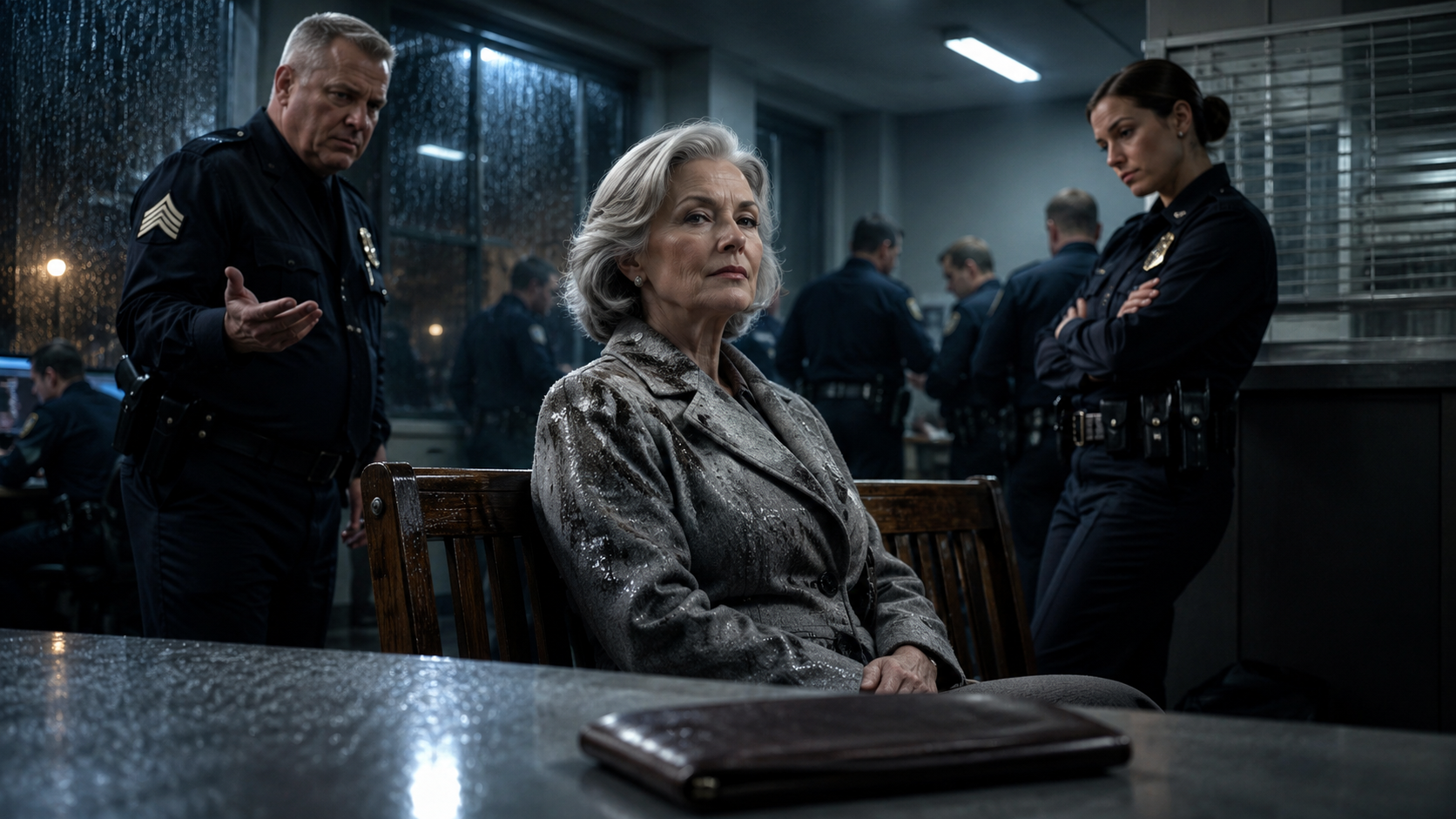
“Records exist,” Evelyn said, “because institutional memory is often more generous to authority than it is to ordinary citizens.”
Captain Grant nodded.
“We’ll implement the directives.”
“Implementation is not sending an email.”
“I understand.”
“I hope so.”
Evelyn closed her folder.
“This review is recessed pending the independent investigative findings.”
The room began to move.
Chairs scraped against the floor.
Attorneys gathered papers.
Command staff whispered among themselves.
Evelyn remained seated.
Officer Ortiz approached cautiously.
“Inspector General?”
Evelyn looked up.
“Officer Ortiz.”
“Can I ask you something?”
“Certainly.”
“Last night, when you told me to keep asking the right question…”
She hesitated.
“What if asking it destroys my career?”
Evelyn considered that.
She did not offer an easy answer.
“Sometimes institutions punish discomfort before they reward integrity.”
Ortiz looked concerned.
“That’s not very encouraging.”
“No.”
Evelyn smiled faintly.
“But courage isn’t pretending there is no risk.”
She closed her notebook.
“It’s deciding what kind of professional you want to be when risk appears.”
Ortiz nodded slowly.
“Do you think I handled it correctly?”
“I think you recognized the problem.”
“But I didn’t stop it.”
“No.”
Ortiz lowered her eyes.
Evelyn’s voice softened.
“Next time, perhaps you will.”
Ortiz looked at her again.
“There’ll be a next time?”
“There is always a next time.”
Six weeks later, the independent report was released.
It did not describe what had happened as one spectacular act of corruption.
The truth was more uncomfortable.
The station had developed a culture in which small procedural violations had become normal.
Officers skipped steps when busy.
Supervisors discouraged questions.
Incomplete reports were approved because correcting them took time.
Complaints were treated as irritations rather than warnings.
Nothing seemed catastrophic.
Until all of those habits converged on one rainy night.
Sergeant Reddick was removed from supervisory duty.
The independent investigator concluded that he had ordered an unlawful detention, authorized an improper property search and retaliated against a subordinate for questioning his decision.
Officer Boone received a suspension and mandatory retraining after investigators determined he had used unnecessary physical force and ignored multiple opportunities to verify Evelyn’s identity.
Captain Grant remained in command but under a year of enhanced oversight.
Officer Ortiz completed probation.
Three months later, she joined a pilot training group teaching recruits how to challenge unlawful instructions through proper channels.
Yet the most important consequence was harder to measure.
People inside the station began asking questions again.
Why is this person being held?
Who authorized this search?
Where is the property receipt?
Why is the camera off?
Has anyone checked the identification?
Questions that once sounded annoying began sounding professional.
One evening, nearly four months after the incident, Evelyn returned to Harbor District Station.
There was no rain this time.
She entered through the same front doors.
A new officer was behind the desk.
He stood immediately.
“Good evening. Can I help you?”
“Perhaps.”
Evelyn placed a wallet on the counter.
The officer opened it.
His eyes widened.
“Inspector General Mercer.”
“Good evening.”
Captain Grant emerged from his office.
He smiled nervously.
“I wasn’t expecting you.”
“That’s usually when inspections are most useful.”
He laughed.
This time, Evelyn did too.
As they walked toward the conference room, she noticed Officer Ortiz speaking with an elderly man beside the entrance.
The man appeared confused.
He was searching through several pockets.
Ortiz waited patiently.
“No problem,” she told him. “Take your time.”
Eventually he produced an identification card.
Ortiz checked it and handed it back.
“You’re all set, sir.”
The man thanked her and left.
Ortiz noticed Evelyn watching.
Their eyes met.
Evelyn gave her a small nod.
Ortiz returned it.
Nothing dramatic happened.
No one shouted.
No one was humiliated.
No one needed to discover that the confused elderly man was secretly powerful.
He wasn’t.
He was simply a man who had walked into a police station needing help.
And that was precisely the point.
Evelyn had spent most of her career listening to people argue that institutions could be repaired by finding better heroes.
She had never believed that.
Heroes were unreliable.
Systems had to function on ordinary days, for ordinary people, when no cameras were recording and no important person was watching.
Especially then.