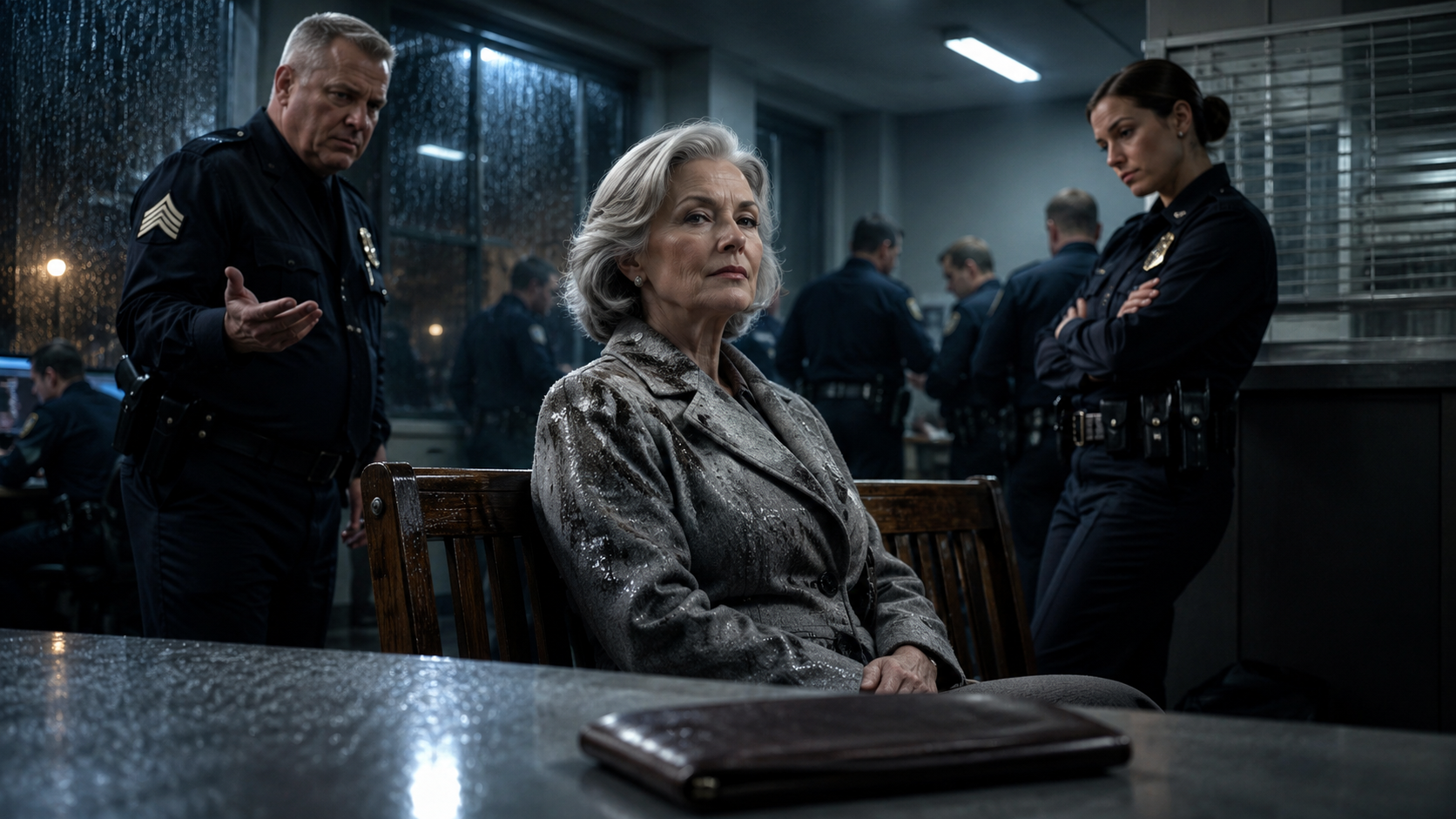
“Inspector General Mercer, I want to apologize.”
Evelyn looked at him.
“For what?”
The question caught him off guard.
“For everything that happened tonight.”
“That’s broad.”
“We need to determine exactly—”
“No.”
She picked up her coat.
“You need to determine exactly what happened because it is your duty to determine exactly what happened.”
Grant nodded.
“Yes.”
“An apology is not an investigation.”
“No, ma’am.”
She put on her coat.
“And embarrassment is not accountability.”
“No.”
Evelyn walked toward the doorway.
Reddick stepped backward when she emerged.
Boone looked as though he wanted the floor to open beneath him.
Evelyn stopped in front of Officer Ortiz.
“You asked whether there was a lawful basis to hold me.”
Ortiz nodded.
“Yes, ma’am.”
“Why?”
Ortiz hesitated.
“Because I didn’t think there was one.”
“Good.”
Reddick shifted uncomfortably.
Evelyn continued.
“Keep asking that question.”
Ortiz glanced toward her supervisors.
Evelyn followed her gaze.
“Especially when asking it is uncomfortable.”
Then she turned toward Reddick.
The entire station waited.
He looked different now.
Less certain.
Smaller somehow.
“Inspector General—”
She raised one hand.
“You will have an opportunity to speak.”
“I really didn’t know who you were.”
Evelyn studied him.
Then she said the sentence that everyone in the room would remember.
“That’s the problem.”
Reddick frowned.
“I don’t understand.”
“You believe your conduct would have been wrong only if you had known who I was.”
His face hardened.
“That’s not what I meant.”
“It is exactly what you meant.”
She looked around the station.
“I shouldn’t have needed an official title to deserve lawful treatment.”
No one moved.
“If I had been a teacher, a cashier, a tourist, a homeless woman, or someone’s grandmother, your obligations would have been identical.”
Reddick looked away.
Evelyn took her handbag from the counter.
Then she noticed the notebook.
Several pages had been bent.
She smoothed them carefully.
“Eight o’clock,” she said.
Grant nodded.
“Yes, ma’am.”
“Conference chamber?”
“Second floor.”
“I’ll see you there.”
Reddick stared at her.
“You still intend to conduct the review?”
Evelyn looked at him.
“Of course.”
“But after tonight—”
“Tonight will not decide the findings.”
Reddick seemed relieved.
Then she continued.
“But tonight will be preserved as evidence.”
His relief vanished.
At eight o’clock sharp, the review began.
Not at a courthouse.
Not in front of a cheering crowd.
There were no dramatic television cameras waiting inside the room.
Only facts.
That was worse.
A long rectangular table occupied the center of the municipal hearing chamber.
Representatives from the mayor’s office sat on one side.
Police command staff sat on the other.
Three civilian auditors were present.
A union attorney arranged folders in front of him.
Officer Ortiz sat at the rear.
Reddick and Boone had been temporarily relieved of duty pending investigation.
They entered with counsel at 7:58.
At 8:00, the side door opened.
Evelyn Mercer walked in.
Her silver hair was neatly pinned.
Her gray coat had been replaced by a dark navy suit.
She carried the same notebook.
There was no triumph in her expression.
That frightened Reddick more than anger would have.
Everyone stood.
Evelyn took her seat.
“Please sit.”
The room settled.
She opened a folder.
“This review was scheduled three weeks ago following a pattern analysis involving Harbor District Station.”
The union attorney shifted.
Evelyn continued.
“During the previous eighteen months, this office received thirty-seven complaints alleging improper detention, retaliatory arrest, incomplete property documentation and failures to activate body-worn cameras.”
Reddick stared at the table.
Evelyn looked toward Captain Grant.
“Captain, how many of those complaints resulted in sustained findings?”
Grant answered.
“Two.”
“And how many were reviewed by investigators outside this district?”
“None.”
“Why?”
“We considered them internal personnel matters.”
Evelyn nodded.
“That decision is one reason this review exists.”
An auditor switched on a recorder.
Evelyn turned a page.
“The purpose of oversight is not to assume misconduct.”
She looked around the room.
“It is to make misconduct difficult to hide and honest work easy to defend.”
Several officers in the gallery looked up.
“Good officers should not fear accurate records.”
Her gaze moved toward Reddick.
“Neither should supervisors.”
The review continued.
One complaint involved a construction worker who had been detained for nearly four hours after photographing an arrest.
Another involved a delivery driver whose identification had not been checked until after his vehicle was impounded.