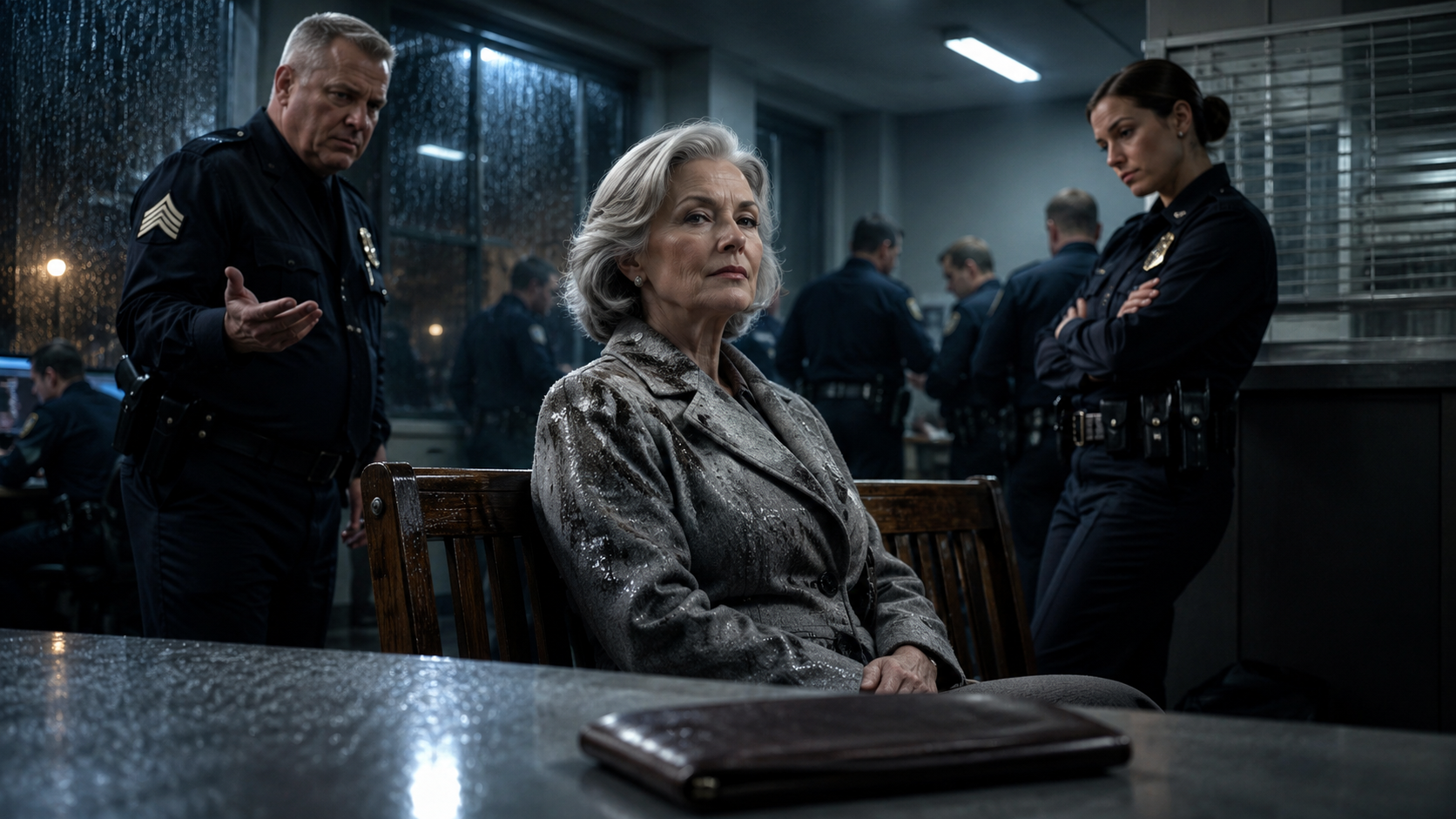
They Treated Her Like She Was Invisible. The Next Morning, the Entire Department Had to Answer to Her.

The rain had been falling since sunset.

By eleven o’clock, the streets around Harbor District Station reflected every red traffic light and every flashing patrol beacon like broken pieces of glass.

Inside the station, the night shift was restless.

Phones rang.

Radios cracked.

Doors slammed.

Officers carried paper cups of coffee from one desk to another while a television mounted near the ceiling played silently above them.

No one paid much attention to the woman sitting alone on the wooden bench beside the front desk.

She looked to be in her late fifties.

Her gray wool coat was wet around the shoulders. A few strands of silver hair had escaped from the loose knot at the back of her head.

She held a small leather handbag on her lap.

Nothing about her seemed important.

At least not to Sergeant Mark Reddick.

He came through the swinging door from the booking area, glanced at her once, and kept walking.

“Who’s she?”

Officer Tyler Boone looked up from his computer.

“Found near the warehouse protest.”

“Arrested?”

“Not exactly.”

Reddick stopped.

“What’s that supposed to mean?”

Boone shrugged.

“She wouldn’t leave when we cleared the sidewalk.”

From the bench, the woman spoke.

“That isn’t what happened.”

Both men turned.

Her voice wasn’t loud.

That seemed to irritate Reddick more than shouting would have.

“Nobody asked you.”

The woman studied him for a second.

“I was standing at a bus stop.”

Boone laughed quietly.

Reddick walked closer.

“We gave everyone an order to move.”

“You gave a crowd an order to move from the east entrance of the warehouse.”

“And?”

“I was half a block away.”

Reddick tilted his head.

“You’re a lawyer now?”

The woman said nothing.

That silence made Boone smile.

Reddick leaned over the front desk.

“Identification.”

“I tried to show your officer my identification twenty minutes ago.”

“Show me.”

She opened her handbag.

Reddick immediately raised a hand.

“Slowly.”

She stopped.

Then, with deliberate care, she removed a narrow wallet.

Before she could open it, Boone reached across the desk and took it from her.

“Thank you,” the woman said.

Boone ignored her.

Instead of opening the wallet, he tossed it onto the counter beside his keyboard.

“You can wait.”

“For what?”

“Until we’re ready.”

The woman looked at the clock.

11:14 p.m.

“I would prefer this misunderstanding to be resolved now.”

Reddick smiled without warmth.

“And I’d prefer a quiet shift.”

He turned away.

The woman remained seated.

Ten minutes passed.

Then twenty.

An officer brought in two young men from the protest.

Another officer escorted a furious driver toward an interview room.

The woman watched everything.

She watched the way officers spoke to one another.

She watched the way reports were exchanged.

She watched when body cameras were turned off.

She watched when they were turned back on.

At 11:47, Officer Boone finally looked at her again.

“Still here?”

“My identification is still beside your keyboard.”

He glanced down.

“Oh.”

He picked up the wallet.

But Reddick called from across the station.

“Tyler, booking room.”

Boone dropped the wallet again.

“Looks like you’re waiting.”

The woman exhaled slowly.

“You haven’t even asked my name.”

Boone stood.

“Lady, tonight I’ve got forty people shouting about rights, six arrests, three cars blocking emergency access, and a lieutenant calling every five minutes. You being annoyed is not exactly my emergency.”

She looked directly at him.

“People become careless when they decide someone doesn’t matter.”

Boone stared at her.

Then he laughed.

“You practicing a speech?”

“No.”

She looked at the clock again.

“I’m remembering.”

Boone’s smile disappeared for half a second.

Then he followed Reddick through the door.

At 12:09 a.m., everything became worse.

A young officer named Lena Ortiz came to the front desk.

She couldn’t have been more than twenty-six.

She saw the woman.

Then she saw the unopened wallet.

“Has anyone processed you?”

“No.”

Ortiz frowned.

“How long have you been here?”

“Almost an hour.”

“Why?”

“I was hoping someone here could explain that.”

Ortiz picked up the wallet.

Reddick returned at exactly that moment.

“Ortiz.”

She turned.

“Sergeant?”

“What are you doing?”

“Checking her identification.”

“I didn’t tell you to do that.”

Ortiz looked confused.

“She’s been sitting here—”

“I know where she’s been sitting.”

The woman watched the exchange carefully.

Ortiz lowered the wallet.

Reddick walked around the desk.

“We have a possible disorderly-conduct situation. Until I decide how we’re handling it, she stays.”

The woman spoke.

“Am I under arrest?”

Reddick looked at her.

“Do you want to be?”

“That wasn’t my question.”

“No. You’re not under arrest.”

“Then I’m leaving.”

She stood.

Reddick stepped in front of her.

“Sit down.”

“You just said I’m not under arrest.”

“I said sit down.”

“And I’m asking whether I am legally required to remain here.”

The station became quieter.

Several nearby officers were listening now.

Reddick took a step closer.

“You people always do this.”

The woman frowned.

“What people?”

“People who think knowing a few legal words means they can turn everything into an argument.”

Her expression changed.

Not much.

But Ortiz noticed.

The woman was no longer merely patient.

She was evaluating him.

“You should be very careful with your next sentence, Sergeant.”

Reddick laughed.

“My next sentence?”

“Yes.”

“Fine. Here’s my next sentence.”

He pointed toward the bench.

“Sit down before I put you in a cell.”

Ortiz moved slightly closer.

“Sergeant, maybe we should just check her ID.”

Reddick turned sharply.

“Did I ask for your opinion?”

“No, sir.”

“Then don’t give me one.”

The woman looked at Ortiz.

“What’s your name?”

Reddick answered for her.

“You’re not interviewing my officers.”

“I asked her name.”

“I don’t care.”

Ortiz swallowed.

“Officer Lena Ortiz.”

The woman nodded.

“Thank you, Officer Ortiz.”

Reddick’s face tightened.

“Enough.”

He took the woman’s handbag from the bench.

She reached for it.

“Please give that back.”

He pulled it away.

“Property gets inventoried.”

“I’m not under arrest.”

“Keep arguing.”

“I am requesting my property.”

Boone had returned now.

He leaned against the desk, watching.

Reddick opened the handbag.

The woman’s entire demeanor changed.

“You do not have permission to search that.”

Reddick rummaged through it anyway.

A pair of glasses.

A phone.

Keys.

A notebook.

A fountain pen.

A sealed envelope.

Boone held up the notebook.

“Maybe she’s a journalist.”

Reddick took it from him.

The woman spoke more firmly.

“Put that down.”

Boone grinned.

“Definitely a journalist.”

Reddick opened the notebook.

The woman stepped forward.

“Sergeant.”

Two officers moved instinctively toward her.

She stopped.

Reddick flipped through several pages.

His expression shifted from amusement to confusion.

The pages contained dates, badge numbers, incident references and short handwritten observations.

“What is this?”

“My notebook.”

“I can see that.”

“Then your question seems unnecessary.”

Boone laughed.

Reddick didn’t.

He turned another page.

There were more names.

More dates.

More case numbers.

He looked up.

“Why are you writing down police information?”

The woman held out her hand.

“Give it back.”

Reddick closed the notebook.

“I think we’re past that.”

“No. You’re approaching something else entirely.”

Boone stepped beside him.

“What?”

The woman looked at both men.

“A decision you’re going to wish you had made differently.”

Boone whistled.

“Was that a threat?”

“No.”

She glanced toward the station cameras.

“It was an observation.”

Reddick had heard enough.

“Put her in Holding Two.”

Ortiz looked stunned.

“On what charge?”

Reddick slowly turned his head.

“What did you say?”

“We don’t have a charge.”

“We’re detaining her.”

“For what?”

“Interference.”

“She wasn’t—”

“Ortiz.”

His voice cut through the station.

“Do you want to spend the rest of your probation directing traffic outside the stadium?”

Ortiz fell silent.

The woman looked at her.

There was no anger in her face.

Only recognition.

She had seen fear like that before.

“Don’t punish her for asking the right question,” she said.

Reddick pointed toward the hallway.

“Take her back.”

Boone reached for the woman’s arm.

She pulled it away.

“I can walk.”

“You’ll walk when I tell you.”

He grabbed her again.

This time harder.

Ortiz stared at his hand.

“Officer Boone.”

He ignored her.

The woman looked directly at him.

“Remove your hand.”

“Or what?”

“Or you’ll have to explain why it was there.”

Boone chuckled.

“To who?”

For the first time that night, the woman smiled.

It was barely a smile at all.

“That’s the interesting part.”


Holding Two was a windowless room with a metal bench bolted to the wall.

They took her coat.

They took her handbag.

They took her phone.

No one gave her a receipt.

No one explained what she was being charged with.

Thirty-five minutes later, Reddick came inside carrying the notebook.

Boone followed him.

The woman sat with her hands folded.

Reddick dropped the notebook on the table.

“I’ve got questions.”

“I’ve been waiting for you to ask one intelligently.”

Boone laughed.

Reddick did not.

“Who are you collecting information for?”

“No one.”

“You expect me to believe you just wander around writing down badge numbers?”

“I don’t wander.”

“Then what are you doing?”

“Observing.”

“For who?”

“Myself.”

“Why?”

The woman looked at him.

“Because memory is useful, but contemporaneous notes are better.”

Something about the answer bothered him.

Perhaps it was the vocabulary.

Perhaps it was the absence of fear.

“What’s your name?”

She almost laughed.

“You finally asked.”

“Name.”

“Evelyn Mercer.”

Boone typed it into a tablet.

Nothing obvious appeared.

Reddick leaned closer.

“Occupation?”

“Public service.”

Boone smirked.

“That means unemployed.”

“No.”

“What kind of public service?”

Evelyn looked at the clock above the door.

12:58 a.m.

“You’ll know soon enough.”

Reddick slammed his palm against the table.

“Stop playing games.”

Evelyn didn’t flinch.

“I have been requesting permission to identify myself since I arrived.”

Boone frowned.

Reddick said nothing.

“My wallet has been sitting on your front desk for most of the evening.”

Boone and Reddick looked at each other.

For the first time, uncertainty entered the room.

Reddick recovered quickly.

“You think some card is going to scare me?”

“No.”

“What, then?”

Evelyn leaned back.

“I think information usually improves decisions.”

Reddick scooped up the notebook.

“Keep her here.”

“For how long?” Boone asked.

“Until I say otherwise.”

Evelyn spoke as they reached the door.

“Sergeant Reddick.”

He turned.

“Six thirty.”

“What?”

“You should make sure you’re still here at six thirty tomorrow morning.”

“Why?”

“Because leaving early would only delay the conversation.”

He stared at her.

“What conversation?”

Evelyn’s expression was calm.

“The one your captain is going to have with you.”


At 5:52 a.m., Captain Samuel Grant arrived nearly an hour before his normal shift.

That alone was unusual.

What made it stranger was the person accompanying him.

Deputy Chief Renee Wallace.

By 6:03, three supervisors had been called into the conference room.

By 6:07, Officer Ortiz had been asked to prepare a written account of the previous evening.

At 6:11, every officer who had interacted with the unknown woman was ordered not to alter, delete or overwrite any recording, log entry, message or body-camera file from the night.

At 6:16, Mark Reddick finally understood that something was wrong.

He approached Captain Grant.

“What’s happening?”

Grant looked exhausted.

“Where is she?”

“Who?”

Grant stared at him.

“The woman brought in from Harbor Street.”

Reddick attempted a shrug.

“Holding Two.”

“You put her in a holding room?”

“Temporary detention.”

Grant closed his eyes.

“Tell me you checked her identification.”

Reddick stopped breathing for a moment.

“Boone was supposed to.”

“Did you?”

“No.”

Grant looked past him.

“Where’s her property?”

“Front desk.”

Deputy Chief Wallace walked over.

“Open the wallet.”

Boone, now visibly nervous, retrieved it.

The station had become so quiet that the snap of the leather sounded strangely loud.

He unfolded the wallet.

The first card was a driver’s license.

Evelyn Marie Mercer.

Age fifty-eight.

The second card carried the seal of the state.

Boone’s face changed.

Reddick reached for it.

Boone didn’t hand it over immediately.

“What?”

Reddick grabbed the card himself.

Then read the title.

Once.

Twice.

A third time.

Inspector General — Office of Public Integrity.

Reddick looked at Captain Grant.

“She’s an inspector?”

Grant’s voice was barely controlled.

“Not an inspector.”

He pointed at the card.

“The Inspector General.”

Boone turned pale.

Deputy Chief Wallace added quietly,

“And at eight o’clock this morning, she’s scheduled to chair the emergency integrity review of this district.”

Nobody spoke.

Grant looked at Reddick.

“You detained the state Inspector General the night before she was scheduled to review complaints against this station.”

Reddick’s lips parted.

“She never identified herself.”

Ortiz, standing near the doorway, spoke.

“She tried.”

Everyone turned toward her.

Ortiz looked frightened but continued.

“More than once.”

Boone stared at the floor.

Grant looked at him.

“Is that true?”

Boone hesitated.

“She had a wallet.”

“Did you open it?”

“No.”

“Why not?”

“I was busy.”

Grant looked toward Holding Two.

“Get her out.”


At 6:27 a.m., the holding-room door opened.

Evelyn was standing.

She had already heard enough through the hallway to know what had happened.

Captain Grant entered first.

Deputy Chief Wallace followed.

Reddick and Boone remained outside.

“Ms. Mercer,” Grant began.

“Inspector General Mercer is appropriate in an official setting.”

Grant swallowed.

“Inspector General Mercer, I want to apologize.”

Evelyn looked at him.

“For what?”

The question caught him off guard.

“For everything that happened tonight.”

“That’s broad.”

“We need to determine exactly—”

“No.”

She picked up her coat.

“You need to determine exactly what happened because it is your duty to determine exactly what happened.”

Grant nodded.

“Yes.”

“An apology is not an investigation.”

“No, ma’am.”

She put on her coat.

“And embarrassment is not accountability.”

“No.”

Evelyn walked toward the doorway.

Reddick stepped backward when she emerged.

Boone looked as though he wanted the floor to open beneath him.

Evelyn stopped in front of Officer Ortiz.

“You asked whether there was a lawful basis to hold me.”

Ortiz nodded.

“Yes, ma’am.”

“Why?”

Ortiz hesitated.

“Because I didn’t think there was one.”

“Good.”

Reddick shifted uncomfortably.

Evelyn continued.

“Keep asking that question.”

Ortiz glanced toward her supervisors.

Evelyn followed her gaze.

“Especially when asking it is uncomfortable.”

Then she turned toward Reddick.

The entire station waited.

He looked different now.

Less certain.

Smaller somehow.

“Inspector General—”

She raised one hand.

“You will have an opportunity to speak.”

“I really didn’t know who you were.”

Evelyn studied him.

Then she said the sentence that everyone in the room would remember.

“That’s the problem.”

Reddick frowned.

“I don’t understand.”

“You believe your conduct would have been wrong only if you had known who I was.”

His face hardened.

“That’s not what I meant.”

“It is exactly what you meant.”

She looked around the station.

“I shouldn’t have needed an official title to deserve lawful treatment.”

No one moved.

“If I had been a teacher, a cashier, a tourist, a homeless woman, or someone’s grandmother, your obligations would have been identical.”

Reddick looked away.

Evelyn took her handbag from the counter.

Then she noticed the notebook.

Several pages had been bent.

She smoothed them carefully.

“Eight o’clock,” she said.

Grant nodded.

“Yes, ma’am.”

“Conference chamber?”

“Second floor.”

“I’ll see you there.”

Reddick stared at her.

“You still intend to conduct the review?”

Evelyn looked at him.

“Of course.”

“But after tonight—”

“Tonight will not decide the findings.”

Reddick seemed relieved.

Then she continued.

“But tonight will be preserved as evidence.”

His relief vanished.


At eight o’clock sharp, the review began.

Not at a courthouse.

Not in front of a cheering crowd.

There were no dramatic television cameras waiting inside the room.

Only facts.

That was worse.

A long rectangular table occupied the center of the municipal hearing chamber.

Representatives from the mayor’s office sat on one side.

Police command staff sat on the other.

Three civilian auditors were present.

A union attorney arranged folders in front of him.

Officer Ortiz sat at the rear.

Reddick and Boone had been temporarily relieved of duty pending investigation.

They entered with counsel at 7:58.

At 8:00, the side door opened.

Evelyn Mercer walked in.

Her silver hair was neatly pinned.

Her gray coat had been replaced by a dark navy suit.

She carried the same notebook.

There was no triumph in her expression.

That frightened Reddick more than anger would have.

Everyone stood.

Evelyn took her seat.

“Please sit.”

The room settled.

She opened a folder.

“This review was scheduled three weeks ago following a pattern analysis involving Harbor District Station.”

The union attorney shifted.

Evelyn continued.

“During the previous eighteen months, this office received thirty-seven complaints alleging improper detention, retaliatory arrest, incomplete property documentation and failures to activate body-worn cameras.”

Reddick stared at the table.

Evelyn looked toward Captain Grant.

“Captain, how many of those complaints resulted in sustained findings?”

Grant answered.

“Two.”

“And how many were reviewed by investigators outside this district?”

“None.”

“Why?”

“We considered them internal personnel matters.”

Evelyn nodded.

“That decision is one reason this review exists.”

An auditor switched on a recorder.

Evelyn turned a page.

“The purpose of oversight is not to assume misconduct.”

She looked around the room.

“It is to make misconduct difficult to hide and honest work easy to defend.”

Several officers in the gallery looked up.

“Good officers should not fear accurate records.”

Her gaze moved toward Reddick.

“Neither should supervisors.”

The review continued.

One complaint involved a construction worker who had been detained for nearly four hours after photographing an arrest.

Another involved a delivery driver whose identification had not been checked until after his vehicle was impounded.

A third involved a nurse who claimed officers had threatened arrest after she questioned why a patient was being handcuffed inside an emergency room.

Each incident sounded different.

Different dates.

Different people.

Different explanations.

Yet the administrative failures followed the same pattern.

Unclear detention authority.

Missing timestamps.

Unlogged property.

Incomplete video.

Supervisors approving reports without resolving contradictions.

Evelyn did not raise her voice once.

She didn’t need to.

By noon, the atmosphere in the chamber had changed completely.

The department’s defense was no longer that every complainant had exaggerated.

There were too many inconsistencies.

Too many missing pieces.

Too many coincidences.

After a short recess, Evelyn returned to the chamber.

“This review will now address an incident occurring between approximately eleven ten last night and six twenty-seven this morning.”

Reddick’s attorney stood.

“We object to Inspector General Mercer’s participation in reviewing an incident in which she is personally involved.”

Evelyn nodded.

“A reasonable objection.”

The attorney seemed surprised.

She continued.

“For that reason, I will make no disciplinary recommendation regarding Sergeant Reddick, Officer Boone or any other employee involved in my detention.”

The attorney sat slowly.

“That matter has already been referred to an independent investigator in another jurisdiction.”

Reddick whispered something to his lawyer.

Evelyn continued.

“However, evidence from the incident may be considered when evaluating systemic procedures, provided those findings do not determine individual discipline.”

One of the auditors nodded.

“Agreed.”

The first recording played.

It showed Evelyn arriving at the station.

The room watched Boone place her wallet beside the computer without opening it.

The second clip showed Officer Ortiz attempting to check it.

The third showed Reddick ordering her not to.

The fourth showed her handbag being searched.

The fifth showed Boone taking hold of her arm.

Reddick closed his eyes.

Evelyn didn’t watch him.

She watched the screen.

The final clip ended.

Silence filled the room.

Then Evelyn asked,

“Captain Grant, what policy required an unidentified, uncharged individual to remain in custody for more than six hours?”

Grant answered carefully.

“None.”

“What report documented the legal basis for detention?”

“None.”

“What property receipt was issued?”

“None.”

“What supervisor reviewed the detention before morning?”

“None.”

Evelyn closed the folder.

“Then last night was not a mysterious failure.”

She paused.

“It was a series of ordinary choices.”

That sentence landed harder than an accusation.

“A wallet was not opened.”

“A question was dismissed.”

“A junior officer was discouraged from challenging a decision.”

“A detention was extended because no one wanted to admit the basis for it had never been established.”

“A bag was searched because procedure became whatever the most senior person in the room said it was.”

She looked toward the command staff.

“Systems fail dramatically only after people become comfortable with smaller failures.”

No one interrupted.

Reddick stared at her.

At last, he raised his hand slightly.

His lawyer whispered,

“Don’t.”

But Evelyn noticed.

“Sergeant Reddick?”

He cleared his throat.

“May I speak?”

“Regarding department procedure, yes.”

He stood.

For the first time since Evelyn had met him, he did not appear angry.

He appeared tired.

“I made assumptions.”

Evelyn waited.

He continued.

“I thought you were part of the protest.”

“Would that have changed your obligations?”

“No.”

He looked down.

“I suppose that’s your point.”

“It’s one of them.”

Reddick nodded.

“I also thought you were trying to embarrass me in front of my officers.”

“Why?”

“Because you kept questioning me.”

Evelyn leaned forward.

“Sergeant, leadership that cannot survive a lawful question is not leadership.”

The room remained silent.

Reddick sat down.

The review lasted another three hours.

When it ended, no one applauded.

Evelyn would not have wanted applause.

She read the preliminary directives calmly.

All detentions exceeding thirty minutes without formal arrest would require documented supervisory review.

Property taken from people not under arrest would require written justification and a receipt.

Body-camera interruptions would receive automatic audit flags.

Complaints alleging retaliation would be reviewed outside the accused employee’s direct chain of command.

Probationary officers could request confidential supervisory review when they believed an instruction violated policy.

Most importantly, unexplained gaps in records would no longer automatically be interpreted in favor of the department.

“Records exist,” Evelyn said, “because institutional memory is often more generous to authority than it is to ordinary citizens.”

Captain Grant nodded.

“We’ll implement the directives.”

“Implementation is not sending an email.”

“I understand.”

“I hope so.”

Evelyn closed her folder.

“This review is recessed pending the independent investigative findings.”

The room began to move.

Chairs scraped against the floor.

Attorneys gathered papers.

Command staff whispered among themselves.

Evelyn remained seated.

Officer Ortiz approached cautiously.

“Inspector General?”

Evelyn looked up.

“Officer Ortiz.”

“Can I ask you something?”

“Certainly.”

“Last night, when you told me to keep asking the right question…”

She hesitated.

“What if asking it destroys my career?”

Evelyn considered that.

She did not offer an easy answer.

“Sometimes institutions punish discomfort before they reward integrity.”

Ortiz looked concerned.

“That’s not very encouraging.”

“No.”

Evelyn smiled faintly.

“But courage isn’t pretending there is no risk.”

She closed her notebook.

“It’s deciding what kind of professional you want to be when risk appears.”

Ortiz nodded slowly.

“Do you think I handled it correctly?”

“I think you recognized the problem.”

“But I didn’t stop it.”

“No.”

Ortiz lowered her eyes.

Evelyn’s voice softened.

“Next time, perhaps you will.”

Ortiz looked at her again.

“There’ll be a next time?”

“There is always a next time.”


Six weeks later, the independent report was released.

It did not describe what had happened as one spectacular act of corruption.

The truth was more uncomfortable.

The station had developed a culture in which small procedural violations had become normal.

Officers skipped steps when busy.

Supervisors discouraged questions.

Incomplete reports were approved because correcting them took time.

Complaints were treated as irritations rather than warnings.

Nothing seemed catastrophic.

Until all of those habits converged on one rainy night.

Sergeant Reddick was removed from supervisory duty.

The independent investigator concluded that he had ordered an unlawful detention, authorized an improper property search and retaliated against a subordinate for questioning his decision.

Officer Boone received a suspension and mandatory retraining after investigators determined he had used unnecessary physical force and ignored multiple opportunities to verify Evelyn’s identity.

Captain Grant remained in command but under a year of enhanced oversight.

Officer Ortiz completed probation.

Three months later, she joined a pilot training group teaching recruits how to challenge unlawful instructions through proper channels.

Yet the most important consequence was harder to measure.

People inside the station began asking questions again.

Why is this person being held?

Who authorized this search?

Where is the property receipt?

Why is the camera off?

Has anyone checked the identification?

Questions that once sounded annoying began sounding professional.

One evening, nearly four months after the incident, Evelyn returned to Harbor District Station.

There was no rain this time.

She entered through the same front doors.

A new officer was behind the desk.

He stood immediately.

“Good evening. Can I help you?”

“Perhaps.”

Evelyn placed a wallet on the counter.

The officer opened it.

His eyes widened.

“Inspector General Mercer.”

“Good evening.”

Captain Grant emerged from his office.

He smiled nervously.

“I wasn’t expecting you.”

“That’s usually when inspections are most useful.”

He laughed.

This time, Evelyn did too.

As they walked toward the conference room, she noticed Officer Ortiz speaking with an elderly man beside the entrance.

The man appeared confused.

He was searching through several pockets.

Ortiz waited patiently.

“No problem,” she told him. “Take your time.”

Eventually he produced an identification card.

Ortiz checked it and handed it back.

“You’re all set, sir.”

The man thanked her and left.

Ortiz noticed Evelyn watching.

Their eyes met.

Evelyn gave her a small nod.

Ortiz returned it.

Nothing dramatic happened.

No one shouted.

No one was humiliated.

No one needed to discover that the confused elderly man was secretly powerful.

He wasn’t.

He was simply a man who had walked into a police station needing help.

And that was precisely the point.

Evelyn had spent most of her career listening to people argue that institutions could be repaired by finding better heroes.

She had never believed that.

Heroes were unreliable.

Systems had to function on ordinary days, for ordinary people, when no cameras were recording and no important person was watching.

Especially then.

Before leaving the station that evening, she passed the wooden bench where she had spent the beginning of that long night.

For a moment she stopped.

Captain Grant noticed.

“Bad memory?”

Evelyn looked at the bench.

“No.”

“Really?”

“Useful memory.”

Grant nodded toward the front desk.

“A lot changed because of that night.”

Evelyn shook her head.

“No.”

He seemed surprised.

“But the new procedures—”

“Procedures changed because people finally decided the old ones weren’t acceptable.”

She buttoned her coat.

“Never give one person too much credit for something an institution is responsible for fixing.”

Grant considered that.

“Fair enough.”

He opened the door for her.

Outside, evening traffic moved along Harbor Street.

A bus slowed at the corner.

The same bus route she had been waiting for months earlier.

Evelyn smiled at the coincidence.

Grant stood in the doorway.

“Need a ride?”

“No.”

“You’re sure?”

“Quite.”

She walked toward the bus stop.

Then Grant called after her.

“Inspector General?”

She turned.

“I’m glad we opened the wallet.”

Evelyn looked at him for a moment.

Then she smiled.

“So am I.”

She started walking again.

“But next time,” she called over her shoulder, “open it before six hours have passed.”

Grant laughed.

The bus arrived.

Evelyn climbed aboard and took an empty seat near the window.

No escort.

No official car.

No special treatment.

Around her were nurses finishing late shifts, students carrying backpacks, restaurant workers checking their phones and tired parents heading home.

People whose names would never appear on government letterhead.

People who would never enter a station carrying an impressive title.

People who still deserved every protection the law promised them.

Evelyn watched the city move past the window.

Power had never impressed her.

Power was easy.

Restraint was difficult.

Authority was easy.

Accountability was difficult.

Demanding respect was easy.

Giving it to someone when you believed they had nothing to offer you in return—

that was the real test.

And on one rainy night, a police station had failed it.

What mattered now was whether it had learned enough not to fail again.

They Treated Her Like She Was Invisible. The Next Morning, the Entire Department Had to Answer to Her.
This boy was an unwanted child and was later saved by his coat – today he is a Hollywood starlet