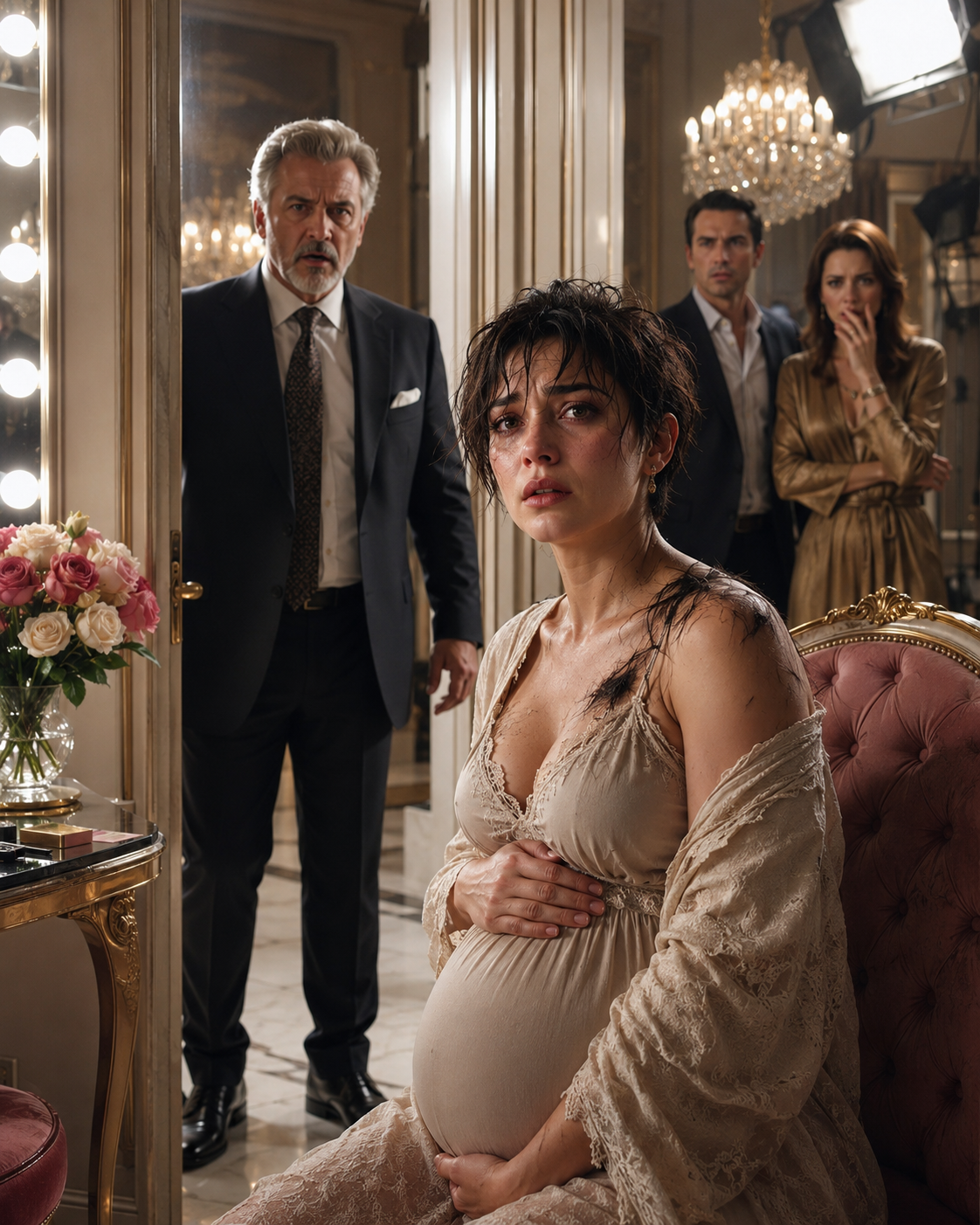
They Took Her Hair to Break Her — Until the Father She Buried in Her Mind Walked In

The first thing Mila Hart noticed was the light.

Not the razor.

Not the laughter.

Not even the phone cameras angled toward her face like little black eyes hungry for proof.

The light came first — white, sharp, expensive — pouring down from three studio lamps that had been dragged into the Ashford family’s private beauty room as if they were preparing a magazine shoot instead of a punishment.

Mila sat in a velvet chair with her hands folded over her swollen stomach. She was seven months pregnant, exhausted, and so dizzy she had begun counting her breaths just to stay upright.

In.

Out.

Don’t faint.

Don’t cry.

Don’t give them what they want.

Across from her, her husband Julian Ashford leaned against a marble counter, his phone in one hand, his expression calm in the way rich people looked calm when they had already decided no one else’s pain mattered.

“Mila,” he said, using the patient tone he reserved for staff, reporters, and women he intended to embarrass, “this is supposed to help you.”

His sister, Celeste, stood behind Mila with a pair of silver clippers in her hand. She was smiling for the livestream.

“Everyone has been worried about you,” Celeste told the camera. “Our sweet Mila has been struggling with emotional episodes. We thought maybe a fresh start would help her let go of all this… instability.”

Mila’s throat tightened.

“Please don’t say that,” she whispered.

Celeste bent closer, her perfume cold and floral. “Then stop acting unstable.”

The comments on the livestream moved too quickly for Mila to read, but she could hear Celeste’s assistant giggling as she watched them from a tablet.

“She’s trending already,” the assistant murmured.

Julian’s eyes flicked toward the screen. “Good.”

That one word landed harder than a slap.

Good.

Her humiliation was good.

Her fear was good.

The shaking in her hands was content.

Mila turned her head toward Julian. “Please. I said no.”

He sighed, as if her refusal was another inconvenience in a long list of her failures.

“You’ve said no to everything lately. No to dinners. No to interviews. No to family appearances. No to the prenatal wellness retreat Mother arranged. You hide in your room and accuse everyone of plotting against you.”

“Because you are,” Mila said.

Julian’s face changed.

Not much. Just enough.

The smoothness disappeared from his eyes.

“There it is,” he said softly. “The paranoia.”

Celeste lifted the clippers.

Mila tried to stand, but Julian’s mother, Beatrice Ashford, placed one thin hand on her shoulder and pressed her back down with a smile that belonged on a portrait in a haunted house.

“Darling,” Beatrice said, “a mother must learn grace under pressure.”

“I’m not your doll,” Mila said.

Celeste switched on the clippers.

The buzzing filled the room.

Mila flinched so hard the baby kicked.

The first strip of hair fell over the black cape Celeste had tied around her. It slid down like something dead.

Mila stared at it.

Her hair had been the only thing she still recognized about herself.

Before Julian, she had worn it long and loose down her back when she worked double shifts at the children’s clinic in Portland. Children used to braid it when they were frightened. Her mother used to brush it on Sunday nights while telling Mila stories about courage, storms, and women who survived by remembering who they were.

After her mother died, Mila brushed it herself and pretended she was fine.

Then Julian came.

Handsome Julian Ashford, heir to the Ashford hotels, charities, private schools, and old money no one questioned too closely. He came to the clinic after a minor car accident, flirted with her while she cleaned a cut on his forehead, sent flowers the next day, and told her she had “a quiet kind of beauty.”

For a lonely woman grieving her only parent, that phrase had sounded like rescue.

Now she understood that some cages arrived wrapped in flowers.

Another strip of hair fell.

“Stop,” Mila said, louder this time.

Celeste smiled at the camera. “See? This is what we mean. She panics over kindness.”

“This is not kindness.”

Julian stepped forward. “Mila, behave.”

The baby moved again, sharper this time.

Mila pressed one hand beneath her ribs.

Something tightened low in her stomach.

“Julian,” she said, her voice thin. “I feel sick.”

Celeste rolled her eyes. “Of course you do.”

“I’m serious. The baby—”

“Don’t use the baby to manipulate us,” Beatrice said.

The room tilted.

Mila gripped the arms of the chair. The lamps blurred into halos. For one horrible second she thought she would slide onto the floor in front of thousands of strangers.

Julian lifted his phone higher.

“Keep recording,” he told Celeste’s assistant. “This is exactly what I was talking about.”

Mila looked at him then.

Really looked.

And in that moment, the last fragile thread of her love snapped.

Not because he had betrayed her.

Not because he had let his family mock her.

Not because she knew about the woman in the downtown apartment, the one whose perfume clung to his shirts and whose messages appeared on his watch at midnight.

The love died because she finally understood the truth.

Julian was not failing to protect her.

He was documenting her breaking.

A sound rose in the hallway.

Heavy footsteps.

Several pairs.

Confident, fast, controlled.

The buzzing stopped.

Celeste turned, irritated. “Who is coming in here?”

The double doors opened before anyone answered.

A man stood in the doorway.

He was tall, broad-shouldered, and dressed in a dark charcoal suit that looked severe enough to have been cut from storm clouds. His hair was black with silver at the temples. His face was older than the photograph Mila had once found hidden in her mother’s old sewing box, but the eyes were the same.

Gray.

Unmistakable.

Impossible.

Behind him stood two security officers and a woman in a navy medical coat carrying a black emergency bag.

The room went silent.

The man’s gaze moved from the clippers in Celeste’s hand to the hair scattered across the floor, then to Mila’s trembling body beneath the white lights.

His expression did not explode.

It froze.

That was worse.

Mila’s lips parted.

She knew him.

She knew him from the one photograph her mother had never explained.

She knew him from the shape of her own eyes in the mirror.

She knew him from the empty place in every childhood question that had been answered with one sentence.

Your father died before you were born.

The man took one step forward.

“Mila,” he said.

Her heart stopped.

No one had said her name like that since her mother.

Not as a possession.

Not as a problem.

As if it hurt him to speak it.

Mila’s voice broke.

“Who are you?”

The man swallowed.

“My name is Adrian Blackwell,” he said. “And I am your father.”

Celeste laughed once, too sharply. “That is absurd.”

Julian’s phone lowered.

Beatrice’s hand slipped from Mila’s shoulder.

The man did not look at any of them.

He crossed the room and knelt in front of Mila, careful not to touch her until she nodded. His hands, large and steady a moment ago, trembled when he reached for the edge of the cape around her neck.

“Are you in pain?” he asked.

Mila stared at him.

“You’re dead.”

His eyes filled.

“No,” he said. “But I think someone needed you to believe I was.”

The baby kicked again, and Mila winced.

The woman in the medical coat stepped forward at once.

“I’m Dr. Renata Sloane,” she said gently. “Mila, I’m here to check you and the baby. May I?”

Mila nodded because she had no strength left for pride.

Julian finally moved.

“This has gone far enough,” he said, his polished voice returning. “You cannot enter my home and frighten my wife with delusions.”

Adrian Blackwell stood slowly.

The air changed with him.

Until that moment, Julian had owned every room Mila had ever seen him enter. He knew how to smile for donors, intimidate assistants, charm journalists, silence servants, and make cruelty sound like concern.

But Adrian did not shrink under Julian’s confidence.

Julian shrank under Adrian’s silence.

“I have spent twenty-seven years building companies in industries where men lie for sport,” Adrian said. “Do not test me with amateur theater.”

Julian’s jaw tightened. “This is a private family matter.”

“You made it public when you put my pregnant daughter under lights and broadcast her distress.”

“She agreed to a makeover.”

Mila lifted her head.

“No,” she whispered.

The word was small, but everyone heard it.

Adrian turned toward her immediately.

Mila forced herself to continue.

“I said no. I said stop. He told them to keep filming.”

The room became very still.

Celeste lowered the clippers behind her back, but one of Adrian’s security officers had already seen.

Beatrice recovered first.

“Mr. Blackwell,” she said, stepping forward with the poise of a woman who had bought her way out of every consequence, “this is an emotional misunderstanding. Mila has struggled since the pregnancy began. We have only tried to support her.”

Adrian looked at the hair on the floor.

“Is that what support looks like in this house?”

Celeste’s cheeks flushed. “She was embarrassing Julian. She refuses to appear at events. She looks unwell. We were helping.”

“You shaved her head while she begged you to stop.”

Celeste said nothing.

Adrian looked at Julian.

“And you watched.”

Julian’s eyes narrowed.

“You have no idea what kind of woman she is.”

Adrian smiled faintly.

There was no warmth in it.

“I know exactly what kind of woman she is. I have statements from nurses who worked with her. Families whose children she cared for. A clinic director who cried when my investigator said her name. I know she stayed after shifts without pay. I know she sent half her savings to her mother’s medical bills. I know she married a man who mistook gentleness for weakness.”

Mila’s eyes burned.

No one in the Ashford house had spoken about her life before Julian except as something embarrassing.

A nurse.

A rented apartment.

A used car.

A mother with debts.

A past that did not match the family portraits.

But Adrian spoke of it like proof.

Julian’s mask cracked.

“You’ve been investigating us.”

“For three weeks.”

Mila turned to him. “Three weeks?”

Adrian’s face softened. “I found out you existed three weeks ago.”

The words struck her harder than the clippers.

“You didn’t know?”

“No.”

“My mother said you were dead.”

“I know.”

“Why?”

Pain crossed his face. “Because someone made sure she was afraid of me. And because later, someone made sure I could never find her.”

Beatrice’s eyes flickered.

It was barely visible.

But Adrian saw it.

So did Mila.

Julian stepped between them. “This is nonsense. Mila is tired. She needs rest, not a stranger feeding her fantasies.”

Dr. Sloane looked up from checking Mila’s pulse.

“She needs medical observation,” the doctor said sharply. “Her blood pressure is elevated, she is dehydrated, and she has been placed under extreme stress.”

“She’s dramatic,” Celeste muttered.

Adrian turned his head.

Celeste went silent.

Dr. Sloane removed the cape from Mila’s shoulders. Adrian took off his suit jacket and wrapped it around her, covering the jagged remains of her hair and the tremble in her arms.

Mila wanted to be brave.

Instead, she began to cry.

“I look ridiculous,” she whispered.

Adrian crouched in front of her again.

“No,” he said. “They look cruel.”

Something inside her cracked open.

For months, Julian had told her she was too sensitive. Beatrice had told her she should be grateful. Celeste had told her rich families required discipline. Even the servants had stopped meeting her eyes, as if loneliness were contagious.

And now a man she had mourned without knowing him looked at her as if she had never been the problem.

Julian reached for her arm.

“She is not leaving.”

Adrian’s security officer stepped forward, not touching anyone, only blocking the space.

Adrian’s voice dropped.

“She is leaving if she wants to.”

Everyone looked at Mila.

For the first time in that house, her choice mattered.

Her knees shook as she stood.

The room swam, and Adrian caught her only after she reached for him.

“I want to leave,” Mila said.

Julian’s expression darkened.

“Mila, think carefully. If you walk out now, you are proving everything I have said.”

“No,” she said, one hand resting protectively over her stomach. “I am proving I can still walk.”

Adrian supported her toward the door.

At the threshold, Mila looked back.

The lamps still burned.

The phone still streamed.

Her hair lay across the marble floor like evidence.

Celeste looked frightened now. Beatrice looked calculating. Julian looked furious.

Mila looked straight into the camera.

She did not know how many people were watching.

She did not care.

“My name is Mila Hart,” she said. “I did not consent to this.”

Then she turned away.

The ride to the Blackwell Medical Pavilion passed in fragments: black leather seats, rain streaking the windows, Adrian’s hand hovering near hers but not trapping it, Dr. Sloane speaking in calm instructions, the baby’s heartbeat later filling a private exam room with the most beautiful sound Mila had ever heard.

Strong.

Fast.

Alive.

Mila sobbed when she heard it.

Adrian sat beside the bed, one hand pressed against his mouth. He looked like a man who could buy towers, airports, newspapers, and silence, but not one lost year.

“Your daughter is stable,” Dr. Sloane said. “Your grandson is stable. She needs rest, hydration, continued monitoring, and distance from the situation that caused this.”

Distance.

Mila almost laughed.

The word sounded simple.

As if leaving a life could be done by crossing a room.

After the doctor left, Adrian remained beside her bed.

For a while, neither of them spoke.

Mila touched the uneven edge of her hair. A stylist had come quietly to soften the damage, trimming what was left into a short, delicate cut. It was not what she would have chosen.

But it was hers now.

Finally, she looked at Adrian.

“Tell me everything.”

He nodded as if he had been waiting for the order.

“Your mother, Elise, worked for one of my legal teams before I became… what I am now. I was thirty, reckless, rich enough to attract enemies and not wise enough to protect anyone from them. She was brilliant. Kind. Impossible to impress.”

A sad smile touched his mouth.

“She loved you?”

“I think she did. And I loved her badly.”

Mila watched him.

“Badly?”

“I thought money could solve fear. I thought security guards and contracts could make her feel safe. But people were circling me then. Business rivals. Former partners. Men who would have enjoyed using her to control me.”

“What happened?”

“She vanished. Left a letter saying she had ended the pregnancy and wanted no contact. I searched for her. I searched for years. Then I was told she had died in another state.”

“My mother died last year.”

Adrian closed his eyes.

“I know that now.”

“How did you find me?”

“A pediatric surgeon named Tomas Vale recognized your mother’s name on an old clinic award list. He had known Elise. He contacted me after seeing your photograph in a charity article about the Ashford family.”

Mila’s stomach tightened.

“The article Julian forced me to do.”

“Yes.”

“He said it would help people see me as suitable.”

Adrian’s jaw hardened. “It helped me see you as my daughter.”

Tears filled her eyes again, but these were quieter.

“Why didn’t you contact me?”

“I tried. Calls disappeared. Letters were returned. Emails bounced. Your old phone number had been disconnected. Your clinic was told not to forward messages. Someone built a wall around you.”

Mila knew who before he said it.

Julian.

Julian, who had changed her phone plan because married couples should share accounts.

Julian, who had taken over her email because pregnancy made her forgetful.

Julian, who collected the mail every morning before she came downstairs.

Mila covered her mouth.

“He knew.”

Adrian did not deny it.

The door opened.

A woman entered carrying a leather folder. She was in her forties, with dark curls pulled back and the calm, exact expression of someone who preferred truth even when it hurt.

“Mila,” Adrian said, “this is Mara Ellison. She is my attorney.”

Mara approached the bed carefully.

“I’m sorry we’re meeting like this.”

Mila looked at the folder.

“What is that?”

Mara glanced at Adrian, then back at her.

“Evidence.”

The word turned the room cold.

Mila opened the folder with shaking hands.

Inside were photographs, financial records, printed messages, legal drafts, and a timeline so detailed it made her skin crawl.

Julian outside an apartment building with a woman Mila recognized from a gala.

Julian transferring money into a shell company.

Julian messaging Celeste about “the visual impact” of Mila’s breakdown.

Beatrice asking whether a doctor could be persuaded to support an emergency mental health petition.

A draft custody filing describing Mila as erratic, paranoid, emotionally unfit, and potentially dangerous.

Mila read until the letters blurred.

“They wanted my baby,” she whispered.

Mara’s voice stayed gentle. “They wanted control of the child. And through the child, access to any inheritance or trust connected to you once Mr. Blackwell acknowledged paternity.”

Mila stared at Adrian.

“Inheritance?”

“I was preparing a private trust for you,” he said. “I had not made it public. But someone close to the Ashfords learned I was looking for Elise’s daughter.”

Mila laughed once, broken and empty.

“So Julian didn’t just want me gone.”

“No,” Mara said. “He needed you discredited.”

The livestream.

The shaved hair.

The panic.

The cameras.

All of it had been a trap.

Not cruelty that went too far.

Cruelty with paperwork waiting behind it.

Mila turned away and pressed both hands over her stomach.

“I almost believed them,” she said. “I almost believed I was losing my mind.”

Adrian’s voice shook.

“That is what they needed.”

That night, Mila slept for three hours, woke from a nightmare, and found Adrian sitting in the chair near the window, still in yesterday’s shirt, reading through files with a pair of glasses low on his nose.

“You stayed,” she said.

He looked up immediately.

“Yes.”

“You don’t have to.”

His face folded with grief.

“I missed your first steps. Your first words. Your birthdays. Your graduations. I missed every ordinary day a father should have protected. Do not ask me to miss tonight.”

Mila did not know how to answer that, so she cried again.

By morning, the livestream had been removed from the Ashford family accounts.

But the internet had already saved it.

Clips spread everywhere. Not the version Celeste had intended, with captions calling Mila unstable and spoiled, but the raw footage: Mila saying no, Mila warning that she felt sick, Julian telling them to continue, the door opening, Adrian Blackwell entering like judgment in a tailored suit.

By noon, Ashford Hotels lost two sponsors.

By three, three board members resigned from the family foundation.

By five, Beatrice released a statement asking for privacy during “a painful domestic misunderstanding.”

Mila read none of it.

She spent the day in a private suite overlooking the city, eating soup, drinking water, and learning how slowly a person returns to herself after being trained to disappear.

Mara came in the evening.

“There is an event tonight,” she said.

Mila already knew.

The Ashford Legacy Gala.

Julian’s biggest public night of the year.

He would stand in a ballroom full of donors and cameras and turn himself into the victim before anyone else could speak.

Mila looked toward the window.

“I should hide.”

Adrian sat across from her.

“You can.”

The answer surprised her.

“You’re not going to tell me to fight?”

“No. I will not turn your pain into another performance. If you want silence, I will defend your silence. If you want court, I will bring the best lawyers in the country. If you want to disappear for a while, I own houses in places no one can find without permission.”

Mila stared at him.

“And if I want to go?”

“Then I will walk beside you.”

At seven forty-five that evening, the ballroom of the Ashford Grand Hotel glittered with chandeliers, white roses, champagne towers, and people who had learned to confuse wealth with goodness.

Julian stood on the stage in a black tuxedo, pale but composed.

Celeste sat near the front, eyes red from either crying or trying to appear as if she had.

Beatrice greeted donors with the tragic elegance of a queen whose palace had been scratched.

At eight, Julian took the microphone.

“My family has endured a heartbreaking private incident,” he began. “My wife, Mila, has been under immense emotional strain. We ask for compassion as she receives the help she needs.”

The crowd murmured.

He lowered his voice.

“I love my wife. I love our unborn child. And I refuse to let malicious outsiders exploit her condition for attention.”

Near the back of the ballroom, the doors opened.

Every head turned.

Mila entered in a deep green gown that skimmed gently over her pregnant body. Her shortened hair had been styled away from her face. She wore no diamonds, no borrowed Ashford pearls, no costume chosen by Beatrice.

Only her mother’s small gold ring on a chain around her neck.

Adrian walked on one side of her.

Mara on the other.

The room went so quiet Mila could hear the click of Julian’s hand tightening around the microphone.

He stepped down from the stage, smiling with his mouth and warning her with his eyes.

“Mila,” he said softly. “You should be resting.”

“I did,” she said.

“This is not good for you.”

“No,” she replied. “It isn’t good for you.”

A few people close enough to hear exchanged glances.

Beatrice moved in quickly.

“Darling, let us handle this with dignity.”

Mila looked at her.

“I used to think dignity meant staying quiet while other people lied.”

Beatrice’s smile thinned.

Adrian stepped forward, his voice carrying without effort.

“Mrs. Ashford, your family forfeited the right to define dignity when you turned cruelty into a broadcast.”

A wave of whispers passed through the room.

Julian lifted both hands.

“Mr. Blackwell is emotional. He has only just learned of Mila and is being manipulated by a very troubled young woman.”

Mila flinched.

Old reflex.

Old wound.

Old fear.

Then her baby moved.

A small push beneath her palm.

She breathed in.

Out.

And walked to the microphone.

Julian tried to block her.

Mara simply said, “Careful.”

He stopped.

Mila faced the ballroom.

The lights were bright here too, but they no longer felt like weapons.

“My name is Mila Hart,” she said. “Not Mrs. Ashford. Not Julian’s wife. Not Beatrice’s disappointment. Not Celeste’s project. Mila Hart.”

No one moved.

“For months, I was told that my fear was paranoia. My exhaustion was weakness. My questions were disrespect. My pregnancy was used as proof that I was too emotional to understand what was happening around me.”

Her voice trembled.

She let it.

“I thought if I stayed gentle, they would become kind. I thought if I stayed quiet, my son would have a family. I was wrong.”

Julian’s face hardened.

“Mila, enough.”

She turned toward him.

“No. You have had enough of my silence. You do not get to have more.”

The ballroom changed then.

People leaned forward.

Reporters lifted cameras.

Donors stopped pretending not to listen.

Mara handed a sealed envelope to a uniformed officer waiting near the side entrance. Another officer stepped forward. There were no dramatics. No shouting. No chase. Only the sound of consequences walking quietly across a polished floor.

Julian stared.

“What is this?”

Mara answered, “Evidence of coercion, unlawful recording, attempted fraud, and conspiracy to file false medical claims.”

Celeste stood so quickly her chair scraped back.

“This is insane.”

Mila looked at her.

“You said that word a lot when I cried.”

Celeste’s mouth shut.

Beatrice’s face lost color.

Julian looked at Adrian with naked hatred.

“You think money lets you do this?”

Adrian’s reply was calm.

“No. Your arrogance did this. My money only made sure the right people saw it clearly.”

The officers asked Julian to come with them for questioning.

The ballroom erupted.

Julian’s mask fell at last.

He turned on Mila.

“You were nothing when I found you.”

Mila felt the sentence strike the old bruise in her soul.

Once, it would have broken her.

Now she only looked at him with sadness.

“No,” she said. “I was lonely. You mistook that for nothing.”

Julian had no answer.

As he was led away, Beatrice reached for Mila, not with love, not with apology, but with the desperate instinct of a woman trying to save the family portrait before it burned.

“Mila, think of the baby. Think of his name.”

Mila stepped back.

“He will have one,” she said. “Mine.”

Three months later, the world looked different.

Not healed.

Different.

Mila gave birth on a rainy morning in April while Adrian stood outside the delivery room crying into both hands and pretending he was not.

Her son arrived furious, healthy, and loud.

She named him Elias Hart.

When the nurse placed him on her chest, Mila touched his tiny dark hair and laughed through tears.

“Keep yours,” she whispered. “No one gets to take anything from you.”

Julian’s lawyers fought.

Beatrice gave interviews without giving interviews, leaking sorrow through friends and outrage through anonymous sources.

Celeste claimed she had been misunderstood.

But evidence had a way of being less fragile than reputation.

The livestream, the messages, the false medical draft, the financial transfers, the intercepted letters from Adrian — all of it held.

Julian lost the foundation first.

Then his board seat.

Then the apartment he had hidden under someone else’s name.

The Ashford name survived, because names that old often did, but it no longer opened every door.

Mila did not watch the collapse closely.

She had a newborn.

She had therapy twice a week.

She had a father who asked permission before helping, who knocked before entering, who learned the names of her favorite teas, who cried the first time Elias wrapped a fist around his finger.

One afternoon, six weeks after the birth, Mila stood in Adrian’s garden while spring sunlight warmed the scar of winter inside her.

Her hair had begun to grow in soft, uneven curls.

Adrian found her near the fountain.

“You look like your mother today,” he said.

Mila smiled.

“Did she forgive you?”

He looked away.

“I don’t know.”

“Do you forgive her?”

His answer took time.

“I understand her better.”

Mila nodded.

For a while, they listened to the water.

Then she said, “I used to think being rescued meant someone carrying me out.”

Adrian looked at her.

“And now?”

“Now I think it means someone opening the door and letting me decide whether to walk.”

His eyes shone.

“That sounds like something Elise would have said.”

Mila touched the gold ring at her neck.

“She was brave?”

“Very.”

“So am I?”

Adrian’s voice broke.

“More than anyone I know.”

Mila looked across the garden where Elias slept in a stroller beneath the shade of a white umbrella.

She thought of the velvet chair.

The buzzing clippers.

The cameras.

The hair on the floor.

For a long time, that room had been the place where she believed she lost herself.

But now she understood something else.

That was not where her story ended.

That was where the lie ended.

The woman who walked out of that room had been bruised, frightened, half-shorn, and shaking.

But she had walked.

And sometimes survival did not look like victory at first.

Sometimes it looked like one word whispered under cruel lights.

No.

Sometimes it looked like a door opening.

Sometimes it looked like a father who was not dead after all.

And sometimes it looked like a woman touching the first new growth of her hair and realizing that everything they took from her had already begun to return.

They Took Her Hair to Break Her — Until the Father She Buried in Her Mind Walked In
Haunting historical photographs and their hidden histories