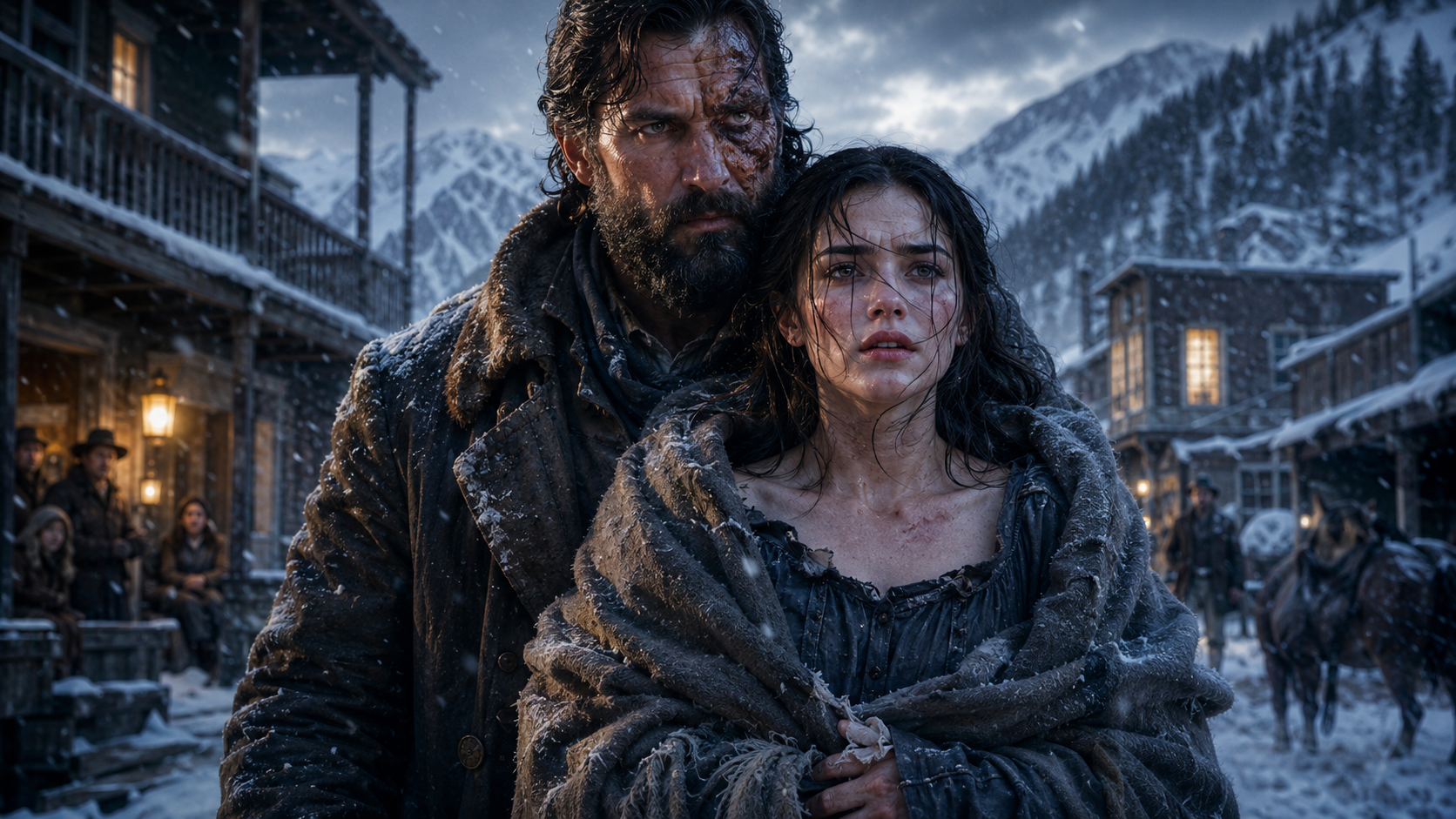
His shoulder was bound beneath his coat. His burned face drew whispers. He ignored them all. When Eliza had asked him to come, he had said towns were worse than storms because storms at least admitted what they were.
She told him she did not need him to like the town.
She needed one honest face behind her.
So he came.
The proceedings had been swift because the ledger had done what no sermon in Mercy Ford ever had: told the truth without trembling. It named payments, stolen bonds, guard schedules, and the judge’s seal. Thomas Marr’s delayed letter proved suspicion before the ambush. Bracken’s surviving man confirmed everything for the promise of not hanging.
But the strongest evidence had been Eliza’s voice.
She told the federal court about the coach road, Thomas’s death, the camp, the threats, the silence forced on her by a man who wore law like a mask. When Creed’s lawyer suggested that months among outlaws blurred the difference between captive and companion, Eliza looked at him until he looked away.
“A cage does not become a home because a woman survives inside it,” she said.
No one interrupted her after that.
Now Pastor Bellows stood at the pulpit, pale beneath the eyes.
“We have gathered,” he began, “because Mercy Ford owes Miss Marr an apology.”
Eliza listened.
A year ago, she might have wanted those words more than bread.
Now they felt too small.
The pastor swallowed. “We failed you.”
Some people cried.
Mrs. Cady pressed a handkerchief to her mouth. Mr. Voss stared at the floor. Others watched Eliza with that uncomfortable expression people wear when they want forgiveness before understanding.
The pastor turned toward her. “Miss Marr, if you wish to speak, this town will hear you.”
Jonas shifted slightly behind her.
Not touching.
There.
Eliza stood.
The church grew so quiet she could hear snowmelt dripping from the eaves outside.
She placed both hands on the back of the chair before her.
“I used to think,” she said, “that being believed would make me clean again.”
Her voice carried.
“But I was never unclean. Not when my brother died trying to save me. Not when Bracken’s men dragged me from that road. Not when Judge Creed threatened me. Not when you shut your doors. Not when you sent me into the snow and called it righteousness.”
Several people bowed their heads.
She did not soften.
“You wanted shame to belong to me because then it would not have to belong to you.”
Pastor Bellows closed his eyes.
“I do not know if I forgive Mercy Ford,” Eliza said. “Maybe one day I will. Maybe I will not. That is not a debt I owe on command.”
A woman sobbed.
Eliza looked toward the pews where the town’s daughters sat pressed against their mothers.
“But I know this. If another woman comes to your door cold, hungry, frightened, and inconvenient, do not ask whether she is respectable before deciding whether she deserves a blanket. Ask whether she is alive. Then help her stay that way.”
No one moved.
Eliza turned, walked down the aisle, and passed the same faces that had once watched her freeze.
Outside, sunlight struck the melting snow so brightly the street seemed unfamiliar. Mercy Ford looked smaller than it had from the ground where they tried to leave her.
Marshal Rowan waited near a wagon.
“Judge goes to Helena by noon,” he said. “Trial will finish there, but I don’t expect him to come back.”
Eliza looked toward the jail wagon. Creed sat chained between two deputies. He watched her through the bars with empty hatred.
She expected to feel triumph.
She felt release.
That was better.
Rowan handed her a folded paper. “Rail company signed the reward. Recovery of payroll bonds. Witness compensation. Your brother’s estate claim. It’s enough to start over properly.”
Eliza stared at the paper.
“To start what?”
The marshal shrugged. “Whatever you want.”
She looked at Jonas.
He stood beside his horse, uncomfortable under the town’s staring eyes.
“What did you want before all this?” he asked.
The answer came from a place she thought had frozen solid.
“A kitchen with front windows,” she said. “An oven big enough for twelve loaves. A door no hungry person had to fear knocking on.”
Jonas looked at the street, then at the mountains beyond.
“You talking about a bakery?”
“I suppose I am.”
He nodded slowly, as if considering foundation depth.
“You’ll need dry storage.”
She blinked.
“And good stone under the oven,” he added. “Bad stone cracks.”
A laugh rose in her chest, fragile and real.
“You have opinions about my bakery?”
“I have opinions about buildings that don’t fall down.”
“My bakery is already under inspection?”
“Somebody has to prevent disaster.”
“Mr. Vale, I have survived a blizzard, a judge, an outlaw camp, and your cooking. I think I can manage a shop.”
His good eye warmed.
“Your courage is greater than your memory. My coffee kept you alive.”