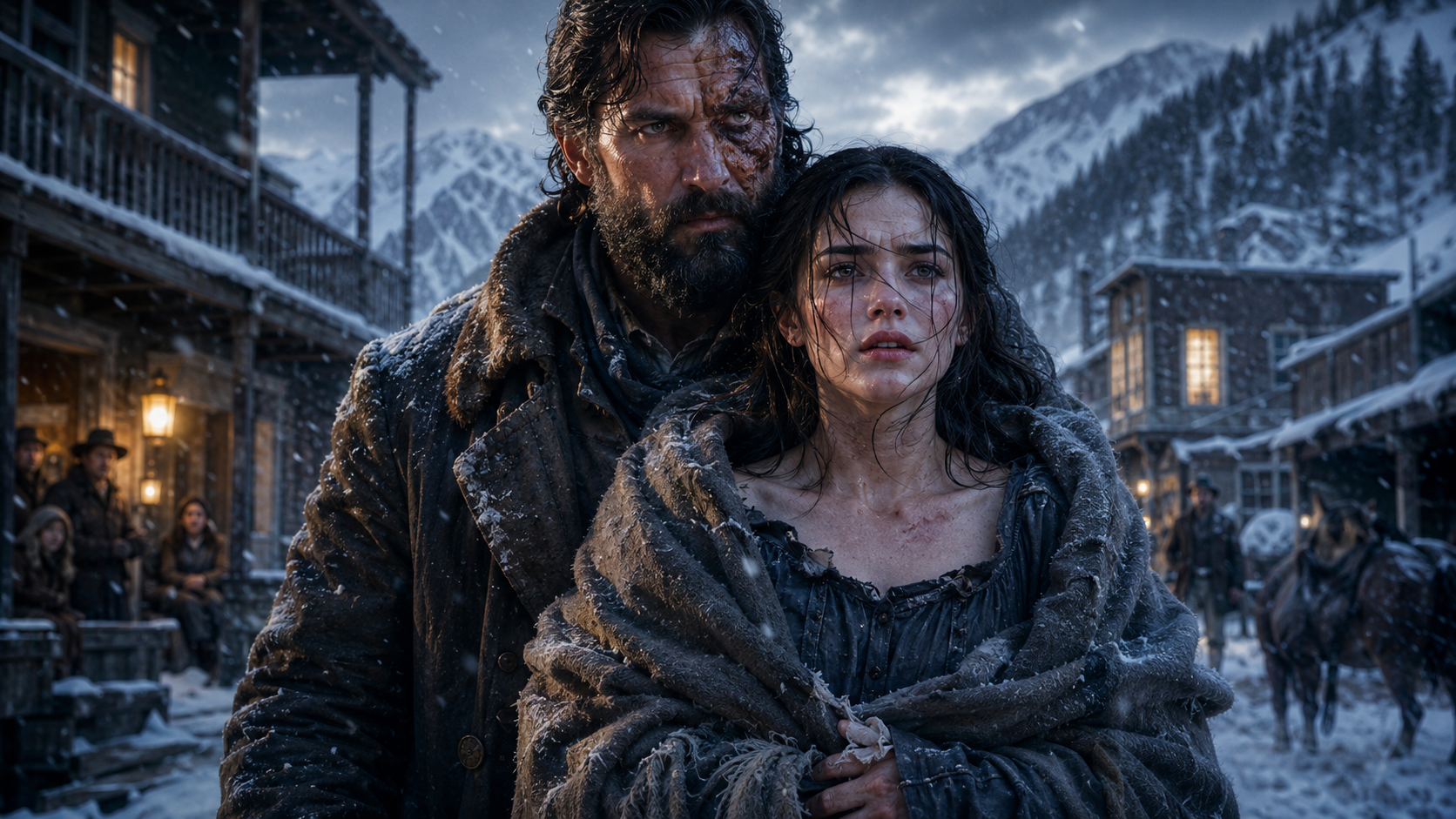
The first thing Eliza Marr heard was laughter.
Not loud laughter. Not the kind that belonged to a dance hall or a harvest supper or children running through a summer yard.
This laughter was thin and careful, the kind people used when they wanted cruelty to sound like judgment.
She stood in the middle of Mercy Ford’s main street with snow collecting on her lashes, her hair half fallen from its pins, her dress torn at the hem and dark with frozen mud. Behind the windows, faces appeared and vanished. Curtains moved. Doors stayed shut.
The church bell had rung only once that morning, not for worship, not for fire, not for death.
For her.
“Eliza Marr,” Deputy Harlan Pike called from the boardwalk, keeping one gloved hand on the butt of his pistol as though she were a wolf instead of a woman barely able to remain upright. “By order of Judge Alton Creed and the Mercy Ford council, you are to leave town before sundown.”
A murmur moved through the gathered people.
Eliza looked from face to face.
Mrs. Cady, who had once asked Eliza to sit with her feverish twins.
Mr. Voss, the butcher who had extended credit to half the town but refused Eliza even a scrap of salt pork that morning.
Pastor Bellows, holding a Bible so tightly his knuckles had gone white.
And Judge Creed himself, tall and polished beneath a black beaver hat, his silver watch chain shining against his waistcoat.
The judge did not look angry.
That was the worst of it.
He looked satisfied.
“I have done nothing wrong,” Eliza said.
Her voice came out rough from cold and hunger, but it carried farther than she expected. Several women lowered their eyes. No one stepped forward.
Judge Creed sighed as if she had embarrassed him. “Miss Marr, mercy has limits.”
A bitter smile tugged at her cracked lips. “Is that why your town is named after it? To remind you where the limits are?”
The deputy’s face hardened. “Watch your mouth.”
“No,” Eliza said. “I have watched it long enough.”
The street went quiet.
For months she had swallowed every accusation. She had endured whispers in the mercantile, women pulling their children close, men staring at her with either disgust or hunger. She had waited for someone to ask the right question. Not why she had been found near an outlaw camp. Not why a dead man’s coat had been on her shoulders. Not why she had not screamed loudly enough, fought cleanly enough, escaped quickly enough.
The right question was simpler.
What happened to you?
No one in Mercy Ford had asked.
Judge Creed stepped down from the boardwalk. Snow did not cling to his polished boots. He stopped close enough that only she could hear him.
“You should have left when I first advised it.”
Eliza stared into his pale eyes. “You mean when you first threatened me.”
His smile remained small and fatherly. “You survived a rough company, Miss Marr. That does not make you innocent. It merely makes you inconvenient.”
Her stomach tightened.
There it was.
The truth beneath the sermons.
“You are afraid of what I know,” she whispered.
His smile vanished so quickly she might have imagined it.
Then he turned back to the crowd and raised his voice.
“This woman was taken in by the Bracken gang. She traveled with thieves, killers, and train robbers. She refuses to account for the missing payroll bonds from the Copperline raid. Until such time as the marshal’s office retrieves her, Mercy Ford will not shelter criminal filth.”
Filth.
Eliza heard someone gasp. She could not tell whether it was outrage or pleasure.
Snow swirled harder, needling her cheeks. Beyond the town, the Bitterroot hills climbed white and merciless under a slate sky. The old pass would be nearly gone by evening.
They knew that.
Everyone knew that.
“You’re sending me into a storm,” she said.
Deputy Pike looked away.
Judge Creed said nothing.
A woman near the church steps crossed herself. Another muttered, “Better the snow than shame under our roofs.”
Eliza turned toward the voice. “What was that?”
The woman’s chin lifted, but her eyes shook. “Let the snow cover what God won’t.”
Eliza almost laughed.
She had not felt clean in so long that the word shame had begun to feel like a second skin. But in that moment, hearing them use God to dress up cowardice, something inside her went strangely still.
A horse snorted at the end of the street.
All heads turned.
A dark rider had stopped beside the livery, his horse steaming in the cold. He sat high in the saddle, enormous beneath a black buffalo coat dusted with snow. A scarred brown hat shadowed his face. A rifle lay across his thighs.
No one had heard him arrive.
That, more than anything, frightened the town.
“Jonas Vale,” someone whispered.
Eliza knew the name.
Everyone knew the name.
The Burned Man of Wolfhook Ridge.
Some said he had murdered three railroad guards in Dakota. Others said he had once been a soldier and had set fire to a prison camp with men still inside. Children dared one another to climb halfway to his cabin and run back before he shot them. Grown men pretended not to fear him and then avoided saying his name after dark.
He rode into Mercy Ford perhaps six times a year, always alone, always buying flour, ammunition, coffee, lamp oil, and nails. No one invited him anywhere. No one refused his money either.
The horse moved forward with slow, heavy steps.
Deputy Pike squared his shoulders. “This ain’t your business, Vale.”
The rider stopped beside Eliza.
Only then did she see his face.
The left side was handsome in a hard, weathered way: dark eye, black beard, broad cheek, mouth set in a line that looked carved rather than made. The right side had been burned long ago. Shiny scar tissue pulled from his temple to his jaw, pale and ridged, disappearing beneath his beard and collar. One eye on that side was clouded silver.
Eliza should have been afraid.
Instead she felt, absurdly, seen.
Jonas Vale looked at the crowd, then at the judge, then at Eliza’s bare hands turning blue in the storm.
His voice was low.
“You gave her no coat.”
Judge Creed stiffened. “This is a lawful matter.”
“Lawful men don’t send a woman into mountain weather dressed for September.”
“She is accused of grave crimes.”
“Accused by whom?”
The judge’s eyes sharpened. “By men sworn to protect this town.”
Jonas looked at Deputy Pike. The deputy stopped breathing for a second.
Then Jonas looked back at the judge. “That so?”
Pike’s hand twitched near his pistol.
Jonas did not move. “Try it, deputy, and your widow will spend Christmas selling that pistol for burial money.”
A child began to cry somewhere behind the crowd.
Judge Creed’s voice turned cold. “Are you threatening an officer?”
“I’m educating him.”
Eliza’s knees nearly buckled. She did not understand what was happening. She had been alone a moment ago, so alone that even the sky seemed to be leaning away from her.
Now the most feared man in the county had placed his horse between her and the town.
Pastor Bellows stepped forward. “Mr. Vale, this woman carries corruption with her. The town has decided—”
“The town can decide to go to hell,” Jonas said.
A collective gasp passed through the street.
The pastor went red. “Sir.”
Jonas finally looked down at Eliza.
Up close, his one good eye was not hard at all.
It was tired.
“You got somewhere to go?”
Eliza almost said yes because pride was the last rag she owned.
Then the wind cut through her torn sleeves, and her fingers went numb.
“No,” she said.
Jonas reached behind him, pulled a folded wool blanket from his saddle roll, and dropped it over her shoulders. It smelled of smoke, horse, pine pitch, and cold iron.
The warmth struck her so sharply that tears filled her eyes.
Judge Creed spoke through his teeth. “If you take her, you place yourself against the court.”
Jonas leaned forward in the saddle.
“Judge, I been against worse things than you and still woke up hungry the next morning.”
“She will bring ruin to your door.”
“Ruin already knows the way.”
“Eliza Marr is no innocent lamb.”
Jonas looked at her again, and for one terrible instant she thought he might ask what everyone else had asked.
What did you do?
Instead he said, “Can you ride?”
She swallowed. “I can try.”
He swung down from the saddle. The movement was surprisingly graceful for a man so large. When he stepped close, Eliza saw that his right hand was scarred too, the skin twisted around the knuckles. He did not grab her. He held out his arm.
She hesitated only once.
Then she took it.
The crowd shifted as he helped her mount. Someone muttered, “Let him have the shame if he wants it.”
Jonas turned.
The street froze.
“What did you say?”
No one answered.
Snow hissed against the storefronts.
Jonas’s voice dropped lower.
“You want the mountain to bury her shame?”
His gaze traveled over every face, slow and unforgiving.
“Then the mountain will have to bury me too.”
No one laughed after that.
He climbed into the saddle behind Eliza, one arm steadying her without pulling her close. The horse turned toward the road leading out of town.
As they passed the church, Eliza looked back once.
Judge Creed stood in the street, his black hat collecting snow, his expression no longer satisfied.
It was afraid.
That was when Eliza knew.
Whatever waited in the mountains, the danger had not ended.
It had only changed direction.
The trail vanished before they reached the pines.
Wind came down from Wolfhook Ridge like something alive and furious. Snow blew sideways, filling hoofprints almost as soon as the horse made them. Eliza clutched the front of the saddle with hands she could barely feel. Twice she slipped, and twice Jonas’s arm tightened just enough to keep her from falling.
He said little.
“Lean forward.”
“Keep your chin down.”
“Breathe through the blanket.”
His voice gave her something to follow when the world became white noise.
After an hour, or perhaps five minutes, or perhaps the rest of her life, the cold began to change. At first it hurt. Then it stopped hurting, and that frightened her more.
“My feet are gone,” she whispered.
“They’re still there.”
“I can’t feel them.”
“I know.”
“Maybe that means they left.”
A rough sound came from him. It might have been a laugh if it had belonged to a man who remembered how.
“Stubborn woman.”
“I have been called worse today.”
“I heard.”
She closed her eyes. “Why did you help me?”
The horse climbed steadily.
Jonas did not answer for a long while.
Then he said, “Because nobody else did.”
That should not have broken her.
It did.
Eliza bowed her head and cried into the wool blanket, the tears freezing almost as soon as they left her skin. She cried for her brother Thomas, dead on a road west of Helena. She cried for the seven months she had spent with men who treated mercy as a weakness to be beaten out of the world. She cried for the town that had known her since girlhood and still found it easier to believe she had become wicked than that wickedness had been done to her.
Her body sagged.
Jonas noticed immediately.
“Stay with me.”
“I’m awake.”
“No, you’re answering. That ain’t the same.”
“I’m tired.”
“Be tired tomorrow.”
“I might not have tomorrow.”
His arm became iron around her.
“You do.”
“You don’t know that.”
“I said you do.”
There was such command in his voice that some foolish part of her believed him.
The horse stumbled near a ravine. Jonas cursed softly, slid down, and led the animal on foot while keeping one hand on Eliza’s leg to steady her. The storm swallowed everything beyond a few yards: trees, sky, trail, God.
At last, through the blur, a glow appeared.
Then logs.
Then a door.
Eliza remembered being lifted. She remembered protesting because she was too heavy, because she had been told too many times that she was too much trouble, too much body, too much need.
Jonas ignored her.
“You weigh less than a wet saddle,” he said.
“That is not a compliment.”
“It is from me.”
The door opened.
Warmth rushed out.
Eliza smelled woodsmoke, coffee, cedar, drying leather, and stew. The cabin was larger than she expected, built deep into the shoulder of the ridge with stone at the back wall and thick logs darkened by years of smoke. A great hearth burned at one end. Tools hung in careful rows. A small table stood under a window half buried in snow. Dried herbs, onions, and strips of meat hung from rafters.
Jonas set her on a bed near the fire as gently as if she were made of thin glass.
She tried to sit up.
“No.”
“I need—”
“You need heat.”
“My dress—”
“Is frozen.”
Her breath caught.
He saw the fear before she could hide it.
Jonas stepped back at once and turned his face away. “I’ll cut the outer cloth where it’s iced. You’ll stay covered. I’ve got my mother’s old screen in the corner. I’ll set it up. You can cuss me the whole time if you need.”
Eliza stared at him.
He was still turned away.
A man who could have taken any amount of space instead gave her all of it.
She began to shake, not from cold this time.
“I don’t have strength to cuss.”
“Then blink mean.”
Despite everything, a broken laugh escaped her.
Jonas set the screen, warmed blankets by the fire, and worked with the brisk care of someone who had treated wounds before. He never touched without warning. He kept his eyes on his hands or the floor. When her boots had to come off, he did it slowly, murmuring, “This will hurt,” before pain tore through her feet and made her gasp.
“Good,” he said.
“That was good?”
“Pain means blood’s coming back.”
“I dislike your definition of good.”
“Most do.”
He gave her bitter tea, broth from a tin cup, and a stone wrapped in flannel for her feet. At some point, she woke to find him seated beside the hearth with a rifle across his knees, watching the door while the storm clawed at the roof.
“You think they’ll come?” she whispered.
His face turned toward her.
In firelight, the burned half looked less monstrous than mournful.
“Not tonight.”
“But later?”
“Maybe.”
“You should have left me.”
“No.”
“You do not know what Judge Creed is.”
“I know enough.”
Eliza swallowed. “No, you don’t. He is not only a judge. He has men. Money. Friends in Helena. He knows about the Copperline bonds. He knows I saw him.”
Jonas leaned forward.
There it was: the first spark of something colder than anger.
“What did you see?”
Eliza closed her eyes.
For months, the truth had sat inside her like a live coal. She had been afraid to speak it because every time she opened her mouth, someone else told the story first.
But the storm was at the door.
The town was below.
And this stranger had ridden into both for her.
“My brother and I were traveling west,” she said. “Thomas had sold our father’s place after the fever took our parents. He meant to buy sheep country near the Bitterroot. I was to keep books and bake pies for hired men. That was the plan.”
Her voice trembled.
“Near Sawtooth Bend, the Bracken gang stopped the coach. Thomas reached for the shotgun under the seat. Rafe Bracken shot him before he cleared the barrel.”
Jonas did not interrupt.
His stillness helped.
“They took me because I had seen faces. At first they meant to kill me. Then Bracken decided a woman could cook, mend, distract guards, and make men hesitate. He told others I was his willing woman because he liked watching me deny it.”
Jonas’s scarred hand tightened around the rifle stock.
Eliza continued.
“I survived by becoming useful. I cooked. I cleaned wounds. I listened when they forgot I had ears. That is how I learned about the Copperline robbery. Judge Creed was not robbed by the gang. He hired them.”
The fire cracked loudly.
Jonas’s good eye narrowed.
“He gave them the route?”
“And the guard changes. And the names of men carrying payroll bonds. He promised them safe passage through Mercy Ford afterward. But Bracken kept a ledger. Payments, dates, names. Creed feared it.”
“Where is it?”
Eliza looked toward the window, where snow had covered nearly all the glass.
“Not with Bracken. Not anymore.”
Jonas waited.
“When the marshals raided the camp, Bracken fled with two men and took me as shield. We crossed a frozen creek. He fell through near the old mill gorge. The saddlebag with the ledger went under. Bracken drowned. One of his men dragged me out, then left me when he heard riders. I walked until I found Mercy Ford.”
“And Creed got to you before the marshals did.”
She nodded. “He told me no one would believe a woman who had lived among outlaws. He said if I spoke, he would swear I planned the Copperline raid. He said my brother’s death would become my shame too.”
“He needed the ledger.”
“He still does. I know where it sank. I marked the place with a broken willow branch before I ran.”
Jonas stood and crossed to the window. For a moment, he was only a broad shadow against storm-white glass.
“The gorge is below Mercy Ford.”
“Yes.”
“Close enough for Creed to search when weather clears.”
“Yes.”
He turned back. “Then we get there first.”
Eliza laughed once, bitterly. “I cannot even stand.”
“You will.”
“And if I cannot?”
“I’ll carry you.”
“You say that like it is simple.”
“It is.”
“No, Mr. Vale. It is not. Nothing about me is simple.”
He looked at her for a long moment.
Then he said, “Good.”
She had no answer to that.
For four days, the ridge disappeared beneath snow.
Eliza slept in pieces. Sometimes fever dragged her backward into the outlaw camp, and she woke fighting blankets, certain hands were reaching for her. Each time, Jonas was there but not too close.
“You’re in my cabin.”
“The door’s barred.”
“Nobody touches you here.”
Once she woke crying for Thomas, and Jonas placed a cup of water on the floor beside the bed because she could not bear a hand near her. Another time she woke to find him outside splitting wood in snow up to his thighs, his burned face turned away from the wind as if the weather owed him money.
By the fifth morning, she could stand with one hand on the bedpost.
By the sixth, she took three steps and called it victory.
Jonas called it reckless.
She called him sour.
He almost smiled.
The cabin slowly became more than a place where she had not died.
She learned that Jonas kept his coffee in a tin marked Nails because no visitor would steal nails. He owned six rifles but only two plates. He could stitch a wound with terrifying precision and burn biscuits with equal confidence. He had a habit of standing in doorways as if expecting trouble to arrive on schedule.
She also learned there had once been laughter in the cabin.
A woman’s shawl lay folded in a cedar chest. A child’s slate leaned behind a stack of books. On the mantel stood a wooden bird, carved smooth by small hands.
Eliza did not ask at first.
People in pain recognized locked rooms in one another.
On the seventh evening, she found him sharpening a knife by the fire.
“Who were they?” she asked softly.
His hand stopped.
“The shawl. The slate. The bird.”
For a moment she thought he would not answer.
Then he set the knife aside.
“My wife was named Ruth. My boy was Eli.”
Eliza sat very still.
“Fever took the mining camp at Alder Creek,” Jonas said. “Company men locked the sick families in a supply barn to keep infection from spreading. I was hauling timber downriver. Came back to smoke.”
Her breath caught.
“They burned it?”
“Said a lantern fell.”
His voice had gone flat.
“It didn’t.”
Eliza understood then why the town feared him.
Not because he was a monster.
Because he had seen what decent men could do when they were afraid, and he had stopped pretending decency was guaranteed.
“What happened?” she whispered.
“I killed two men who barred the door and one who tried to shoot me while I was carrying my boy out.”
“Was your son alive?”
Jonas looked into the fire.
“No.”
The word filled the room.
Eliza’s eyes burned.
“I am sorry.”
He nodded once, but his face did not change.
“Ruth lived until morning. She asked me not to turn cruel.”
“Did you?”
His mouth tightened.
“I turned quiet.”
Eliza looked around the cabin, at the guns, the walls, the careful order of a life built far away from other lives.
“Sometimes quiet is cruelty turned inward.”
His good eye lifted to hers.
She regretted the words immediately. “Forgive me. I had no right.”
Jonas’s scarred fingers rested against the knife handle.
Then he said, “You might.”
Something changed after that.
Not quickly. Nothing honest changed quickly.
But the silence between them grew less defensive. Eliza began helping where she could. She mended his gloves, reorganized his medicine bottles, and made stew edible enough to prove that survival did not require punishment. Jonas repaired the torn seams of her coat, shaped crutches from ash branches, and taught her how to load the revolver he kept in the top drawer.
“I don’t want to shoot anyone,” she said.
“I don’t want you to.”
“Then why teach me?”
“Because wanting has never stopped men from coming through doors.”
She hated that.
She also knew it was true.
On the ninth day, the storm broke.
Sunlight struck the ridge so fiercely the whole world flashed silver. Snow lay deep over the pines. Far below, Mercy Ford sent up thin lines of chimney smoke as if nothing unforgivable had happened there.
Eliza stood on the porch wrapped in Jonas’s mother’s old coat. It was too broad in the shoulders and too tight at the hips, but it was warm. For the first time in weeks, cold air did not feel like a sentence.
“Do you miss them?” she asked.
Jonas stood beside her, watching the valley.
“Every day.”
“Do you ever stop hating the men who did it?”
“No.”
The answer startled her with its honesty.
Then he added, “But I stopped feeding the hate first.”
“What do you feed now?”
He looked uncomfortable, as if she had caught him undressed.
“Chickens, when foxes don’t get them.”
She gave him a look.
The corner of his mouth moved.
“Woodstove,” he said. “Horse. Myself, most days.”
“That is not enough.”
“No.”
His gaze shifted to her.
“No, it ain’t.”
Eliza felt warmth rise beneath her skin that had nothing to do with the sun.
Down in the valley, a dog barked.
Jonas’s face changed.
The softness vanished. He stepped to the porch rail, listening.
Another bark came.
Then another.
Not from town.
From the lower trail.
“Hounds,” he said.
Eliza’s blood went cold.
He moved fast.
Inside, he barred the door, checked the shutters, brought down a rifle, loaded two revolvers, and placed one on the table before her.
“How many?” she asked, hating the shake in her voice.
He opened a narrow viewing slit.
“Seven riders. One wagon. Two hounds. Pike is with them.”
“And Creed?”
Jonas watched longer.
“Yes.”
Her hand went to the revolver. “He came himself.”
“Greed likes to watch its meals.”
The first shout came minutes later.
“Vale!”
Deputy Pike’s voice echoed up from the clearing below the cabin.
Jonas did not answer.
“Jonas Vale! By order of Judge Alton Creed, surrender Eliza Marr to lawful custody!”
Eliza flinched at the word lawful.
Jonas looked at her. “Whatever they say, breathe.”
“I am breathing.”
“Do it lower.”
She obeyed because his calm made space for her fear without letting it rule.
Judge Creed’s voice followed, smoother and nearer.
“Mr. Vale, this need not become violent. You are harboring a fugitive wanted for theft and conspiracy.”
Jonas called back, “You always bring hounds to polite conversation?”
“I bring caution where dangerous people are concerned.”
Eliza stood before she could think better of it.
Jonas’s hand shot out but stopped before touching her, asking without words.
She nodded.
He let her move to the shutter.
“I am not your prisoner,” she shouted.
Silence fell outside.
Then Creed said, “Miss Marr, you poor foolish woman. You have mistaken a murderer’s cabin for refuge.”
“And you have mistaken a robe for righteousness.”
One of the men outside cursed.
Jonas glanced at her.
This time there was no almost about his smile.
Creed’s voice sharpened. “Send her out, Vale.”
“No.”
“I have authority.”
“You have weather, horses, and men paid enough to pretend.”
“You cannot hold against the county.”
Jonas set the rifle barrel through the firing slit.
“I don’t see the county. I see trespassers.”
Eliza heard movement below. Men spreading out.
Creed spoke one last time.
“Burn him out.”
The cabin exploded into sound.
Bullets hammered the logs. Crockery shattered. A lantern burst against the wall, spilling flame before Jonas kicked it out. Eliza dropped behind the table with the revolver in both hands, heart slamming so hard her vision pulsed.
Jonas moved through the chaos like a man who had already died once and found the experience unimpressive.
He fired from one window, crossed to another, fired again. Outside, a horse screamed. A man shouted for his mother. Snow kicked up where bullets struck the drifts.
Then Eliza heard scratching at the back wall.
Not the door.
Lower.
The storage hatch.
“Jonas,” she whispered.
“I hear it.”
He could not leave the front. Two rifles were pinning him from the trees.
The scratching became a crack.
Someone prying the hatch.
Eliza crawled across the floor, splinters digging into her palms. She reached the hatch just as the latch broke.
A face appeared in the gap.
Deputy Pike.
His eyes widened when he saw the revolver.
Then he smiled.
“Look at you. Judge said you always were good at playing helpless.”
The old terror rose. The wagon. The camp. Men’s boots. Closed doors.
Eliza’s hands shook.
Pike lifted his pistol.
She fired first.
The blast threw her backward. Smoke filled her nose. Pike disappeared with a cry, falling away from the hatch into the snow.
Eliza stared at the smoking revolver.
The world narrowed.
Jonas was beside her suddenly. “Are you hit?”
She shook her head.
He looked through the broken hatch, then pulled it shut and shoved a crate against it.
“I shot him,” she whispered.
“He came in armed.”
“I shot him.”
“You lived.”
The words struck deeper than comfort.
You lived.
A hiss cut through the smoke.
Jonas’s head snapped up.
“Down!”
Something crashed through the roof gap and landed near the stove, wrapped in oilcloth with a sputtering fuse.
Dynamite.
Jonas seized Eliza and drove them both behind the stone hearth.
The explosion ripped the cabin open.
For a few moments there was no sound, only pressure, white light, and the sensation of the world breaking apart. Snow fell through the roof. Smoke rolled along the floor. The table was gone. One wall sagged inward.
Eliza opened her eyes to find Jonas half over her, his body shielding hers.
“Jonas.”
He did not answer.
Blood ran down his neck. A roof beam had struck his shoulder and pinned his right arm beneath it. Eliza shoved with everything in her. The beam shifted a fraction. Jonas groaned but did not cry out.
“Help me,” she said.
His eye opened.
Together they got him free.
He could barely stand.
The front door hung splintered from one hinge.
Through the smoke, Judge Alton Creed walked in with a pistol in his hand.
Two hired men followed, both pale, both armed.
Creed’s coat was torn. Snow clung to his hair. Without his polished courtroom calm, he looked smaller.
Meaner.
“There,” he said softly. “All this suffering because you could not be sensible.”
Jonas reached for the rifle with his left hand.
Creed aimed at Eliza. “Don’t.”
Jonas froze.
Creed smiled. “There is the truth of men like you, Vale. Always dangerous until someone finds what you love.”
Eliza’s chest tightened.
What you love.
Jonas’s face revealed nothing, but Creed had seen enough.
The judge turned to Eliza. “Where is the ledger?”
She lifted her chin.
Creed stepped close to Jonas and pressed the pistol barrel against his wounded shoulder.
Jonas’s body went rigid.
“Where?” Creed asked.
Eliza looked at Jonas.
His good eye said no.
His blood said hurry.
She took a shaking breath.
“It is not in the gorge anymore.”
Creed’s face changed. Greed leaned forward inside him.
“Where?”
“Bracken moved it before he drowned.”
“Eliza,” Jonas warned.
She ignored him.
“He hid it inside Saint Agnes Mine. Behind the second ore chute. He said nobody would search there because of the cave-in.”
One of Creed’s men spat. “That mine’s cursed.”
Creed did not look away from Eliza.
“Are you lying to me?”
She let fear tremble in her mouth because fear was useful.
“No.”
The judge studied her.
Then he smiled.
“You will draw me a map.”
“I will.”
“And after that?”
“You let Jonas live.”
Creed gave a small laugh.
It was worse than a shout.
“My dear girl, you have mistaken negotiation for prayer.”
He raised the pistol toward Jonas’s head.
A rifle shot cracked from outside.
Creed screamed.
The pistol flew from his hand, spinning into the ashes. Blood poured between his fingers.
The hired men turned, but a voice from the doorway stopped them cold.
“Drop the guns.”
A lean man in a gray duster stood amid the smoke, a U.S. Marshal’s star pinned to his coat. Behind him, armed deputies moved through the trees, rifles trained on the cabin.
“I said drop them.”
The hired men obeyed.
Creed fell to one knee, clutching his ruined hand. “Marshal Rowan.”
The marshal stepped inside.
His face was weathered and calm, the kind of calm that did not need to prove itself.
“Judge Creed,” he said. “You are a hard man to catch in honest weather.”
“This woman is a criminal.”
“No,” the marshal said. “She is a witness.”
Eliza could not breathe.
Marshal Rowan looked at her. His voice gentled.
“Eliza Marr?”
She nodded.
“I’m Samuel Rowan, United States Marshal. Your brother Thomas wrote to my office before he died. Said he feared someone in Mercy Ford was connected to the Bracken gang.”
Her hand went to her mouth.
“Thomas?” she whispered.
“We found the letter delayed in a burned mail sack outside Deer Creek. Then we found Bracken’s surviving man. He talked once he learned Creed had no intention of paying him.”
Creed’s face had gone gray.
Rowan continued, “We searched the old mill gorge at dawn. Found a saddlebag trapped beneath ice near a broken willow.”
Eliza’s knees almost failed.
Jonas caught her with his left arm despite his wound.
The marshal reached inside his coat and drew out a wrapped packet, dark with damp and mud.
“The ledger survived well enough.”
For a moment no one spoke.
Eliza had imagined the truth as thunder, as fire, as something that would shake the world apart once it was revealed.
Instead it arrived wet, dirty, and held in a marshal’s hand.
Small enough to carry.
Heavy enough to bury a judge.
Creed lurched up. “That book is forged.”
Rowan looked at him. “Then you can explain why your private seal appears beside six payments to Rafe Bracken.”
One of the hired men cursed under his breath.
Creed’s eyes darted toward the door.
Jonas, wounded and half kneeling, lifted his rifle with one hand.
“Don’t,” he said.
Creed stopped.
The marshal’s gaze shifted to Jonas.
“Vale.”
Jonas’s jaw tightened. “Marshal.”
“I’ve been looking for you too.”
Eliza went still.
Creed gave a bloody smile. “Yes. Ask him about the men he burned at Alder Creek. Ask your savior what sort of monster you’ve taken into your arms.”
Jonas’s face closed.
Marshal Rowan’s eyes hardened. “Alton, you are running out of lies and choosing poor ones.”
Creed stared.
Rowan turned to Eliza. “Jonas Vale killed three company guards after they locked fever families inside a supply barn. Two had set the fire. The third aimed at him while he carried out a child. Territorial review cleared him nine years ago.”
Eliza looked at Jonas.
He did not look back.
“All these years,” she said softly.
“I didn’t go back for the paper,” he said.
Rowan snorted. “No, you did not. Took a pardon and turned it into a ghost story.”
Jonas’s mouth twitched, though pain had drained the color from his face.
Creed began to laugh, high and ragged. “It will not matter. Do you hear me? None of it will matter. A woman like her cannot stand in court. One good question about that camp and she will fold.”
Eliza stepped away from Jonas.
Smoke twisted around her. Snow fell through the broken roof into her hair. Her dress was torn. Her hands were black with soot. Deputy Pike’s blood marked one sleeve. She was shaking so badly that standing felt like defiance.
But shame was gone.
Not healed.
Not forgotten.
Gone from where it had never belonged.
“I will stand,” she said.
Creed looked at her with hatred.
Eliza stepped closer.
“I will stand in court. I will say your name. I will say Bracken’s name. I will say my brother’s name. And when your lawyer asks me what I did to survive, I will answer every question loud enough for the back row.”
The judge’s face twisted.
“You think they will pity you?”
“No,” she said. “I think they will hear me.”
Three weeks later, Mercy Ford filled its church for judgment.
Not Sunday worship.
Judgment.
Judge Alton Creed sat in chains in the front pew, his wounded hand bandaged thickly. His black coat hung loose on him now. Without his watch chain, his hat, and the town’s obedience, he looked like any other frightened man facing consequence.
Two hired riders sat behind him, guarded by federal deputies. Deputy Pike had survived Eliza’s shot but would limp forever. He had agreed to testify before sunrise.
The town had scrubbed the church windows and polished the pulpit as if cleanliness could make the gathering holy.
Eliza sat at a table near the front in a dark blue dress lent by Marshal Rowan’s wife. It fit her differently than she wanted. A month ago she would have folded her arms, turned sideways, tried to disappear inside her own bones.
That morning, she sat straight.
Let them see.
Jonas sat behind her.
His shoulder was bound beneath his coat. His burned face drew whispers. He ignored them all. When Eliza had asked him to come, he had said towns were worse than storms because storms at least admitted what they were.
She told him she did not need him to like the town.
She needed one honest face behind her.
So he came.
The proceedings had been swift because the ledger had done what no sermon in Mercy Ford ever had: told the truth without trembling. It named payments, stolen bonds, guard schedules, and the judge’s seal. Thomas Marr’s delayed letter proved suspicion before the ambush. Bracken’s surviving man confirmed everything for the promise of not hanging.
But the strongest evidence had been Eliza’s voice.
She told the federal court about the coach road, Thomas’s death, the camp, the threats, the silence forced on her by a man who wore law like a mask. When Creed’s lawyer suggested that months among outlaws blurred the difference between captive and companion, Eliza looked at him until he looked away.
“A cage does not become a home because a woman survives inside it,” she said.
No one interrupted her after that.
Now Pastor Bellows stood at the pulpit, pale beneath the eyes.
“We have gathered,” he began, “because Mercy Ford owes Miss Marr an apology.”
Eliza listened.
A year ago, she might have wanted those words more than bread.
Now they felt too small.
The pastor swallowed. “We failed you.”
Some people cried.
Mrs. Cady pressed a handkerchief to her mouth. Mr. Voss stared at the floor. Others watched Eliza with that uncomfortable expression people wear when they want forgiveness before understanding.
The pastor turned toward her. “Miss Marr, if you wish to speak, this town will hear you.”
Jonas shifted slightly behind her.
Not touching.
There.
Eliza stood.
The church grew so quiet she could hear snowmelt dripping from the eaves outside.
She placed both hands on the back of the chair before her.
“I used to think,” she said, “that being believed would make me clean again.”
Her voice carried.
“But I was never unclean. Not when my brother died trying to save me. Not when Bracken’s men dragged me from that road. Not when Judge Creed threatened me. Not when you shut your doors. Not when you sent me into the snow and called it righteousness.”
Several people bowed their heads.
She did not soften.
“You wanted shame to belong to me because then it would not have to belong to you.”
Pastor Bellows closed his eyes.
“I do not know if I forgive Mercy Ford,” Eliza said. “Maybe one day I will. Maybe I will not. That is not a debt I owe on command.”
A woman sobbed.
Eliza looked toward the pews where the town’s daughters sat pressed against their mothers.
“But I know this. If another woman comes to your door cold, hungry, frightened, and inconvenient, do not ask whether she is respectable before deciding whether she deserves a blanket. Ask whether she is alive. Then help her stay that way.”
No one moved.
Eliza turned, walked down the aisle, and passed the same faces that had once watched her freeze.
Outside, sunlight struck the melting snow so brightly the street seemed unfamiliar. Mercy Ford looked smaller than it had from the ground where they tried to leave her.
Marshal Rowan waited near a wagon.
“Judge goes to Helena by noon,” he said. “Trial will finish there, but I don’t expect him to come back.”
Eliza looked toward the jail wagon. Creed sat chained between two deputies. He watched her through the bars with empty hatred.
She expected to feel triumph.
She felt release.
That was better.
Rowan handed her a folded paper. “Rail company signed the reward. Recovery of payroll bonds. Witness compensation. Your brother’s estate claim. It’s enough to start over properly.”
Eliza stared at the paper.
“To start what?”
The marshal shrugged. “Whatever you want.”
She looked at Jonas.
He stood beside his horse, uncomfortable under the town’s staring eyes.
“What did you want before all this?” he asked.
The answer came from a place she thought had frozen solid.
“A kitchen with front windows,” she said. “An oven big enough for twelve loaves. A door no hungry person had to fear knocking on.”
Jonas looked at the street, then at the mountains beyond.
“You talking about a bakery?”
“I suppose I am.”
He nodded slowly, as if considering foundation depth.
“You’ll need dry storage.”
She blinked.
“And good stone under the oven,” he added. “Bad stone cracks.”
A laugh rose in her chest, fragile and real.
“You have opinions about my bakery?”
“I have opinions about buildings that don’t fall down.”
“My bakery is already under inspection?”
“Somebody has to prevent disaster.”
“Mr. Vale, I have survived a blizzard, a judge, an outlaw camp, and your cooking. I think I can manage a shop.”
His good eye warmed.
“Your courage is greater than your memory. My coffee kept you alive.”
“Your coffee threatened my will to live.”
For the first time, Jonas Vale smiled where the whole town could see it.
People stared as if the mountain had moved.
Mrs. Cady hurried across the muddy street with a basket clutched in both hands.
Jonas stiffened.
Eliza touched his sleeve. “It’s all right.”
Mrs. Cady stopped before them, breathless.
“I should have opened my door,” she said.
Eliza said nothing.
The woman’s eyes filled. “My boys lived because you sat with them through fever. And when you needed me, I closed my curtains. I told myself I was protecting my children from scandal. But I was protecting myself from courage.”
She held out the basket.
“Bread. Cheese. Apples. It is not enough.”
“No,” Eliza said gently. “It is not.”
Mrs. Cady flinched.
Eliza took the basket.
“But it is something.”
The woman nodded, crying quietly.
Jonas helped Eliza into the wagon. As they rolled toward the edge of town, curtains moved again. This time Eliza did not feel trapped by the watching.
At the last bend, she looked back once.
Mercy Ford sat beneath thawing snow, no longer a kingdom, no longer a sentence.
Only a town.
Only people.
Only doors that had closed and might, if shame taught them anything, open faster next time.
Then the road curved.
The town disappeared.
Spring came late to the Bitterroot valley.
It began with dripping roofs and mud deep enough to steal boots. Ice broke along creek beds. Pines released their loads of snow with heavy sighs. Elk moved down through the lower meadows, thin from winter but alive.
Eliza and Jonas did not go back to Wolfhook Ridge to live.
They returned once to repair the cabin roof, bury what had been broken, and collect what mattered: Ruth’s shawl, Eli’s slate, the wooden bird, Jonas’s tools, the coffee tin marked Nails.
Eliza stood in the cabin doorway on their last evening there.
“This place saved me,” she said.
Jonas loaded the wagon in silence.
“But it was built for hiding.”
He looked toward the hearth.
“Yes.”
“I do not want to hide.”
“No.”
She stepped closer. “Do you?”
The question stood between them.
Jonas looked older in the gold light, his burned face carved with shadows, his broad shoulders bent slightly under memories no one else could carry for him.
“I don’t know how to live among people anymore.”
Eliza took his scarred hand.
“I do not know how to trust them.”
His thumb brushed once over her knuckles.
“That sounds like trouble.”
“It sounds like company.”
He looked down at her hand in his.
Then he said, “Front windows?”
“Yes.”
“Good oven?”
“The best we can afford.”
“Two doors.”
“Why two?”
“In case one gets crowded.”
She smiled.
“Jonas Vale, are you planning an escape route for a bakery?”
“I plan for human foolishness.”
“That may be wise.”
They bought an empty dry goods store in the town of Willow Bend with reward money, stubbornness, and a loan from Marshal Rowan that he called an investment and Eliza called charity until he threatened to charge interest just to quiet her.
The building leaned east. The roof leaked. The back door stuck. The old sign had lost every letter except O and D, which Jonas claimed was a good omen because they were already halfway to “open door.”
Eliza named the bakery The Open Door before the floor was even level.
Work did not heal them all at once.
Nothing did.
Some mornings Eliza woke tasting smoke that was not there. Some afternoons a customer’s loud laugh turned her hands cold. Once, a man reached across the counter too quickly and she dropped a tray of rolls, then locked herself in the pantry and shook until Jonas sat outside the door and talked about flour barrels for twenty minutes because flour barrels were safe.
Jonas had his own ghosts.
He woke at night and went still as stone, listening for flames from years ago. He hated crowded rooms. He flinched when children coughed. The first time a lantern broke in the shop, he carried it outside with his bare hands and did not notice the burns until Eliza made him sit down.
They learned each other slowly.
Not as saviors.
As witnesses.
Jonas built counters from pine and sanded them until they shone pale gold. He reinforced the oven wall with stone hauled from the creek. He hung Ruth’s shawl in their upstairs room, not as a shrine to sorrow but as proof love could belong to more than one chapter of a life.
Eliza baked.
At first, badly.
Her first loaves came out hard enough that Jonas claimed they could be used to discourage bandits. Her biscuits leaned. Her pies wept. She burned cinnamon rolls twice and cried over the third batch because the smell reminded her of a girl she had been before the road west.
Jonas ate the burned ones anyway.
“You don’t have to,” she said.
“Sugar’s sugar.”
“That is the saddest philosophy I have ever heard.”
“Kept me alive.”
“Then we must improve your reasons.”
By summer, people came from three streets away when bread came out of the oven.
The miller’s wife declared Eliza’s molasses rye a civic blessing. Schoolchildren spent pennies on broken roll pieces. Miners bought meat pies by the sack. Widows came for tea and stayed because Eliza never rushed them. Drifters swept the floor for supper. Women with bruises were given work before questions.
A sign hung beside the door in Jonas’s careful carving:
Nobody hungry is turned away.
People asked about Jonas’s scars. Not often, and not twice if they valued comfort. They asked about Eliza’s past even less because Willow Bend had troubles enough without making theater of someone else’s wounds.
Months passed.
The bakery grew warm with habit.
One autumn afternoon, Marshal Rowan entered with dust on his coat and tiredness in his eyes. Eliza put coffee before him before he asked.
“Creed is sentenced,” he said.
Jonas came out from the kitchen, flour on his sleeves.
Eliza’s hands went still.
“Hanging?” she asked.
“Life at hard labor. Bracken’s surviving man swung. Pike got twenty years. Mercy Ford elected a new judge and appears deeply invested in appearing moral.”
Eliza snorted.
Rowan smiled. “Thought you’d appreciate that.”
“Let them become kind when nobody is watching. Then I may be impressed.”
The marshal pushed a packet across the counter.
“What is this?”
“Final payment. The rail company discovered more bonds connected to the case. Your portion.”
Eliza stared at it.
Jonas leaned against the doorway. “You could expand.”
She looked around The Open Door: sunlight across tables, Ruth’s shawl folded in a basket upstairs, children arguing over whether raisins belonged in buns, a kettle steaming on the stove.
“Maybe,” she said. “Or maybe we build a room out back.”
“For storage?”
“For people who need somewhere safe before they know where else to go.”
Jonas’s face softened.
“That needs good walls.”
“I know someone with opinions.”
He nodded solemnly. “Many.”
That evening, after the last customers left and the floor was swept, Eliza stood in the front window watching rain silver the street. Jonas came behind her, stopping close enough that she could feel his warmth but not touching until she leaned back.
Only then did his arms settle around her.
“You built it,” he said.
“We built it.”
“No,” he said. “I built shelves. You built the door.”
She turned in his arms.
His burned face was gentle in lamplight.
“Jonas.”
He looked down.
She lifted her hand slowly, giving him the same choice he had always given her. When he did not move away, she touched the scar along his jaw.
“You are not what they called you.”
His breath caught.
“Neither are you,” he said.
For a moment, neither of them moved.
Then he asked, barely above a whisper, “May I kiss you?”
Eliza smiled through sudden tears.
“Yes.”
The kiss did not erase the past.
It did not bring back Thomas. It did not restore Ruth or Eli. It did not turn Mercy Ford brave before cowardice mattered. It did not make scars vanish or nightmares gentle.
But it was chosen.
Warm.
Free.
And for Eliza, that made it holier than any apology spoken under a church roof.
When they parted, Jonas rested his forehead against hers.
“I love you,” he said, as if the words had crossed a battlefield to reach her.
Eliza closed her eyes.
“I love you too.”
From behind the counter, a small voice said, “Does that mean the broken rolls are free?”
They turned.
Three children stood near the display case, solemn with hope.
Jonas looked mortified.
Eliza laughed so hard she had to hold his sleeve.
“No,” she said. “Love does not destroy business.”
The children groaned.
Jonas gave them the broken rolls anyway.
By the next winter, The Open Door had become the warmest place in Willow Bend.
People came for bread, but they stayed for the feeling of being allowed to arrive as they were. Ranch hands with empty pockets. Mothers with crying babies. Old men with stories no one at home wanted to hear. A runaway boy who stole two buns and returned the next day to confess because Eliza had wrapped a third in paper and left it where he could find it.
One night during the first hard snow, a young woman stood outside the bakery long after closing. She wore no hat. One sleeve was torn. A bruise darkened her cheek.
Eliza saw her from the window.
Jonas saw Eliza see her.
He said nothing.
Eliza opened the door.
Cold rushed in.
The young woman took a step back. “I don’t have money.”
Eliza stood aside.
“Then you can wash cups for supper.”
The girl looked past her at Jonas, huge and scarred in the lamplight.
He placed a fresh loaf on the counter and moved away, giving space.
The girl entered.
Eliza closed the door behind her, not to trap her, but to keep winter out.
Later, when the girl slept upstairs beneath Ruth’s old shawl, Eliza stood in the quiet shop with flour on her sleeves and tears in her eyes.
Jonas came to her.
“Cold?” he asked.
She looked toward the sign above the door.
Open.
She thought of the road where Thomas had fallen. The camp. The town. The storm. The cabin. The judge’s face when truth found him. The church full of people waiting to be forgiven. The first day she unlocked this door with shaking hands.
“No,” she said.
Jonas kissed her temple.
Outside, snow covered the street.
Inside, bread rose in the dark, slow and certain.
The woman Mercy Ford had tried to bury stood alive in golden lamplight, held by the man the world had mistaken for a monster.
Neither of them was untouched.
Neither of them was made whole by pretending nothing had broken.
But love, Eliza had learned, was not a clean page.
It was a hand offered in a storm.
It was a door left open.
It was truth spoken without begging.
It was bread shared before questions.
It was choosing, day after day, not to become cruel just because cruelty had once been powerful.
Far away, Wolfhook Ridge stood beneath the stars, the old cabin repaired and empty, its windows dark against the snow.
It was no longer a hiding place.
It was a marker.
A place where one life had reached for another.
A place where shame had died because no one worthy came to claim it.
And in Willow Bend, beneath the scent of cinnamon, smoke, and rising dough, The Open Door burned warm through the winter.
Not perfect.
Not untouched.
Open.

