They Left Twelve Dead Cars in a Single Father’s Driveway to Break Him — But They Never Knew He Owned the Patent That Could Bring Their Company Down

For nearly four years, Celeste Harrow had been trying to turn Alder Road into something shinier than it had any right to be. She did not care about the families who lived there, the maple trees that leaned over the sidewalks, or the small houses with patched roofs and porch lights that came on before sunset. To Celeste, Alder Road was not a neighborhood. It was an unfinished business plan.

The new project had a name already: Harrow Motor Square. Three buildings. Glass fronts. Electric vehicle chargers. A financing office. A luxury showroom where ordinary people would be made to feel poor before being convinced to sign contracts they did not understand.

There was only one problem.

A modest gray house sat exactly where the main entrance was supposed to go.

The house belonged to Micah Vale.

Micah was not loud. He did not attend town meetings unless he had to. He repaired cars at a small independent garage six days a week, raised his daughter, June, alone, and kept his yard clean in the old-fashioned way of a man who believed tools should be put back where they belonged and promises should be kept even when nobody was watching.

Celeste had tried buying him out.

First came the letter with polite language and insulting assumptions. Then came a real estate agent in a navy suit, carrying a folder thick with numbers and a smile thin enough to cut paper. After that came a phone call from Celeste herself, though she pretended it was a courtesy rather than pressure.

Micah had listened to all of them.

Then he had said the same thing every time.

“No, thank you.”

The real estate agent had blinked as if he had misunderstood.

“Mr. Vale, this offer is well above the value of the property.”

Micah had looked past him toward the porch, where June sat cross-legged with a sketchbook in her lap, drawing the old oak tree at the edge of the driveway.

“It is above the value of the property,” Micah said. “Not the home.”

When Celeste heard the story, she did not slam her hand on the desk or shout at anyone. She sat very still in her corner office at Harrow Automotive, staring at the survey map spread open in front of her. Around Micah’s little gray house, her planners had drawn bold red arrows. Entrance here. Service lane here. Customer flow here. Profit here.

And in the center of it all was Micah Vale, a man she had already decided was too ordinary to matter.

Celeste believed every person had a weak place. Debt. Pride. Reputation. Fear. A secret. A child.

Micah had a child.

So Celeste stopped thinking like a buyer and started thinking like a bully.

The idea came during a late meeting with two sales directors, a towing contractor, and her assistant, Leah Park, who stood near the door taking notes on a tablet. Harrow Automotive had a storage issue behind its south lot. Twelve vehicles sat there gathering rust and lawsuits: flood-damaged SUVs, a pickup with a bent frame, a sedan with a ruined electrical system, a delivery van with mold under the mats, and an old black muscle car stripped so badly it looked like someone had stolen its future.

The cars were worthless to sell and expensive to dispose of properly.

Celeste looked at the storage report, then at the map of Alder Road.

“Move them,” she said.

The towing contractor frowned. “Move them where?”

Celeste tapped one manicured finger on Micah’s property line.

“His driveway.”

The room went quiet.

One sales director gave a nervous laugh, then stopped when he saw her face.

“That could be considered illegal dumping,” the contractor said carefully.

Celeste leaned back. “Then don’t make it look like dumping. Prepare transfer papers. Call it a promotional salvage evaluation. Make it messy enough that removing them becomes his problem.”

Leah looked up from the tablet. “Does Mr. Vale know anything about this?”

Celeste turned her head slowly.

“He will in the morning.”

Nobody spoke after that.

Everyone understood the purpose. By sunrise, Micah would have twelve junk cars blocking his driveway and yard. The neighbors would stare. Someone would film it. Someone would laugh. Code enforcement would get involved. Micah would miss work. June would be embarrassed. The pressure would rise until selling the house felt easier than standing his ground.

Celeste smiled faintly.

“Some people,” she said, “only understand cost after they pay it.”

Leah’s fingers tightened around the tablet. She had worked for Celeste long enough to know when a line had been crossed, and long enough to know what happened to employees who pointed at the line.

So she said nothing.

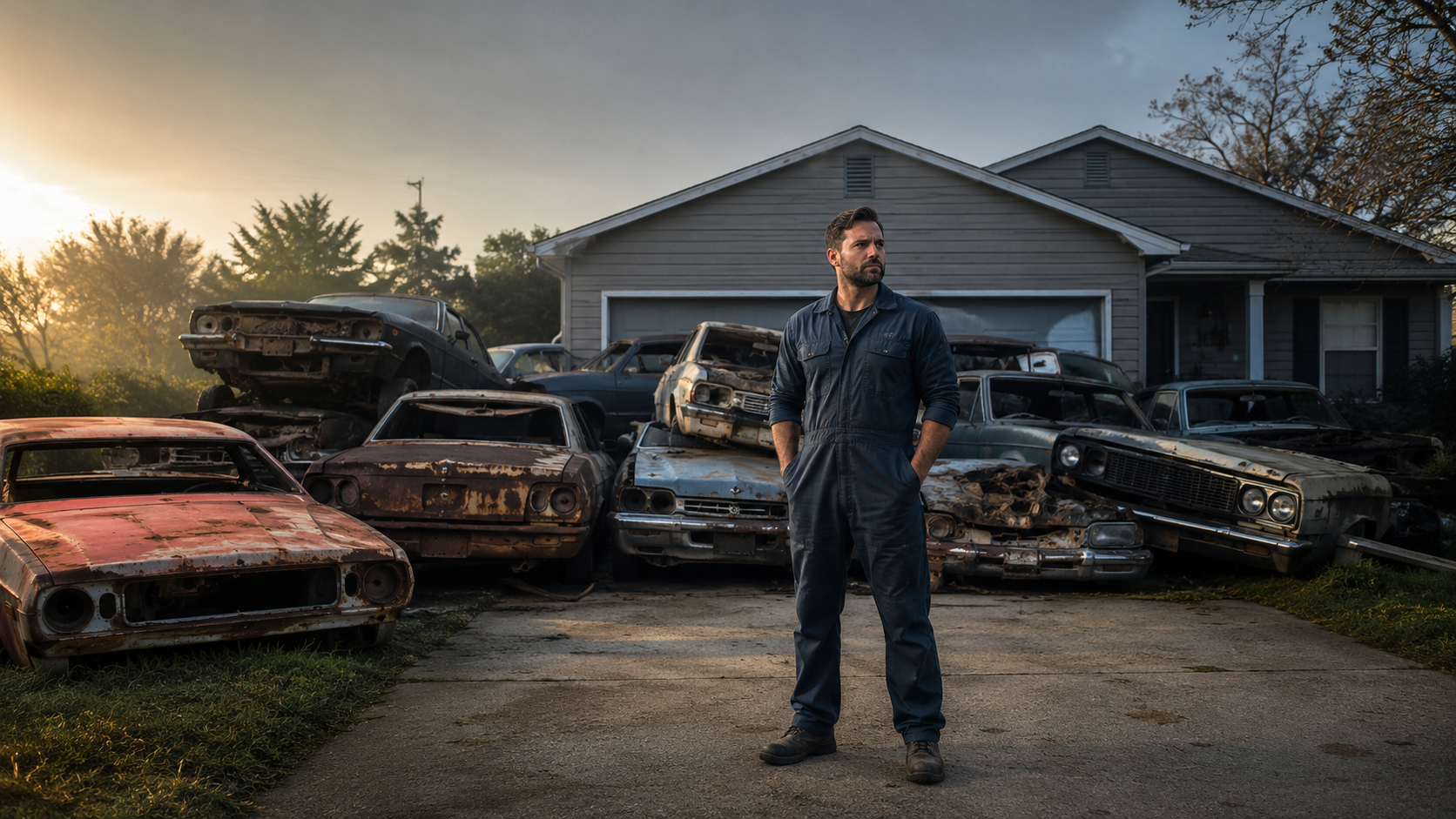
At 4:26 the next morning, the first tow truck rolled quietly onto Alder Road with its headlights dimmed. By 5:11, the second had arrived. By 5:48, twelve dead vehicles sat across Micah Vale’s driveway, front lawn, and curb like a rusted parade of contempt. Someone had tied a silver ribbon around the hood of the gutted muscle car.

June saw them first.

She had come downstairs with one sock on and one sock in her hand, heading toward the kitchen where Micah was making scrambled eggs. She stopped at the window.

“Dad?”

Micah turned from the stove. “What is it, Bug?”

June did not answer. She pointed outside.

Micah walked to the window with the spatula still in his hand.

For several seconds, he said nothing.

There were cars everywhere.

A red pickup with no doors. A green minivan with duct tape over the rear window. A silver sedan sitting crooked on a spare tire. Two SUVs with mud lines still visible inside the cabin. A white delivery van with cracked glass. The black muscle car shell with the silver ribbon shining on it like a joke told by someone who had mistaken cruelty for wit.

Their neighbor, Theo Bennett, came jogging across the street before Micah had even opened the front door.

“Micah,” Theo said, stopping near the curb. “What in God’s name happened?”

June stepped onto the porch behind her father, wearing her backpack and holding a piece of toast.

“Are those ours?” she asked.

Micah looked at the cars, then at the ribbon, then down the street where a woman had already lifted her phone to record.

“No,” he said. “Not yet.”

Theo stared at him. “What does that mean?”

Micah did not answer.

A cream-colored envelope had been taped to the windshield of the black muscle car. Micah walked over, pulled it free, and opened it. Inside was a typed note on Harrow Automotive letterhead.

Complimentary salvage opportunity. Since Mr. Vale seems so attached to old property, we thought he might enjoy more of it. Storage responsibility transfers upon delivery. Best wishes.

There was no signature.

There did not need to be.

Theo swore under his breath. “Celeste Harrow did this.”

June looked up at her father. “Is this because you told her no?”

Micah folded the letter carefully and slid it into his jacket pocket.

“Most likely.”

“Are we in trouble?”

He looked down at her, and the hardness in his eyes softened.

“No, Bug. We are inconvenient.”

June thought about that. “Is inconvenient bad?”

“For some people,” Micah said. “It is terrifying.”

By eight o’clock, half of Alder Road had come outside. Some people looked sorry for him. Some looked entertained. A teenager filmed the mess and uploaded it before breakfast with a laughing comment about Micah opening a junkyard overnight.

By noon, the video had spread through Briar Glen.

By three in the afternoon, Celeste Harrow watched it from her office, smiling as the comments rolled in.

Guess he should have sold.

Harrow always gets what she wants.

That mechanic is finished.

Celeste set the phone down.

“Give him a few days,” she told one of her managers. “Pride becomes expensive when everyone can see it.”

Leah stood near the door and felt sick.

But Micah did not give Celeste a few days.

He gave her one night.

After June fell asleep, Micah opened the garage and switched on the fluorescent lights. Theo came over with coffee, expecting to find rage or panic or a plan involving the sheriff. Instead, he found Micah kneeling beside the black muscle car, shining a flashlight into the empty engine bay.

“You need a lawyer,” Theo said.

“I know.”

“You also need every tow company in the county.”

“Maybe.”

Theo frowned. “Maybe? Micah, they dumped twelve dead cars on your property.”

Micah ran one hand along the rusted frame of the muscle car, then smiled without humor.

“No,” he said. “They delivered twelve pieces of evidence to my front door.”

Theo blinked. “Evidence of what?”

Micah stood slowly.

“That depends on how stupid they were.”

He started with the flood-damaged SUVs. By midnight, he had photographed VIN plates, title stickers, odometer readings, airbag modules, corrosion marks, cracked seals, repair labels, and hidden wiring damage. By two in the morning, he had matched one SUV to a customer complaint buried in a public arbitration record. By three, he found a second vehicle that had been sold as certified despite signs of flood exposure. By four, he found a pickup whose emissions components had been modified in a way that should never have passed inspection.

Theo watched him move from car to car with calm precision.

“How do you know where to look?” Theo asked.

Micah looked up from beneath the hood of the minivan.

“Because I designed the system they are pretending to follow.”

Theo lowered his coffee cup.

“What system?”

Micah did not answer right away.

For fifteen years, Micah Vale had allowed Briar Glen to believe he was simply a mechanic. It was not a lie exactly. He was a mechanic. But it was not the whole truth.

Before Briar Glen, before the gray house on Alder Road, before school lunches and quiet mornings and the small garage where he worked for hourly pay, Micah had been the founder of ValeTrace Systems, a vehicle diagnostics and salvage-chain verification platform used by insurers, auction houses, lenders, and compliance auditors across the country.

He had built the first prototype in a rented garage.

His wife, Elise, had turned it into a company.

Elise had been the one who understood that a broken machine could still tell the truth if someone knew how to listen. She built contracts, licensing agreements, investor decks, legal protections, and the future Micah had never been brave enough to imagine for himself.

Then she died in a highway crash when June was still a baby, returning from a patent mediation meeting that should never have taken place in bad weather.

After that, Micah walked away from the company.

Not completely. He kept the patents in a trust. He kept control of the core diagnostic framework. He allowed license payments to pass quietly through lawyers and accountants. But he left the boardrooms, the interviews, the conferences, and the industry that had swallowed the last years of his wife’s life.

He moved to Briar Glen and became ordinary on purpose.

People misunderstood quiet men.

They thought quiet meant weak.

They thought grief meant finished.

They thought a small house meant a small life.

Celeste Harrow had made all three mistakes.

The next morning, June found her father at the kitchen table surrounded by printed reports, vehicle records, photographs, and legal pads covered in notes. His eyes were tired, but his hands were steady.

“Did you fix them?” she asked.

“Not yet.”

“Can you?”

“Some.”

“Should you?”

Micah looked at her and smiled.

“That,” he said, “is the best question anyone has asked.”

June poured cereal into a bowl with serious concentration.

“If someone gives you garbage to be mean, is it still garbage?”

Micah looked out the window at the twelve vehicles.

“Depends who opens the hood.”

At nine fifteen, Micah walked into the office of Vivian Cross, a former state prosecutor who now worked above a pharmacy downtown. Vivian was in her sixties, wore red glasses, and had the kind of calm that made louder people nervous.

“You are the man with the cars,” she said.

“Yes, ma’am.”

“Harrow Automotive?”

“Yes.”

Vivian sighed. “Of course.”

Micah placed a folder on her desk.

“I need to protect my property. I also need these vehicles preserved before anyone moves them.”

Vivian opened the folder.

For five minutes, she said nothing.

Then ten.

At fifteen, she removed her glasses and looked at him.

“Mr. Vale, why does a garage mechanic have documentation that looks like a national compliance audit?”

Micah sat quietly.

Vivian waited.

Finally, he said, “Because I used to be ValeTrace Systems.”

Vivian’s expression changed.

The name meant something to her.

It did not mean much to most people in Briar Glen, but Vivian had prosecuted enough fraud cases to know the platform. ValeTrace was the technology behind several vehicle-history, salvage-verification, and compliance-tracking systems used across the industry.

“You are that Vale?” she asked.

Micah nodded once.

“I thought ValeTrace was sold.”

“Licensed,” Micah said. “Not sold.”

“To whom?”

“Several companies. Including one vendor that supplies Harrow Automotive’s inventory and compliance software.”

Vivian leaned back slowly.

“Celeste Harrow dumped twelve questionable vehicles on the property of the man who owns the diagnostic patent behind the system she uses to legitimize her inventory?”

“Yes.”

Vivian smiled.

It was not a friendly smile.

It was the smile of a lawyer who had just found a locked door with the key already in her hand.

“Well,” she said. “That was generous of her.”

By that afternoon, Vivian had filed a police report, contacted code enforcement before Celeste could weaponize it, issued preservation notices to Harrow Automotive, and arranged for an independent examiner to inspect the vehicles. She also demanded every record connected to the twelve cars: title histories, customer complaints, inspection reports, repair orders, auction transfers, emissions certificates, internal emails, and delivery instructions.

Celeste received the letter at 4:37 p.m.

Leah watched her read it.

The smile disappeared from Celeste’s face one line at a time.

“Who is Vivian Cross?” Celeste asked.

“A local attorney,” Leah said.

“Why is she asking for vehicle histories?”

Leah swallowed.

“Because you delivered the vehicles to Mr. Vale.”

Celeste looked up slowly. “Be careful with your tone.”

Leah lowered her eyes.

For the first time in two years, she heard uncertainty enter Celeste Harrow’s voice when Celeste called the company’s general counsel.

By Friday, Micah’s driveway had become the most famous place in Briar Glen.

At first, people came to stare. Some still laughed. Then they saw Micah working. He documented each vehicle with the patience of a surgeon and the suspicion of a detective. He tagged components, photographed hidden damage, logged corrosion, checked VINs against records, and built a timeline that grew uglier by the hour.

June sat on the porch doing homework and asking questions.

“What is title washing?”

“When someone tries to make a damaged car look clean on paper,” Micah said.

“What is odometer rollback?”

“Fraud, usually.”

“What is a flood vehicle?”

“A warning people are supposed to respect.”

“What is a certified pre-owned car?”

Micah paused.

“Sometimes a promise. Sometimes a costume.”

Theo nearly choked on his coffee.

On Saturday, a local reporter named Nora Ames knocked on Micah’s door. She expected him to refuse an interview. He almost did.

Then June looked up from her math worksheet.

“If you do not tell the truth,” she said, “they will tell the mean version louder.”

Micah looked at his daughter.

“That is uncomfortably wise.”

“I know.”

So Micah spoke.

He did not shout. He did not insult Celeste. He simply stood in front of the twelve cars and explained what had happened. Harrow Automotive had delivered them without consent. Some appeared to have troubling histories. His attorney had requested records. He would not be selling his home.

Nora asked why Celeste might target him.

Micah glanced toward June, sitting beside Theo on the porch.

“Because she thought I was easy to move,” he said.

The clip aired Monday morning.

By Monday afternoon, people were no longer laughing at Micah.

They were asking questions about Harrow Automotive.

That was when the first former customer called Vivian Cross.

Then another.

Then another.

A man named Raymond Holt said he had bought an SUV from Harrow that failed electronically three weeks later. A nurse named Priya Mason said her minivan’s airbags failed inspection after being sold as safe. A retired school principal said the mileage on his truck never made sense, but the dealership told him he was confused.

Vivian created a second folder.

Then a third.

By the end of the week, she had enough to contact state consumer protection investigators.

Celeste was no longer dealing with one mechanic.

She was dealing with a pattern.

Inside Harrow Automotive headquarters, the mood changed. Managers stopped laughing in the hallways. Doors stayed closed. Celeste held meetings with lawyers and finance people who no longer smiled when she entered the room.

At 10:52 one night, Leah sat alone at her desk staring at an email Celeste had forwarded.

Remove informal communications regarding Alder Road delivery. Keep only official transfer paperwork.

Leah read it three times.

For two years, she had told herself she was just an assistant. She scheduled meetings. She prepared files. She took notes. She did not make the decisions.

But excuses, like rust, spread when ignored.

Leah opened a private folder.

Then she began copying emails.

Not deleting.

Copying.

The next morning, Micah found a small padded envelope in his mailbox. No return address. Inside was a flash drive and a handwritten note.

She planned it. Do not let her erase it.

Micah brought it straight to Vivian.

The flash drive contained delivery instructions, internal messages, edited transfer documents, and one audio recording from the meeting where Celeste ordered the cars moved to Micah’s driveway.

Her voice was clear.

“Make it public. Make it humiliating. Make him understand that refusing me has consequences.”

Vivian listened once.

Then she said, “That woman has a rare gift for helping the other side.”

Micah almost smiled.

The lawsuit was filed the following Monday.

Micah Vale v. Harrow Automotive Group.

The claims included trespass, illegal dumping, harassment, interference with property, intentional infliction of emotional distress, and potential violations connected to title history, vehicle disclosure, and consumer protection law. Vivian also referred the records to regulators.

The story became local news.

Then regional news.

Then industry news, once someone discovered who Micah Vale used to be.

That part nearly broke the quiet life Micah had built.

Reporters called him the hidden millionaire mechanic. Websites wrote about the genius inventor living in a gray house. Strangers searched his wife’s name. People who had ignored him suddenly wanted quotes, photos, interviews, explanations.

June came home from school one day angry.

“Why does everyone care about money now?”

Micah was washing dishes. He turned off the faucet.

“Because money is easier to understand than grief.”

June sat at the kitchen table.

“Were you hiding because of Mom?”

Micah dried his hands slowly.

He had never lied to June about Elise. He had told the truth in small pieces, the way a person carries heavy things one box at a time. But June was older now, and older children ask sharper questions.

“Yes,” he said.

“Did the cars make you stop hiding?”

Micah looked through the window at the driveway, where several vehicles still sat under tarps as evidence.

“Maybe they reminded me that hiding does not always protect what you love.”

June thought about that.

“Celeste thought we were weak.”

“Yes.”

“Are we?”

“No.”

June nodded once.

“Good.”

Then she returned to her homework as if the matter had been settled.

Celeste tried to control the story.

She issued a statement claiming the vehicles had been delivered as part of a community salvage-training opportunity and that Micah had misunderstood the arrangement. She called the accusations false, opportunistic, and harmful to a family-owned company.

Vivian responded by releasing one sentence from Celeste’s recorded meeting.

Make him understand that refusing me has consequences.

The internet did the rest.

By the next morning, Celeste’s statement was gone.

But Celeste was not finished.

Two weeks before the first hearing, someone cut the lock on Micah’s side gate after midnight and tried to remove the black muscle car shell from the driveway. Theo saw headlights at 1:16 a.m. and called Micah before running outside holding a baseball bat he later described as “decorative.” The tow truck driver panicked and fled, leaving tire marks across the lawn.

Unfortunately for him, Micah had installed cameras.

The truck belonged to a subcontractor used by Harrow Automotive.

Vivian added attempted evidence tampering to the file.

Settlement discussions began the next morning.

The meeting took place in a neutral conference room downtown. Celeste arrived in a white suit, immaculate and cold. Micah arrived in jeans, boots, and a clean blue shirt June had chosen because she said it made him look “less like a tired forest ghost.”

Vivian sat beside him.

Celeste’s attorney began with polished regret. Harrow Automotive was prepared to offer money, vehicle removal, lawn repair, and a mutual non-disparagement agreement. Celeste watched Micah like she expected him to understand he was being given the privilege of escape.

Micah listened.

Then he said, “No.”

Celeste’s eyes narrowed.

Her attorney cleared his throat. “Mr. Vale, this is a significant offer.”

“No,” Micah repeated.

Celeste leaned forward.

“What do you want?”

Micah looked at her for a long moment.

“You still think this is about money.”

Celeste’s mouth tightened.

“Everything is about money.”

“That,” Micah said, “is why you are losing.”

Vivian slid a document across the table.

It was Micah’s counteroffer.

Celeste read it.

Her face hardened with every line.

Micah wanted a public apology. Full removal and environmental cleanup. Payment for property damage. Cooperation with state investigators. Compensation for customers harmed by misrepresented vehicles. Independent compliance monitoring. And the donation of Harrow Automotive’s unused training facility to create a nonprofit automotive repair and diagnostics school for single parents, veterans, and low-income students.

Finally, he required Harrow Automotive to license the updated ValeTrace compliance system at market rate under independent audit requirements.

Celeste looked up slowly.

“You want me to fund a school?”

“No,” Micah said. “I want you to fund accountability.”

“You arrogant little mechanic.”

Micah did not react.

That made her angrier.

“I built an empire,” she snapped. “You work in a garage.”

Micah leaned forward slightly.

“And still, you came to my driveway.”

The room went still.

Celeste’s attorney whispered her name, but she stood.

“This is over.”

Vivian gathered her papers.

“Then we will see you in court.”

They did.

The preliminary hearing drew reporters, former customers, local officials, and enough residents that the courtroom overflowed. Celeste sat at the defense table looking carved from glass. Micah sat quietly with Vivian. Theo sat behind him. June waited in the hallway with Nora Ames because Micah did not want her inside for the ugliest parts.

The judge reviewed the evidence.

Photographs. Delivery records. The unsigned note. The audio file. The attempted removal footage. Vehicle histories. Customer complaints. Internal emails.

Celeste’s team tried to argue the delivery had been a misunderstanding.

Then Vivian played the recording.

Celeste’s own voice filled the courtroom.

“Make it public. Make it humiliating. Make him understand that refusing me has consequences.”

Even the judge looked up.

The court granted Micah’s injunction, ordered preservation of all vehicle evidence, prohibited Harrow Automotive or its agents from entering his property, and referred several matters for further investigation.

It was not the final victory.

But it was the first public one.

Outside the courthouse, reporters shouted questions.

Micah ignored most of them.

Nora Ames asked, “Mr. Vale, what do you want people to understand?”

Micah stopped.

June had come out of the building and slipped her hand into his.

He looked at the cameras.

“I want people to understand that quiet people are not empty,” he said. “Sometimes they are just finished explaining themselves to people who refused to listen.”

That clip traveled farther than anything else.

Not because Micah was dramatic.

Because he was not.

The investigations lasted months. Harrow Automotive’s problems spread like rust under fresh paint. Regulators found title irregularities, improper disclosures, and patterns of misrepresentation. Customers filed claims. Two managers cooperated. Leah turned over the original records and resigned before Celeste could fire her. Later, she testified that Celeste had personally ordered the Alder Road delivery.

Celeste tried blaming subordinates.

It failed.

Her fourth dealership collapsed first. Then one lender withdrew. Then another. Inventory financing tightened. Customers avoided Harrow lots. Sales dropped. The empire did not explode in a single fireball. It lost oxygen slowly, one room at a time.

Meanwhile, Micah did something nobody expected.

He fixed the cars.

Not all of them. Some were too damaged and became evidence, then scrap. But six had enough value to become something else. With Theo, volunteers from the garage, and June supervising from a folding chair with a clipboard, Micah turned the junkers into training projects.

The red pickup became the first rebuild.

A former Army mechanic named Darius learned brake systems on it. A young mother named Lena learned diagnostics. A laid-off factory worker named Paul learned emissions repair. June labeled parts with masking tape and corrected grown adults when they misplaced sockets.

“What is she, the boss?” Darius asked one Saturday.

Micah glanced at June, who was frowning at a torque wrench.

“Assistant boss.”

June looked up.

“Temporary.”

By spring, the old warehouse near Alder Road had become the Vale Repair and Diagnostics Center. Not because Celeste agreed willingly, but because settlement became her only realistic alternative after regulators closed in. Her insurers pushed. Her lenders pushed harder. Her attorney finally told her the truth nobody in her company had dared say.

“You are not negotiating from strength anymore.”

The final settlement amount remained confidential, but everyone in Briar Glen knew the visible terms.

Celeste issued a public apology.

She stood behind a podium, dressed in black, with cameras in front of her and Micah standing off to the side beside Vivian. Her voice was controlled, but not victorious.

“Harrow Automotive acted improperly in delivering vehicles to Mr. Micah Vale’s property without consent. The action was unacceptable. I apologize to Mr. Vale, his daughter, and the Briar Glen community.”

It was not heartfelt.

Micah did not require heartfelt.

He required public.

The training center received funding. Affected customers received compensation. Harrow Automotive entered independent monitoring using updated ValeTrace technology. Celeste stepped down as chief executive and remained only a minority owner after restructuring.

Her name stayed on a few signs for a while.

Her control did not.

The day the first class began at the Vale Repair and Diagnostics Center, June insisted on cutting the ribbon. Micah tried explaining that adults usually handled ribbon cuttings. June said adults had caused most of the trouble, so maybe they should stand back.

Nobody argued.

She cut the ribbon with oversized scissors and a serious expression.

The crowd applauded.

Micah stood behind her with his hands in his pockets, overwhelmed in the quiet way grief sometimes changes into purpose when no one is watching. The building smelled of fresh paint, rubber mats, coffee, machine oil, and second chances. Along one wall hung a framed photograph of Elise Vale, smiling beside the original diagnostic prototype in their first garage.

Below the photo was a plaque.

For Elise, who believed repair was a form of truth.

Micah stood in front of it long after everyone left.

Theo found him there.

“She would have liked this,” Theo said.

Micah nodded, unable to speak for a moment.

Then he said, “She would ask why it took me so long.”

Theo laughed softly.

“Also true.”

The center grew faster than anyone expected. Local schools sent students. Veterans’ groups sent applicants. Community colleges asked for partnerships. Insurance companies sponsored diagnostic modules. Small dealerships signed up for compliance training because nobody wanted to become the next Harrow Automotive.

Micah taught the first course himself.

What a Vehicle Tells You Before It Fails.

His teaching style was exactly like his parenting style: quiet, precise, and allergic to nonsense.

“Cars do not lie,” he told the first class. “People lie about cars. Learn the difference.”

June sat in the back doing homework and raising her hand whenever she felt adults were missing the obvious.

Micah always called on her.

By the end of the first year, the center had placed dozens of graduates in jobs. By the second, it had expanded into compliance auditing and consumer protection training. Micah did not become flashy. He still woke early. He still packed June’s lunch. He still worked with his hands. He still lived in the gray house on Alder Road.

But the town changed around him.

People stopped calling him ordinary as if it meant small.

Celeste watched from a distance.

She had sold two of her three dealerships. Her glass office now belonged to someone else. Leah, once the silent assistant, became operations manager at the Vale center after Micah hired her with one condition.

“No hiding.”

Leah accepted.

Nearly two years after the junk cars appeared, Celeste walked into the training center.

The room went quiet.

Micah was under the hood of a rebuilt truck, explaining sensor data to two students. He looked up, wiped his hands on a rag, and waited.

Celeste looked different. Still elegant. Still controlled. But the polish around her had thinned.

“I wanted to see it,” she said.

Micah said nothing.

She glanced at the tool stations, the students, the repaired cars, the photograph of Elise on the wall.

“You turned my mistake into a monument.”

Micah shook his head.

“No. We turned your cruelty into something useful.”

Celeste flinched slightly.

Leah, watching from across the room, did not look away.

Celeste moved toward Elise’s photograph.

“Your wife?”

“Yes.”

“She was part of ValeTrace?”

Micah’s voice softened.

“She was ValeTrace. I built tools. She built the future around them.”

Celeste nodded slowly.

“I underestimated you.”

“You underestimated everyone who did not look profitable.”

That landed harder.

For once, Celeste did not answer immediately.

Then she reached into her purse and removed an envelope. Leah stiffened, but Celeste placed it on the workbench and stepped back.

“It is a donation,” Celeste said. “Personal. Not Harrow. No press.”

Micah did not touch it.

“Why?”

Celeste looked toward a student helping Lena rotate tires.

“My father started with one garage,” she said. “Then money came, and he forgot what the garage was for. I followed him farther than I should have.”

It was the closest thing to honesty Micah had ever heard from her.

He picked up the envelope and handed it to Leah.

“Put it in the scholarship fund.”

Celeste nodded.

As she turned to leave, June came out of the classroom carrying a stack of papers. She was older now, taller, still serious.

“You are Celeste Harrow,” June said.

Celeste stopped.

“Yes.”

“You made my dad angry.”

“I did.”

“He does not get angry often,” June said. “So that was inefficient.”

Theo coughed near the tool chest to hide a laugh.

Celeste blinked, then gave a small, surprised smile.

“You are probably right.”

“I usually am,” June said, and walked away.

Celeste left quietly.

Micah watched her go and felt no triumph. Triumph was too loud, too brief, too dependent on the person who had tried to hurt you.

What he felt was better.

Distance.

The kind that meant someone no longer controlled the weather inside your life.

Years passed.

The twelve junk cars became legend in Briar Glen. People still pointed at Micah’s driveway when telling visitors the story. The black muscle car, once decorated with a silver ribbon, was restored by the center’s first graduating classes and placed in the lobby. Its paint was deep midnight blue now. Its engine was rebuilt. Its interior was clean. A small plaque stood beside it.

Delivered as an insult. Rebuilt as evidence. Finished as proof.

June hated the plaque at first because she said it sounded dramatic.

Then she turned thirteen and decided drama was acceptable if properly edited.

Micah stayed Micah. He did not buy a mansion, though he could have. He did not buy a luxury truck, though Theo sent him listings every month. He repaired the porch, painted the garage, and replaced the damaged driveway after the legal case ended.

In the wet cement near the edge, June pressed a small wrench.

Beside it, Micah wrote Elise’s initials.

The ValeTrace patents eventually became part of a larger safety compliance platform used across the country. Micah licensed them broadly, but refused to sell outright. He had learned that ownership mattered, not for pride, but for protection. Celeste had reminded him of that in the ugliest way possible.

When June turned sixteen, Micah gave her the keys to the rebuilt muscle car.

She stared at him as if he had lost his mind.

“This is the evidence car,” she said.

“It is also very safe now.”

“It has too much history.”

“So do we.”

June ran one hand across the hood.

“Mom would have liked it?”

Micah smiled.

“Your mom would have driven it too fast just to scare me.”

June laughed, then cried, then hugged him with the sudden force of a child who was not fully a child anymore.

“I am glad you did not sell the house,” she whispered.

Micah held her tightly.

“Me too, Bug.”

That evening, June drove the car slowly down Alder Road with Micah in the passenger seat. Theo followed behind in his truck “for safety,” though everyone knew he simply wanted to witness it. Neighbors came outside to wave. The old oak tree threw long shadows across the yard. The training center lights glowed in the distance.

June kept both hands on the wheel.

“Dad?”

“Yeah?”

“When you said people did not know who you were, did you know all this would happen?”

Micah looked out at the road Celeste had tried to take, the town that had learned to look closer, and the future that had grown from twelve dead cars.

“No,” he said. “I only knew who I was not.”

June glanced at him.

“Who were you not?”

Micah smiled faintly.

“Someone easy to move.”

She nodded, satisfied.

They drove past the place where Harrow Motor Square was supposed to stand. They drove past the center where students learned engines, diagnostics, and the difference between broken and worthless. They drove past the repaired driveway, the gray house, and the porch light that still came on before sunset.

Nothing about Alder Road looked like Celeste Harrow’s dream anymore.

It looked like repair.

And in the quiet passenger seat of a car once meant to humiliate him, Micah Vale finally understood what Elise had known years before.

A machine can be broken and still hold value.

A person can be underestimated and still hold power.

A life can be interrupted, damaged, rusted by grief, and still be rebuilt into something stronger than it was before.

They Left Twelve Dead Cars in a Single Father’s Driveway to Break Him — But They Never Knew He Owned the Patent That Could Bring Their Company Down
16 unique archive photos that are worth seeing at least once in your life!