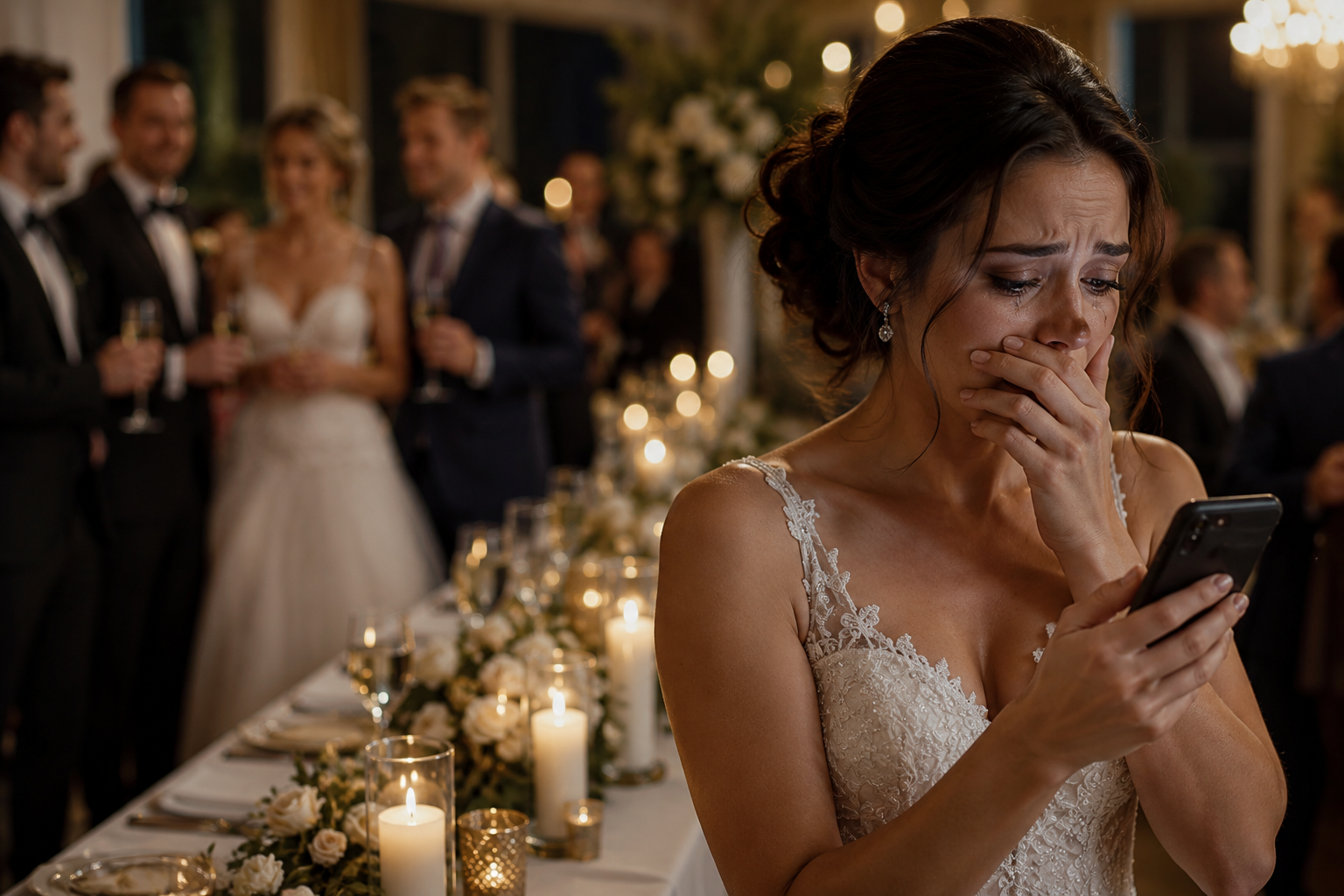
“I didn’t correct it,” she said.
It was the closest thing to honesty she had given me in years.
“Why?”
“Because it was easier.”
There it was.
Not pretty.
Not polished.
But true.
I looked down at my ring.
For most of my life, I had confused confession with repair. I thought if someone finally admitted the truth, the hurt would loosen.
It didn’t.
Sometimes truth only shows you the size of the room you had been locked inside.
“It was easier for you,” I said.
She started crying.
“I don’t know how to fix this.”
I believed her.
That was the sad part.
Maribel knew how to be admired. She knew how to be forgiven. She knew how to stand in the center of a room and let everyone else adjust the lighting.
But she did not know how to repair something without being applauded for trying.
“I don’t need you to fix it before my wedding,” I said. “I need my wedding to be a place where I don’t have to wonder who secretly wishes I were smaller.”
“That’s unfair.”
“No,” I said. “It’s late.”
She was quiet for a long time.
Then she said, “So that’s it?”
“No,” I said. “That’s just where I’m standing now.”
I hung up gently.
I cried afterward.
Of course I did.
People think boundaries feel powerful.
Sometimes they do.
Mostly, at first, they feel like grief wearing armor.
The guest cards arrived from the printer three weeks before the wedding.
They were cream-colored, simple, and beautiful. No gold foil. No dramatic calligraphy. Just names and words.
I sat at the dining table, checking each one.
Miles — For making loyalty look easy.
Grace — For opening the door before I knew how to knock.
Nina — For sitting beside me when silence was all I had.
Tessa — For choosing truth over comfort.
Mrs. Donnelly — For seeing the lonely girl behind the good grades.
Dr. Patel — For reminding me healers need care too.
Ben and Carla — For proving neighbors can become family.
Jonah watched me read them, one by one.
“Are you okay?” he asked.
I smiled through tears.
“For once, yes.”
We didn’t know then that the cards would be the thing that exposed everything.
Not because we meant them to.
Not because we sent them to newspapers or posted them online.
Because three days before the wedding, our photographer asked if she could take detail shots of the reception setup for her portfolio.
I said yes.
The hall looked magical that afternoon. Autumn light came through the tall windows. The long wooden tables were covered with linen runners, candles, copper leaves, and small cards waiting at each place. Above the seating chart, our planner had hung a simple sign:
MAKE ROOM FOR THE PEOPLE WHO MADE ROOM FOR YOU.
I loved it the second I saw it.
It felt like a sentence my younger self had needed.
Our photographer posted one photo that evening.
Just one.
It showed the seating chart and a few of the table names. No full guest names, no private notes visible. But the sign was clear. So were the empty spaces where a traditional family table might have been.
Her caption was innocent:
One of the most meaningful seating displays I’ve ever photographed. This couple named every table after the kind of love that actually showed up.
By morning, the photo had been shared thousands of times.
By noon, it was everywhere.
People wrote comments about chosen family. About being excluded. About parents who cared more about appearances than children. About siblings who smiled in pictures while leaving someone out of the room.
Then someone from my extended family commented.
Not Tessa.
Not anyone kind.
My aunt Linda wrote:
Funny how she talks about people making room when she refused to attend her own sister’s wedding.
That was all it took.
Tessa replied before I could stop her.
She didn’t refuse. She was told there was “no room,” then her mother told everyone she couldn’t get off work. There were 180 guests.
I stared at the screen, heart pounding.
For thirty seconds, nothing happened.
Then everything happened.
Screenshots spread.
Comments multiplied.
People asked questions.
Relatives began arguing publicly, which was both horrifying and deeply on brand.
Someone posted a photo from Maribel’s wedding program showing the full bridal party, extended family, and guest count printed on the back.
Someone else noticed I wasn’t in a single picture.
Then a cousin from my father’s side wrote:
I always wondered why Ava wasn’t there. Renee told us she chose work.
My phone became unusable.
Calls. Texts. Notifications. Unknown numbers. Messages from people I hadn’t spoken to since childhood.
Some were kind.
Some were curious.
Some were cruel.
But the truth had left the house.
And once truth gets outside, families like mine don’t know how to catch it without looking guilty.
My mother called eighteen times in one hour.
I didn’t answer.