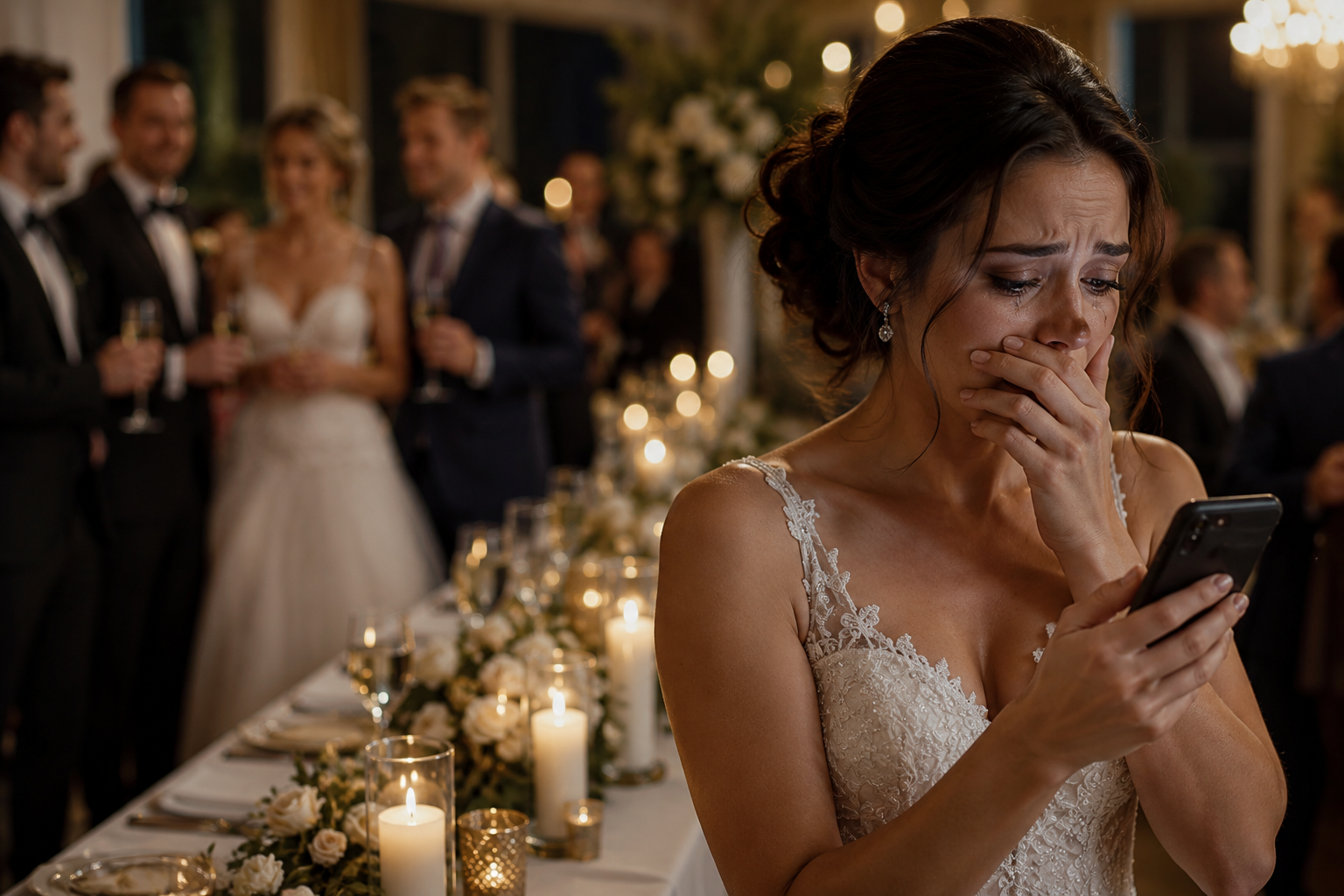
The first lie came wrapped in an apology.
Not a real apology. Not the kind that lowers its eyes and tells the truth. It came in the form of a pale blue text message from my mother, written with the soft, careful punctuation she used whenever she wanted cruelty to look like manners.
Ava, sweetheart, please don’t make this harder than it already is. The venue is very strict about numbers. Maribel is heartbroken, but there simply isn’t room.
I read it twice while standing in the hallway outside the hospital pharmacy, my lunch untouched in one hand and my badge still clipped crookedly to my scrub pocket.
There simply isn’t room.
For a second, I thought I had misunderstood.
My sister, Maribel, was getting married in six weeks. She was my only sibling. We had shared a bedroom until she turned thirteen and decided my breathing bothered her. I had braided her hair before school, covered for her when she came home late, helped her write her college application essay, and wired her six hundred dollars during her first year in Boston when she claimed her rent check had bounced by accident.
Now there was no room for me at her wedding.
I stared at the message until the words stopped looking like words.
Then another text appeared.
Mom:
Please be gracious about this. You know how sensitive Maribel is right now.
Sensitive.
That was the word my family used when Maribel cried.
When I cried, I was dramatic.
When Maribel made mistakes, she was overwhelmed.
When I made mistakes, I was selfish.
When Maribel wanted something, the family rearranged itself around her.
When I needed something, I was asked why I always had to make everything about me.
I locked my phone and leaned against the wall.
The hospital smelled like disinfectant, coffee, and old fear. Somewhere down the corridor, a machine beeped steadily. Nurses moved past me with the tired, practiced speed of people who understood that pain did not wait for anyone to be ready.
I should have gone back to work.
Instead, I opened my phone again and typed one sentence.
Me:
You are telling me my sister has no seat for me at her wedding?
My mother replied almost instantly.
Mom:
It isn’t personal.
That was the second lie.
It was always personal.
It had been personal since childhood, when Maribel got the bedroom with the big window because she was “more artistic,” and I got the smaller one near the laundry room because I was “practical.” It had been personal when my father missed my nursing school graduation because Maribel had a gallery opening for three paintings she didn’t even finish herself. It had been personal when my parents used the money my grandmother left “for both girls” to pay for Maribel’s failed boutique, then told me I was old enough to understand family priorities.
But this was different.
A wedding was not a misunderstanding.
A missing invitation was not an accident.
A chair with no name on it was a decision.
I didn’t answer my mother.
For the rest of my shift, I did what I always did. I checked vitals. I changed dressings. I calmed a frightened teenager before surgery. I laughed when Dr. Patel made a terrible joke about hospital coffee being classified as a controlled substance. I held an old man’s hand while his daughter drove through traffic to say goodbye.
No one at work knew that something inside me had gone very quiet.
Not broken.
Just quiet.
There is a kind of pain that screams.
There is another kind that simply closes the door.
That evening, when I got home, Jonah was on the kitchen floor fixing the loose cabinet hinge I had been pretending not to notice for three months.
He looked up the moment I walked in.
“What happened?”
That was Jonah.
He didn’t ask if something had happened. He knew.
He had known me long enough to recognize the version of me that smiled too carefully.
I dropped my bag beside the door and handed him my phone.
He read the messages without speaking. His jaw tightened once, near the end, but he didn’t explode. Jonah never performed anger for attention. His anger arrived quietly, like a storm seen far out over water.
After a moment, he set the phone on the table.
“I’m sorry,” he said.
The words almost undid me.
Not because they were dramatic.
Because they were simple.
My family always explained pain.
Jonah acknowledged it.
I sat on the floor beside him, still wearing my shoes, and pressed the heels of my hands into my eyes.
“She didn’t even call,” I said. “Mom did it for her.”
Jonah was silent.
“And the worst part is, I knew,” I whispered. “Some part of me knew they’d find a way to make me smaller that day. I just didn’t think they’d erase me completely.”
He reached for my hand.
“You’re not erased.”
I laughed once, bitterly.
“I’m not invited to my only sister’s wedding.”
“No,” Jonah said. “You’re not invited into the story they want to tell about themselves.”