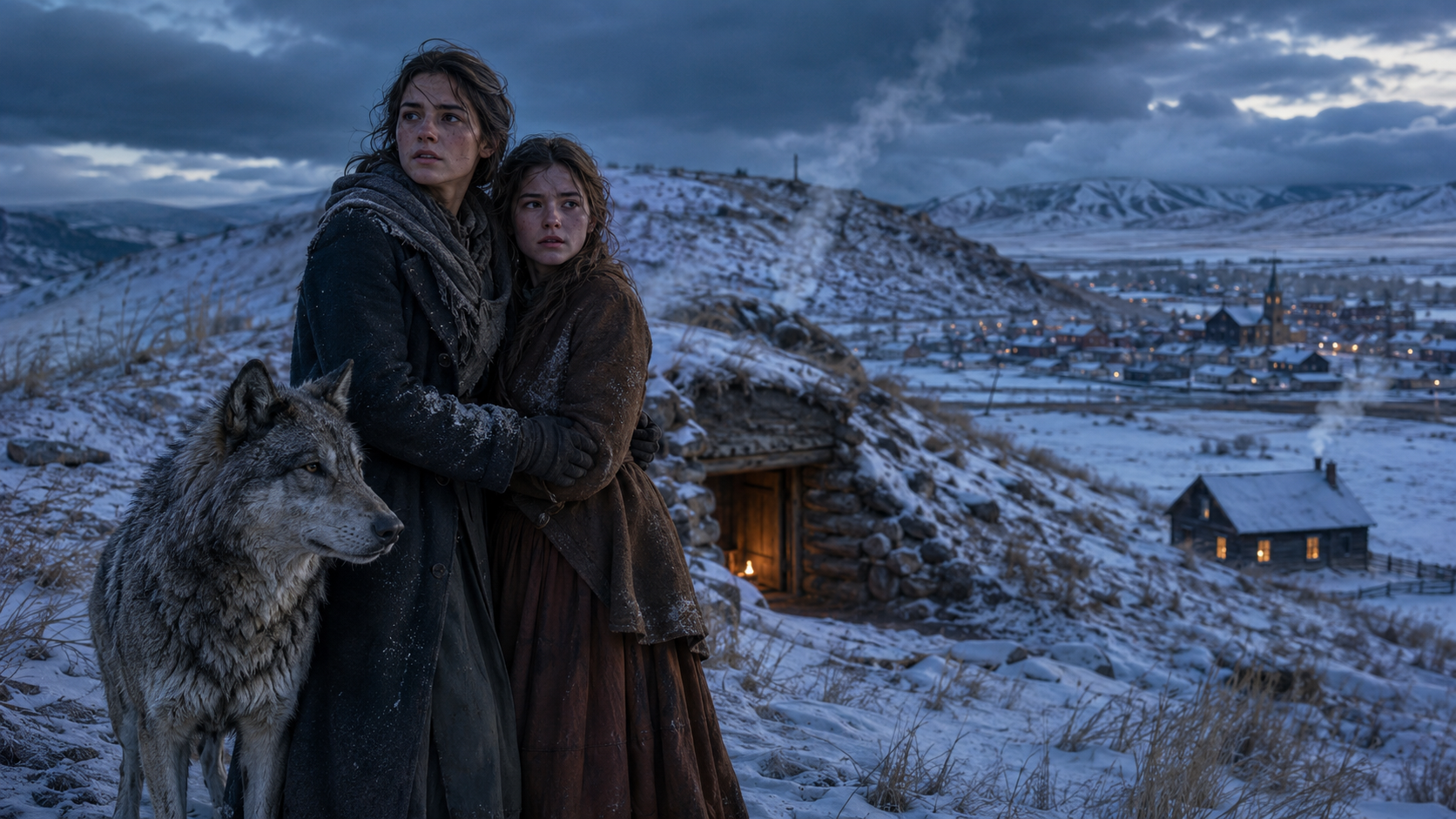
They Cast Two Orphan Sisters Into a Montana Winter — But the Home They Dug Beneath the Hill Became the Shelter That Exposed the Town’s Cruelest Lie

When Maren Vale first understood that a house could turn against its own children, she was standing in the kitchen where her mother had once sung over bread dough.

The stove was cold. The curtains were gone. Her father’s chair had been pulled close to the hearth, though no one had sat in it since the day Elias Vale was lowered into frozen ground. And Cora Whitlock, who had worn widow’s black for exactly twelve days before changing into a blue wool dress trimmed with stolen lace, stood beside the table with a paper in her hand and victory in her eyes.

“You and your sister will be gone before dusk,” Cora said.

Maren did not move.

Her younger sister, Lottie, stood at the pantry door with flour on her sleeve and fear held so tightly in her jaw it looked like anger. At sixteen, Lottie was all sharp elbows, dark braids, and wounded pride. She had cried only once since their father died, and even then she had done it outside behind the smokehouse, where she thought no one could hear.

“You can’t throw us out,” Maren said. “This is Papa’s house.”

Cora laid the paper on the table as if she were setting down the law itself.

“Not anymore.”

Maren looked at the document. She saw a seal. She saw a signature that pretended to be her father’s. She saw the name of Mr. Pritchard, the town clerk. She saw lines of neat ink declaring Cora the lawful keeper of the Vale farm, the livestock, the tools, the money, and the girls until they could be “placed.”

Placed.

Like broken furniture.

Lottie stepped forward. “Papa couldn’t sign anything. His right hand was swollen useless the last week. I fed him broth. I held the cup.”

Cora’s face hardened. “Grief makes girls dramatic.”

“It makes liars brave too,” Lottie snapped.

Cora lifted her hand and struck her.

The sound cracked through the kitchen.

Maren moved before she thought. She pushed herself between Cora and Lottie, one hand gripping the edge of the table.

“Touch her again,” Maren said, “and you’ll regret it.”

Cora smiled then. Not a loud smile. Not a wicked smile like in storybooks. Something worse. A small, practical smile.

She walked to the hearth, lifted the iron poker, and pointed it toward the door.

“You have one blanket each,” she said. “You may take your mother’s Bible, since it has no value. You may take that ugly dog if you insist on feeding another useless mouth. But nothing else belongs to you now.”

From beneath the table came a low growl.

Bram, their father’s old wolfhound, rose slowly. He was enormous, gray at the muzzle, scarred along one ear, and gentle with children. But he had never liked Cora. Now his lips pulled back just enough to show teeth.

Cora took one step away from him.

“Keep that beast from me,” she hissed.

“He knows a thief,” Lottie said.

Cora’s eyes flashed. “Careful, girl. By supper, I can have Sheriff Hask come here and swear you threatened me. I can say the dog lunged. I can say your sister tried to steal from me. Who do you think this town will believe?”

Maren knew the answer.

That was the worst part.

They left with two blankets, a dull knife, three matches in a tin, their mother’s Bible, a small sack of cornmeal Lottie had hidden beneath her coat, and Bram trotting beside them like a silent judge.

Cora stood on the porch wearing Elias Vale’s sheepskin coat.

Maren saw it and almost turned back.

Lottie did turn.

Maren caught her wrist.

“Don’t,” she whispered.

“She’s wearing him.”

“I know.”

“I hate her.”

“So do I. But we leave alive.”

They walked down the road while the first snow of November dragged pale lines across the Montana sky.

At the church, Reverend Silas Morrow listened with his hands folded and his eyes lowered in careful sympathy.

When Maren finished, he sighed as if the girls had brought him an inconvenience rather than a wound.

“Mrs. Whitlock is your stepmother by marriage,” he said. “A household cannot be governed by emotion. If there is a legal paper—”

“It is forged,” Maren said.

The reverend’s mouth tightened.

Lottie leaned forward. “Our father was dying. He couldn’t even lift his hand.”

“Accusations are dangerous,” Reverend Morrow said. “Especially against a respectable widow.”

Maren swallowed. “We don’t need you to fight for us. We need a corner to sleep in. Just for a few nights. I can scrub floors. I can mend altar cloths. Lottie can chop wood.”

The reverend looked past them toward the sanctuary.

“I cannot encourage rebellion against a lawful guardian. Return to Mrs. Whitlock. Humble yourselves. Ask forgiveness.”

Lottie stared at him. “For being robbed?”

“For speaking with bitterness,” he said.

Maren pulled her sister up before Lottie said something they could not afford.

At the mercantile, Thatcher Bell laughed so hard that the men near the stove turned to watch.

“Two girls tossed from a warm house in November,” he said. “Ain’t usually the innocent ones that get thrown out.”

His nephew, Owen Bell, leaned against the pickle barrel and grinned.

“Maybe the dog can dig them a den.”

Bram growled.

Owen’s grin died.

Maren kept her voice level. “We are asking for work.”

Thatcher tapped ash from his pipe. “What you’re asking for is trouble. Cora Whitlock showed me that paper this morning. Proper seal. Proper witness. You start calling folk forgers, and next time you won’t be asking for work. You’ll be asking a judge for mercy.”

A woman buying needles would not meet Maren’s eyes. A ranch hand stared at the floor. The clerk pretended to count nails.

By sundown, all of Coldwater Crossing knew the Vale girls had been put out.

By nightfall, all of Coldwater Crossing had decided that knowing was enough.

Their last hope lived beyond the east creek.

Grandfather Abram Keene had been born in Pennsylvania coal country and carried the mines in his lungs. Every breath whistled faintly. His back had a permanent bend from years of low tunnels and lower wages. He owned little: a narrow cabin, a rusted stove, a mule too stubborn to die, and thirty acres of rough hillside south of town that no farmer had ever wanted.

But he opened his door before Maren knocked.

“Took longer than I expected,” he said, looking past them into the snow. “That woman finally showed her teeth?”

Lottie ran into him first.

Abram held her with one arm and reached for Maren with the other.

For one night, he asked no questions.

He fed them beans and coffee. He gave Bram scraps. He let Lottie cry into a quilt that smelled of cedar smoke. Maren sat by the stove and watched the fire until her eyes burned dry.

In the morning, Abram spread old papers across the table.

“This was your mother’s,” he said.

Maren leaned closer.

A deed. Yellowed at the edges. Written in ink faded brown with years.

“South slope of Broken Antler Hill,” Abram said. “Thirty acres. Your mother’s land before she married Elias. He never worked it because stone eats the plow up there. Cora likely doesn’t know about it. Pritchard might, but he won’t care unless there’s profit in it.”

Lottie rubbed her swollen cheek. “What are we supposed to do with a hill?”

Abram’s eyes warmed with the faintest humor.

“Burrow into it.”

The sisters stared.

“A house?” Maren asked.

“A good one,” Abram said. “Better than most board houses in a Montana winter, if you build it right.”

He took a charred stick from the stove and drew on the tabletop: a slope, a cut beneath it, a door turned south, a smoke pipe hidden among stones, drainage lines, timber bracing, packed clay, sod roof.

“When I was young,” he said, “miners knew the earth better than preachers know scripture. Down deep, weather loses its temper. Cold can rage above you, but earth keeps its own mind. You dig in, brace well, keep water out, and you can live where the wind can’t find your bones.”

Lottie’s eyes sharpened.

“Could people see it?”

“Not if we choose the fold carefully.”

Maren understood then. “You mean hide.”

Abram’s face grew serious.

“I mean survive. Hiding is what you do when you have no plan. Surviving is what you do until the truth has teeth.”

They began two days later.

Broken Antler Hill looked useless from the road. Dry grass, scattered stones, sagebrush, and a crease in the slope where spring runoff had cut a shallow scar. But Abram walked it like he was reading a book. He marked a spot between two ribs of rock where the land folded inward and the entrance could be hidden by shadow.

“Fourteen feet wide,” he told them. “Twenty-three deep. Seven high. Don’t cheat height. A girl who has been pushed low by people ought to stand straight in her own home.”

So they dug.

The work was brutal.

Maren swung the pick until her hands blistered, split, bled, hardened, and split again. Lottie hauled dirt in a sled. Bram learned to pull a rope tied to a wooden drag, though sometimes he forgot the purpose and tried to chase jackrabbits while still harnessed. Abram sat wrapped in blankets on a stump, coughing into a cloth, correcting them whenever the angle was wrong.

“Drainage first,” he said. “A dry shelter is a living shelter.”

“Beam thicker,” he said. “Snow is quiet until it becomes heavy.”

“Door lower than pride, higher than flood.”

At night, the sisters returned to Abram’s cabin too tired to hate anyone.

That became a kind of mercy.

Hatred needed energy. Digging took all of it.

By late November, the hole had become a chamber. By the first week of December, it had a timbered roof. By the second, it had clay-packed walls and a narrow stove salvaged from an abandoned line camp. Abram showed them how to set the stovepipe through stone so smoke would emerge thin and broken, mistaken for ground mist if a person was not watching closely.

Coldwater Crossing heard about them anyway.

A cattleman named Hiram Pike saw fresh dirt near the hill and carried the story back to Thatcher Bell’s store.

“Those Vale girls are living like foxes,” he announced. “Dug themselves into a bank like animals.”

Owen Bell laughed. “They’ll be dead by Christmas.”

Men laughed because it was easier than wondering whether two girls had built something they could not.

Then the smoke appeared.

The first morning it rose, Maren was boiling coffee inside the earth house. The stove breathed softly. The clay walls held warmth. A square of oiled muslin over the small window glowed amber with sunrise.

Outside, thin gray smoke slipped from between stones above the roof and vanished into the cold.

A boy driving cattle saw it.

By noon, the town had a story.

By evening, it had a name.

Ghost smoke.

Thatcher Bell rode out with two men to find the entrance. They walked over the hillside for an hour and found nothing but grass, stone, and Bram’s paw prints leading in circles because Lottie had trained him well.

The next morning, smoke rose again.

That irritated the town more than silence ever could.

Because every gray thread climbing from Broken Antler Hill said the same thing:

The Vale girls had not died.

Not only had they not died — they were warm.

The first person to find the hidden entrance came in the form of a young man Maren did not trust.

Jonah Morrow, the reverend’s son, appeared at dusk with his hands raised and a bundle beneath one arm.

Maren had been carrying kindling when he stepped from behind the rocks.

“Don’t scream,” he said.

She drew the knife.

Bram appeared beside her like a storm with teeth.

Jonah swallowed. “I deserved that.”

“What do you want?”

“I brought glass.”

Maren did not lower the knife.

“For what?”

“For a proper window.”

“We don’t have one.”

“You could.”

He laid the bundle on the ground and backed away. Inside were three panes wrapped in burlap, chipped but whole.

Maren stared at them.

“Your father told us to crawl back to Cora.”

“I know.”

“Your father called us rebellious.”

“I know that too.”

“Then why are you here?”

Jonah looked toward town, where faint yellow lights trembled in the dark.

“Because my father knows rules better than mercy. Because I watched you and Lottie haul beams in sleet while men twice your size mocked you from a stove. Because when I saw the smoke, I thought I’d find desperation. Instead, I found a home built with more sense than anything in Coldwater Crossing.”

Maren did not know what to do with kindness when it arrived wearing the face of someone who had stood by while she suffered.

So she said, “Leave it there.”

Jonah nodded.

“I won’t tell.”

“Why should I believe you?”

“Don’t,” he said. “Just watch what I do.”

He left.

The glass stayed.

That was how help began: not as a parade, not as apology, but as small things left near the entrance at dusk.

A sack of beans from someone who did not sign her name.

Lamp oil.

A spool of wire.

A coil of rope.

A jar of goose fat to seal cracks.

Mrs. Tamsin Rook, the midwife, came openly one morning and ducked through the hidden door with a satisfied grunt.

“Well,” she said, looking around the warm room, the shelves, the stove, the table made from scrap planks, “I’ll be damned.”

Lottie raised an eyebrow.

“Ma’am?”

“I said what I said.” Tamsin tapped the packed wall. “My grandmother slept in a dugout in Kansas. Summer cool, winter steady. Folks get a few glass windows and think old ways are stupidity. Then weather comes and teaches school.”

She stayed for tea and left three blankets.

Dr. Ansel Reed came next under the excuse of looking for grouse. He listened to Abram’s chest, frowned, and stepped outside with Maren.

“He’s worse than he admits,” the doctor said.

Maren looked back through the doorway. Abram was showing Lottie how to carve wooden pegs.

“How long?”

Dr. Reed’s face softened.

“Long enough to see what you built. Not long enough for what he deserves.”

In January, Abram moved into the earth house for good.

They brought him by sled after Maren found him on his cabin floor, one hand against his chest, the fire nearly out. He was lighter than she expected. That frightened her more than the cough.

They placed him near the warmest wall. For two days he drifted in and out of fever, calling names from mines and wars and marriages long buried. On the third morning, he woke clear.

He studied the room.

The stove. The window. The walls. The shelves of dried beans, cornmeal, rabbit jerky, onions, potatoes, candles, and spare kindling. The braided rug Lottie had made from old shirts. Bram sleeping at the foot of his bed.

“This is fine work,” Abram whispered.

Maren sat beside him. “Don’t talk like goodbye.”

Abram smiled faintly.

“Girl, everything old men say is part goodbye.”

Lottie turned away.

Abram reached for her hand.

“Don’t spend your whole life sharpening grief,” he said. “A knife is useful. But not if you sleep holding the blade.”

Lottie’s mouth trembled.

“I don’t know how to be anything else.”

“Then build until you learn.”

The worst storm began with a quiet sky.

On the morning of February 18, Abram woke before dawn and asked Maren to open the inner door. A hard, metallic smell slid through the tunnel.

He closed his eyes.

“Bad weather.”

Lottie looked out. “Stars are clear.”

Abram’s voice dropped. “That’s when the mean ones sneak up.”

That same morning, Cora Whitlock came to take what remained.

The ghost smoke had become an insult she could not ignore. She had stolen the Vale farm, but people still whispered about the girls beneath the hill. Worse, someone had told her the hill might legally belong to their dead mother.

Cora had not endured two stepdaughters, a dying husband, and a year of pretending gentleness just to be beaten by a piece of land she had overlooked.

So she hired Rusk Gannet.

Gannet was a tracker from the northern line, a man with pale eyes and a reputation for finding people who did not want to be found. He watched Jonah ride east with supplies. He watched Tamsin Rook carry blankets. He watched Dr. Reed take the long road. Then he followed a half-covered track and found the hidden fold between the stones.

He did not go in.

He went to Cora.

By noon, she had gathered witnesses: Thatcher Bell, Reverend Morrow, Clerk Pritchard, Owen Bell, Hiram Pike, Rusk Gannet, and four men who told themselves they were rescuing wayward girls from a dangerous delusion.

Dr. Reed went because he did not trust any rescue that began with a crowd.

Jonah saw them leave and rode hard by another path.

Inside the earth house, Lottie was grinding corn when Bram lifted his head.

A growl rolled through the room.

Maren looked toward the tunnel.

Voices.

Not on the hill.

At the door.

Abram opened his eyes from the bed.

“How many?”

“Too many,” Lottie said.

Maren reached for the rifle hanging above the shelf.

Before she could lift it, Jonah stumbled through the entrance, breathless, cheeks raw from cold.

“They found you,” he said. “Cora brought half the town.”

Lottie grabbed the knife.

“Good.”

Maren looked at Abram.

The old man was not watching the door. He was listening to the wind.

Outside, Cora’s voice rang through the entrance tunnel.

“Maren Vale, come out at once. You are occupying disputed property and hiding goods that belong to my household.”

Lottie laughed, sharp and ugly.

“Goods. That means us.”

Thatcher Bell called next. “No one wants trouble. Step out and we’ll handle this civilly.”

Maren stood behind the inner door, rifle pointed down.

“Civilly?” she called. “Like when you laughed us out of your store?”

Silence.

Then Clerk Pritchard spoke. “The filed document gives Mrs. Whitlock authority.”

Jonah stepped forward.

“And the deed gives this hill to their mother’s daughters. I’ve seen it.”

Murmurs rose outside.

Cora’s voice hardened. “That deed is irrelevant.”

Abram coughed from his bed.

“Come inside and say irrelevant to my face, Cora.”

No one answered.

Then the wind hit.

It slammed into the hillside so suddenly the outer tunnel filled with snow like flour thrown from a sack. Someone shouted. A horse screamed. The temperature seemed to fall with one breath.

Dr. Reed yelled, “Back to town!”

But the town had disappeared.

The blizzard swallowed the world.

Within minutes, the air outside turned white and violent. Men lost sight of one another at ten paces. Horses tore loose. The sky vanished. The road vanished. Sound became wind, fear, and the dull thud of bodies stumbling into drifts.

Inside, Lottie dropped the bar across the door.

“Let them freeze.”

Maren stood still.

Through the thick wood she heard pounding. Shouting. A woman’s voice stripped of pride.

“Maren! Help me!”

Cora.

Lottie’s face twisted. “No.”

The pounding weakened.

Jonah looked at Maren but did not speak.

Abram struggled upright.

Maren rushed to him. “Don’t.”

He pushed her hand away with what little strength remained.

“Listen,” he said. “A shelter that only opens for friends is just another cruel house with better walls.”

Lottie’s eyes filled.

“They came to steal it.”

“Yes,” Abram said. “And the storm came to steal them. Decide which thief you want to resemble.”

Maren stared at the door.

She remembered Cora wearing her father’s coat.

She remembered Thatcher laughing.

She remembered Reverend Morrow telling two homeless girls to apologize for being wronged.

She remembered every window in town glowing warm while she and Lottie walked through snow.

Then she remembered her father, who had once carried food to a neighbor who had cursed him in public, because hunger was real even when decency was not.

Maren lowered the rifle.

“Lottie.”

Her sister shook her head.

“I will not forgive them.”

“I’m not asking you to forgive them. I’m asking you to help me keep children from burying parents.”

That reached where anger could not.

Lottie wiped her face with her sleeve, cursed, and lifted the bar.

They opened the door.

Snow exploded inward.

Jonah and Maren dragged Cora first. She collapsed over the threshold, lips blue, hair frozen white at the edges. Lottie hauled Reverend Morrow by his coat. Dr. Reed shoved Thatcher Bell through next. Hiram Pike crawled in on his hands and knees. Owen Bell came after, crying from pain, one ear white with frostbite.

More arrived.

Not all.

But enough.

By midnight, thirty people crowded the earth house they had mocked.

By morning, Maren and Jonah had tied ropes around their waists and gone into the storm to pull in anyone close enough to save. Bram found two children under an overturned wagon board and barked until Lottie dug them free with bleeding hands. Dr. Reed worked without sleeping. Tamsin Rook, found half-buried near the creek road, took over boiling water the moment her fingers could bend.

For eight days, the blizzard held Coldwater Crossing prisoner.

The earth house was too small for dignity. That was the first thing the town lost.

Men who had laughed at Maren slept on her floor. Women who had whispered against Lottie took broth from her hands. Children huddled under the sisters’ blankets while Bram moved among them like a gray guardian.

Maren organized everything because no one else could think clearly.

Children nearest the stove. Elderly along the back wall. The sick where Dr. Reed could reach them. Able-bodied adults in shifts: melt snow, feed fire, clear tunnel, ration food, check frostbite, hold the rope line.

No one ate enough.

Everyone ate.

The chimney drew. The walls held. The roof did not break.

On the fourth night, little Nell Pike began crying because her hands hurt as they thawed. Bram lowered his huge head into her lap.

“Is he a wolf?” she whispered.

Lottie handed the child a cup of broth.

“Only when necessary.”

Several adults looked away.

On the sixth night, Clerk Pritchard’s fever rose.

Fever has a strange loyalty to truth. It digs under manners. It opens locked drawers in the mind.

Maren was sitting beside Abram when she heard her father’s name.

Pritchard tossed beneath a blanket near the stove.

“Elias wouldn’t sign,” he muttered. “Wouldn’t do it. Said the girls kept the house. Said Cora had enough.”

Maren turned slowly.

The room quieted.

Pritchard’s eyes were open but seeing another place.

“She pressed his hand to the pen. I guided it. He was nearly gone. Maybe already gone. Morrow signed because Thatcher said it was settled. Thatcher said land troubles scare buyers. Clean papers. Clean town.”

Cora pushed herself upright against the wall.

“He’s fevered.”

Pritchard began to cry.

“You paid me.”

Cora’s face went white.

“You lying coward.”

“You paid me with Elias’s money. Said if the south hill ever proved useful, I’d have a share for keeping quiet.”

A gasp moved through the shelter.

Maren looked at Cora.

“You knew about Mother’s land.”

Cora’s mouth trembled, then hardened.

“Your father was going to leave me scraps.”

Abram’s voice came weak but sharp from the bed.

“He was going to leave you a widow’s portion. Not their lives.”

Cora’s eyes burned.

“I married into a house haunted by a dead woman. Her dishes. Her quilts. Her daughters staring at me like I was dirt on the floor. I worked. I smiled. I waited. And when Elias died, I chose not to be cast aside.”

Maren stared at her.

“So you cast us out first.”

“I survived.”

Lottie stood so fast Jonah caught her arm.

“You call this surviving?”

Cora looked around the packed room: the townspeople she had gathered to witness the sisters’ humiliation, now witnessing hers.

The truth did not explode.

It settled.

That was worse.

Cora had forged the paper. Pritchard had filed it. Thatcher Bell had known enough to keep quiet because a railroad man had once asked questions about the south ridge. Reverend Morrow had signed without seeing Elias alive because rules were easier than doubt. Others had suspected and chosen silence because two orphan girls were a small price for peace.

Coldwater Crossing had not merely failed the Vale sisters.

It had spent them.

Thatcher Bell stood slowly. Frostbite had made his face gray and old.

“I knew the paper was wrong,” he said.

No one moved.

“I told myself it was not my affair. I told myself girls need authority. I told myself Cora would keep the farm working and the town steady. Truth is, I kept quiet because a clean document kept business simple.”

Maren said nothing.

Thatcher removed his hat though there was no room for ceremony.

“If I live through this, I will testify.”

Lottie’s voice was cold.

“And that makes you noble?”

“No,” Thatcher said. “It makes me late.”

Reverend Morrow covered his face.

Jonah looked at his father. “You signed it.”

The reverend’s voice broke.

“Yes.”

“You sent them back to her.”

“Yes.”

“Why?”

Reverend Morrow lowered his hands.

“Because mercy required courage, and I mistook obedience for goodness.”

No one spoke for a long time.

Outside, the storm screamed over the buried roof.

Inside, something colder than winter began to crack.

When the blizzard finally loosened its grip, Coldwater Crossing was nearly unrecognizable.

The church steeple had fallen. Two barns were gone. The mercantile roof had caved under snow. Smoke rose from only a handful of chimneys. Twenty-four people had died, some within sight of doors they never reached.

The earth house had saved thirty-seven.

Law came slowly, as it often does where roads vanish beneath snow. But it came.

Dr. Reed testified.

Tamsin Rook testified.

Jonah testified.

Thatcher Bell testified, and the words seemed to cost him more than frostbite had.

Pritchard confessed fully in exchange for prison instead of a rope. Reverend Morrow stepped down from his pulpit before anyone asked him to. Cora Whitlock was charged with fraud, theft, and unlawful dispossession. By the time spring thawed the creek, she had stopped calling herself a victim aloud, though her eyes still carried the old complaint against a world that had not given her everything.

Maren did not hate her as cleanly as Lottie wanted.

That became one more thing the sisters argued about.

“She deserves nothing,” Lottie said at their father’s grave.

“She deserves the truth,” Maren replied. “After that, the law can keep her.”

“You’re too soft.”

“No,” Maren said. “I’m trying not to let her finish making me.”

Lottie looked toward Broken Antler Hill, where a thin line of smoke rose in the sunset.

“I don’t know how to stop being angry.”

Maren put an arm around her.

“Then don’t stop all at once.”

Abram Keene died in April, after the first green showed through the prairie grass.

He lived long enough to see the judge declare the south hill legally Maren and Lottie’s. He lived long enough to watch Thatcher Bell and Hiram Pike bring shovels to the schoolyard and begin digging the town’s first public storm cellar. He lived long enough to hear men who had mocked the sisters ask Lottie how thick a beam ought to be.

That pleased him greatly.

On his last evening, he asked to be carried to the entrance of the earth house.

Maren, Lottie, Jonah, and Dr. Reed lifted his bed into the golden light. Bram lay across his feet. The prairie stretched before him, scarred by winter, bright with thaw.

“You built well,” Abram whispered.

Maren held his right hand. Lottie held his left.

“We had a good teacher,” Maren said.

Abram smiled.

“Then teach.”

Lottie wiped her cheek with the back of her wrist.

“Everyone?”

“Especially fools,” Abram said. “They need it most.”

She laughed through tears.

He turned his head toward the hidden doorway.

“Remember this. Earth holds what people forget. Warmth. Patience. Weight. If you build with spite, water gets in. If you build with pride, wind finds you. Build with sense.”

At sunset, his breathing slowed.

Bram lifted his head once, then laid it down again.

Abram Keene died with smoke rising behind him.

They buried him beside their mother and father on the hill Cora had thought worthless.

The next winter, Coldwater Crossing was ready.

Not proud.

Not comfortable.

Ready.

Three public shelters had been dug into hillsides. The school had a storm cellar. The rebuilt church had earth-packed walls and a lower roof. Every new family was shown the rope lines, the emergency food stores, and the south hill where the Vale sisters had lived when no one would open a door.

Thatcher Bell never again laughed at work he did not understand.

When strangers asked about the thin smoke sometimes rising from Broken Antler Hill, he would say, “That smoke saved us because two girls knew more than a town full of men. Ask questions before you mock. Better yet, bring a shovel.”

Lottie became the best shelter builder in three counties.

She took contracts from ranchers, schools, churches, and railroad camps. She spoke plainly, charged fairly, and frightened lazy men into competence. When anyone called her difficult, she smiled.

“Difficult things stand longer.”

Bram lived to be old, gray, and deeply spoiled. When he died, Lottie buried him beside Abram and carved his marker herself:

BRAM — HE GUARDED THE DOOR WHEN PEOPLE WOULD NOT.

Jonah Morrow married Maren six years after the blizzard at the entrance of the earth house. His father attended, seated in the back, older and quieter, grateful to be allowed near joy he had not earned. Tamsin Rook performed the ceremony with a Bible in one hand and a look that dared anyone to object.

“Love,” she said, “is a shelter. It needs labor, humility, warmth, and a roof strong enough for ugly weather.”

Lottie groaned.

“That is the least romantic blessing ever spoken.”

Maren laughed, and Jonah looked at her as if that laughter alone could carry him through winter.

Years passed.

Coldwater Crossing grew. The dirt road became a wagon road, then a graded road. Telegraph poles appeared. Children who had never known the great blizzard began to think of it as a story adults used to make them stack firewood.

Whenever Maren heard that tone, she took them to Broken Antler Hill.

Even as an old woman, she could still feel the air change at the entrance. Aboveground, weather had its moods. Beneath the hill, the earth kept its old promise.

The shelter remained.

Every winter morning, someone lit the stove. Every winter morning, smoke rose from the stones.

People stopped calling it ghost smoke.

They called it the Vale smoke.

It meant preparation. It meant wisdom hidden under plain grass. It meant the kind of strength people do not recognize until pride is freezing outside the door.

On the last morning of Maren’s life, her granddaughter helped her to the hill.

Dawn spread pink across the Montana prairie. Frost silvered the grass. The air was cold enough to make breath visible. From the old chimney hidden among stones, a thin gray line climbed into the quiet sky.

Her granddaughter squeezed her hand.

“Do you see it, Grandma?”

Maren smiled.

“I see it.”

The smoke trembled upward, fragile and stubborn.

“It was your great-grandfather Elias,” Maren whispered. “It was your great-grandmother. It was Abram coughing by the stove and Lottie swinging a pickaxe with frozen tears on her face. It was Bram at the door. It was Jonah bringing glass when the world brought judgment.”

The girl leaned closer.

Maren’s voice softened.

“And someday, it will be you. Keep the fire burning when people laugh. Especially then.”

The sun rose over Broken Antler Hill.

The smoke climbed higher.

And beneath the earth, the old shelter waited — warm as mercy, strong as memory, ready for the next storm.

They Cast Two Orphan Sisters Into a Montana Winter — But the Home They Dug Beneath the Hill Became the Shelter That Exposed the Town’s Cruelest Lie
Amazing girl. Pictures show Shayk’s nine-year-old daughter Shayk with the Hollywood star