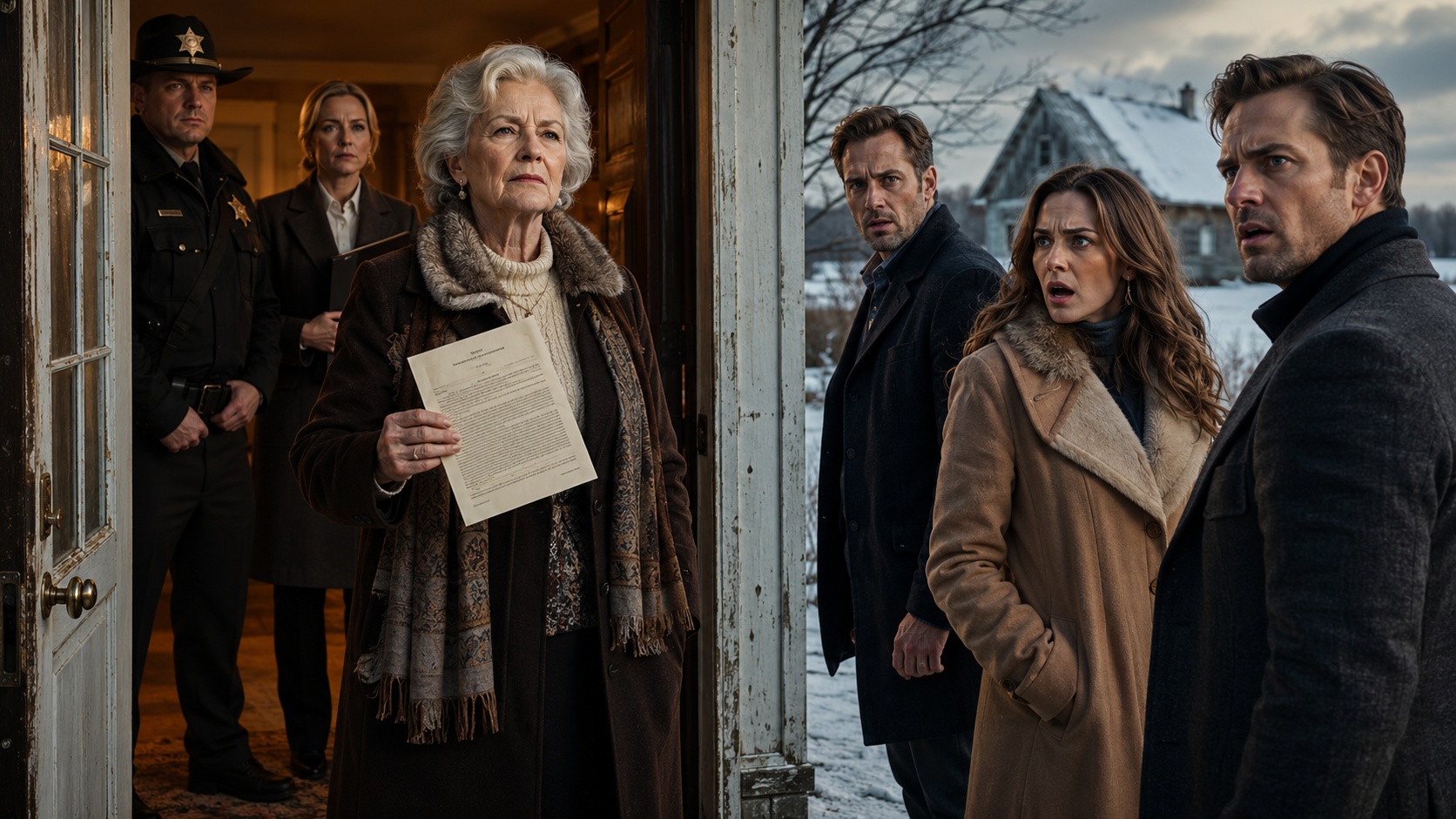
He cried harder.
“I can fix it.”
“Maybe.”
He looked up.
“Will you let me?”
Eleanor studied him.
Her youngest.
Her softest child.
Her most easily led child.
Also a grown man who had chosen comfort over conscience.
“I will not give you money,” she said.
He nodded quickly. “I don’t want money.”
“I will not change the trust.”
“I know.”
“I will not protect you from the legal consequences of what you helped do.”
His face twisted.
But he nodded.
Eleanor leaned back.
“If you want to fix something, start with the truth. Not with me. With yourself.”
Owen wiped his face with his sleeve like he had when he was little.
“I’m sorry, Mom.”
“I know.”
“Do you hate me?”
That was the first question that sounded like her son.
Eleanor closed her eyes briefly.
When she opened them, they were wet.
“No,” she said. “That would be easier.”
He broke then.
Not dramatically.
Quietly.
Completely.
And Eleanor, after everything, placed one hand over his.
Not forgiveness.
Not permission.
Just proof that love could still exist without surrendering the house.
Outside, Derek’s SUV roared down the driveway.
Natalie’s car followed more slowly.
Owen stayed for another hour.
He signed a statement.
He answered questions.
He left without asking for anything.
That alone felt like a beginning.
By late afternoon, the snow had stopped.
Sheriff Price left with copies of the documents. Attorney Crowe packed her folder and paused near the door.
“You did well today,” she said.
Eleanor gave a small smile.
“I don’t feel well.”
“No,” Vivian said. “I suppose justice rarely feels clean while it’s happening.”
After everyone left, Eleanor stood alone in the sitting room.
The house was quiet again.
But it was a different quiet.
For years, silence had sat around her like neglect.
Now it felt like space.
She walked to the window and watched the fields turn blue in the evening light.
The land was still hers to live on.
No developer could flatten the barn.
No child could trade the pond for debt relief.
No forged signature could carry Henry’s work into someone else’s profit.
A week later, Derek hired an attorney.
Two weeks later, North County opened a formal investigation.
Three weeks later, Natalie sent a letter.
Not a text.
A letter.
It arrived in a cream envelope with Eleanor’s name written carefully on the front.
Inside, Natalie admitted what she had done, what she had known, what she had ignored. She did not ask for money. She did not ask to be added back into the will. She wrote only one sentence that Eleanor read three times.
I thought being your daughter meant I could always come back, but I forgot that coming back is not the same as never leaving.
Eleanor folded the letter and placed it in Henry’s walnut box.
Not with the evidence.
With the old photographs.
A month later, Owen began volunteering at the senior center in town.
Eleanor did not praise him for it.
She also did not mock him.
She let good actions remain actions, not performances.
Derek did not call.
That hurt.
Then it hurt less.
Then, one morning in April, Eleanor walked the fence line with a thermos of coffee and realized she had gone almost an entire hour without thinking of him.
The guilt came immediately.
Then relief.
Then grief.
Then peace.
Healing, she discovered, was not one feeling.
It was a room full of feelings learning to stop fighting.
By spring, the Briar Hill Senior Advocacy Foundation had its first case.
A seventy-eight-year-old woman named Ruth came to the farmhouse with a plastic grocery bag full of bank statements and trembling hands. Her nephew had been taking her pension checks. Her church friend had driven her out to Briar Hill because she heard “a lady there knows what to do.”
Eleanor made coffee.
Vivian reviewed the papers.
Owen, who happened to be repairing a porch step that day, stayed outside until Ruth left because he understood the sight of him might make her uncomfortable.
That was the first thing Eleanor noticed.
He was learning when not to enter the room.
Progress, sometimes, was simply not making yourself the center of someone else’s pain.
That evening, after Ruth had gone and the porch step was fixed, Eleanor stood beside Owen in the yard.
The sunset turned the fields amber.
Owen wiped sawdust from his hands.
“Dad would’ve liked this,” he said quietly.
Eleanor looked at him.
For once, the mention of Henry did not feel like theft.
“Yes,” she said. “He would have.”
Owen nodded.
Then he said, “I’m still sorry.”
“I know.”
“I’ll probably be sorry for a long time.”
“You should be.”
He accepted that.
And because he accepted it, Eleanor finally gave him something softer.
“Come for supper next Sunday.”
Owen froze.
“Really?”
“One supper,” she said. “No promises after that.”
He smiled through tears.
“One supper is enough.”
Eleanor looked across the land.
“No,” she said. “It isn’t. But it’s a start.”
The farmhouse windows glowed behind them.
The barn stood steady in the distance.
The old oak waited for leaves.
And beneath their feet, the land remained exactly where Henry had left it.
Not sold.
Not stolen.
Not surrendered.
Protected.
Like Eleanor.
Like every woman who finally learns that a locked door is not bitterness.
Sometimes it is the first honest boundary love has ever had.