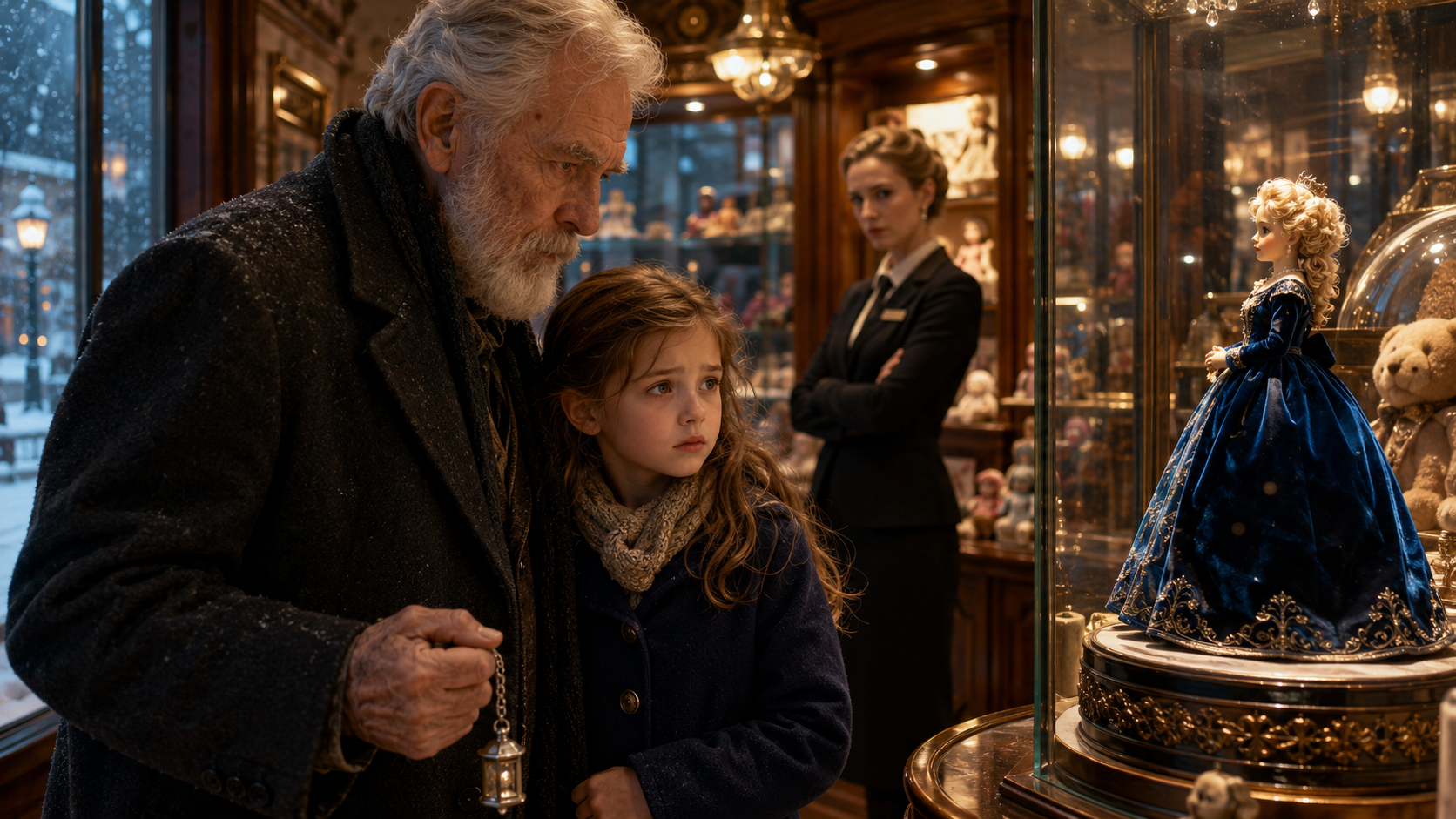
Nathaniel asked Elsie to draw the foundation’s symbol.
She drew a bluebell under a lantern.
Samuel cried when he saw it.
On opening day, the line outside the flagship store wrapped around the block. Parents came with children. Former employees came with flowers. Women who had once worked beside Mara came to tell stories Samuel had never heard.
One said Mara kept peppermints in her drawer for interns.
Another said Mara fixed a broken bear for her little boy during a visit to the design room.
Another admitted she had believed Malcolm because it was easier.
Samuel thanked the first two.
He walked away from the third.
Forgiveness, he had learned, was not something people were owed because they finally felt uncomfortable.
Inside the store, Elsie stood beside a display of Blue Lullaby dolls wearing a small name tag Nathaniel had made for her.
Elsie Reed — Keeper of the Song.
She took the job seriously.
Whenever children came close, she turned the little brass crank and let the melody play.
Then she told them, with her chin lifted, “My mommy made this song.”
Not once did she whisper.
Not once did she look ashamed.
That was the ending Samuel wanted more than money.
Near closing time, he noticed a woman standing by the entrance.
The pearl earrings were gone.
So was the polished certainty.
It was the saleswoman who had accused Elsie that first day.
Elsie saw her too and moved closer to Samuel.
“That’s the mean lady,” she whispered.
“Yes,” Samuel said.
The woman approached slowly.
Nathaniel began to step between them, but Samuel lifted a hand.
Let her come.
She stopped a few feet away.
“I’m sorry,” she said.
No excuse.
No speech about policy.
No explanation about stress or training or pressure from management.
Just sorry.
She looked at Elsie.
“I was cruel to you. You didn’t deserve it.”
Elsie stared at her.
Samuel did not tell the child what to say.
Adults had forced enough feelings onto her family.
After a moment, Elsie said, “You made me cry.”
The woman’s eyes filled.
“I know.”
“My mommy said people who make children cry should have to sit alone and think about it.”
Somewhere behind them, a cashier coughed to hide a laugh.
The woman nodded, tears spilling down her cheeks.
“Your mommy was right.”
Elsie considered her carefully.
Then she said, “Okay.”
Not forgiveness.
Not friendship.
Just okay.
For eight years old, that was plenty.
That night, Samuel and Elsie walked home under Christmas lights. Snow drifted down in soft silver pieces, settling on Elsie’s hair and the shoulders of Samuel’s old coat.
He could have called a car now.
He could have bought a warmer coat that very afternoon.
But Elsie wanted to walk, and Samuel had spent too many years rushing through sadness to refuse a peaceful moment.
She carried her own Blue Lullaby doll in one arm and held his hand with the other.
“Grandpa,” she asked, “was Mommy famous?”
Samuel thought about it.
Famous was a strange word.
Fame was cameras, headlines, a name printed on boxes, strangers saying they had always known.
Mara had deserved those things.
But they were not what made her matter.
“Your mommy was loved,” he said.
Elsie frowned.
“That’s not what I asked.”
Samuel chuckled softly.
“No. It isn’t.”
He looked at the snow shining under the streetlights.
“Yes,” he said. “She’s famous now.”
Elsie smiled.
“Good.”
Then she added, “But she was always famous to me.”
Samuel stopped walking.
The world blurred.
Elsie tugged his hand.
“Grandpa?”
He knelt in the snow and hugged her gently, carefully, because she was still the last living piece of his daughter’s song.
But maybe, he thought, the heart had more hidden rooms than a man knew.
Maybe some things survived like letters inside music boxes, waiting for a child’s hand to turn the key.
One year later, The Velvet Lantern held a public memorial for Mara Reed.
Not in a hotel ballroom.
Not in a corporate hall.
In the first store.
The one Beatrice had opened.
The one Samuel had helped build.
The one where Mara had once drawn dolls beneath the counter.
Children filled the aisles, each holding a small blue paper lantern. Nathaniel spoke briefly, then handed the microphone to Samuel.
For a long moment, Samuel only looked at the crowd.
Parents.
Employees.
Reporters.
Old friends.
Children who knew nothing about stolen patents, forged records, or powerful men who lied.
They only knew the dolls played a beautiful song.
That was enough.
“My daughter used to say toys were not about porcelain, velvet, or paint,” Samuel began. “She said toys were about giving children something soft to hold when the world became too hard.”
His voice shook.
“She understood that because the world was often hard on her.”
Elsie stood beside him, one hand wrapped around his sleeve.