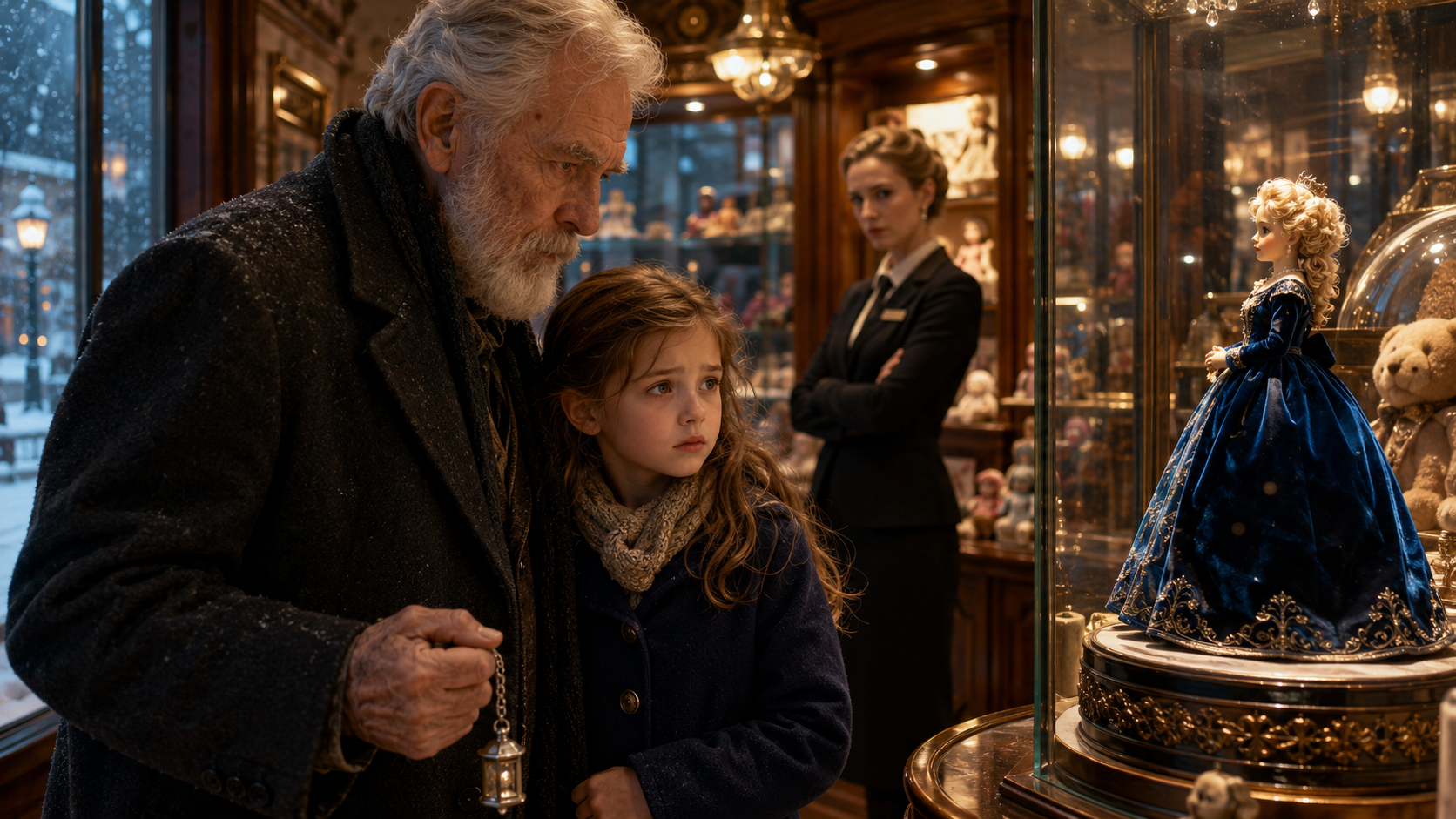
“My grandmother used to say The Velvet Lantern had three souls,” he said. “Hers, a carpenter’s, and a girl with blue ink on her fingers.”
Samuel felt his breath catch.
Mara had always had blue ink on her fingers.
She sketched with cheap fountain pens. Blue ink on her wrists, palms, cuffs, even once on the end of her nose. Beatrice used to tease her, “One day I’ll know every doll you touch because she’ll have a blue thumbprint somewhere.”
Samuel looked toward the glass case.
“The child came to see the doll,” he said.
Nathaniel followed his gaze.
“The Blue Lullaby.”
“Mara used to sing about it.”
Elsie wiped her eyes with her sleeve.
“Mommy said it had a sleepy song,” she whispered.
Nathaniel’s face changed.
The business mask fell away completely.
He turned to the woman in pearls.
“Go to the back office.”
“But, sir—”
“Now.”
She left with stiff steps, her face white.
Nathaniel took a key from his pocket and unlocked the glass case himself. The hinges opened without a sound. He lifted the doll carefully, with two hands, as if it were a sleeping child.
The shoppers watched.
Elsie looked at Samuel.
“Can I hold her?”
Samuel wanted to say no.
Not because he feared Elsie would break the doll.
Because he feared the doll would break him.
But he nodded.
Nathaniel knelt and placed the Blue Lullaby doll in Elsie’s arms.
The moment Elsie touched it, her face softened in a way Samuel had not seen since Mara was alive.
“She’s cold,” Elsie said.
Nathaniel gave a sad little smile.
“Porcelain usually is.”
“No,” Elsie said, serious. “I mean she feels like she’s been waiting.”
No one laughed.
Nathaniel looked at Samuel.
“There’s an office upstairs. Private. I think we should talk.”
Samuel almost refused.
He had spent more than two decades avoiding The Velvet Lantern. He crossed streets to avoid its windows. He turned off the television when holiday commercials showed children hugging dolls built from Mara’s stolen drawings. He could not pass the flagship store without feeling as if his chest were filling with broken glass.
But Elsie held the doll tightly and looked up.
“Grandpa, can we hear the song?”
That was why he followed.
Not for Nathaniel.
Not for the company.
Not for the shoppers whose guilt had arrived too late to be useful.
For Elsie.
They climbed a carpeted staircase to the second-floor office. The walls were lined with framed photographs: store openings, newspaper clippings, charity events, celebrity children holding limited-edition toys. At the end of the hall hung an old black-and-white picture of the first shop.
Samuel stopped.
There was Beatrice Harrow standing outside the narrow storefront, hair pinned back, smile bright enough to warm winter.
Beside her stood a younger Samuel, though most of him had been cropped out.
Only one arm remained visible, holding a plank of wood.
Mara was nowhere in the photo.
Samuel stared at the frame.
Nathaniel saw where he was looking.
“I never noticed that before,” he said softly.
Samuel did not take his eyes from the missing space.
“That’s how lies survive. First they cut people out of pictures. Then they tell the children those people were never there.”
Nathaniel said nothing.
Inside the office, Elsie sat in a leather chair with the Blue Lullaby doll on her lap. Her feet did not reach the floor.
Samuel stood beside her.
Nathaniel did not sit behind his desk. That mattered to Samuel. Men who sat behind desks while discussing ruined lives usually wanted distance. Nathaniel stood in front of the desk like someone prepared to be blamed.
“My father, Malcolm Harrow, told the family that Mara Reed stole prototype sketches for the Blue Lullaby collection,” Nathaniel said. “He said she copied my grandmother’s work, took the founder’s lantern charm, and tried to sell everything to a competitor.”
Samuel’s fingers closed around the silver charm.
“Mara didn’t take the charm. Beatrice gave it to her.”
Nathaniel looked at the object.
“May I see it?”
“No.”
The answer came fast.
Nathaniel nodded immediately.
“All right.”
That surprised Samuel.
For twenty-two years, every person from this company who came near him had wanted something. A signature. A silence. A statement. A promise to stop speaking Mara’s name near their brand.
Nathaniel was the first to ask and accept refusal.
Elsie ran her fingers over the doll’s velvet skirt.
“Can I turn the key?”
Nathaniel glanced at Samuel.
Samuel nodded.
Elsie found the little brass crank on the doll’s back and turned it slowly.
The music began.
It was soft at first, almost too delicate to fill the room. Then the melody unfolded, note by note, like light moving under a door.
Samuel closed his eyes.
Twenty-two years disappeared.
Mara was nineteen again, sitting at the kitchen table with fabric scraps in her lap and sketches spread everywhere. Her hair was falling out of its braid. Blue ink stained the side of her thumb.