They Called His Daughter a Thief for Twenty-Two Years—Until Her Little Girl Turned the Music Box

The first thing Samuel Reed noticed was not the price tag.

It was the way the woman in the pearl earrings looked at his granddaughter.

Not at her face. Not even at her hands.

At her coat.

At the missing button near the collar. At the little patch of faded thread where Samuel had tried to mend a tear with fingers that no longer obeyed him the way they used to. At the scuffed winter boots Elsie wore because children grew faster than old men could earn.

Then the woman’s eyes moved to Samuel.

To his gray beard, his bent shoulders, his old wool coat, the one that still smelled faintly of fireplace smoke and winter rain.

Her lips tightened.

“Please don’t touch that,” she said.

Elsie froze.

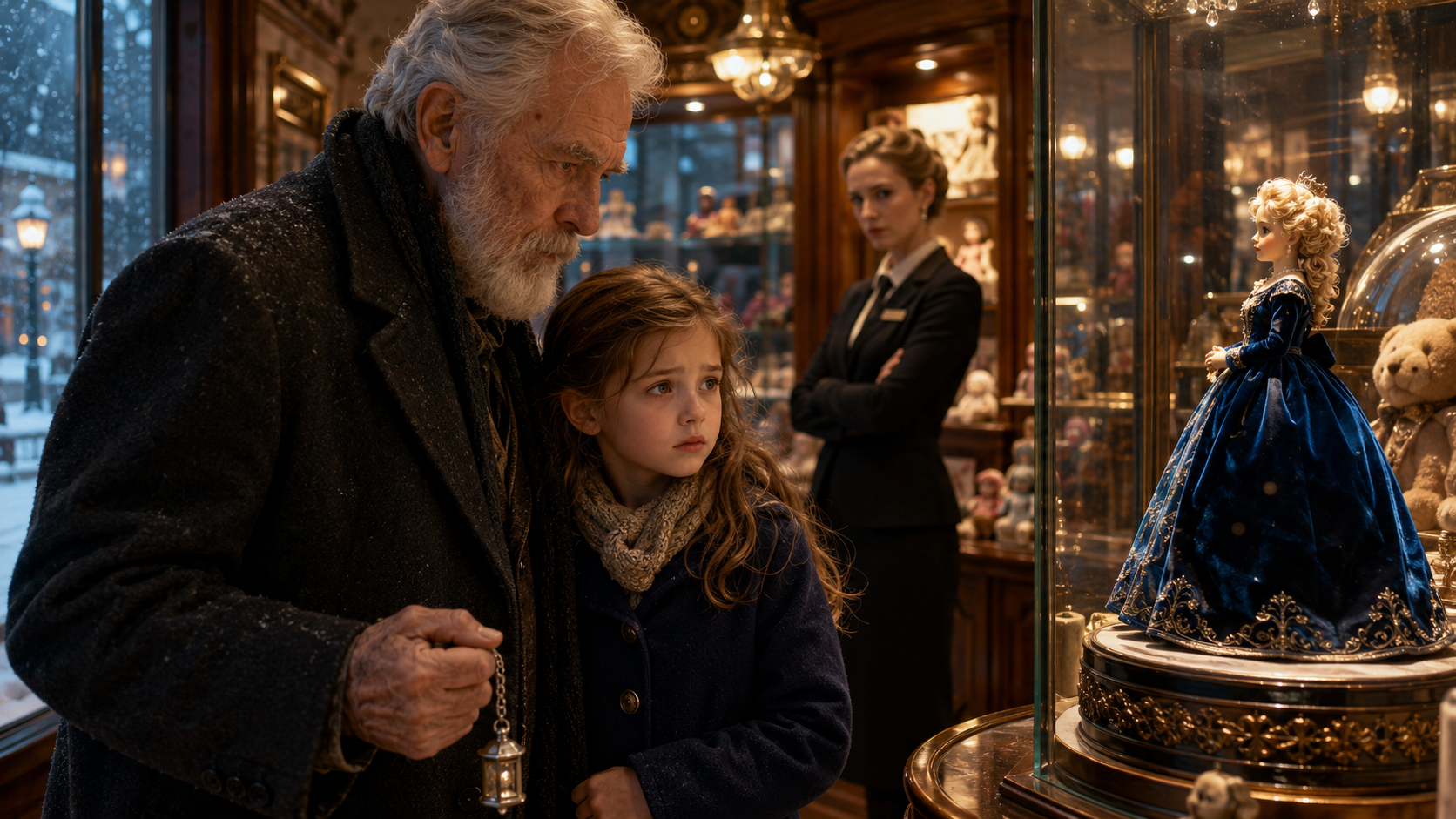
Her small hand hovered over the glass case in the center of the store. Inside, beneath warm lights, sat a porcelain music-box doll dressed in midnight-blue velvet. Silver thread curled around the hem of her skirt. Tiny painted flowers climbed her sleeves. Her eyes were made of blue glass, and on her back was a little brass crank shaped like a crescent moon.

Elsie had not opened the case.

She had not touched the doll.

She had only pressed two fingers to the glass, as if she were afraid the beautiful thing might vanish if she looked away.

“I wasn’t touching it,” Elsie whispered.

The woman in pearl earrings gave a smile that had no kindness in it.

“Children say that after they touch things.”

Samuel felt something old and ugly move in his chest.

The toy store was called The Velvet Lantern, though it had not been a simple toy store for many years. It was a palace now. Three floors of polished wood, crystal chandeliers, gold-lettered signs, and displays arranged like museum exhibits. Parents came from wealthy neighborhoods and bought handmade bears, music boxes, dolls, train sets, puzzles, and rocking horses at prices Samuel could not say out loud without feeling foolish.

But once, long ago, The Velvet Lantern had been a narrow shop with a leaking roof and two shelves Samuel had built himself.

Once, it had smelled of sawdust, glue, paint, and fresh coffee.

Once, a woman named Beatrice Harrow had stood behind a wooden counter and told him, “Sam, one day children will press their noses to this window because they’ll feel loved before they even walk inside.”

He had believed her.

He had helped her.

He had carried boxes, repaired locks, carved display stands, and swept floors after closing. His daughter, Mara, had grown up beneath that counter, drawing dolls on brown paper while Beatrice laughed and called her “the little dreammaker.”

Then money came.

Then investors came.

Then Beatrice’s son-in-law came.

And after that, The Velvet Lantern became rich enough to forget the hands that built it.

Elsie looked up at Samuel with tears in her eyes.

“Grandpa, I didn’t do anything.”

“I know,” Samuel said.

The woman crossed her arms.

“Sir, I’m going to have to ask you to step away from the display.”

Samuel did not move.

Elsie had asked for only one thing for her eighth birthday. Not a toy. Not a cake. Not new shoes, though she needed them.

She wanted to see the Blue Lullaby doll.

“My mommy used to sing about her,” Elsie had said that morning, holding the old photograph of Mara against her chest. “She said the doll had a song inside.”

Samuel had tried to explain that the doll was expensive, that they were only going to look, that looking had to be enough.

Elsie had nodded solemnly.

“I know. I just want to hear her song.”

So Samuel had taken two buses across the city. He had gripped the overhead rail with aching hands while Elsie stood between his knees. He had walked past windows filled with dresses, watches, cakes shaped like castles, and shoes that cost more than his rent.

And now, inside the store his daughter’s imagination had helped create, a woman in pearls was looking at Elsie as if poverty were a crime waiting to happen.

“She didn’t touch anything,” Samuel said.

The woman’s eyes sharpened.

“Sir, I saw her very close to the case.”

“She’s a child looking at a doll.”

“She was lingering.”

Samuel almost laughed.

Lingering.

That was what rich people called it when poor children loved something they could not buy.

A few shoppers had begun to watch. A man holding a wrapped rocking horse slowed near the front counter. Two women with matching shopping bags looked over, then pretended not to. A cashier stopped scanning a purchase.

Elsie moved closer to Samuel’s leg.

“I’m sorry,” she whispered, though she had done nothing wrong.

That almost broke him.

For twenty-two years, his family had been told to apologize for things they had not done.

Twenty-two years since they called Mara Reed a thief.

Twenty-two years since she came home with trembling hands and red eyes, saying, “Dad, I swear on everything good, I didn’t steal those designs.”

Twenty-two years since Samuel believed her and the world did not.

Now her little girl stood in the same company’s flagship store, being treated as if stealing lived in the blood.

Samuel’s voice turned low.

“My granddaughter has nothing to apologize for.”

The woman looked him up and down.

“Sir, this is a luxury shop. We have had incidents with people coming in to distract staff while children take small items.”

A murmur went through the nearby customers.

Elsie’s face crumpled.

Samuel stepped forward.

“Say what you mean.”

The woman blinked.

“I beg your pardon?”

“You’re dressing it up. Say what you mean.”

The woman’s cheeks flushed.

“I mean I’m responsible for protecting our merchandise.”

“You mean she looks poor enough to steal.”

The whole store seemed to inhale.

Elsie began to cry silently.

Samuel reached for her hand. His fingers brushed the small silver charm in his coat pocket, as they often did when anger threatened to make him careless.

The charm was old, shaped like a little lantern with a star cut into its center. He had carried it for so long that the edges had worn smooth.

It had belonged to Beatrice Harrow first.

Then it had belonged to Mara.

After Mara died, Samuel kept it in his pocket because he could not bear to put it in a drawer.

The woman’s expression hardened.

“I think you should leave.”

Before Samuel could answer, a man’s voice came from behind them.

“Why is there a child crying in my store?”

The shoppers parted.

A man in a dark green suit walked toward the center display. He was perhaps thirty-five, tall, clean-shaven, with tired eyes and the guarded posture of someone raised among rules. Samuel recognized him before he knew why.

The shape of his jaw.

The dark hair.

The Harrow eyes.

The woman in pearls straightened instantly.

“Mr. Harrow, I was handling a situation.”

The man looked at Elsie first. Then at the woman. Then at Samuel.

“I heard enough of the situation from the staircase.”

The woman went pale.

“She was too close to the display.”

“She is eight,” the man said.

“This piece is very valuable.”

“Then perhaps we should be more careful about the adults near it.”

The woman opened her mouth, then closed it.

The man’s gaze shifted to Samuel’s coat pocket.

Samuel realized the charm had slipped partly out.

The man went still.

All the authority in him disappeared for half a second. What remained was recognition. Not of Samuel’s face, but of something older than the room.

He looked at the charm like a person looking at a ghost.

“Where did you get that?” he asked quietly.

Samuel’s hand closed around it.

“It was given to me.”

“By whom?”

Samuel did not answer.

The woman in pearls tried to recover.

“Mr. Harrow, should I call security?”

“No,” the man said sharply.

The word cracked through the store.

Elsie stopped crying for a moment.

The man took a careful step closer to Samuel.

“My name is Nathaniel Harrow,” he said. “My grandmother founded this company.”

Samuel stared at him.

Beatrice’s grandson.

Of course.

He had seen photographs of the family in newspapers. He had read about store expansions, charity galas, holiday product launches, and the Harrow legacy. Nathaniel had been a boy when Mara was ruined. Too young, perhaps, to understand. Too young to stop anything.

But not too young now.

Samuel’s voice was rough.

“I knew your grandmother.”

Nathaniel swallowed.

“What is your name?”

The store seemed to lean toward them.

Samuel wanted to walk out.

He wanted to take Elsie home, make her cocoa, and tell her the world was ugly only because some people forgot how to be human.

But Elsie had come to hear her mother’s song.

So he said the name.

“Samuel Reed.”

The change in Nathaniel’s face was immediate.

It was as if someone had opened a sealed room inside him and let the dust out.

“Reed,” he repeated.

The woman in pearls frowned.

“Mr. Harrow?”

Nathaniel did not look at her.

“Your daughter was Mara Reed.”

Samuel’s jaw tightened.

“Yes.”

A whisper moved through the shoppers.

Some knew the name. Maybe not the truth, but the scandal. The stolen doll designs. The disgraced young artist. The lawsuit that never became a trial. The rumors that Mara Reed had tried to sell company secrets and vanished when she was caught.

Mara had not vanished.

She had been pushed out.

She had tried to rebuild a life while every door closed. She had raised Elsie for five years with a smile too tired to fool Samuel. Then illness took what shame had left behind.

Nathaniel looked stricken.

“My father told me she stole from us.”

Samuel’s laugh was quiet and cold.

“Your father lied very well.”

The woman in pearls took a step back.

Nathaniel shut his eyes for a moment. When he opened them, they were wet.

“My grandmother used to say The Velvet Lantern had three souls,” he said. “Hers, a carpenter’s, and a girl with blue ink on her fingers.”

Samuel felt his breath catch.

Mara had always had blue ink on her fingers.

She sketched with cheap fountain pens. Blue ink on her wrists, palms, cuffs, even once on the end of her nose. Beatrice used to tease her, “One day I’ll know every doll you touch because she’ll have a blue thumbprint somewhere.”

Samuel looked toward the glass case.

“The child came to see the doll,” he said.

Nathaniel followed his gaze.

“The Blue Lullaby.”

“Mara used to sing about it.”

Elsie wiped her eyes with her sleeve.

“Mommy said it had a sleepy song,” she whispered.

Nathaniel’s face changed.

The business mask fell away completely.

He turned to the woman in pearls.

“Go to the back office.”

“But, sir—”

“Now.”

She left with stiff steps, her face white.

Nathaniel took a key from his pocket and unlocked the glass case himself. The hinges opened without a sound. He lifted the doll carefully, with two hands, as if it were a sleeping child.

The shoppers watched.

Elsie looked at Samuel.

“Can I hold her?”

Samuel wanted to say no.

Not because he feared Elsie would break the doll.

Because he feared the doll would break him.

But he nodded.

Nathaniel knelt and placed the Blue Lullaby doll in Elsie’s arms.

The moment Elsie touched it, her face softened in a way Samuel had not seen since Mara was alive.

“She’s cold,” Elsie said.

Nathaniel gave a sad little smile.

“Porcelain usually is.”

“No,” Elsie said, serious. “I mean she feels like she’s been waiting.”

No one laughed.

Nathaniel looked at Samuel.

“There’s an office upstairs. Private. I think we should talk.”

Samuel almost refused.

He had spent more than two decades avoiding The Velvet Lantern. He crossed streets to avoid its windows. He turned off the television when holiday commercials showed children hugging dolls built from Mara’s stolen drawings. He could not pass the flagship store without feeling as if his chest were filling with broken glass.

But Elsie held the doll tightly and looked up.

“Grandpa, can we hear the song?”

That was why he followed.

Not for Nathaniel.

Not for the company.

Not for the shoppers whose guilt had arrived too late to be useful.

For Elsie.

They climbed a carpeted staircase to the second-floor office. The walls were lined with framed photographs: store openings, newspaper clippings, charity events, celebrity children holding limited-edition toys. At the end of the hall hung an old black-and-white picture of the first shop.

Samuel stopped.

There was Beatrice Harrow standing outside the narrow storefront, hair pinned back, smile bright enough to warm winter.

Beside her stood a younger Samuel, though most of him had been cropped out.

Only one arm remained visible, holding a plank of wood.

Mara was nowhere in the photo.

Samuel stared at the frame.

Nathaniel saw where he was looking.

“I never noticed that before,” he said softly.

Samuel did not take his eyes from the missing space.

“That’s how lies survive. First they cut people out of pictures. Then they tell the children those people were never there.”

Nathaniel said nothing.

Inside the office, Elsie sat in a leather chair with the Blue Lullaby doll on her lap. Her feet did not reach the floor.

Samuel stood beside her.

Nathaniel did not sit behind his desk. That mattered to Samuel. Men who sat behind desks while discussing ruined lives usually wanted distance. Nathaniel stood in front of the desk like someone prepared to be blamed.

“My father, Malcolm Harrow, told the family that Mara Reed stole prototype sketches for the Blue Lullaby collection,” Nathaniel said. “He said she copied my grandmother’s work, took the founder’s lantern charm, and tried to sell everything to a competitor.”

Samuel’s fingers closed around the silver charm.

“Mara didn’t take the charm. Beatrice gave it to her.”

Nathaniel looked at the object.

“May I see it?”

“No.”

The answer came fast.

Nathaniel nodded immediately.

“All right.”

That surprised Samuel.

For twenty-two years, every person from this company who came near him had wanted something. A signature. A silence. A statement. A promise to stop speaking Mara’s name near their brand.

Nathaniel was the first to ask and accept refusal.

Elsie ran her fingers over the doll’s velvet skirt.

“Can I turn the key?”

Nathaniel glanced at Samuel.

Samuel nodded.

Elsie found the little brass crank on the doll’s back and turned it slowly.

The music began.

It was soft at first, almost too delicate to fill the room. Then the melody unfolded, note by note, like light moving under a door.

Samuel closed his eyes.

Twenty-two years disappeared.

Mara was nineteen again, sitting at the kitchen table with fabric scraps in her lap and sketches spread everywhere. Her hair was falling out of its braid. Blue ink stained the side of her thumb.

“Dad,” she had said, “what if a doll could keep a secret for a child? Not a bad secret. A safe one. A note from their mother. A tiny drawing. A lock of hair. Something to find when they need to remember they were loved.”

Samuel had been sanding a wooden shelf.

“You’re making toys sound like churches.”

Mara had smiled.

“Maybe children need smaller churches.”

Now her daughter sat in a company office, holding the doll Mara had dreamed into being while the world finally listened.

The song ended.

Elsie frowned.

“That’s not all.”

Samuel opened his eyes.

“What do you mean, sweetheart?”

“Mommy sang more.”

Nathaniel went still.

Elsie hugged the doll and sang in a small, trembling voice.

“Where the bluebells sleep at night, turn the lantern toward the light.”

The room changed.

Samuel felt it before he understood it.

Nathaniel’s face drained of color.

“Say that again,” he whispered.

Elsie looked frightened.

Samuel touched her shoulder.

“It’s all right.”

Elsie repeated it more softly.

“Where the bluebells sleep at night, turn the lantern toward the light.”

Nathaniel moved to an old cabinet near the window. He unlocked the bottom drawer and pulled out a thick folder tied with ribbon. His hands shook as he opened it.

“These are my grandmother’s archived design notes,” he said. “I found them after she died, but my father told me they were sentimental drafts. Nothing legal. Nothing important.”

He turned page after page.

Tiny drawings of dolls appeared. Some dressed as birds. Some as queens. Some as children in pajamas carrying moons. Each had a symbol: a star, a rose, a bell, a lantern.

Then Nathaniel stopped.

He pulled out a faded sheet and laid it on the desk.

The drawing showed the Blue Lullaby doll.

At the bottom, in Beatrice Harrow’s handwriting, was a note:

Bluebell child. Lantern key. Memory chamber not yet disclosed.

Samuel stared at the words.

“Memory chamber?”

Nathaniel looked at the doll.

“I thought it was an idea they abandoned.”

Elsie whispered, “Mommy said she kept something safe.”

Samuel’s heart began to pound so hard it hurt.

Mara had said strange things near the end of her life. Fever and pain had blurred her words. She had taken Samuel’s hand one night in the hospital and said, “Dad, don’t lose the lantern. Elsie will know the song.”

Samuel thought it was grief speaking.

Now he reached into his pocket and pulled out the charm.

The silver lantern lay in his palm.

For twenty-two years, he had carried it as a keepsake.

Not as a key.

Nathaniel looked at it, then at the sketch.

“May I look near it? Not take it. Just look.”

Samuel hesitated, then held it out while keeping the chain wrapped around his finger.

Nathaniel bent close.

“There,” he said.

On the bottom edge of the lantern charm was a seam so fine Samuel had never noticed it. He pressed his thumbnail into the groove. Something clicked. A tiny metal tooth folded out from the side.

Elsie gasped.

“It opened.”

Samuel’s hand trembled.

Nathaniel lifted the doll gently from Elsie’s lap.

“May I?”

Elsie looked at Samuel.

“We stay right here,” Samuel said.

Only then did she let Nathaniel turn the doll over.

Beneath the velvet skirt, stitched into the porcelain base, was a bluebell flower no bigger than a fingernail. Nathaniel pressed it. A narrow slot appeared behind the music mechanism.

Samuel inserted the lantern key.

For a second nothing happened.

Then came a small click.

The back of the doll opened.

Inside was a rolled paper, sealed in cloudy plastic.

No one moved.

Nathaniel stepped back.

Samuel understood why.

Whatever was inside did not belong to the Harrows.

It belonged to Mara.

He took the paper out with fingers that could barely hold it.

Elsie slid off the chair and stood against his side.

Samuel unrolled the paper.

The handwriting hit him first.

Blue ink.

Mara’s handwriting.

Dad, if this reaches you, then I was right to be afraid.

Samuel’s knees nearly gave out.

Nathaniel reached for the chair, but Samuel shook his head.

He would stand for this.

He owed Mara that much.

He read aloud, his voice breaking and rebuilding itself with every line.

Beatrice signed the Blue Lullaby collection to me before she died. She said the company had become too hungry and that Malcolm wanted to turn every gentle thing into a machine for profit. She trusted me to protect the original designs until the truth could be placed somewhere safe.

Samuel heard Nathaniel make a sound behind him.

He kept reading.

Malcolm found out. He demanded the transfer papers. When I refused, he said he would make sure no one believed a girl like me over a man like him. If they call me a thief, remember this: I did not steal from The Velvet Lantern. The Velvet Lantern stole from me.

Elsie began to cry, though she did not understand all the words.

Samuel’s voice shook harder.

The proof is hidden in the doll with the bluebells. Beatrice said the lantern key would stay with the only man she trusted before the store had money. She meant you, Dad. She said you built the first shelves and never asked to own the room.

Nathaniel covered his mouth.

Samuel read the last lines.

If anything happens to me, please tell Elsie I tried. Tell her her mother made something beautiful. Tell her I was not a thief. And if she ever hears the song, tell her the song was always meant to bring me home.

The office blurred.

Samuel lowered the letter.

For twenty-two years, he had wanted proof.

He had begged lawyers to look at sketches. He had written letters no one answered. He had stood outside company headquarters with copies of Mara’s drawings until security escorted him away. He had watched his daughter die with the word thief still attached to her name like a chain.

And the proof had been inside a doll.

A doll displayed under glass in a store that had grown rich selling Mara’s imagination.

Nathaniel whispered, “My father did this.”

Samuel looked at him.

“Don’t whisper it because you’re ashamed. Say it because it’s true.”

Nathaniel straightened.

“My father did this.”

“Then call the police.”

Nathaniel’s eyes lifted.

For a moment, Samuel saw a frightened boy. Then he saw something else.

A man choosing which family legacy he would keep.

Nathaniel picked up the phone.

Malcolm Harrow arrived forty minutes later.

He came through the office door in a charcoal overcoat, polished shoes, and the expression of a man who believed rooms rearranged themselves around his will.

He was older now than Samuel remembered, but the eyes were the same.

Cold.

Measuring.

Empty where mercy should have been.

Malcolm looked first at Nathaniel, then at the police officer near the window, then at Samuel.

For one brief second, his face changed.

Fear.

Then it vanished beneath contempt.

“Samuel Reed,” he said. “I wondered when you would come crawling back.”

Samuel folded Mara’s letter carefully and placed it on the desk.

“I never crawled.”

Malcolm’s mouth tightened.

Nathaniel stepped forward.

“Dad, the letter is real. Grandmother transferred the Blue Lullaby collection to Mara.”

Malcolm laughed once.

“My mother was old. Sentimental. Confused.”

Nathaniel flinched.

Samuel stepped closer.

“Careful. That old woman built the name you hide behind.”

Malcolm looked at the doll on the desk.

“The prototype belongs to The Velvet Lantern.”

Elsie grabbed Samuel’s coat.

“No,” she said.

Everyone looked at her.

Her voice trembled, but she did not stop.

“It belongs to my mommy.”

Malcolm’s eyes narrowed.

Samuel moved between them.

“You don’t look at her like that.”

Malcolm turned to the police officer.

“This is a corporate matter. A misunderstanding over intellectual property.”

Samuel laughed.

The sound startled even him.

It was not joy. It was not humor.

It was the sound of twenty-two years of swallowed rage finally finding air.

“You called my daughter a thief in newspapers,” he said. “You ruined her name in public. You let the world spit on her memory in public. You sold her dolls in public. So no, Malcolm. You don’t get privacy now.”

Outside the office, employees had gathered in the hall.

Customers stood on the staircase.

Phones were raised.

The truth had found witnesses.

Malcolm saw them.

For the first time, he understood the room was no longer his.

By midnight, the story was everywhere.

By morning, The Velvet Lantern was not a beloved toy empire. It was a scandal wrapped in velvet and gold.

Reporters came. Lawyers came. Former employees came.

Some came with apologies.

Some came with documents.

Some came with excuses Samuel did not want to hear.

A retired bookkeeper admitted she had seen Malcolm remove boxes from Mara’s studio the night before the accusation. Beatrice’s old attorney produced a sealed copy of the transfer agreement. A former assistant sent Nathaniel an inventory list showing Blue Lullaby sketches logged under Mara Reed’s name before the company changed the archive.

The lie did not collapse all at once.

Lies built by powerful people rarely do.

They crack first.

Then they leak.

Then, if enough light enters, they rot from the inside.

Malcolm resigned before the board could remove him.

Then he was arrested for fraud, destruction of records, and conspiracy to conceal estate documents.

Samuel watched the news once, then turned it off.

He did not need strangers explaining his pain back to him.

Three days after the store incident, Nathaniel came to Samuel’s house.

No lawyers.

No cameras.

No public statement printed on expensive paper.

Just Nathaniel in a dark coat, standing on the porch with a folder under his arm and exhaustion in his face.

Elsie watched from behind the curtain.

Samuel opened the door but did not invite him inside.

Nathaniel seemed to understand.

“I found more,” he said.

Samuel waited.

“My grandmother’s private ledger. She gave Mara ownership of the Blue Lullaby designs. Royalties. Creative credit. Everything.” His voice faltered. “She also left you a small founder’s share.”

Samuel frowned.

“Me?”

Nathaniel nodded.

“Three percent of the original company. She wrote that The Velvet Lantern began with her dream, your hands, and Mara’s imagination.”

Samuel gripped the doorframe.

Three percent.

Of a company worth more than he could comprehend.

He thought of every winter when he turned the heat low because Elsie needed medicine.

He thought of Mara skipping treatment because insurance delayed approval.

He thought of birthdays with candles stuck in discount muffins because cake cost too much.

It was not the money that hurt.

It was what the missing money had stolen.

Nathaniel looked down.

“I know this doesn’t repair what happened.”

“No,” Samuel said. “It doesn’t.”

“But Elsie will never have to grow up thinking her mother left her nothing.”

Samuel glanced back through the doorway.

Elsie had disappeared from the curtain, but he could hear her in the kitchen humming the Blue Lullaby tune to herself.

“Mara left her plenty,” Samuel said. “Songs. Courage. A stubborn little heart.”

Nathaniel nodded.

“And now the world will know she left more.”

The company changed faster than Samuel expected.

Perhaps because guilt is faster when cameras are watching.

The founder wall in the flagship store was removed. The cropped photograph came down. In its place went three full portraits.

Beatrice Harrow, smiling in front of the first shop.

Samuel Reed, young and broad-shouldered, holding a shelf he had built with his own hands.

Mara Reed, nineteen years old, sitting at a worktable covered in blue sketches, holding the unfinished Blue Lullaby doll.

Beneath the portraits was a brass plaque:

Beatrice Harrow, Samuel Reed, and Mara Reed — The Dream, The Hands, and The Song Behind The Velvet Lantern.

Elsie stood in front of her mother’s picture for a long time.

“She looks happy,” she whispered.

Samuel swallowed.

“She was, sweetheart.”

Nathaniel stepped beside them.

“There’s one more thing.”

In the center of the store stood a glass case. Inside it were the original Blue Lullaby doll, Mara’s letter, Beatrice’s ledger, and the silver lantern charm.

Samuel’s hand moved automatically to his pocket.

For twenty-two years, the charm had been his only proof that Mara’s story had once touched something good.

Now it had done its job.

Nathaniel noticed.

“You can keep it,” he said. “No one would argue.”

Samuel looked at the case.

Then at Elsie.

Then at Mara’s photograph.

“No,” he said quietly. “Let it open doors for someone else.”

The trial months later was crowded.

Samuel attended only once. Elsie stayed home with Mrs. Alvarez from next door, who made soup too salty and loved Elsie as if love could be added by the spoonful.

Malcolm Harrow looked smaller in court.

Without the company around him, without the polished store and obedient employees, he was just an old man in an expensive suit trying to explain why greed should be called business.

When Samuel stood to speak, the courtroom became still.

His hands shook.

His voice did not.

“Malcolm Harrow did not only steal drawings,” Samuel said. “He stole the way people looked at my daughter. He stole job offers. He stole friendships. He stole peace. He stole the years when Mara should have been proud of what she made.”

Malcolm stared straight ahead.

Samuel continued.

“He stole from a child who had not yet learned to speak. Elsie grew up hearing whispers about a mother she loved but could not defend. But he did not steal everything. He did not steal Mara’s truth. He did not steal my memory. And he did not steal my granddaughter’s right to know her mother was brilliant.”

The judge listened.

The reporters wrote.

Malcolm never looked at him.

That was fine.

Samuel had not come for remorse.

He had come so the official record would hear Mara’s name without shame.

Malcolm was convicted on enough charges to remove him from the company forever.

Not enough for Samuel’s heart.

Nothing would have been enough.

But when Elsie asked, “Did the bad man get punished?” Samuel could kneel beside her and say, “Yes, sweetheart. He did.”

The first Christmas after the truth came out, The Velvet Lantern released the Blue Lullaby collection again.

Not Malcolm’s version.

Mara’s.

Every box carried her name.

Every doll came with a small card:

A toy should hold love, not lies.

A portion of every sale went to the Mara Reed Foundation, created to give birthday gifts, school supplies, and grief counseling to children who had lost a parent.

Nathaniel asked Elsie to draw the foundation’s symbol.

She drew a bluebell under a lantern.

Samuel cried when he saw it.

On opening day, the line outside the flagship store wrapped around the block. Parents came with children. Former employees came with flowers. Women who had once worked beside Mara came to tell stories Samuel had never heard.

One said Mara kept peppermints in her drawer for interns.

Another said Mara fixed a broken bear for her little boy during a visit to the design room.

Another admitted she had believed Malcolm because it was easier.

Samuel thanked the first two.

He walked away from the third.

Forgiveness, he had learned, was not something people were owed because they finally felt uncomfortable.

Inside the store, Elsie stood beside a display of Blue Lullaby dolls wearing a small name tag Nathaniel had made for her.

Elsie Reed — Keeper of the Song.

She took the job seriously.

Whenever children came close, she turned the little brass crank and let the melody play.

Then she told them, with her chin lifted, “My mommy made this song.”

Not once did she whisper.

Not once did she look ashamed.

That was the ending Samuel wanted more than money.

Near closing time, he noticed a woman standing by the entrance.

The pearl earrings were gone.

So was the polished certainty.

It was the saleswoman who had accused Elsie that first day.

Elsie saw her too and moved closer to Samuel.

“That’s the mean lady,” she whispered.

“Yes,” Samuel said.

The woman approached slowly.

Nathaniel began to step between them, but Samuel lifted a hand.

Let her come.

She stopped a few feet away.

“I’m sorry,” she said.

No excuse.

No speech about policy.

No explanation about stress or training or pressure from management.

Just sorry.

She looked at Elsie.

“I was cruel to you. You didn’t deserve it.”

Elsie stared at her.

Samuel did not tell the child what to say.

Adults had forced enough feelings onto her family.

After a moment, Elsie said, “You made me cry.”

The woman’s eyes filled.

“I know.”

“My mommy said people who make children cry should have to sit alone and think about it.”

Somewhere behind them, a cashier coughed to hide a laugh.

The woman nodded, tears spilling down her cheeks.

“Your mommy was right.”

Elsie considered her carefully.

Then she said, “Okay.”

Not forgiveness.

Not friendship.

Just okay.

For eight years old, that was plenty.

That night, Samuel and Elsie walked home under Christmas lights. Snow drifted down in soft silver pieces, settling on Elsie’s hair and the shoulders of Samuel’s old coat.

He could have called a car now.

He could have bought a warmer coat that very afternoon.

But Elsie wanted to walk, and Samuel had spent too many years rushing through sadness to refuse a peaceful moment.

She carried her own Blue Lullaby doll in one arm and held his hand with the other.

“Grandpa,” she asked, “was Mommy famous?”

Samuel thought about it.

Famous was a strange word.

Fame was cameras, headlines, a name printed on boxes, strangers saying they had always known.

Mara had deserved those things.

But they were not what made her matter.

“Your mommy was loved,” he said.

Elsie frowned.

“That’s not what I asked.”

Samuel chuckled softly.

“No. It isn’t.”

He looked at the snow shining under the streetlights.

“Yes,” he said. “She’s famous now.”

Elsie smiled.

“Good.”

Then she added, “But she was always famous to me.”

Samuel stopped walking.

The world blurred.

Elsie tugged his hand.

“Grandpa?”

He knelt in the snow and hugged her gently, carefully, because she was still the last living piece of his daughter’s song.

But maybe, he thought, the heart had more hidden rooms than a man knew.

Maybe some things survived like letters inside music boxes, waiting for a child’s hand to turn the key.

One year later, The Velvet Lantern held a public memorial for Mara Reed.

Not in a hotel ballroom.

Not in a corporate hall.

In the first store.

The one Beatrice had opened.

The one Samuel had helped build.

The one where Mara had once drawn dolls beneath the counter.

Children filled the aisles, each holding a small blue paper lantern. Nathaniel spoke briefly, then handed the microphone to Samuel.

For a long moment, Samuel only looked at the crowd.

Parents.

Employees.

Reporters.

Old friends.

Children who knew nothing about stolen patents, forged records, or powerful men who lied.

They only knew the dolls played a beautiful song.

That was enough.

“My daughter used to say toys were not about porcelain, velvet, or paint,” Samuel began. “She said toys were about giving children something soft to hold when the world became too hard.”

His voice shook.

“She understood that because the world was often hard on her.”

Elsie stood beside him, one hand wrapped around his sleeve.

“For twenty-two years, people called Mara Reed a thief. Today, in the store that sold her dreams without her name, I ask you to remember her correctly.”

The room went silent.

“She was a daughter. A mother. An artist. A woman who protected what was hers when powerful people tried to frighten her into silence.”

He looked down at Elsie.

“And she was loved by the child she left behind.”

Elsie lifted her blue paper lantern.

Then, one by one, every child in the store lifted theirs.

A hundred tiny lanterns rose into the air.

Samuel could not speak after that.

He did not need to.

The song began to play over the speakers.

Not the commercial version.

Mara’s original recording.

Her voice, young and soft, filled the store.

Where the bluebells sleep at night, turn the lantern toward the light.

People cried openly.

Nathaniel covered his face.

Samuel closed his eyes and listened to his daughter sing inside the place that had tried to erase her.

For once, the walls did not feel stolen.

They felt returned.

Later, after the crowd left, Elsie placed her paper lantern beneath Mara’s photograph.

“Mommy,” she whispered, “we did it.”

Samuel stood behind her with one hand on her shoulder.

“Yes,” he said. “We did.”

But deep down, he knew the truth.

Mara had done it.

She had hidden the letter.

She had taught Elsie the song.

She had trusted Samuel with the lantern before any of them knew it was a key.

She had built a truth small enough to fit inside a doll and strong enough to bring a toy empire to its knees.

As they walked toward the door, Nathaniel stopped Samuel.

“Mr. Reed,” he said, “the board would like to offer you an honorary chair position.”

Samuel stared at him.

Then he laughed.

A real laugh.

The kind he thought age and grief had stolen.

“I’m too old for chairs that don’t rock.”

Nathaniel smiled.

“Then what do you want?”

Samuel looked across the store.

At the children.

At Elsie.

At Mara’s name finally where it belonged.

“I want a shelf,” he said.

“A shelf?”

“One shelf in every Velvet Lantern store. Low enough for children to reach. Toys no child is told they can’t touch because their pockets are empty.”

Nathaniel’s face softened.

“We can do that.”

“And no child gets chased out for looking.”

Nathaniel lowered his eyes.

“Never again.”

Six months later, every Velvet Lantern store had a Mara Shelf.

Children could choose one toy from it for free on their birthday.

No proof of income.

No humiliating questions.

No cold employee deciding who looked worthy.

Just a shelf low enough for small hands and kind enough for tired families.

Elsie visited the first one with Samuel.

She watched a little boy choose a stuffed rabbit, then hug it so tightly his mother began to cry.

Elsie leaned against her grandfather’s side.

“Grandpa,” she said, “Mommy would like this.”

Samuel looked at the shelf.

At the toys waiting to be held.

At the children walking out with something soft in their arms.

“Yes,” he said. “She would.”

That night, Samuel placed Elsie’s Blue Lullaby doll on her dresser.

The original stayed in the store display, safe behind glass. But Nathaniel had made Elsie a perfect copy.

Inside it, Samuel placed a tiny note written in his own shaky hand.

Your mother was not a thief.

She was the song.

Elsie would find it years later.

But for now, she only climbed into bed, hugged the doll, and asked Samuel to turn the crank.

The melody filled the room.

Soft.

Fragile.

Alive.

Samuel sat beside her until her eyes closed.

Outside, snow began to fall again.

Inside, the little doll played Mara’s song.

And for the first time in twenty-two years, Samuel did not feel like he was guarding the truth alone.

The truth had a voice now.

It had Elsie’s hands.

It had Mara’s name.

And it had a place in the world no thief could ever steal again.

They Called His Daughter a Thief for Twenty-Two Years—Until Her Little Girl Turned the Music Box
A rare green puppy was born on an Italian farm