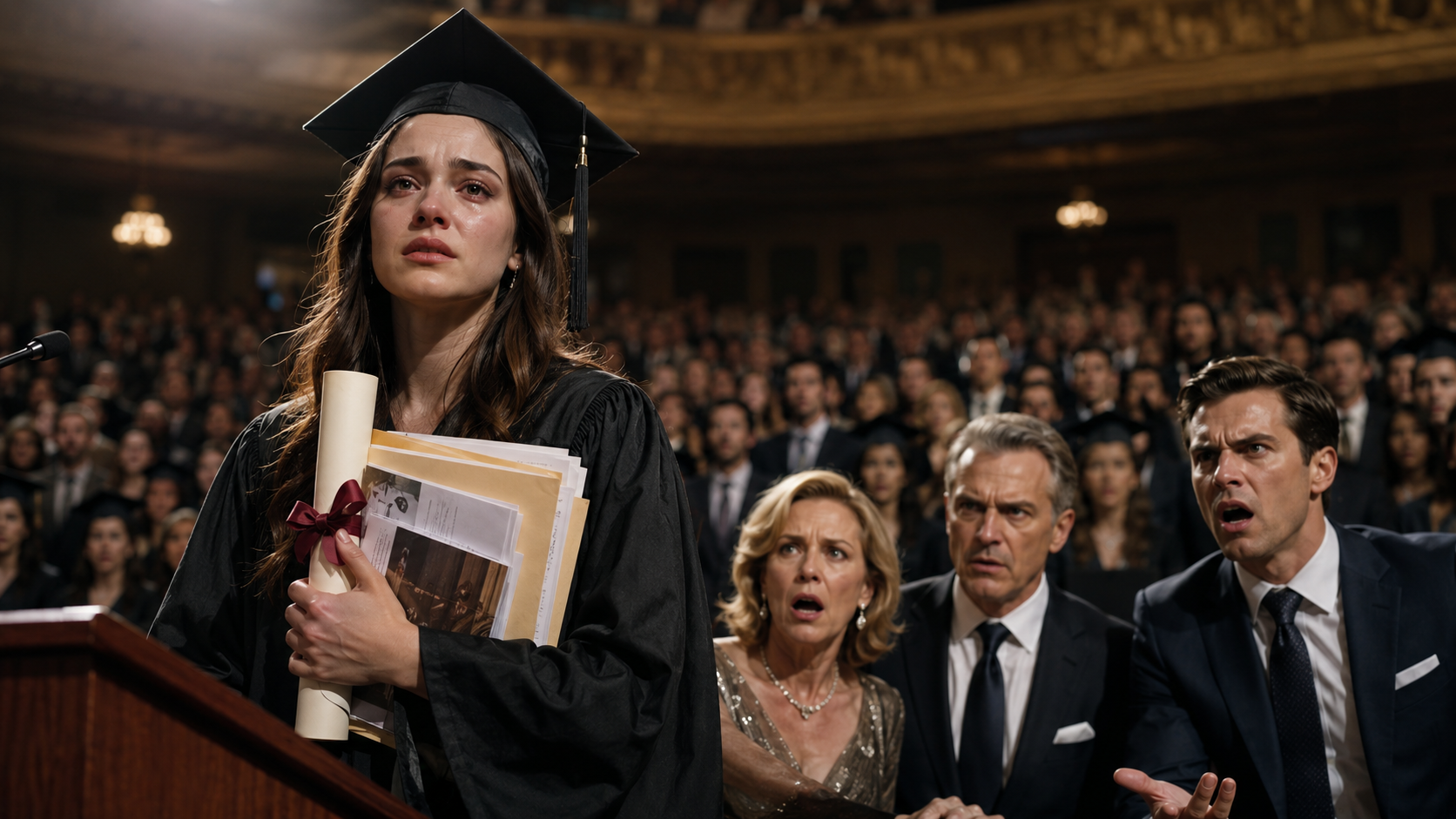
Denise was crying because Preston had said the word sacrifice into a microphone.
Preston ended to loud applause.
Then came the announcement: the Whitmore Foundation, in partnership with the university, would fund a new mentorship center.
A center based on Preston’s “original model.”
Original.
Claire closed her eyes.
For four years, she had told herself silence was maturity.
For four years, she had believed exposing him would make her look bitter.
For four years, she had let her family turn stolen work into a golden staircase for their favorite child.
But then President Harlan returned to the podium.
“And now we come to one of the highest honors Wexford University can bestow.”
Claire opened her eyes.
Beside her, Jade squeezed her hand so hard it hurt.
“The Whitcomb Research Medal is awarded each year to a graduating student whose work demonstrates exceptional originality, discipline, and social impact. This year’s recipient has not only completed a groundbreaking thesis on educational access algorithms, but has also been accepted into the doctoral fellowship program at Northeastern Institute with full funding.”
Claire heard a sound behind her.
Her mother.
A soft, confused intake of breath.
President Harlan smiled.
“Please join me in congratulating Claire Elise Whitmore.”
For a moment, no one around her moved.
Then Jade screamed.
The honor graduates stood. Faculty rose. Applause rolled through the auditorium, growing louder, wider, impossible to ignore.
Claire stood slowly.
Her legs felt distant.
She walked toward the stage with every eye on her, but she only looked once at her family.
Her father’s face had gone pale.
Her mother’s mouth was open.
Preston was no longer smiling.
Claire climbed the steps.
President Harlan handed her the medal. Dr. Maren Bell, her research advisor, hugged her with one arm and whispered, “You earned this. All of it.”
Claire almost broke then.
Not because of the applause.
Because someone had said earned without making it sound like an accident.
She turned toward the audience with the medal in her hands.
The applause kept going.
And for the first time in her life, her family could not pretend they did not see her.
President Harlan waited for the room to quiet.
“As this year’s medal recipient,” he said, “Claire will now deliver the graduate response.”
Somewhere in the audience, her father stood halfway out of his seat.
“What?” he said, loud enough for the nearby rows to hear.
Claire looked at him.
Then she stepped to the microphone.
The paper she had prepared was folded inside her sleeve.
But when she saw Preston’s face — the anger, the warning, the silent command to stay small — she knew she did not need it.
She leaned toward the microphone.
“My name is Claire Whitmore,” she said. “And for most of my life, I believed I was the least impressive person in my family.”
The auditorium went quiet.
Not polite quiet.
Curious quiet.
“My brother was the gifted one. The confident one. The one teachers remembered, donors trusted, and my parents celebrated. I was the difficult one. The emotional one. The one who was told she asked for too much and achieved too little.”
Her mother’s hand flew to her throat.
Claire kept going.
“When I was eighteen, I almost didn’t come to college. Not because I wasn’t accepted. Not because I didn’t want it. But because the money set aside for my education had been used elsewhere.”
Her father’s face hardened.
Preston slowly sat back in his chair.
“I was told to be practical. I was told to stop dreaming. I was told that some people are leaders and some people are support.”
Claire looked down at the medal.
“For a long time, I believed them.”
She lifted her eyes again.
“But then I met professors who read my work before judging my name. I met friends who stayed up with me when I wanted to quit. I met students who reminded me that being overlooked is not the same as being empty.”
A few people applauded softly.
Claire waited.
“And I learned something else. Sometimes the person called worthless is not worthless at all. Sometimes they are simply surrounded by people who profit from them not knowing their value.”
The air changed.
She felt it move across the room.
A warning before a storm.
“My thesis,” Claire said, “began as a project when I was seventeen. It was a mentorship model for first-generation students, built around predictive support, peer pairing, and community accountability. I wrote it after watching classmates fall through cracks no one bothered to measure.”
Preston stared at her.
Now he knew.
“Years ago, an early version of that project was taken from me.”
Someone gasped.
Claire’s father stood fully.
“Claire,” he said sharply.
She did not look away from the audience.