With anger at breakfast.
With silence in hallways.
With doors left open a little longer each week.
Lydia moved into a small house on the edge of the Kingsley estate, not the mansion.
“I spent too many years dreaming of that house,” she told Hannah. “I won’t live inside it until I know it doesn’t own me.”
Arthur accepted that.
He visited.
He knocked.
He brought old photo albums and left when Lydia got tired.
Sometimes she yelled.
Sometimes he cried.
Sometimes Hannah sat between them and wondered how love could survive so much damage and still be love.
Daniel became the easiest part of the new life.
He taught Hannah how to ride a bicycle in the long driveway.
He burned pancakes every Sunday.
He called himself her cousin, then corrected it to uncle, then gave up and said, “Family is confusing. Just yell when you need me.”
Hannah did.
Often.
Margot’s trial lasted four months.
The courtroom was full every day.
Reporters wrote about greed, betrayal, inheritance, and the downfall of one of the city’s most admired women.
But Hannah remembered something different.
She remembered sitting beside her mother while Lydia testified.
Her mother’s hands shook at first.
Then steadied.
Margot watched from the defense table, dressed in black, still trying to look untouchable.
But she looked smaller without the ballroom.
Without diamonds.
Without people stepping aside.
Lydia told the truth.
All of it.
The stolen sapphire.
The locked greenhouse.
The false orders.
The threats.
The gate.
The years of exile.
When the prosecutor played the recording, the courtroom went silent.
Arthur wept openly.
This time, no one looked away.
Margot was found guilty on fraud, conspiracy, evidence tampering, and intimidation charges.
The city called it justice.
Lydia called it late.
Six months after the night Hannah walked into Kingsley Hall, Arthur reopened the ballroom.
Not for a gala.
Not for donors.
Not for wealthy guests pretending kindness was a performance.
He opened it for the people who had never been invited inside.
Shelter families.
Church volunteers.
Nurses from the clinic.
Food bank workers.
Children from St. Agnes.
The cooks, drivers, cleaners, gardeners, and seamstresses who had kept grand houses running while standing outside their stories.
There were no champagne towers.
No velvet ropes.
No photographers allowed near the children.
At the front of the ballroom stood a new plaque beneath Eleanor Kingsley’s portrait.
For Lydia Vale and Hannah Vale.
For every truth buried by power.
For every child who deserves to be believed.
Arthur stood onstage before the evening began.
He looked older now.
Less polished.
More human.
“This hall spent too many years honoring wealth,” he said. “Tonight, it will honor survival.”
He looked at Lydia.
Then at Hannah.
“And the courage it takes to come home when home has failed you.”
Lydia squeezed Hannah’s hand.
No one laughed now.
No one called her a liar.
No one looked at her torn dress and saw shame.
The dress had been repaired, but not remade.
Lydia insisted on that.
“Scars are part of evidence,” she said.
Hannah wore it again that night.
The ivory satin.
The blue embroidered flowers.
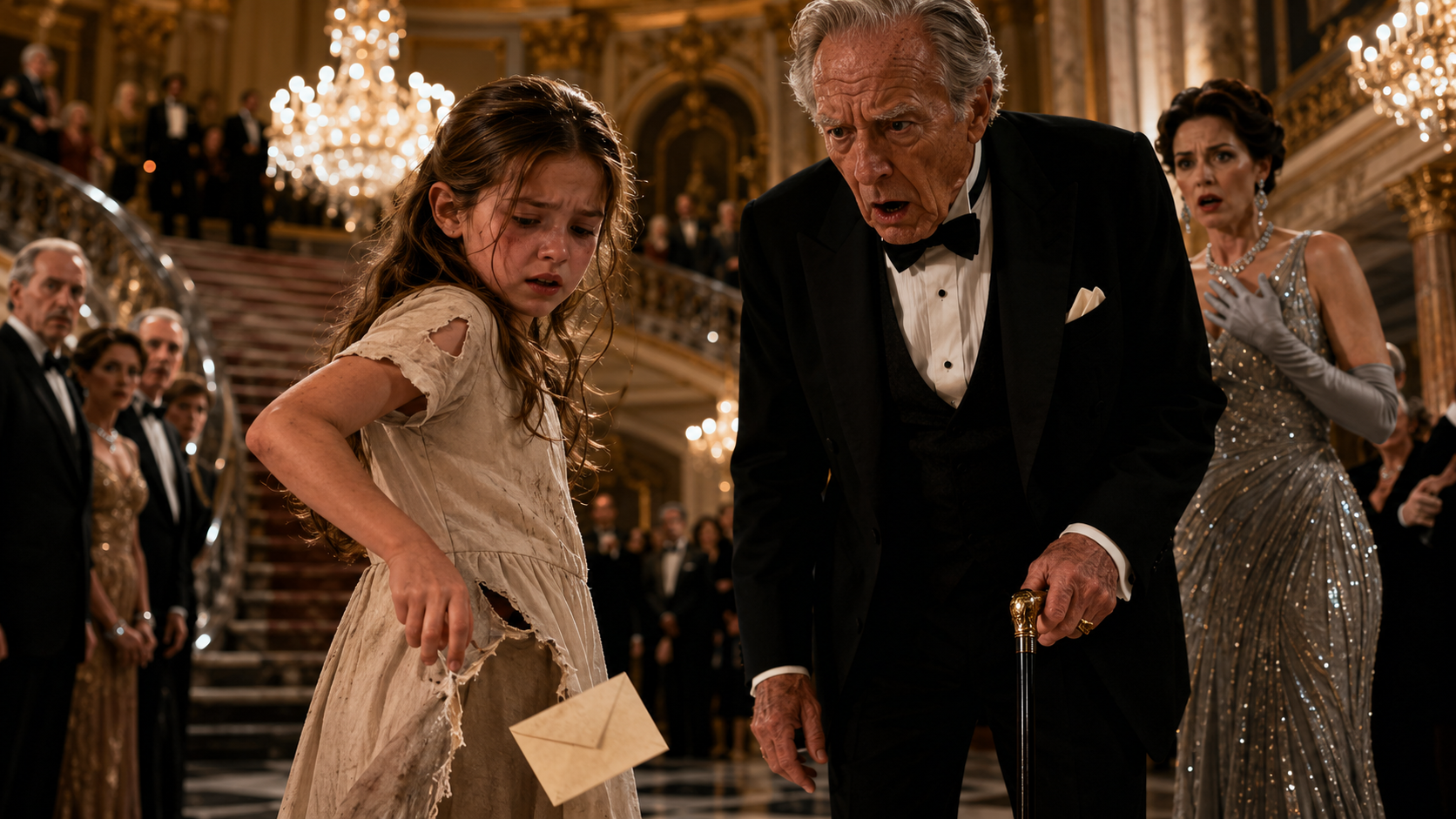
The seam where the letter had fallen was stitched with gold thread now, not to hide the tear, but to mark it.
After Arthur’s speech, Lydia walked to the center of the room.
For a moment, she only stood there.
Then Hannah joined her.
Three hundred guests had watched Hannah be humiliated.
Now hundreds more watched her mother take back her name.
Lydia did not sing.
She did not perform.
She simply spoke.
“My daughter came here hungry,” she said. “She came here afraid. She came here because I told her truth still mattered in this house.”
Her voice trembled.
“I was not sure I believed that when I said it.”
Arthur lowered his head.
Lydia continued.
“But Hannah believed it enough for both of us.”
The applause began softly.
Then grew.
Not polite applause.
Not rich applause.
Human applause.
Messy.
Loud.
Alive.
Hannah looked around the ballroom.
The chandeliers were still there.
The marble was still cold.
The portraits still watched from gilded frames.
But the room felt different.
Not because it had changed.
Because the truth had entered it.
And truth, once spoken, has a way of rearranging every shadow.
Later that night, after the guests had gone and the staff were clearing the last plates, Hannah returned to the grand staircase where she had first stood alone.
Arthur found her there.
He stopped a few steps away.
“May I sit?”
Hannah nodded.
He sat beside her carefully.
For a while, neither spoke.
Then Arthur said, “I have spent months trying to think of what I can give you.”
Hannah looked at him.