They Called Her a Liar in Front of 300 Rich Guests — Then Her Mother’s Hidden Her Dress

The first thing Hannah Vale noticed was the sound of laughter.

Not warm laughter.

Not the kind that came from joy, or comfort, or people who truly liked one another.

This laughter was sharp.

Polished.

Expensive.

It rose beneath the crystal chandeliers of the Kingsley Hall like the clinking of knives against glass. Three hundred guests stood in clusters across the marble floor, dressed in gowns that glittered like frost and tuxedos blacker than the night pressing against the tall windows.

They held champagne flutes.

They wore diamonds.

They spoke softly, because wealthy people never needed to shout to be cruel.

And every single one of them was staring at Hannah.

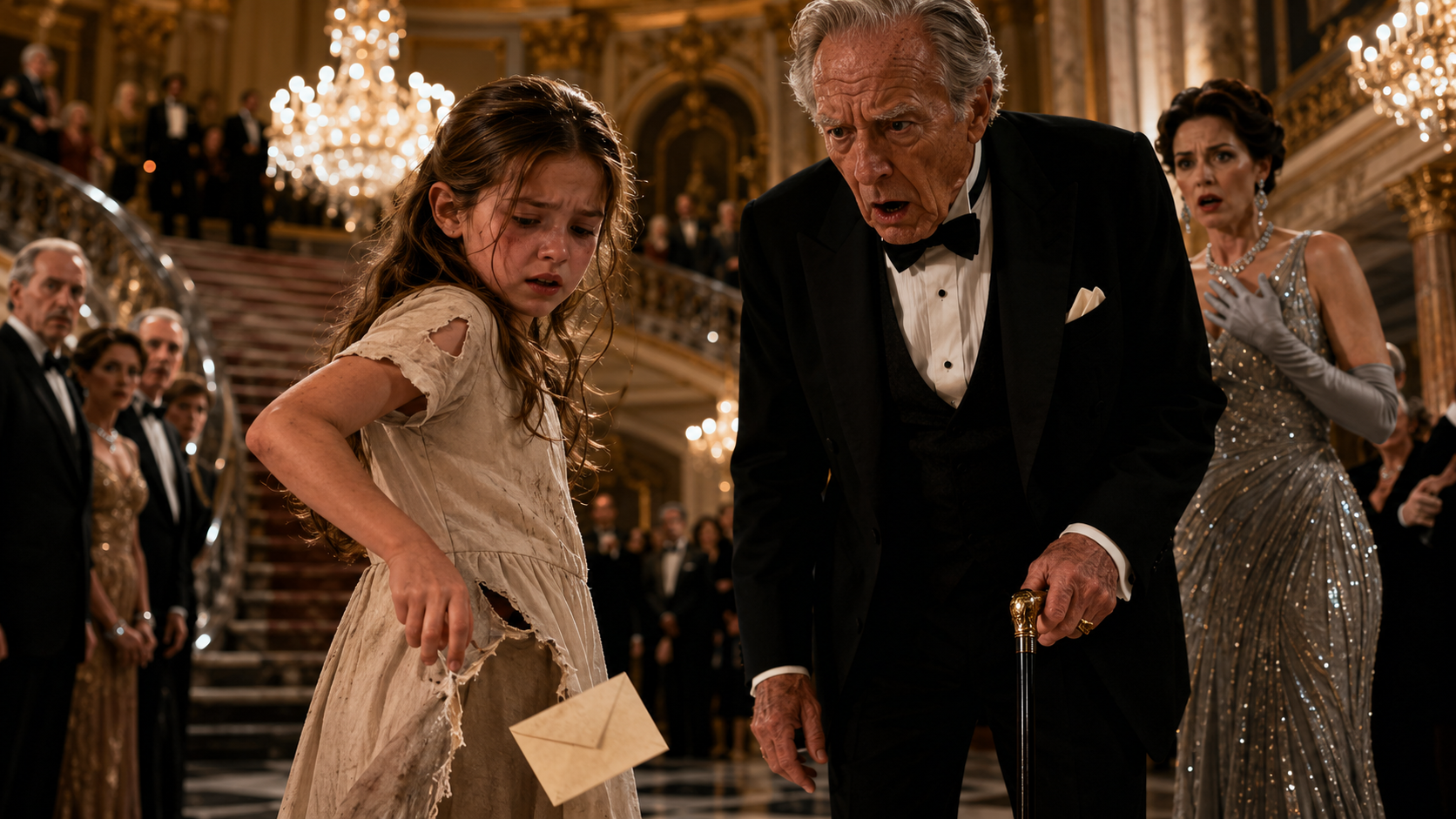
She stood near the grand staircase in a faded ivory dress that had once belonged to her mother. The hem was torn. One sleeve had been mended with thread that did not match. Her shoes were too small, borrowed from a woman at the shelter who had whispered, “At least they’re clean.”

Clean did not mean they fit.

Clean did not stop the blisters.

Clean did not make Hannah belong in a room where one flower arrangement probably cost more than everything she had owned in her life.

A woman in a silver gown stepped forward.

Her name was Margot Ashbourne.

Everyone in the room knew her.

Hannah did not.

But she understood power when she saw it.

Margot’s hair was pinned perfectly. Her diamonds sat at her throat like drops of ice. Her smile was beautiful in the way a locked door was beautiful — smooth, expensive, and impossible to open.

“This child is lying,” Margot said.

The room became still.

At the far end of the ballroom, beside a portrait of the late Eleanor Kingsley, an old man turned slowly.

Arthur Kingsley.

Owner of Kingsley Rail, Kingsley Hotels, Kingsley Charities, and half the buildings whose lights painted the city skyline at night.

He had been about to announce a fifty-million-dollar donation in his wife’s name when Hannah walked through the service entrance.

Hungry.

Shaking.

Carrying only a folded photograph and the last instruction her mother had ever given her.

Find Kingsley Hall.

Ask for Arthur.

Tell him the blue rose still blooms.

At first, no one had listened.

Security had tried to drag her out.

A waiter had told her children were not allowed inside.

Then Hannah had said her mother’s name.

Lydia Vale.

And something in Arthur Kingsley’s face had broken.

Not completely.

Not enough for kindness.

But enough for silence.

Now he stared at Hannah as though she had walked out of a grave.

Margot laughed softly.

“Arthur, please,” she said. “Look at her. Some girl wanders in from the street wearing an old dress, says she knows a private family phrase, and suddenly we’re supposed to believe she belongs here?”

Hannah swallowed.

The ballroom smelled of roses, perfume, candle wax, and food.

So much food.

Silver trays moved through the guests with tiny pastries, lobster bites, roasted figs, slices of beef so tender they nearly fell apart beneath the knives.

Hannah had not eaten since yesterday morning.

A stale bagel.

Half of it.

Because she had given the other half to her mother before remembering that her mother was gone.

No.

Not gone.

Missing.

There was a difference.

A painful one.

A difference Hannah held onto because it was the only thing keeping her standing.

Arthur took one step closer.

“What did you say your name was?” he asked.

His voice was rough.

Hannah’s fingers tightened around the photograph.

“Hannah.”

“Hannah what?”

“Hannah Vale.”

A whisper moved across the ballroom.

Vale.

The name traveled from mouth to mouth like a secret waking up.

Margot’s smile did not move, but her eyes changed.

Only for a second.

Hannah saw it anyway.

Children who grow up afraid learn to read faces quickly.

Margot turned toward the guests.

“Convenient,” she said. “Very convenient. Lydia Vale vanishes years ago in disgrace, and now some child appears during Arthur’s most public charity event? With a dramatic story? In that dress?”

Hannah looked down.

Her mother’s dress had been beautiful once.

Pale ivory satin.

Tiny blue flowers embroidered around the waist.

Her mother had kept it wrapped in brown paper under the bed, even when they had nothing else worth keeping. Even when the landlord banged on the door. Even when Hannah asked why they didn’t sell it.

“Because some things are proof,” Lydia had said.

“Proof of what?”

“That I was loved once.”

Hannah had not understood then.

She was starting to understand now.

Arthur’s gaze dropped to the dress.

His face paled.

“Where did you get that?”

“My mother gave it to me.”

“That dress belonged to—”

“To Lydia,” Hannah said.

The old man closed his eyes.

The room held its breath.

Margot stepped in quickly.

“Arthur, don’t let this become a spectacle.”

“It already is one,” a younger man said.

He stood near the front row, tall, dark-haired, wearing a navy tuxedo and an expression caught somewhere between anger and confusion.

Hannah would later learn his name was Daniel Kingsley.

Arthur’s grandson.

Margot’s nephew by marriage.

A man who had grown up inside the Kingsley family but had never been told the whole truth about it.

Margot gave him a cold look.

“Daniel, this is not your concern.”

He did not look away.

“A child is being humiliated in front of three hundred people. It should be everyone’s concern.”

For the first time that night, someone spoke as if Hannah was human.

Her throat tightened.

Arthur looked back at her.

“You said Lydia was your mother.”

Hannah nodded.

“Where is she?”

That question hurt more than the laughter.

Hannah looked down at the marble floor.

“I don’t know.”

Margot gave a small, victorious sigh.

“There it is.”

Arthur’s voice hardened.

“Let her answer.”

Margot froze.

It was the first time Hannah heard anyone silence her.

Arthur repeated, softer this time, “Where is Lydia?”

Hannah forced herself to speak.

“Three weeks ago, she left our room before sunrise. She said she had found something. Something that could clear her name. She told me if she didn’t come back by midnight, I should wait one day. Then I should come here.”

“What room?” Daniel asked.

Hannah glanced at the guests.

She did not want to say it.

Not here.

Not with all these people wearing clothes that cost more than rent.

Arthur understood before she answered.

His face tightened.

“Where were you living?”

Hannah’s voice was barely more than air.

“Behind St. Agnes Church. In the basement. Sometimes.”

A woman near the front covered her mouth.

Someone whispered, “My God.”

Margot rolled her eyes.

“Oh, very touching.”

Arthur turned on her.

Not loudly.

But something in the room shifted.

“Enough.”

Margot’s lips parted.

He did not let her speak.

“This child says she is Lydia’s daughter. She says Lydia is alive. She is wearing a dress I have not seen in twenty-two years.” His voice shook. “So no, Margot. It is not enough.”

The number struck Hannah.

Twenty-two years.

Her mother had said she left home before Hannah was born.

She had never said how long ago the wound began.

Arthur took another step toward her.

“Did Lydia give you anything?”

Hannah hesitated.

Her mother had given her three things.

The photograph.

The dress.

And one warning.

Do not trust the woman with the silver eyes.

Hannah looked at Margot.

Silver eyes.

Cold eyes.

Eyes that had not shown surprise when Hannah said Lydia’s name.

Only fear.

Hannah reached into the small pocket sewn inside the dress.

The photograph was there.

Old.

Bent at the corners.

She held it out.

Arthur took it carefully.

His hands trembled.

In the photograph, a young woman stood in the garden of Kingsley Hall, laughing beneath a trellis covered in blue roses. She wore the same ivory dress Hannah wore now.

Beside her stood Arthur Kingsley, younger, prouder, one hand resting on her shoulder.

On the back, written in faded ink, were five words.

For my Lydia, always home.

Arthur’s breath caught.

Daniel moved closer.

“Grandfather?”

Arthur did not answer.

He stared at the photograph as if he had forgotten how to breathe.

Margot recovered first.

“A photograph proves nothing,” she said. “Old pictures can be stolen.”

Hannah’s face burned.

“I didn’t steal it.”

“Of course you didn’t.” Margot smiled thinly. “You were probably handed it by whoever sent you.”

“No one sent me.”

“Then who taught you the phrase?”

“My mother.”

“What else did she teach you?” Margot asked. “How to cry on command? How to choose the right night to appear? How to look pitiful enough that an old man forgets reason?”

The guests murmured.

Some looked uncomfortable.

Others leaned closer, hungry for scandal.

Hannah felt suddenly small.

She had survived cold nights.

She had survived hunger.

She had survived watching her mother sew dresses for women who never looked her in the eye.

But this room was different.

This room did not bruise with fists.

It bruised with judgment.

Arthur’s voice was quiet.

“What phrase did Lydia tell you?”

Hannah looked at him.

“The blue rose still blooms.”

Arthur closed his eyes.

The photograph bent slightly in his grip.

Margot went very still.

Daniel noticed.

So did Hannah.

“What does that mean?” Daniel asked.

Arthur opened his eyes.

“It was something my wife used to say.”

“Grandmother?”

Arthur nodded.

“Eleanor planted blue roses in the east greenhouse. They were impossible, everyone told her. Too delicate. Too unnatural. But she kept trying.” A painful smile crossed his face. “When Lydia was little, she used to sneak into the greenhouse and talk to them.”

The room softened around the edges.

For one second, Hannah could see her mother not as the exhausted woman stitching dresses by a broken lamp, but as a little girl among roses, beloved by someone.

Then Margot spoke.

“And because this child knows a family phrase, we ignore reality?”

Arthur looked at her.

“What reality?”

Margot’s voice sharpened.

“The reality that Lydia stole from this family. The reality that she ran away rather than face what she had done. The reality that she broke your heart once already.”

Arthur flinched.

Hannah did not understand everything.

But she understood enough.

“My mother didn’t steal anything.”

Margot turned on her.

“You do not get to stand in this house and speak about things you know nothing about.”

“My mother said she was framed.”

A gasp rippled across the room.

Margot’s expression darkened.

Arthur’s face changed.

Daniel looked from Hannah to Margot.

“Framed by whom?”

Hannah’s mouth went dry.

Her mother’s warning burned in her mind.

Do not trust the woman with the silver eyes.

But fear held her still.

Margot stepped closer.

“You should think very carefully before you answer, little girl.”

Arthur’s cane struck the marble once.

The sound cracked through the ballroom.

“You will not threaten her.”

Margot’s smile returned, but now it looked forced.

“I am protecting you.”

“No,” Arthur said slowly. “You are protecting something.”

The air changed.

Hannah felt it.

The guests felt it.

Even the musicians near the balcony lowered their instruments.

Arthur turned to Hannah again.

“Did Lydia tell you who framed her?”

Before Hannah could answer, someone bumped into her from behind.

A guest.

A woman trying to move closer.

Hannah stumbled.

The old stitches near her waist tore.

Something slipped from inside the lining of the dress.

A cream envelope.

It fell onto the marble floor between Hannah and Arthur.

The entire ballroom went silent.

Hannah stared at it.

She had never seen it before.

Her mother had sewn something into the dress.

Not just memory.

Not just proof that she had once belonged somewhere.

A letter.

Margot saw it too.

All color drained from her face.

Arthur bent slowly.

But Daniel reached it first.

He picked up the envelope and froze.

“What is it?” Arthur asked.

Daniel turned it over.

The handwriting was faded but clear.

To my father, if I do not survive the truth.

Arthur made a sound Hannah would remember for the rest of her life.

Not a word.

Not a cry.

Something deeper.

A sound from a place grief had kept locked for twenty-two years.

Margot whispered, “That could be forged.”

Daniel looked at her.

“You haven’t even seen what’s inside.”

Her jaw tightened.

Arthur held out his hand.

Daniel gave him the envelope.

The old man did not open it immediately.

He stared at his daughter’s handwriting.

Then he looked at Hannah.

“May I?”

Hannah nodded.

It was strange.

The letter had been hidden in her dress.

But somehow it belonged to him too.

Arthur opened it carefully.

The paper unfolded with a soft crackle.

He read the first line.

His face collapsed.

The room waited.

Three hundred people who had come to donate money, show off jewelry, and pretend generosity made them good.

Now they watched an old man read a letter from the daughter he had cast out.

Arthur’s voice shook when he finally spoke.

“She says…” He stopped.

His eyes filled.

Daniel moved beside him.

Arthur swallowed and continued.

“She says she did not take the Kingsley Sapphire.”

A wave of whispers swept the ballroom.

“The Kingsley Sapphire?” someone said.

“That was Lydia?”

“I thought she stole it.”

“She disappeared the same night.”

Hannah looked at the guests.

So that was the story.

Her mother had never told her the name of the thing they accused her of stealing.

Only that one lie had destroyed everything.

Arthur read silently for another moment.

Then his eyes lifted to Margot.

Margot stood motionless.

A statue in silver.

Arthur’s voice became colder.

“She says she saw who took it.”

Daniel’s eyes narrowed.

“Who?”

Arthur did not answer him.

He was still looking at Margot.

“She says she saw you.”

The room exploded.

Gasps.

Whispers.

A glass dropped somewhere and shattered.

Margot laughed once.

Too loudly.

Too quickly.

“That is absurd.”

Arthur kept reading.

“She says you told her no one would believe her.”

Margot’s eyes flashed.

“She was unstable.”

“She says you locked her in the east greenhouse until after midnight.”

“That is a lie.”

“She says when she escaped and tried to come to me, my study door was guarded.”

Margot’s breathing changed.

Arthur’s voice dropped.

“She says the guard told her I never wanted to see her again.”

The old man looked up.

“I never gave that order.”

Margot’s mask slipped.

Only for a second.

But a second was enough.

Daniel saw it.

Arthur saw it.

Hannah saw it.

The guests saw it too.

Margot lifted her chin.

“Arthur, you were grieving Eleanor. Lydia was reckless. She had already embarrassed the family more than once. I did what I had to do to protect this house.”

The words hung there.

Not a denial.

Not exactly.

Daniel stepped forward.

“What did you do?”

Margot’s eyes cut to him.

“Stay out of this.”

“No.”

For the first time, Daniel sounded like a Kingsley.

Not rich.

Not polished.

But firm.

“No more secrets.”

Arthur looked back at the letter.

“There is more.”

Hannah’s heart pounded.

The ballroom walls seemed to lean inward.

Arthur read the final paragraph.

Then he closed his eyes.

“She says if the letter is found, the proof is where the roses died.”

Hannah frowned.

“Where the roses died?”

Arthur looked toward the tall windows.

Beyond them, past the terrace and the black winter trees, a glass structure stood in darkness.

The east greenhouse.

Margot took one step back.

No one else seemed to notice.

Hannah did.

Arthur folded the letter with trembling hands.

“Daniel.”

“Yes?”

“Call the police.”

Margot’s head snapped toward him.

“Arthur.”

He ignored her.

“Tell them to send detectives. Not private security. Police.”

“You cannot be serious.”

Arthur looked at her.

“For twenty-two years, I believed my daughter betrayed me. Tonight, a child walked into this house wearing Lydia’s dress and carrying Lydia’s truth sewn into the lining.” His voice broke, then hardened. “I have never been more serious.”

Margot’s composure cracked.

“This is madness.”

“No,” Daniel said. “Madness was letting a child stand barefoot in a ballroom while everyone laughed at her.”

Hannah looked down.

Her borrowed shoes had slipped off when she stumbled.

Her feet were visible against the marble.

Small.

Red.

Blistered.

Arthur saw them.

Something like shame moved across his face.

He turned to a nearby servant.

“Bring her a chair. Food. A blanket. Now.”

Hannah stiffened.

“I don’t need—”

“Yes,” Arthur said gently. “You do.”

She hated that he was right.

A chair appeared.

Then a blanket.

Then a bowl of soup with steam curling above it.

Hannah sat at the edge of the chair, uncertain whether she was allowed to touch anything.

Daniel crouched beside her.

“You can eat.”

She looked at him.

His voice softened.

“No one here is going to stop you.”

Hannah picked up the spoon.

Her hand shook.

The first mouthful nearly made her cry.

Not because it tasted good.

Because it was warm.

Because someone had handed it to her without asking what she could pay.

Arthur watched every bite.

Each one seemed to wound him.

Good, a hard part of Hannah thought.

Let it hurt.

Let him see what Lydia’s daughter became while he lived behind gates and chandeliers.

But another part of her — the child part, the lonely part — wished he would sit beside her and say he was sorry.

He did sit.

Slowly.

Carefully.

As if approaching a frightened animal.

“I did not know about you,” he said.

Hannah stared at the soup.

“My mother said you wouldn’t want to.”

Arthur flinched.

“I deserved that.”

Hannah looked at him then.

Adults did not usually accept painful truths.

They argued.

Denied.

Explained.

Arthur did none of those things.

He looked old.

Not powerful.

Not untouchable.

Just old.

“What happened to her?” he asked.

Hannah swallowed.

“She worked all the time. Sewing. Cleaning. Sometimes singing at a little restaurant when they needed someone. She said she almost came back once when I was six.”

Arthur’s hands tightened.

“What stopped her?”

Hannah looked toward Margot.

Margot was speaking quietly to a security guard near the far wall.

Daniel noticed too.

He stood immediately.

“Keep her here,” he told the guard closest to him.

Margot turned.

“Excuse me?”

Daniel’s voice was sharp.

“You are not leaving.”

The guests murmured again.

Margot laughed.

“You think I would run?”

“I think innocent people usually don’t panic when letters fall out of children’s dresses.”

Her face hardened.

“You insolent boy.”

Arthur stood.

“He is right.”

Margot looked at him.

For the first time, fear showed plainly.

Not fear of being disliked.

Not fear of scandal.

Fear of consequences.

Arthur turned to Hannah.

“Can you walk?”

She nodded, though her feet burned.

Daniel noticed.

“Wait.”

He removed his dress shoes and placed them near her feet.

“They’ll be too big,” he said awkwardly. “But better than the marble.”

Hannah stared at the shoes.

No one had ever taken off their own comfort and given it to her.

Not in a room like this.

Not in front of people.

She slipped her feet inside.

They were enormous.

Warm.

Ridiculous.

Daniel offered his arm.

She hesitated.

Then took it.

Together, they followed Arthur toward the terrace doors.

Behind them came Margot, two guards, half a dozen family members, and more guests than anyone invited, because scandal moved faster than shame.

Outside, the cold hit Hannah like a slap.

The garden was dark except for lanterns along the stone path.

Snow had begun to fall.

The east greenhouse stood ahead, its glass panels clouded with frost and age. Once, it must have been beautiful. Now vines crawled over the frame. Dead stems pressed against the panes like fingers.

Arthur stopped before the door.

“I locked this place after Eleanor died,” he said quietly. “Lydia used to come here anyway.”

Margot’s voice cut through the cold.

“This is pointless.”

Arthur looked at her.

“Then you should have nothing to fear.”

Daniel found the old brass key beneath a loose stone, exactly where Arthur said the gardeners used to keep it.

The greenhouse door opened with a groan.

Inside, the air smelled of soil, dust, and forgotten rain.

Rows of dead planters stretched beneath the glass roof.

At the far end stood a stone fountain shaped like a woman holding roses in her skirt. The water had long since dried.

Arthur walked toward it as if pulled by memory.

“The blue roses were here,” he whispered.

Hannah looked around.

Where the roses died.

Her mother’s words.

She stepped closer to the fountain.

The base was cracked.

Inside the crack, something blue caught the light.

Not a rose.

A ribbon.

Hannah knelt.

Her fingers dug into the dirt and dried leaves.

Daniel crouched beside her.

“Careful.”

Together, they pulled loose a small metal box wrapped in oilcloth.

Arthur stopped breathing.

Margot made a tiny sound.

It was enough.

Daniel turned.

“You knew it was there.”

“I knew nothing.”

But her voice was thin now.

Hannah held the box.

It was heavier than it looked.

There was no lock.

Only rust around the lid.

Arthur reached for it, then stopped.

“No,” he said. “Lydia left this trail. Hannah should open it.”

Everyone looked at her.

For once, not with mockery.

With expectation.

With fear.

With hope.

Hannah opened the box.

Inside lay a stack of documents sealed in plastic, a velvet pouch, and a small silver recorder.

Arthur picked up the papers first.

His face changed as he read.

Receipts.

Bank transfers.

A handwritten note signed by a man named Elias Reed.

Daniel looked over his shoulder.

“What is it?”

Arthur’s jaw clenched.

“Payment records.”

“To whom?”

Arthur looked at Margot.

“To the man hired to remove the sapphire from the house.”

Margot’s face went white.

The old man opened the velvet pouch.

A blue stone slid into his palm.

The Kingsley Sapphire.

Even in the weak greenhouse light, it burned with a deep, impossible glow.

The guests at the door gasped.

Hannah stared.

This tiny thing had ruined her mother’s life.

This bright cold stone had stolen birthdays, bedrooms, safety, family.

It had made Lydia Vale a thief in every mouth that mattered.

Arthur looked as if he might collapse.

Daniel caught his arm.

Then the recorder clicked.

Hannah had touched it by accident.

Static filled the greenhouse.

Then a young woman’s voice.

Shaking.

Breathless.

But unmistakably her mother’s.

“My name is Lydia Kingsley Vale. If this is found, then I was right to be afraid.”

Arthur covered his mouth.

Hannah froze.

She had heard her mother tired.

Angry.

Gentle.

Sick.

Singing softly in the dark.

But never like this.

Young.

Terrified.

Alone.

The recording continued.

“I did not steal the Kingsley Sapphire. I saw Margot Ashbourne take it from my father’s private case during the memorial gala. I followed her to the service corridor. She gave it to Elias Reed and told him to keep it hidden until after the inheritance papers were signed.”

Margot whispered, “No.”

The recorder kept playing.

“When she saw me, she smiled. She said my father was too broken by my mother’s death to choose me over peace. She said if I spoke, she would make sure I lost everything.”

Arthur made a sound like pain leaving the body.

Lydia’s recorded voice broke.

“She was right. By morning, everyone believed I was a thief. My father would not see me. The guards said he ordered me out. I waited in the rain for four hours. He never came.”

Arthur whispered, “I didn’t know.”

No one answered.

Because what could anyone say?

The recording continued.

“I came back years later with my daughter. I wanted him to know her. I wanted to believe blood could still call to blood. Margot met me at the gate. She said if I ever brought my child near the Kingsley name, she would bury us both.”

Hannah’s breath caught.

She remembered that day.

Not clearly.

She had been six.

Rain.

Iron gates.

Her mother’s hand gripping hers too tightly.

A woman in a black coat bending down and touching Hannah’s cheek with fingers cold as coins.

“What a pretty little mistake,” the woman had said.

Hannah had forgotten the words until now.

The recorder played Lydia’s final message.

“If Hannah finds this, my sweet girl, I am sorry. I wanted to give you a family, not a war. But if I am gone, remember this: you are not the lie they call you. You are the truth they feared.”

The recording ended.

The greenhouse was silent except for Hannah’s breathing.

Arthur was crying.

Not neatly.

Not quietly.

The kind of crying that made rich men look no different from poor ones.

Daniel turned to Margot.

“You threatened a child.”

Margot lifted her chin.

The mask returned, but badly.

“She was protecting a thief.”

Arthur looked at her.

“My daughter was innocent.”

“She was weak.”

“She was my daughter.”

Margot’s eyes flashed.

“She was in the way.”

The words came out before she could stop them.

The greenhouse went still.

Daniel stared at her.

Arthur’s face emptied.

Hannah felt something cold settle in her stomach.

There it was.

The truth, not hidden in letters or boxes or recordings.

Just standing there in diamonds, finally tired of pretending.

Margot looked around and realized what she had said.

“I mean—”

Arthur’s voice was quiet.

“Take her inside.”

The guards moved.

Margot stepped back.

“You would arrest me? After everything I did for this family?”

Arthur looked at the sapphire in his palm.

“You did nothing for this family. You fed on it.”

Her face twisted.

“I kept your name clean.”

“No,” he said. “You taught me to value a clean name more than a living child.”

The guards took her arms.

Margot fought then.

Not gracefully.

Not like a queen.

Like a trapped animal.

“You think this changes anything?” she spat. “Lydia is gone. The city remembers what it remembers. That girl will always be street trash in a stolen dress.”

Hannah flinched.

Arthur stepped forward.

For a second, he looked like the man people feared in boardrooms.

“No,” he said. “She is my granddaughter.”

The word struck Hannah harder than the insult.

Granddaughter.

It should have felt warm.

Instead, it felt strange.

A grandfather was supposed to know your birthday.

A grandfather was supposed to show up before hunger carved hollows beneath your eyes.

A grandfather was supposed to exist somewhere other than a locked mansion and a story your mother was afraid to tell.

Arthur turned to her.

“Hannah—”

“Find my mother,” she said.

The words came out before she could stop them.

Arthur went still.

Hannah’s voice shook.

“You want to fix something? Find her.”

Arthur looked at the box.

The sapphire.

The papers.

The recorder.

Then at Hannah.

“I will.”

“Don’t promise if rich people promises are just words.”

Daniel looked down.

Arthur took the blow.

He deserved it.

“You are right,” he said. “Then I will not promise. I will act.”

And for the first time that night, Hannah believed he might mean it.

By midnight, police cars lined the drive of Kingsley Hall.

The guests were sent home with scandal in their mouths and shame on their faces.

The reporters arrived before dawn.

Margot Ashbourne’s arrest became the city’s favorite headline.

But Hannah did not care about headlines.

She cared about one thing.

Her mother.

Arthur opened rooms that had been locked for decades.

He gave detectives names.

Records.

Access.

Money.

Not charity money.

Not the kind rich people gave loudly.

Quiet money.

Fast money.

The kind that moved private investigators, hospitals, shelters, train stations, security archives, and old police files.

For the first week, Hannah stayed in a guest room larger than their entire basement space at St. Agnes.

The bed was too soft.

The ceiling too high.

The silence too complete.

She slept on the rug the first night.

Daniel found her there at dawn.

He did not laugh.

He only brought a blanket and sat near the door until she woke.

“You don’t have to sleep on the floor,” he said gently.

Hannah pulled the blanket tighter.

“I know.”

But knowing did not make the bed feel safe.

Arthur came every morning.

He knocked before entering.

Always.

As if permission mattered now.

Sometimes he brought food.

Sometimes news.

Sometimes only guilt.

Hannah preferred the food.

Guilt was heavy.

She already carried enough of it.

One morning, he placed a small plate of toast beside her and said, “Your mother used to hate orange marmalade.”

Hannah looked at him.

“She loved orange marmalade.”

Arthur blinked.

Then he smiled sadly.

“She hated it when she was seven.”

“She changed.”

“Yes,” he whispered. “I suppose she did.”

That was how they learned each other.

Not all at once.

Not with hugs and forgiveness and music swelling like in stories.

Through crumbs.

Details.

Small facts passed across breakfast trays.

Lydia liked rain.

Lydia hated thunder.

Lydia sang when she was nervous.

Lydia burned soup but made perfect bread.

Lydia kept every birthday candle Hannah had ever blown out because she said wishes deserved evidence.

Arthur listened to every word like a starving man.

Sometimes Hannah wanted to punish him by stopping.

Sometimes she wanted to give him everything because it hurt less than holding it alone.

Three weeks passed.

Then five.

Winter deepened.

The city moved on to other scandals.

Margot’s lawyers denied everything.

Elias Reed, the man from the records, was found in a coastal town under another name. He confessed after detectives showed him the recording.

But Lydia remained missing.

Hannah began to fear the world had swallowed her mother completely.

Then, on a Tuesday morning in February, Daniel ran into the breakfast room without knocking.

Arthur stood so fast his chair fell backward.

“What?”

Daniel held up his phone.

“They found someone.”

Hannah could not move.

The room tilted.

Daniel’s voice shook.

“A woman was admitted to a charity clinic outside Albany six weeks ago. No identification. Head injury. She gave the name Laura, but yesterday one of the nurses saw Hannah’s picture in an article. She thought the woman looked like her.”

Arthur gripped the table.

“And?”

Daniel looked at Hannah.

“When the nurse said the name Hannah, the woman started crying.”

The drive to Albany was a blur.

Snow on the windshield.

Arthur’s hand trembling on his cane.

Daniel making phone calls.

Hannah sitting in the back seat with her mother’s photograph pressed between both palms.

She tried not to hope too much.

Hope was dangerous.

Hope made the fall longer.

At the clinic, a nurse led them down a narrow hallway that smelled of antiseptic and boiled coffee.

Room 18.

The door was half open.

A woman sat by the window.

Her hair was shorter.

Her cheek was thinner.

A pale scar crossed one eyebrow.

But Hannah knew her before she turned around.

Some truths live deeper than memory.

“Mom?”

The woman stood.

For one second, neither of them moved.

Then she said Hannah’s name.

Not as a question.

Not like a stranger.

Like a prayer finally answered.

“Hannah.”

Hannah ran.

Lydia fell to her knees just in time to catch her.

The sound she made was not crying exactly.

It was grief and relief breaking apart in the same breath.

Hannah clung to her so tightly her fingers hurt.

Lydia held her like the world might steal her again if she loosened her arms.

Arthur stayed in the doorway.

For once, he understood the moment did not belong to him.

Only after a long time did Lydia look up.

Her eyes found him.

Everything changed.

Fear first.

Then anger.

Then pain so old it seemed to have bones.

Arthur stepped forward.

“Lydia.”

She flinched.

He stopped immediately.

“I know,” he said.

Tears slid down her face.

“Do you?”

His voice broke.

“Yes. I know what Margot did. I know what I believed. I know what it cost you.”

Lydia’s hand tightened on Hannah’s back.

Arthur lowered his head.

“I am sorry.”

The words were too small.

Everyone knew it.

Sorry did not return twenty-two years.

Sorry did not warm cold rooms.

Sorry did not erase the nights Lydia had gone hungry so Hannah could eat.

Sorry did not undo the gate closing in the rain.

But it was the first honest stone in a bridge that had never been built.

Lydia looked at him for a long time.

Then she said, “I needed you.”

Arthur closed his eyes.

“I know.”

“I wrote to you.”

“I never saw the letters.”

“I came home.”

“I was told you never did.”

“I begged them to let me see you.”

His face crumpled.

“I would have opened the door.”

Lydia shook her head.

“But you didn’t look for me.”

That landed hardest.

Because it was not about Margot.

Not about lies.

Not about forged orders or stolen letters.

It was about a father who believed the worst too easily.

Arthur had no defense.

So he gave none.

“No,” he whispered. “I didn’t.”

Lydia looked away.

Hannah felt her mother shaking.

“Can we leave?” Hannah asked softly.

Lydia kissed her hair.

“Yes.”

Arthur stepped aside.

He did not ask for forgiveness that day.

He did not ask Lydia to come home.

He only paid the clinic bill, arranged a doctor, and waited outside in the snow while his daughter and granddaughter walked past him.

That was the beginning.

Not a happy ending.

Not yet.

Real families do not heal because one secret is exposed.

They heal slowly.

Messily.

With anger at breakfast.

With silence in hallways.

With doors left open a little longer each week.

Lydia moved into a small house on the edge of the Kingsley estate, not the mansion.

“I spent too many years dreaming of that house,” she told Hannah. “I won’t live inside it until I know it doesn’t own me.”

Arthur accepted that.

He visited.

He knocked.

He brought old photo albums and left when Lydia got tired.

Sometimes she yelled.

Sometimes he cried.

Sometimes Hannah sat between them and wondered how love could survive so much damage and still be love.

Daniel became the easiest part of the new life.

He taught Hannah how to ride a bicycle in the long driveway.

He burned pancakes every Sunday.

He called himself her cousin, then corrected it to uncle, then gave up and said, “Family is confusing. Just yell when you need me.”

Hannah did.

Often.

Margot’s trial lasted four months.

The courtroom was full every day.

Reporters wrote about greed, betrayal, inheritance, and the downfall of one of the city’s most admired women.

But Hannah remembered something different.

She remembered sitting beside her mother while Lydia testified.

Her mother’s hands shook at first.

Then steadied.

Margot watched from the defense table, dressed in black, still trying to look untouchable.

But she looked smaller without the ballroom.

Without diamonds.

Without people stepping aside.

Lydia told the truth.

All of it.

The stolen sapphire.

The locked greenhouse.

The false orders.

The threats.

The gate.

The years of exile.

When the prosecutor played the recording, the courtroom went silent.

Arthur wept openly.

This time, no one looked away.

Margot was found guilty on fraud, conspiracy, evidence tampering, and intimidation charges.

The city called it justice.

Lydia called it late.

Six months after the night Hannah walked into Kingsley Hall, Arthur reopened the ballroom.

Not for a gala.

Not for donors.

Not for wealthy guests pretending kindness was a performance.

He opened it for the people who had never been invited inside.

Shelter families.

Church volunteers.

Nurses from the clinic.

Food bank workers.

Children from St. Agnes.

The cooks, drivers, cleaners, gardeners, and seamstresses who had kept grand houses running while standing outside their stories.

There were no champagne towers.

No velvet ropes.

No photographers allowed near the children.

At the front of the ballroom stood a new plaque beneath Eleanor Kingsley’s portrait.

For Lydia Vale and Hannah Vale.
For every truth buried by power.
For every child who deserves to be believed.

Arthur stood onstage before the evening began.

He looked older now.

Less polished.

More human.

“This hall spent too many years honoring wealth,” he said. “Tonight, it will honor survival.”

He looked at Lydia.

Then at Hannah.

“And the courage it takes to come home when home has failed you.”

Lydia squeezed Hannah’s hand.

No one laughed now.

No one called her a liar.

No one looked at her torn dress and saw shame.

The dress had been repaired, but not remade.

Lydia insisted on that.

“Scars are part of evidence,” she said.

Hannah wore it again that night.

The ivory satin.

The blue embroidered flowers.

The seam where the letter had fallen was stitched with gold thread now, not to hide the tear, but to mark it.

After Arthur’s speech, Lydia walked to the center of the room.

For a moment, she only stood there.

Then Hannah joined her.

Three hundred guests had watched Hannah be humiliated.

Now hundreds more watched her mother take back her name.

Lydia did not sing.

She did not perform.

She simply spoke.

“My daughter came here hungry,” she said. “She came here afraid. She came here because I told her truth still mattered in this house.”

Her voice trembled.

“I was not sure I believed that when I said it.”

Arthur lowered his head.

Lydia continued.

“But Hannah believed it enough for both of us.”

The applause began softly.

Then grew.

Not polite applause.

Not rich applause.

Human applause.

Messy.

Loud.

Alive.

Hannah looked around the ballroom.

The chandeliers were still there.

The marble was still cold.

The portraits still watched from gilded frames.

But the room felt different.

Not because it had changed.

Because the truth had entered it.

And truth, once spoken, has a way of rearranging every shadow.

Later that night, after the guests had gone and the staff were clearing the last plates, Hannah returned to the grand staircase where she had first stood alone.

Arthur found her there.

He stopped a few steps away.

“May I sit?”

Hannah nodded.

He sat beside her carefully.

For a while, neither spoke.

Then Arthur said, “I have spent months trying to think of what I can give you.”

Hannah looked at him.

He smiled sadly.

“Money is the easy answer. A home. School. Safety. All things you should have had already.”

She said nothing.

He took a folded paper from his coat pocket.

Not old.

Not hidden.

New.

“I started a trust in your mother’s name. For children who are not believed. Legal help. Housing. Food. Medical care. No speeches. No galas required.”

Hannah looked at the paper.

Then at him.

“That’s good.”

He nodded.

“It is not enough.”

“No.”

The honesty surprised him.

Then he smiled.

“You are very much Lydia’s daughter.”

Hannah looked toward the ballroom floor.

“I used to think if I found you, everything would be fixed.”

Arthur’s face softened with pain.

“And now?”

“Now I think some things don’t get fixed.” She touched the gold-stitched seam of her dress. “They get carried differently.”

Arthur was quiet.

Then he whispered, “Will you let me carry some of it?”

Hannah did not answer quickly.

She thought of cold nights.

Of her mother’s tired hands.

Of Margot’s silver eyes.

Of laughter under chandeliers.

Of soup warming her empty stomach.

Of Daniel’s oversized shoes.

Of the letter falling from the dress like her mother’s voice refusing to stay buried.

Finally, Hannah said, “You can start by remembering her birthday.”

Arthur nodded.

“June twelfth.”

Hannah looked at him.

He swallowed.

“I never forgot.”

For the first time, Hannah believed him.

Not fully.

Not enough to erase anything.

But enough for one small beginning.

Outside, beyond the terrace, the east greenhouse glowed with new lights.

The dead planters had been cleared.

Fresh soil waited in rows.

Lydia had asked for blue roses again.

The gardeners warned her they were difficult.

Almost impossible.

Lydia smiled when they said it.

“So was coming back,” she replied.

Hannah stood and walked to the window.

Arthur joined her.

Together, they looked out at the greenhouse.

At the place where a lie had been buried.

At the place where truth had survived under dirt, frost, and years of silence.

The first rose would not bloom until spring.

But Hannah already knew it would.

Because some things looked too fragile to survive.

A child in a torn dress.

A mother with a stolen name.

A letter hidden in a seam.

A blue rose in winter.

But fragile did not mean weak.

And silence did not mean the story was over.

They Called Her a Liar in Front of 300 Rich Guests — Then Her Mother’s Hidden Her Dress
Jennifer Aniston revealed a surprising fact while working out at a $21 million luxury mansion – amid rumours of an affair with Pedro Pascal