Grief has a way of warping time. It does not move forward in a clean line; it loops, pulling you back into the moments that shattered everything. For Erin, a forty-year-old mother whose world had revolved around her ten-year-old daughter, Lily, the past three weeks had dissolved into a colorless haze. Lily had been the bright center of their family—messy art projects spread across the table, sunflower sketches taped to the wall, and a laugh that could cut through even the darkest mood. That light was taken on a rain-slicked Saturday morning, when a loss of control on the road turned a routine drive to art class into a tragedy Erin could barely name.
Erin’s husband, Daniel, lived through the crash, though “lived” felt like an overstatement for the man who came home from the ICU. He moved through the house like someone half-awake, his body wrapped in bandages and bruises, his eyes carrying something far heavier. He was crushed by survivor’s guilt, certain that missing the sight of a truck approaching around a wet curve was a mistake he could never atone for. Their home, once filled with the everyday rhythm of childhood, had become painfully still. Lily’s room remained exactly as she left it: a sunflower drawing only partly colored on her desk, fairy lights draped along the window, art supplies arranged for hands that would never return.
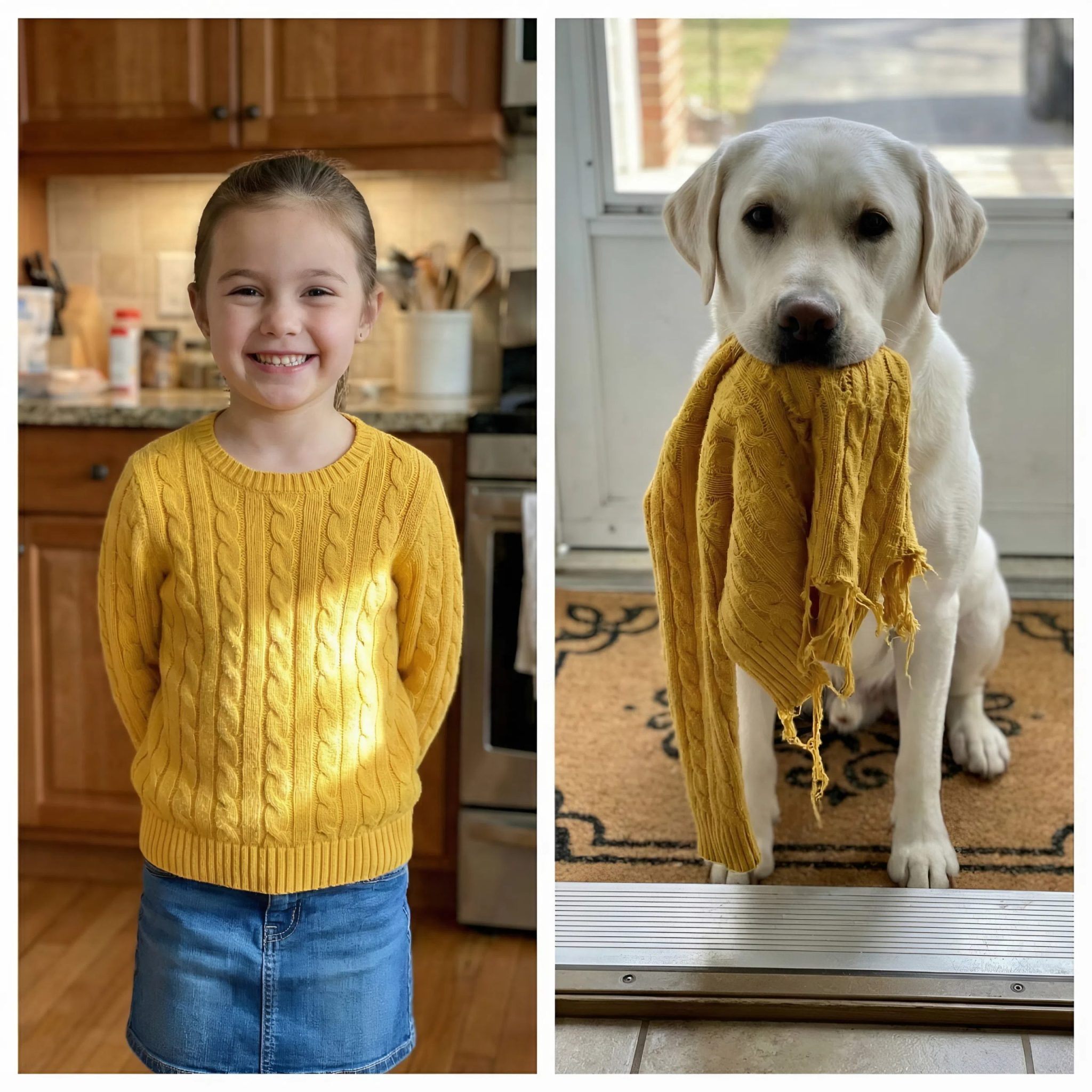
In the days after the accident, the police gathered Lily’s belongings from the scene as part of the investigation. Erin could still feel the sterile chill of the evidence room, the scratch of a pen as she signed forms to reclaim the last objects her daughter had carried: a glittery backpack, a headband, and the yellow sweater. That sweater was more than clothing—it was Lily’s signature. Bright, soft, finished with tiny pearl buttons, it made her look like a walking sunbeam. Knowing it had been sealed away in a plastic bag, stored in darkness, felt like losing her all over again.

Exactly three weeks after the crash, a heavy silver fog clung to their backyard. Erin sat at the kitchen table with both hands wrapped around a “Best Mom Ever” mug—a Mother’s Day gift from Lily that now felt like a sacred artifact. She stared into the gray haze until a sudden sound broke through the silence: frantic, rhythmic scratching at the back door.
It was Baxter, the family’s golden retriever mix and Lily’s devoted companion for five years. Baxter usually stayed outside by choice. He liked the porch and the yard, and he never clawed at the door like this. Erin opened it expecting to find him hurt—or perhaps a stray animal at the steps. Instead, her legs nearly gave out.
Baxter stood rigid at the threshold, eyes wide with urgent intent. In his mouth was a bundle of bright yellow fabric.
When he dropped it at Erin’s feet, a raw gasp tore out of her. It was the sweater. The same shade of yellow. The same pearl buttons. For a breathless moment, her mind fought to make sense of it—had the police returned it without telling her? Had she imagined the whole evidence-room exchange? But when she bent down, Baxter snatched it back up, barked once—sharp and insistent—and turned toward the foggy yard as if giving an order.

Erin followed without thinking. She didn’t grab a coat. She shoved her feet into clogs and chased the flash of Baxter’s fur through the mist. He led her straight to a loose slat in the back fence—a gap Lily had once treated like a secret doorway into the overgrown, empty lot next door. Erin hadn’t set foot there in years, but Baxter moved as if he knew the route by heart.
He stopped at a battered garden shed tucked into a corner of the lot. The door hung crookedly from a single rusted hinge. Baxter stepped inside and waited.
Erin hesitated only long enough for her eyes to adjust to the dim light filtering through warped boards. Then her heart lurched into her throat.
In the far corner, partially hidden behind stacked flowerpots, was something that made the world tilt.
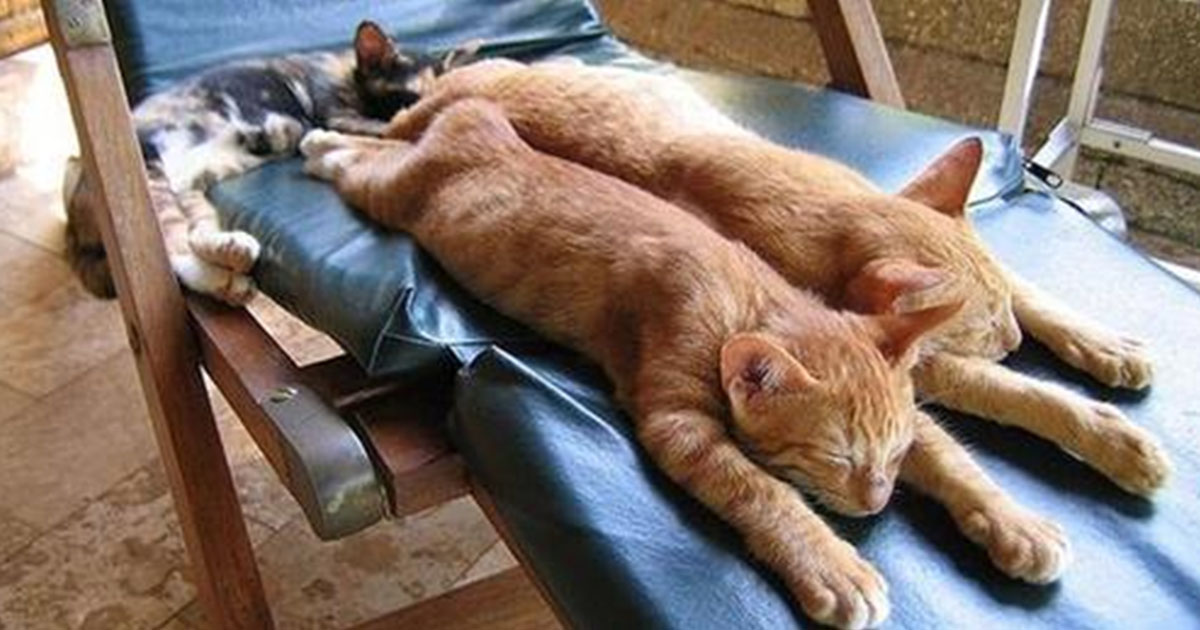
It was a nest—carefully built, not from straw or leaves, but from Lily’s clothing. Items Erin hadn’t even realized were gone: a purple scarf, a blue hoodie, a soft cardigan from second grade. In the middle of this makeshift shelter lay a thin calico cat, her sides rising and falling in calm rhythm. Pressed against her were three tiny kittens, eyes barely open, drawn toward warmth—and the yellow sweater Baxter had just carried in.
Understanding hit Erin like a physical blow. This wasn’t the sweater the police had taken. This was Lily’s second yellow sweater, a backup Erin had bought months earlier. Lily hadn’t been sneaking away to cause trouble. She had been protecting something small and vulnerable in secret. She had found a pregnant stray and spent her final weeks building a safe, warm haven for a family that had nowhere else to go. Baxter hadn’t brought Erin an object from the past—he had led her to a living proof of who Lily was.
“You took care of them,” Erin whispered, sinking to the dirt floor. “Oh, Lily… you were taking care of them all along.”
When Erin reached out, the mother cat didn’t flinch. She watched Erin steadily, as if she had been waiting for the grown-up version of the girl who used to bring food and soft fabric to appear. Baxter nudged Erin’s elbow, tail wagging for the first time since the accident. It was as though he had carried out the last task Lily could no longer finish.
Erin gathered the cat and kittens and carried them home. That evening, when Daniel finally came downstairs, he found Erin sitting on the floor surrounded by towels and the quiet, insistent sounds of new life. The yellow sweater lay draped over a laundry basket where the kittens huddled together.

When Erin told him everything—the shed, the hidden nest, Baxter’s relentless urgency—something in Daniel’s expression shifted. The crushing, endless “why” loosened its grip for a moment, replaced by the simple, luminous truth of “who” their daughter had been. They stayed on the floor together, watching the kittens tumble against the soft yellow sleeves. For the first time in three weeks, their home felt less like a tomb and more like a nursery.
In the days that followed, the kittens grew stronger—and in a quieter way, so did Erin and Daniel. They kept the entire feline family, and every time the mother cat purred or Baxter stood guard beside the basket, it felt like a message carried on a breath: Lily was still here, not as a shadow, but as a legacy.
The grief did not disappear. But it was no longer only emptiness. It now held the imprint of a ten-year-old girl who believed that even in a cold world, everyone deserved a warm place to sleep. And when Erin finally stepped into Lily’s room and picked up her sketchbook, she wasn’t reaching for a ghost—she was reaching for the love her daughter had left behind, a love strong enough that not even a storm could wash it away.