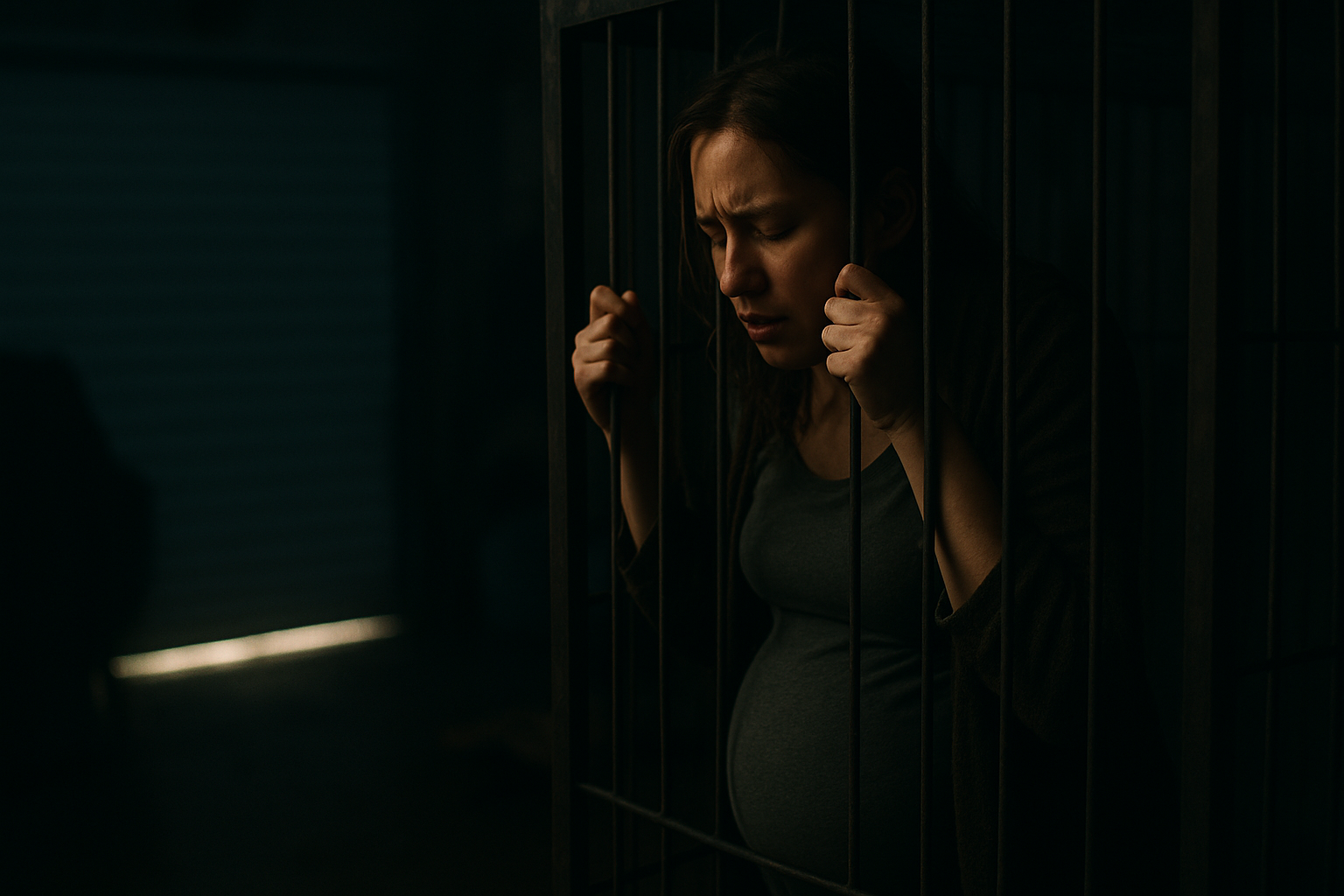
For one second, my brother did not move.
He saw the cage.
He saw me inside it.
He saw my belly, my wet dress, the scratches on the metal floor, the wedding ring in my bleeding hand.
Something in his face changed.
Not because he would hurt me.
Because he had found the thing he would never forgive.
Then he dropped to his knees.
“Mari,” he said, and his voice broke. “I’m here. I’m here.”
“Baby,” I whispered. “He’s coming.”
Julian grabbed the cage door.
Locked.
Of course.
Dante had taken the key.
Julian looked around and found bolt cutters hanging near the workbench. One hard squeeze, and the lock snapped. The door swung open.
He reached toward me, then stopped himself.
“I’m going to help you slowly,” he said, forcing calm into his voice. “Emergency is coming. Look at me. Breathe with me.”
I tried.
Then another contraction came, and I screamed into his shoulder as he lifted me out of the cage and onto a blanket Mrs. Nela had brought from her house.
Mrs. Nela crossed herself.
“My God,” she whispered.
Julian looked up at the cameras in the corners.
His jaw tightened.
“Mrs. Nela,” he said, “record everything. The cage. The scratches. Her condition. Everything.”
Her hands trembled.
But she recorded.
That little seventy-two-year-old woman became the first witness Dante never expected.
The ambulance arrived eight minutes later.
The police came with it.
By then, Julian had found my phone in a locked drawer near the workbench. Dante had barely hidden it. He believed I would never reach it.
The screen was cracked. The battery was low.
But it still turned on.
The officers entered the garage and stopped cold.
One of them, Officer Lidia Salas, looked from me to the cage. Her face hardened.
“Who did this?”
“My husband,” I whispered.
Julian stood beside me, fists clenched.
Officer Salas glanced at him. “Sir, step back and let us handle this.”
He did.
Barely.
The paramedics lifted me onto a stretcher. As they wheeled me out, I saw the words I had scratched into the metal floor with my ring.
DANTE LOCKED ME IN.
CALL JULIAN.
One paramedic saw it too.
He looked away quickly, but not before I saw tears in his eyes.
I reached for my brother.
Julian leaned close.
“Don’t let him take my baby,” I whispered.
His face twisted with pain.
“Never.”
Those were the last words I heard before the ambulance doors closed.
Mateo was born at 9:42 that night at Saint Gabriel Hospital.
He came into the world furious.
That is what the nurse said.
“A strong cry,” she told me. “This boy arrived ready to argue with everybody.”
I laughed and cried at the same time.
He was small. Wrinkled. Red-faced. Perfect.
When they placed him on my chest, something inside me came back from very far away.
Not safety.
Not yet.
But a reason.
“Hi, Mateo,” I whispered. “You made it.”
Julian stood near the door in a hospital gown someone had forced over his clothes. His eyes were red. His hands shook.
My brother had served in dangerous places. He had trained under pressure. He had seen things he rarely spoke about.
But seeing me in that garage had cracked something even the military had not.
“Can I see him?” he asked softly.
I nodded.
He came closer, looked down at my son, and whispered, “I’m your Uncle Julian. I’m going to be annoying, protective, and impossible to impress.”
Mateo opened one eye.
Julian cried.
The police arrested Dante at 11:18 that night.
He was at Bianca’s apartment.
He wore a clean shirt.
He still smelled like expensive cologne.
When the officers arrived, he tried confusion first.
“My wife is unstable,” he said. “She has been emotional because of the pregnancy.”
Then concern.
“Is she okay? Where is she? I was buying medicine.”
Then anger.
“You cannot enter without a warrant.”
Then influence.
“Do you know who my father is?”
That last sentence mattered later.
Because Dante Alvarado came from a family that solved problems without telling the truth.
His father, Octavio Alvarado, had built a logistics empire by smiling at officials, donating to churches, sponsoring charity dinners, and making inconvenient people sign papers they did not understand.
His mother, Celeste Alvarado, led women’s committees and spoke about family values with a diamond cross at her throat.
To them, Dante’s arrest was not a tragedy because I had been hurt.
It was a tragedy because people might find out.
At six the next morning, while Mateo slept beside me, Celeste Alvarado arrived at the hospital with her lawyer.
She wore cream, as if she were visiting after a normal birth. She carried white lilies.
I hated the smell immediately.
Julian was outside speaking with Officer Salas. Mrs. Nela sat beside my bed, refusing to leave until he returned. She was knitting something yellow and muttering prayers between stitches.
Celeste entered without knocking.
“My dear Marisol,” she said, her voice soft as poisoned honey. “Thank God you and the baby are safe.”
Mrs. Nela looked up slowly.
“Who are you?”
“I am the baby’s grandmother.”
Mrs. Nela’s eyes narrowed.
“No. You are the mother of the man who locked her in a cage.”