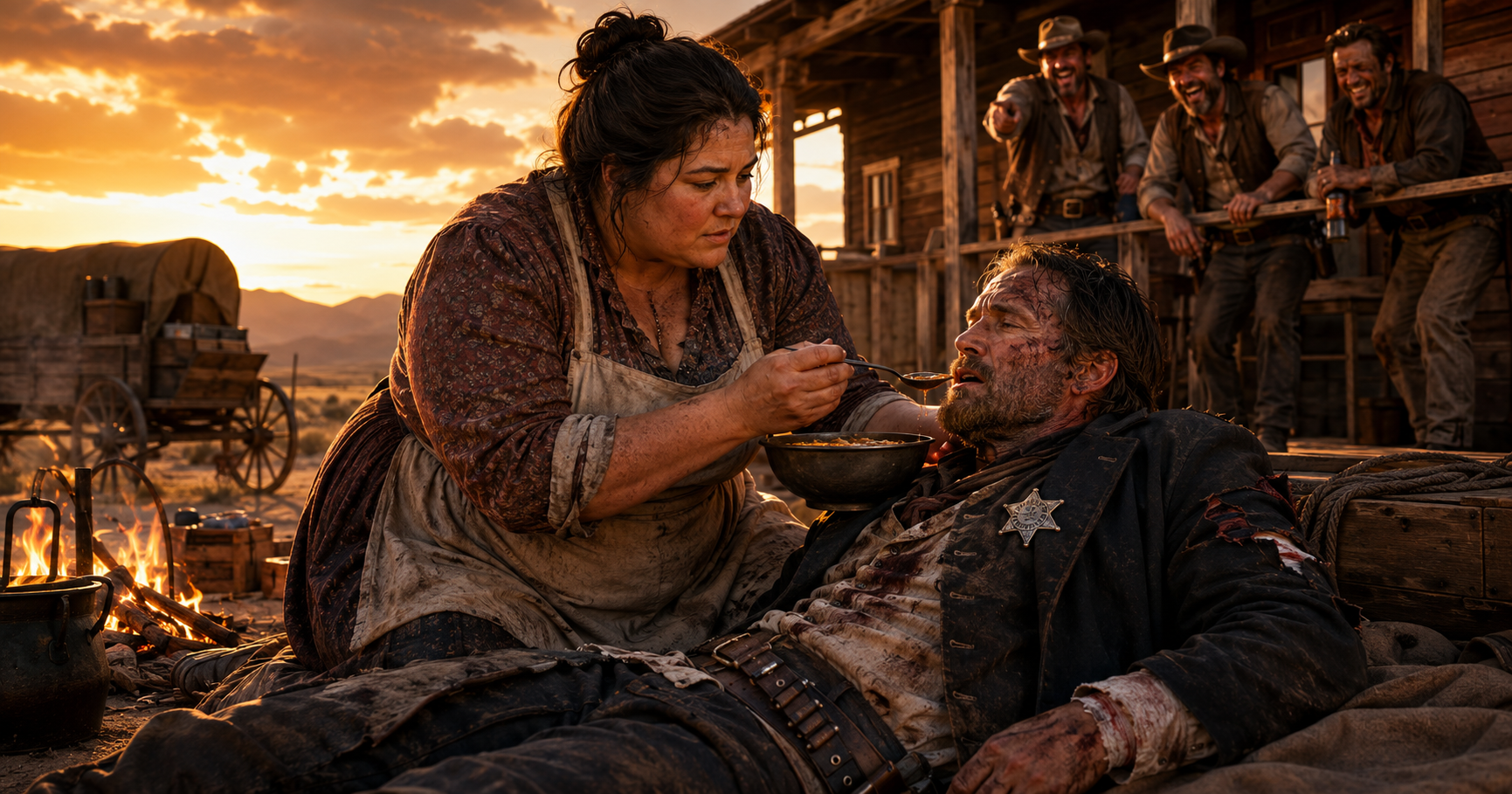
Inside, Elias lay pale but awake, one hand inside his coat where his revolver rested.
Jed stepped back.
The wagon rolled east.
The road to Redemption Crossing cut through red hills and dry gullies where the wind carried dust like whispered warnings. Maribel drove with both hands steady on the reins. She had not slept more than an hour, but purpose worked better than coffee.
Near noon, Elias called from inside the wagon, “How far?”
“Too far for complaints.”
“That an answer?”
“It is from me.”
A faint chuckle. Then silence.
After a while he said, “Your father. What was he like?”
Maribel kept her eyes on the road.
“He made biscuits on Sundays.”
“That’s what you want remembered?”
“It’s what I remember.”
The mule’s ears flicked. The wheels groaned over stone.
“He would wake before sunrise,” she continued. “He said biscuits tasted better if the world was still quiet when you mixed them. He’d sing off-key. Terrible voice. Truly criminal. My mother died when I was small, so he burned a lot of meals before he learned. But he learned. For me.”
Elias said nothing.
“He worked freight accounts for the Silver Crown Company,” she said. “Numbers made sense to him. People didn’t. He thought if he told the truth plainly enough, others would have to respect it.”
“A dangerous belief.”
“Yes.” Her mouth tightened. “It got him killed.”
The marshal shifted. “Creed’s bookkeeper confessed before he died. Said your father discovered false invoices tied to payroll shipments. Creed tried to buy him. Samuel refused. So Creed made him useful another way.”
The reins creaked in Maribel’s grip.
“Useful,” she repeated.
“To carry blame.”
The hills opened before them. Somewhere beyond, Redemption Crossing waited with its new hotel, polished floors, and men who would decide whether Maribel Ward belonged in a kitchen grander than a campfire.
And somewhere in that town, Silas Creed waited too.
The first shot came from the ridge.
It cracked through the air and punched a hole in the coffee tin beside Maribel’s knee.
Junebug screamed.
Maribel dropped flat across the bench and snapped the reins.
“Down!” Elias shouted from inside, which was unnecessary advice but heartfelt.
Another bullet split the wagon rail. A flour sack burst open behind her, filling the air with white dust.
Maribel drove for the wash ahead. The wagon bounced hard enough to throw pans from their hooks. Elias cursed as something heavy struck him.
“You alive?” she shouted.
“Insulted, but alive!”
The second rider came from the left, galloping low with a rifle in hand.
Maribel grabbed the cast-iron skillet from beneath the bench.
When the rider drew alongside, she swung.
The skillet struck his face with a sound like a dropped melon. He toppled from the saddle and vanished in dust.
From inside the wagon, Elias yelled, “Remind me never to criticize your cookware!”
“Criticize my cookware and I’ll demonstrate twice!”
She drove into the wash, where the banks rose on both sides. The ridge shooter could no longer see them. But hoofbeats thundered behind.
Elias crawled to the wagon’s rear flap, revolver in hand.
“You should be lying down,” Maribel said.
“You should be cooking supper. Seems we both changed plans.”
He fired once.
A horse screamed. A man shouted.
Maribel’s jaw clenched. She hated gunfire. Hated the way it turned men into noise and blood and memory. But she drove on until the wash forked, then hauled Junebug sharply right.
The wagon tilted.
For one terrible breath, she thought it would roll.
Then the wheels slammed down.
A rider overshot the turn behind them and crashed into the bank.
The last pursuer kept coming.
Elias fired again. Missed. His hand shook badly now, fever and pain stealing his aim.
Maribel reached for the jar of pepper she kept for sausage rubs.
“What are you doing?” he asked.
“Seasoning trouble.”
She waited until the rider drew close, then flung the jar backward. It shattered against his chest and exploded in a cloud of black pepper. The man shouted, blinded, coughing, clawing at his eyes. His horse veered into mesquite.
The wagon burst from the wash onto open road.
No more shots followed.
For a long while, only the wheels spoke.
Then Elias said, “You knocked a man off a horse with a skillet.”
“He should’ve worn a better face.”
The marshal laughed so hard he nearly fainted.
They stopped near dusk beneath a shelf of stone. Maribel cleaned his wound again. It had reopened. Blood soaked the bandage, and his skin burned beneath her fingers.
“You’re fevering.”
“I’ve been worse.”
“Men always say that right before becoming heavier to bury.”
He looked up at her. “You worried?”
“I am practical. Dead marshals cause paperwork.”
“Maribel.”
The softness in his voice made her hands pause.
She went back to tying the bandage. “Don’t.”
“Don’t what?”