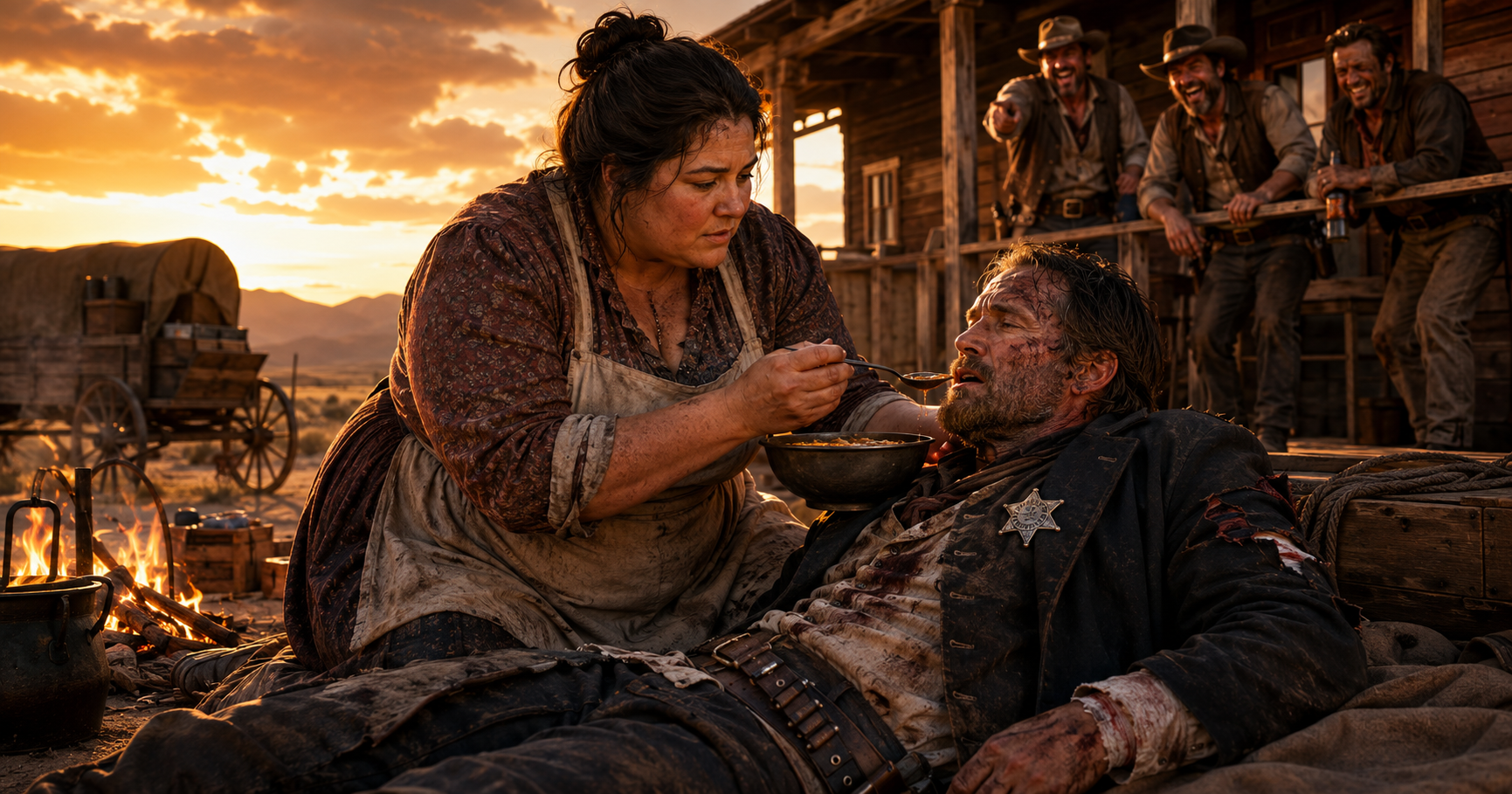
“Don’t waste stew on a corpse,” someone laughed from the porch.
Maribel Ward heard the words as clearly as if the man had leaned over her shoulder and whispered them into her ear. She kept stirring anyway.
The kettle hung above the fire, thick with beans, onions, salt pork, and the last of the sage she had traded for two biscuits and a broken comb back in Dry Creek. The stew was meant for paying passengers, not for a stranger lying half-dead in the dust beside the freight station. But Maribel had never been good at letting hunger make the rules.
The stranger’s coat was torn at the shoulder. His hat was gone. His face was burned red by the desert sun, his lips split, his beard clotted with dirt. A tin star hung crooked on his vest, dull under a crust of blood and trail dust.
A marshal, or a man who had stolen from one.
Either way, he was breathing.
“Woman,” called Jed Larkin, the station keeper, “you hear me? That man’s near gone. No sense wasting food.”
Maribel lifted the wooden spoon from the kettle and let the stew drip slowly back into the pot.
“I heard you,” she said.
The men on the porch laughed again.
She did not turn around. She knew what they saw when they looked at her. A woman too broad for the world’s liking. A brown-skinned cook with arms strong from lifting iron pots and hands scarred from fire. A woman with a face they called plain until they wanted seconds. A woman whose father had died in disgrace because powerful men knew how to bury the truth deeper than bones.
They saw a joke.
Maribel had learned years ago that jokes could still hold a knife.
She filled a cracked bowl, tore a chunk of bread in half, and crossed the yard.
The marshal’s eyes opened when her shadow fell across him. Gray eyes. Fever-bright, but sharp enough to understand danger.
“Easy,” she said. “I’m not here to rob you.”
His mouth moved. No sound came.
“Water first.”
She lifted his head and held a cup to his lips. He drank too fast, choked, coughed, and tried to push himself up.
“Lie still,” Maribel ordered. “You’ve lost blood, sense, or both.”
His eyes narrowed, offended by the tone. That told her he might live.
“Name?” she asked.
He swallowed hard. “Elias.”
“Elias what?”
“Rook.”
The porch went quiet.
Maribel glanced back. Jed Larkin had stopped smiling. So had the three cattle hands leaning beside him.
Marshal Elias Rook.
She knew the name. Everyone from the silver camps to the southern rail crossings knew it. Rook had hunted rustlers, badge thieves, counterfeiters, and murderers through three territories. Folks said he had a memory like a ledger and a temper like a locked door.
But legends bled the same as other men.
Maribel dipped the spoon into the bowl and brought it to his mouth.
He stared at her, suspicious even while dying.
“Eat,” she said.
“I can pay.”
“I didn’t ask.”
“That stew for me?”
“It isn’t for the coyotes.”
His cracked mouth almost smiled. Then he ate.
Behind her, Jed muttered, “Fool woman. Feeding a dead man like he’s Sunday company.”
Maribel did turn then.
Every man on the porch found something else to look at.
“He ain’t dead,” she said. “And if he dies, he won’t die hungry.”
The marshal watched her after that.
Not with pity. Not with amusement. Not with the lazy cruelty men often mistook for charm.
He watched as though he had found a clue.
That made Maribel uneasy.
By sundown, Elias Rook was inside her supply wagon, wrapped in two blankets, his wound washed and packed with boiled cloth. The bullet had passed through his shoulder, ugly but clean. Fever would be the real enemy. Fever and whoever had left him to rot.
Maribel sat outside the wagon, mending the torn strap of her flour sack while the other travelers slept under the awning.
Inside, the marshal stirred.
“You still awake?” he asked.
“I’m always awake when a lawman is bleeding on my blankets.”
“Didn’t mean to trouble you.”
“You didn’t fall in front of my wagon on purpose, did you?”
A pause.
“No.”
“Then hush.”
Another pause.
“You always talk to injured men like schoolboys?”
“Only when they behave like schoolboys.”
His low laugh became a cough. She climbed into the wagon and helped him drink. The lantern swung above them, throwing shadows over stacked pans, spice tins, flour sacks, coffee jars, onions in mesh, and her father’s old knife roll tied with blue cord.
The marshal’s gaze caught on the knife roll.
“You’re a cook.”
“I’m a thunderstorm in an apron. But cooking pays better.”
“Where are you headed?”
“Redemption.”
His brows drew together.
“The town,” she said. “Redemption Crossing. New rail hotel opens next week. I have a trial meal with the owner.”
“You looking to work there?”
“I am looking to run the kitchen.”
“A woman running a rail hotel kitchen?”
She waited for the laugh.
It did not come.