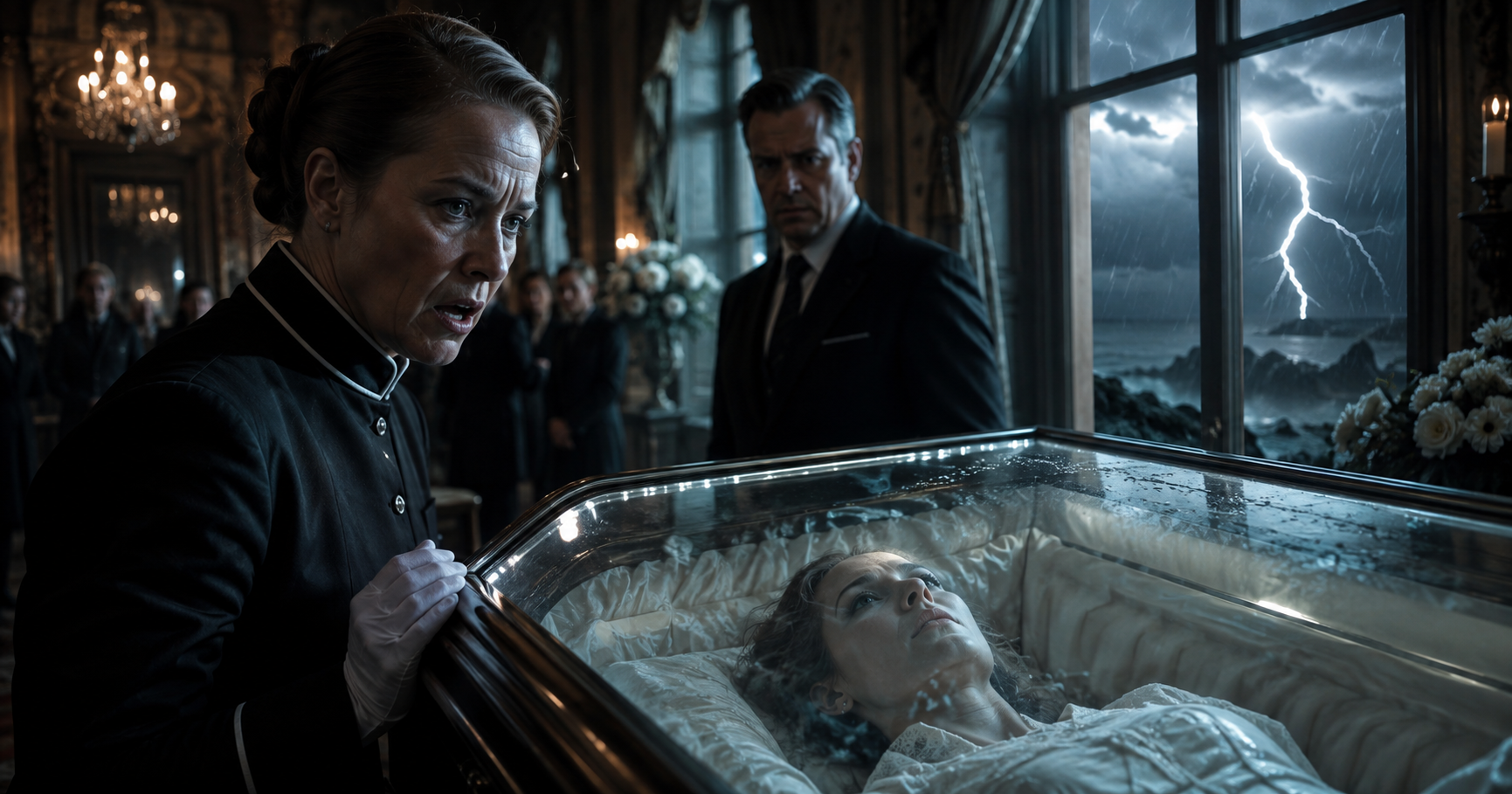
Then Celeste inhaled.
It was not graceful.
It was not gentle.
It was a violent, choking gasp.
Someone screamed.
Rosalind stumbled backward.
Dr. Kerr turned white.
Celeste’s fingers curled.
Her body jerked.
Then she dragged another breath into her lungs.
“Oh my God,” June whispered.
Celeste’s eyelids opened.
Her gaze wandered across the ceiling.
Across the chandelier.
Across the crowd.
Until it found Adrian.
Her expression changed.
Fear filled her eyes.
Adrian took one step backward.
Celeste tried to speak.
Only air came out.
June bent closer.
“Celeste? Can you hear me?”
Her lips moved again.
This time June heard three words.
“The lighthouse model.”
June frowned.
“What?”
Celeste’s fingers closed weakly around June’s sleeve.
“Before midnight.”
Her eyes rolled shut.
Chaos swallowed the room.
Guests shouted.
Someone called emergency services.
Rosalind screamed for blankets.
June held Celeste’s hand while Adrian stood several meters away.
He did not approach his wife.
He did not call her name.
He simply looked at the clock.
It was 6:17 p.m.
Celeste reached St. Matthew’s Medical Center alive.
Barely.
Doctors placed her on a ventilator and rushed blood samples to toxicology.
By nine thirty, Detective Milo Chen arrived at the hospital.
He was a quiet man in his fifties with tired eyes and the unnerving habit of letting silence do most of his questioning.
June told him everything.
The strange illnesses.
The memory problems.
The collapse.
The condensation on the casket.
Celeste’s final words.
“The lighthouse model,” Chen repeated.
“Yes.”
“What lighthouse?”
“I don’t know.”
“And ‘before midnight’?”
“I don’t know that either.”
The detective looked toward the intensive care doors.
“Who had access to her medications?”
“Celeste took very little medication.”
“Who prepared her food?”
“The kitchen staff. Sometimes me.”
“Drinks?”
June hesitated.
“Usually Adrian.”
Chen looked up.
“Usually?”
“He made her evening tonic.”
“What tonic?”
“A herbal drink Dr. Kerr recommended for sleep.”
Chen wrote something down.
At 10:05 p.m., a toxicologist entered.
His expression was serious.
“We found a powerful neuromuscular compound in Mrs. Vane’s bloodstream.”
Chen stood.
“Could it make someone appear dead?”
“It can suppress breathing and reduce detectable movement to an extreme degree. Combined with another sedative found in her system, yes. Under poor conditions, someone could make a catastrophic mistake.”
“Or a deliberate one?”
The doctor paused.
“Yes.”
June felt cold.
“And she was supposed to be cremated tomorrow morning,” Rosalind whispered.
Everyone looked at her.
She covered her mouth.
Adrian had insisted on cremation.
Quickly.
Privately.
Celeste had never once mentioned wanting it.
Chen closed his notebook.
“We’re going back to Harrowmere House.”
Police vehicles climbed the cliff road through heavy rain.
By the time June returned to the mansion, the funeral guests were gone.
Adrian was not.
He stood in the library with two attorneys.
“You have no right to search private property,” one of them said.
Detective Chen placed a document on the desk.
“Now I do.”
Adrian laughed.
But his face had lost its color.
Officers began searching the house.
Bedrooms.
Offices.
Cellars.
The greenhouse.
The medical cabinet.
June walked through the library, repeating Celeste’s words.
The lighthouse model.
She looked at the paintings.
Shelves.
Cabinets.
Nothing.
Then she remembered the west gallery.
Celeste had collected miniature architectural models.
Old railway stations.
Theaters.
Bridges.
Historic buildings.
June hurried upstairs.
At the far end of the gallery, beneath a portrait of Celeste’s grandfather, stood a wooden lighthouse about two feet tall.
June had dusted it hundreds of times.
She approached.
The model represented the lighthouse at Blackthorn Point, abandoned since the 1970s.
Its tiny windows were made from blue glass.
June lifted it.
Heavy.
Too heavy.
“Detective!”
Chen entered.
June turned the model upside down.
Four screws held the wooden base in place.
One was newer than the others.
An officer removed them.
The base opened.
Inside was a waterproof electronic drive.
Adrian appeared in the doorway.
For the first time that night, he stopped pretending.
“No.”
Chen looked at him.
Adrian rushed forward.
Two officers caught him before he reached the table.
“You don’t understand!” he shouted.
Chen held up the drive.
“I suspect this will help.”
Adrian struggled against the officers.
“It’s private family material.”
June stared at him.
“What happens at midnight?”
He stopped moving.
Nobody spoke.