Celeste stood beside him in cream wool, diamonds at her throat, victory already arranged on her face.
Julian stepped to the microphone.
Before he could speak, a reporter shouted, “Mr. Harrow, did your campaign authorize payments to North Pier Strategic?”
His smile flickered.
Another reporter called, “Can you comment on the connection between those payments and Dorian Hale?”
Celeste turned her head sharply.
A third voice cut through the room. “Is it true federal investigators are reviewing evidence of attempted murder conspiracy?”
Julian gripped the podium.
“What nonsense is this?”
The ballroom doors opened.
Evelyn entered alone.
No Matteo. No guards visible. No borrowed power.
Just Evelyn, in a charcoal coat, carrying a leather folder.
The cameras turned.
Julian’s face twisted. “This is harassment.”
“No,” Evelyn said. “This is documentation.”
Celeste whispered, “Julian?”
He ignored her. “She is unstable. I warned all of you.”
Evelyn looked at the reporters. “Six years ago, I believed that loving someone meant protecting the version of himself he wanted the world to see. I was wrong. Love without truth is not loyalty. It is captivity.”
Julian lunged from behind the podium. “Stop talking.”
Two federal agents moved before he reached her.
The room erupted.
Celeste backed away as if scandal were contagious.
By evening, Julian’s campaign suspended operations.
By morning, Benedict Crane was arrested.
By the end of the week, Celeste’s father resigned from three boards and denied knowing anything about the foundation transfers.
Julian was indicted on Friday.
Chicago did what powerful cities always do when exposed.
It pretended it had known the truth all along.
Invitations arrived at Matteo’s house. Apologies came handwritten on thick paper. Women who had laughed behind champagne glasses asked Evelyn to lunch. Men who had dismissed her as discarded began calling her formidable.
She accepted none of it.
One month later, Evelyn returned to the Bellmont Club.
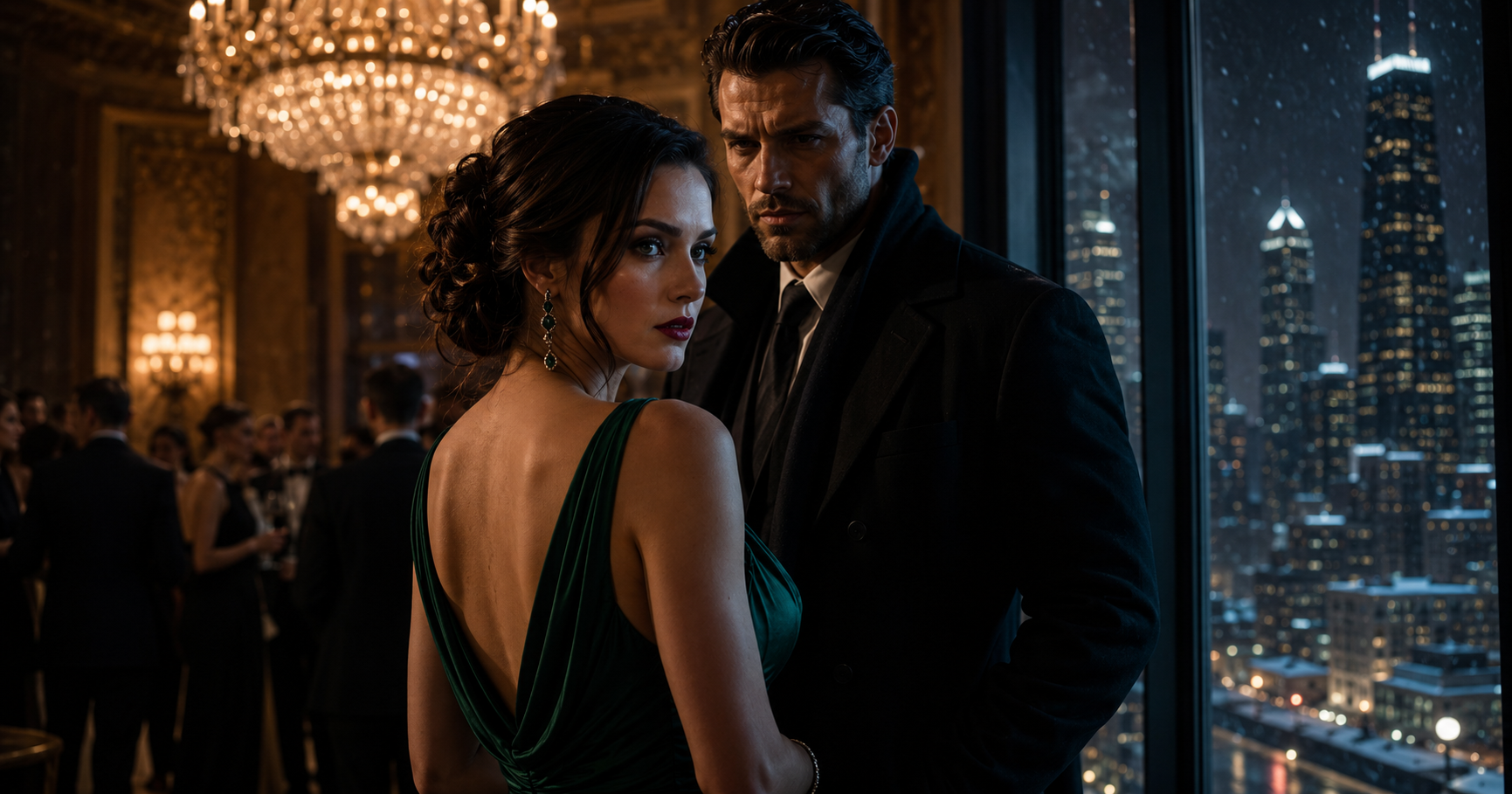
The same chandelier glittered overhead. The same marble staircase curved beneath it. The same faces turned when she entered.
But this time, no one laughed.
Matteo walked beside her, not touching her, not claiming her, simply present. The room opened for him as it always had. But Evelyn noticed something different.
People were not only moving for Matteo.
They were moving for her.
Clara met her near the staircase.
“You look terrifying,” Clara said.
“Thank you.”
“I meant happy.”
“That too.”
Clara glanced at Matteo. “Are you safe?”
Evelyn looked across the ballroom.
Julian was gone. Celeste was gone. Benedict was gone. The whispers remained, but they had changed direction.
“No,” she said honestly. “Not entirely.”
Clara’s smile faded.
Evelyn touched her arm. “But I am free.”
Later, in the library above the ballroom, Matteo found her looking down at the city through tall windows.
“You disappeared,” he said.
“I was thinking.”
“That sounds dangerous.”
“It usually is.”
He stood beside her. For a while, neither of them spoke.
Then Evelyn said, “Our agreement ends in eighteen months.”
“Yes.”
“What happens then?”
Matteo looked at her reflection in the glass. “That depends on whether you still call it an agreement.”
Her heart moved strangely.
“I don’t know what to call it.”
“Then don’t.”
She turned toward him. “You are still a dangerous man.”
“Yes.”
“I still don’t know every secret you keep.”
“No.”
“I may never be the kind of wife this city understands.”
His eyes softened. “I did not marry this city.”
Evelyn looked away first, because suddenly the truth felt more dangerous than any lie.
Below them, the music began again.
Once, she had stood beneath that chandelier and let the city decide what she was worth.
Abandoned.
Pitied.
Forgotten.
Now the same city held its breath when she entered a room.
Not because she had married the most feared man in Chicago.
But because she had become the one thing its elite feared more than power.
A woman with proof.
And the courage to use it.