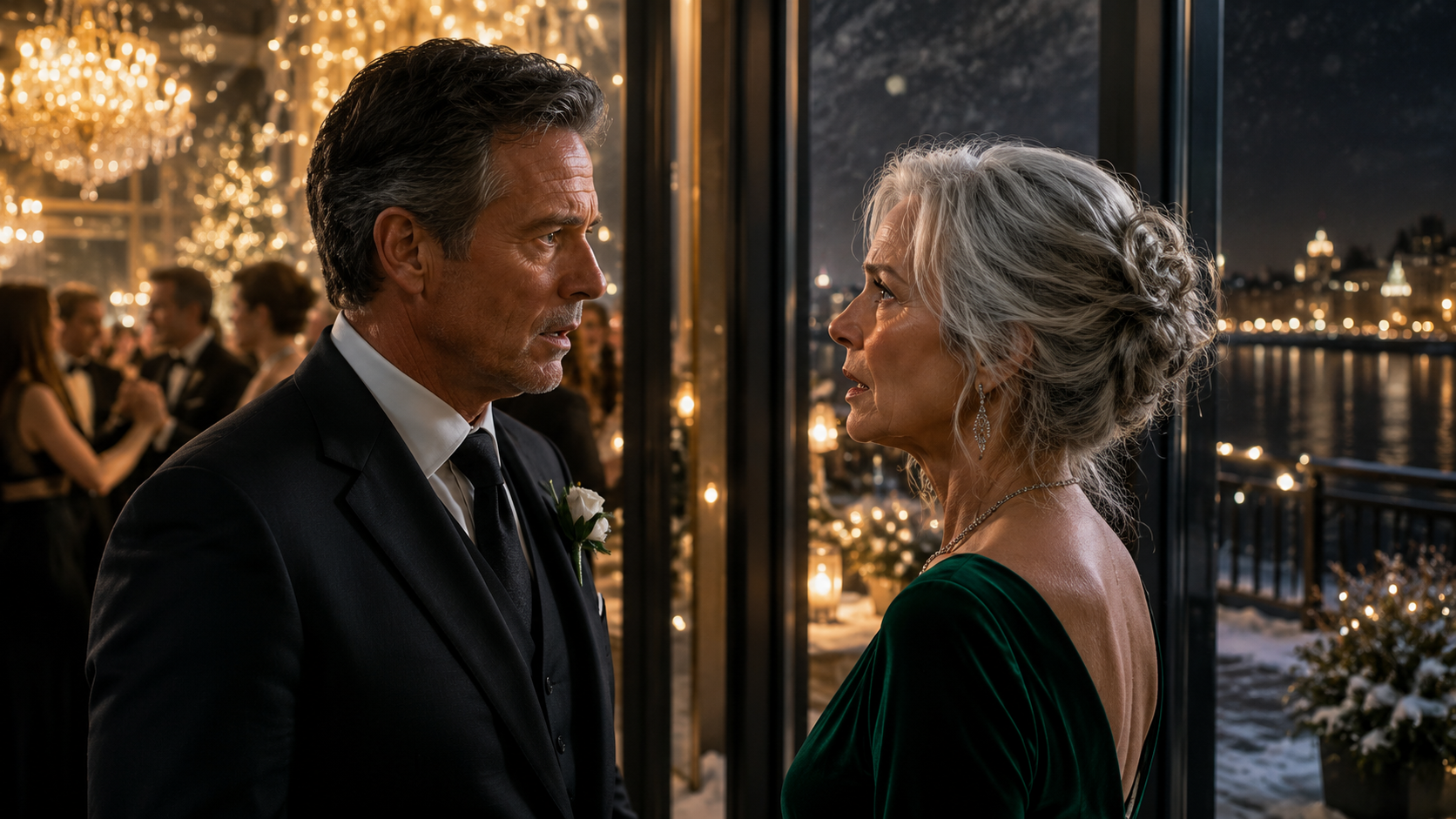
The wedding hall stood above the river like a lantern, all glass walls, polished floors, and golden light spilling into the winter dark. Outside, the water moved slowly under the bridge. Inside, two hundred people were laughing, dancing, clinking glasses, and pretending that happiness was something simple.
Malcolm Reeves stood near the back of the ballroom with his hands folded around a cup of coffee he did not want.
He had never been comfortable at celebrations. Not because he disliked joy, but because joy always seemed to ask him to stand still long enough to feel what it cost to arrive there. And tonight, the cost sat deep in his chest.
His son was married.
Callum Reeves, the boy Malcolm had carried into his house twenty-two years earlier wrapped in a hospital blanket, was now standing in the middle of the dance floor with his bride in his arms. Callum’s tie was crooked. His hair had escaped whatever careful style the barber had given it that morning. His smile was enormous, reckless, almost boyish.
His bride, Hannah, was laughing against his shoulder.
Malcolm watched them with the quiet pride of a man who had never learned how to show big emotions without first taking them apart and labeling every piece.
“You look like you’re trying not to cry.”
Malcolm turned.
His sister, Beatrice, stood beside him with a glass of champagne and a knowing expression.
“I’m not trying,” he said.
“You are. You have the face.”
“I have one face.”
“No, you have three. Business face, disappointed dishwasher face, and trying-not-to-cry-at-your-son’s-wedding face.”
Malcolm looked back toward the dance floor. “He forgot the second half of his vows.”
“He improvised.”
“He promised to love her through flu season and bad parking.”
“It was charming.”
“It was strange.”
“It was Callum.”
That made Malcolm smile.
Yes. It was Callum.
The child who had once hidden crackers under his pillow because he believed food could disappear if grown-ups changed their minds. The teenager who apologized whenever he broke anything, even a pencil. The young man who had taken years to believe that love could be steady, that a home could stay lit, that a father could leave for work in the morning and return in the evening without vanishing forever.
Now Callum was married, laughing under chandeliers, his whole future shining in front of him like a road after rain.
Malcolm should have felt only gratitude.
Instead, he felt something else moving beneath it.
A restlessness.
A pressure.
As if the night had not finished revealing itself.
“Go outside for five minutes,” Beatrice said.
Malcolm looked at her. “Why?”
“Because you’ve been standing in the same corner for half an hour, and if you keep holding that coffee any tighter, the cup is going to file a complaint.”
“I’m fine.”
“People who are fine don’t say it like they’re signing a legal document.”
He sighed.
Beatrice softened. “You did well, Mal.”
He looked at her quickly.
“With him,” she said. “With Callum. You did well.”
Malcolm’s throat tightened. He looked away before she could see too much.
“I made mistakes.”
“Of course you did. You were a father, not a museum display.”
He gave a small laugh.
“Go breathe,” she said. “Then come back in and dance with your daughter-in-law before Callum accuses you of hiding.”
Malcolm placed the coffee cup on a nearby table and walked toward the glass doors at the far side of the room.
The terrace was long and narrow, bordered by black iron railings wrapped in tiny white lights. The cold hit him instantly, sharp enough to clear his head. He stepped outside and closed the door behind him, muting the music into a distant throb.
For a moment, he was alone.
He leaned on the railing and looked down at the river.
Twenty-two years ago, he had not imagined this life.
He had been thirty-one then, running a small clock repair shop that barely kept its lights on, living in an apartment above it, and loving a woman with a laugh that could make an ordinary afternoon feel like a door opening.
Evelyn Sinclair.
Evie.
He had not said her name aloud in years.
Not because he had forgotten it. Forgetting would have been a mercy. He had simply learned to store it carefully, the way he stored fragile watch faces in velvet-lined drawers: protected, hidden, dangerous to touch without preparation.
Evie had been a violin teacher then. She had lived three streets away, in a pale brick building with ivy up one side and a broken elevator that never seemed to get fixed. She wore long coats, carried sheet music in cracked leather folders, and drank terrible coffee because she said good coffee made bad mornings too easy to forgive.
They had loved each other in the fierce, unfinished way young people love when they believe sincerity can solve timing, grief, money, family, fear, and every old wound neither of them has named.
Then she disappeared.
No dramatic farewell. No final argument that explained everything. No betrayal Malcolm could hate her for.
One week she was there.
The next, she was gone.
Her apartment emptied. Her phone disconnected. Her music students told to contact another teacher. A neighbor said she had left with relatives. Someone else said she had gone north. Someone else said she had married quickly.
Malcolm searched longer than pride allowed and less than love required.
That was the sentence he had never forgiven himself for.
He had searched.
But not enough.
Six months later, a baby was found at the side entrance of St. Agnes Medical Center during a snowstorm.
A boy.
Three days old.
A handwritten note pinned beneath the blanket said only:
His name is Callum. Please let him be loved without debt.
Malcolm had been at the hospital that night repairing the old clock in the children’s ward. He saw the nurses gathering near the emergency entrance. He heard the baby crying before he saw him.
Something in that cry went through him.
Not pity. Not charity.
Recognition.
He became a foster parent first. Then, after paperwork, hearings, questions, delays, and more fear than he admitted to anyone, he became Callum’s father.
People told Malcolm he had saved the child.
They were wrong.
The child had saved him from becoming a locked room.
The terrace door opened behind him.
Malcolm straightened, expecting a guest with champagne and a phone camera.
Instead, the past stepped into the cold.
For a second, his mind refused to place her in the present.
She stood beneath the terrace lights in a deep green dress, her dark hair pinned loosely at the back of her neck, silver threaded through it now. Her face was older, of course. So was his. Time had written itself honestly across both of them.
But her eyes were the same.
Gray-green, steady, and full of things she did not say quickly.
Malcolm forgot how to breathe.
“Hello, Malcolm,” she said.
His name in her voice broke something open.
“Evie.”
She smiled, but the smile trembled.
“I wondered if you would still call me that.”
“I wondered if I would ever see you again.”
For a few moments, neither moved.
Inside, the wedding music swelled. Someone cheered. Glasses clinked. Life continued with no respect for ghosts.
Evie stepped farther onto the terrace.
“I saw him,” she said.
Malcolm knew who she meant before she looked through the glass at the dance floor.
“Callum?”
She nodded.
“He looks happy.”
“He is.”
“You raised him well.”
The words should have warmed him. Instead, they unsettled him.
“Do you know him?” Malcolm asked.
Evie’s fingers tightened around the small beaded purse in her hand.
Before she could answer, the terrace door opened again.
A tall man in a navy suit stepped out. He had silver hair, expensive glasses, and the calm expression of someone used to being obeyed before he raised his voice.
“There you are,” he said.
Evie’s shoulders changed.
The shift was small, but Malcolm saw it. A tightening. A folding inward. The body remembering rules before the mouth spoke them.
The man looked from Evie to Malcolm.
“Am I interrupting?”
Evie answered too quickly. “No.”
Malcolm did not like him. Not because he had the right to dislike him, but because instinct sometimes moved faster than manners.
The man smiled politely.
“Victor Lorne,” he said, extending a hand. “Evelyn’s husband.”
Husband.
The word landed exactly where Malcolm expected it to and hurt anyway.
“Malcolm Reeves,” he said, shaking Victor’s hand.
Victor’s eyes sharpened.
“Father of the groom?”
“Yes.”
“Ah,” Victor said. “The adoptive father.”
Malcolm had heard the phrase before. Usually from strangers who did not mean harm. But Victor said it like a correction. Like father required quotation marks.
Evie turned her head toward him.
“The father,” she said quietly.
Victor’s smile thinned.
“Of course,” he said. “That is what I meant.”
No, Malcolm thought. It is not.
Victor placed one hand lightly at Evie’s back without quite touching her. Somehow the gesture still felt like possession.
“We should go inside,” Victor said. “The photographer has been looking for you, and I would prefer not to explain another disappearance.”
Another.
Malcolm looked at Evie.
Her face remained calm, but her eyes had changed. The woman who had stepped onto the terrace with all those unsaid things now stood behind a practiced mask.
“I’ll be there in a moment,” she said.
Victor did not move.
“I think now would be better.”
The cold seemed to press closer.
Malcolm could have said something. He wanted to. The old version of himself might have mistaken anger for courage. The older version knew anger was easy when it had no consequences to pay.
Evie was married.
Callum’s wedding was not a stage for Malcolm’s unfinished history.
So he stayed silent.
Evie looked at him once, long enough that the years between them seemed to lean forward.
Then she went back inside with her husband.
Malcolm remained on the terrace until his hands were numb.
When he returned to the ballroom, Callum found him almost immediately.
“There you are,” Callum said. “I thought you escaped.”
“I considered it.”
“Classic Dad behavior.”
“I came back.”
“That’s also classic Dad behavior.”
Callum smiled, then studied him more closely. The smile faded.
“What happened?”
“Nothing.”
“You taught me not to use that word when it’s lying.”
Malcolm looked at his son. “This is your wedding.”
“And you look like somebody opened an old grave in your chest, so I’m asking.”
Malcolm nearly laughed, but there was no room for it.
“I saw someone I knew a long time ago.”
“The woman in the green dress?”
“You noticed?”
“I notice everything. Childhood trauma gave me superpowers.”
Malcolm winced.
Callum touched his arm. “That was a joke.”
“Not entirely.”
“No,” Callum admitted. “Not entirely.”
They stood together near a table crowded with half-eaten cake slices and abandoned glasses.
“What was she to you?” Callum asked.
Malcolm looked toward the terrace doors.
“The person I thought I would build my life with.”
Callum’s expression softened.
“What happened?”
“I lost her.”
“That’s not an answer.”
“It’s the only one I’ve had for twenty years.”
Callum was quiet for a moment.
Then he said, “Dad, people don’t usually look that wrecked over someone they simply lost.”
Malcolm met his eyes.
Callum had always been too perceptive. It had frightened Malcolm when he was small, the way he could read silence as if it were printed on paper. Later Malcolm understood: children who do not begin life safe become experts in weather.
“I don’t know the whole story,” Malcolm said.
“Maybe tonight is when you find out.”
“It’s not that simple.”
“It never is. But you’re the one who told me that truth doesn’t become kinder because you delay it.”
“That was before you used my advice against me.”
Callum smiled. “Your fault. You raised me.”
Across the room, Hannah waved him over.
Callum looked back at his father. “Don’t disappear into your head, okay?”
“I won’t.”
“You absolutely will. But try to leave a window open.”
Then he ran back to his wife.
Near midnight, the wedding began to soften around the edges. Children slept across chairs. Older relatives hugged everyone twice. The band packed up, leaving behind the quieter sounds of shoes, laughter, and tired goodbyes.
Malcolm helped carry gifts to Callum’s car because carrying things was easier than feeling them.
He had just placed the last box in the trunk when he heard his name.
“Malcolm.”
Evie stood near the side entrance, wrapped in a wool coat.
Alone.
The parking lot lights gave her face a pale, unreal glow. She looked less polished now. Tired. Human. Frightened in a way she was trying to hide from herself.
“Where is your husband?” Malcolm asked.
“He left.”
“Without you?”
She gave a small smile. “Victor believes inconvenience is a useful teacher.”
Malcolm felt his jaw tighten.
“Do you need a ride?”
“I should call a car.”
“That wasn’t my question.”
Evie looked at him then.
“No,” she said softly. “It wasn’t.”
He drove an old black sedan that smelled faintly of leather, cedar polish, and cold air. Evie sat beside him with her hands folded tightly in her lap. For the first few minutes, neither spoke.
The road away from the wedding hall curved along the river. Streetlights passed across the windshield in slow gold bands.
“Where are you staying?” Malcolm asked.
“The Bellwether Hotel.”
“That’s fifteen minutes.”
“Then I have fifteen minutes to decide whether I’m a coward.”
He glanced at her.
She was looking straight ahead.
“Evie.”
“I came tonight because of Hannah’s mother,” she said. “We’re old friends. She invited me before I knew who Hannah was marrying.”
Malcolm kept both hands on the wheel.
“When I saw the name Callum Reeves on the invitation, I almost didn’t come.”
The car seemed to grow smaller.
“Why?”
Evie closed her eyes.
“Because I knew a boy named Callum once.”
Malcolm’s heartbeat changed.
“What are you saying?”
She opened her eyes but did not look at him.
“Pull over.”
He did.
The sedan stopped beside a dark park, beneath bare trees. The river was visible through the branches, black and silver under the moon.
Evie turned toward him.
“Before I tell you, I need you to understand something. I tried to find you.”
Malcolm stared at her.
“After I disappeared,” she said, her voice shaking now. “I wrote to you. I called the shop. I came back once.”
“No.”
“Yes.”
“I was there.”
“No,” she said gently. “You had closed the shop for three weeks after your uncle died. The sign said family emergency. The woman next door told me you had gone south and didn’t know when you’d return.”
Malcolm remembered that winter.
His uncle’s death. The funeral. The repairs on the house in Georgia. The silence waiting for him when he came back.
“I left a letter,” Evie whispered.
“I never got it.”
“I know that now.”
“How?”
“Because my father found the copy I kept. Years later. He thought it was proof of my shame. He threw it at me during an argument like it was still a weapon.”
Malcolm could barely hear past the blood in his ears.
“What was in the letter?”
Evie’s face broke.
“Our son.”
The words did not enter him all at once.
They hovered.
Then they fell.
Malcolm shook his head once, slowly, as if refusing the shape of them.
“What?”
“I was pregnant when I left.”
“No.”
“I didn’t know how to tell you. I was twenty-seven and terrified. My father had found out about us, and he threatened to cut off my mother’s care if I stayed. She was sick. I was weak. I thought I had time to fix it. Then everything moved too fast.”
Malcolm’s hands had gone cold on the steering wheel.
“Evie.”
“They took me to a private clinic outside Boston. I had the baby there. A boy. I named him Callum because you once said if you ever had a son, you wanted a name that sounded like it belonged to someone kind.”
Malcolm closed his eyes.
He had said that.
In his apartment above the clock shop, half-asleep, Evie’s head on his chest, rain tapping at the window.
“I tried to keep him,” she said. “I swear to you. I tried. But I had no money, my mother needed care, and my father controlled everything. He told me you had refused my letter. He told me you had said the child was not yours. He showed me an envelope marked return to sender.”
“That was a lie.”
“I know.”
He opened his eyes.
Evie was crying now, silently, the tears moving down her face as if she had no strength left to stop them.
“They arranged the adoption,” she said. “But I panicked. I couldn’t hand him to strangers through paperwork I didn’t trust. I took him from the clinic nursery. I had him for nine hours. Nine hours, Malcolm. I held him in a bus station bathroom and tried to think of one person in the world who would love him without making him pay for being born.”
Malcolm could not move.
“I left him at St. Agnes,” she whispered. “Because I remembered you repaired the clocks there on Thursdays. I thought if God had any mercy left, the baby would find his way to you.”
The car was silent except for the heater blowing softly.
Malcolm’s voice came out rough.
“Callum.”
“Yes.”
“You knew?”
“Not for certain. Not until tonight. I saw his face. I saw yours in his jaw, mine in his eyes. Then I heard Hannah call him Callum, and I knew.”
Malcolm looked through the windshield at the empty road.
Every year of his life rearranged itself.
The baby in the snow.
The note.
His name is Callum. Please let him be loved without debt.
The first time the child wrapped his whole hand around Malcolm’s finger.
The years of paperwork.
The fear of loving him too much before the court said he could stay.
The adoption day.
The birthday pancakes.
The nightmares.
The scraped knees.
The college acceptance letter.
The wedding vows.
His son.
His son.
Not by accident.
Not by charity.
By blood.
By grief.
By Evie’s impossible choice.
Malcolm turned to her.
“Why tell me now?”
“Because I was afraid if I waited one more day, fear would become my religion again.”
He swallowed hard.
“Does Victor know?”
“Some of it. Enough to use when he wants to hurt me. Not enough to understand.”
“Callum doesn’t know.”
“No.”
“You came to his wedding carrying this?”
“I didn’t mean to. I thought I could leave after the ceremony. Then I saw you on the terrace, and suddenly twenty-two years of silence felt obscene.”
Malcolm pressed his hand over his mouth.
Anger came first. Not at her alone. At her father. At the lie. At himself. At the young man he had been, too wounded and proud and exhausted to keep searching until the world answered.
Then sorrow.
Then something larger than both.
Callum.
“He deserves to know,” Malcolm said.
“Yes.”
“Not tonight.”
“No,” Evie said quickly. “Not tonight. Tonight belongs to his happiness.”
Malcolm looked at her. “And tomorrow?”
“Tomorrow, if you will let me, I’ll tell him with you. I won’t ask for anything. Not forgiveness. Not a place in his life. Not a name. I only want him to have the truth before time steals more than it already has.”
Malcolm’s laugh was small and broken.
“Truth. We keep arriving late to it.”
Evie wiped her face.
“I’m sorry.”
He shook his head.
“Don’t make that word carry twenty-two years alone.”
“I left him.”
“You saved him.”
“I abandoned him.”
“You chose the only door you could reach.”
“I should have fought harder.”
“So should I.”
They sat with that.
Not forgiveness.
Not yet.
But the first stone moved from a wall.
At the hotel entrance, Evie unbuckled her seat belt but did not get out.
“Victor will expect me to come home tomorrow,” she said.
“Will you?”
She looked toward the lobby doors.
“I don’t know where home is anymore.”
Malcolm’s voice softened.
“That’s not the same as having nowhere to go.”
She turned back to him.
For a moment, she looked exactly like the woman who had once stood in his shop with violin rosin on her fingers and asked him whether broken clocks remembered the correct time.
“I am not asking you to rescue me,” she said.
“I know.”
“I have lived too long in rooms where help came with ownership.”
“I won’t own you.”
Her eyes filled again.
“You say that like it’s easy.”
“It isn’t,” he said. “But it’s true.”
She touched the door handle.
“Tomorrow morning?”
“I’ll call Callum.”
“And if he hates me?”
Malcolm thought of his son’s face, his careful heart, his hard-earned gentleness.
“He might be angry. He might be hurt. He might need time. But hate has never been where he goes first.”
Evie nodded as if those words were too much to hold.
“Goodnight, Malcolm.”
“Goodnight, Evie.”
She stepped out of the car.
Before closing the door, she leaned down and whispered, “On the terrace, I wanted to say only one thing.”
“What?”
“That I gave him to you because even when I thought you hated me, I still trusted your love more than anyone else’s.”
Then she closed the door and walked into the hotel.
Malcolm sat there until the valet tapped politely on the window.
The next morning, he invited Callum and Hannah to his house for breakfast.
Callum arrived wearing yesterday’s happiness and a new husband’s exhaustion. Hannah carried a bag of leftover pastries from the hotel and kissed Malcolm’s cheek.
“This feels serious,” she said.
“It is,” Malcolm said.
Callum looked at him. “Are you sick?”
“No.”
“Is Aunt Bea moving in?”
“No.”
“Is this about the woman in the green dress?”
Malcolm exhaled.
“Yes.”
Callum’s smile faded.
They sat at the kitchen table, the same table where Callum had done homework, carved pumpkins, filled out college applications, and once confessed at sixteen that he was afraid no one would ever love him if they knew how much he needed.
Malcolm did not know how to begin.
So he began with the truth.
“Before you were born, I loved a woman named Evelyn Sinclair.”
Callum listened.
Hannah reached for his hand.
Malcolm told them slowly. Not everything at once. Not with drama. He told them about Evie, the disappearance, the baby at St. Agnes, the note, the adoption, the terrace, the car, the truth.
When he finished, Callum did not speak.
He stood and walked to the window.
Hannah started to rise, but Malcolm shook his head.
Give him room.
Callum stared out at the small yard where he had learned to ride a bike, where Malcolm had run beside him with one hand on the seat and lied by saying, “I’m still holding on,” even after he had let go.
Finally, Callum turned.
“My mother was at my wedding.”
Malcolm’s throat tightened.
“Yes.”
“And she knew?”
“Not until she saw you.”
Callum laughed once, without humor.
“That’s insane.”
“I know.”
“She left me.”
Malcolm accepted the blow because it belonged to Callum first.
“She did.”
“But she left me where you would find me.”
“Yes.”
Callum looked at the floor.
“So I was never random.”
“No.”
“I was yours before you knew I was yours.”
Malcolm could not answer. His face had become too difficult to control.
Callum crossed the kitchen and hugged him.
Not gently.
Not neatly.
He held on like the child he had been and the man he had become were both trying to understand how love could be lost, hidden, damaged, and still arrive.
“I’m angry,” Callum said into his shoulder.
“You can be.”
“I don’t know what I feel.”
“You don’t have to know today.”
Callum pulled back, eyes wet.
“Do you hate her?”
Malcolm thought carefully.
“No.”
“Do you love her?”
The question entered the room and changed the air.
Malcolm looked at his son.
“I loved her. I don’t know what the present tense is allowed to be yet.”
Hannah wiped her eyes.
“That might be the most honest sentence anyone has ever said before noon.”
Callum laughed through a breath that almost became a sob.
Later that afternoon, Evie came to the house.
She stood on the porch for nearly a full minute before ringing the bell.
Callum opened the door himself.
Malcolm waited behind him, close enough to steady him, far enough not to decide for him.
Evie looked at Callum, and whatever speech she had prepared disappeared.
“My son,” she whispered.
Callum’s face tightened.
“Please don’t call me that yet.”
Evie flinched, then nodded.
“You’re right. I’m sorry.”
He studied her.
“You named me?”
“Yes.”
“Why Callum?”
“Because your father loved the name.”
Callum looked back at Malcolm.
Then at Evie.
“You left a note.”
“Yes.”
“Why did it say without debt?”
Evie’s mouth trembled.
“Because I didn’t want whoever loved you to make you feel grateful for being cared for. Children shouldn’t owe adults for doing what love requires.”
Callum looked away.
The silence was painful, but it was honest.
Finally he stepped back from the doorway.
“You can come in,” he said. “I’m not promising anything else.”
Evie’s eyes filled.
“That is more than I deserve.”
Callum’s voice was quiet.
“Maybe. But it’s what I can do today.”
That was how they began.
Not as a miracle.
Not as a reunion wrapped in music and easy forgiveness.
As four people around a kitchen table with coffee growing cold, telling the truth in pieces because whole truths can crush a person if dropped too quickly.
Evie told Callum about the clinic, her father, her mother, the fear, the bus station, the hospital door, the note.
Callum asked hard questions.
Evie answered them.
Sometimes she cried.
Sometimes he did.
Malcolm watched his son become older in real time, not because truth stole anything from him, but because it returned a missing room in the house of his own life.
When Evie left that evening, Callum walked her to the porch.
Malcolm watched through the window but did not follow.
Hannah came to stand beside him.
“You okay?” she asked.
“No.”
“Fair.”
He glanced at her.
She smiled sadly. “But maybe okay isn’t the goal today.”
“What is?”
“Honest.”
Malcolm looked through the glass at Callum and Evie speaking under the porch light.
“Yes,” he said. “Maybe.”
The months after that were not simple.
Victor Lorne did not accept Evie’s decision to leave him with grace. Men like Victor rarely mistook freedom for something they were supposed to applaud. He called her selfish. He called her unstable. He called her past a stain she was foolish to uncover.
For the first time in her life, Evie did not fold herself smaller to make an angry man comfortable.
She moved into a small apartment above a bakery two towns away. She began teaching violin again on weekends. She sent Callum a letter every Friday, not asking for replies, simply offering pieces of the story he had never been given.
Sometimes he answered.
Sometimes he did not.
Malcolm never pushed him.
“You’re allowed to take your time,” he told Callum one night in the shop, while repairing the brass pendulum of an old grandfather clock.
Callum sat on the workbench, turning a screwdriver between his fingers.
“What if taking time hurts her?”
“It might.”
“That feels cruel.”
“It isn’t cruel to heal at the speed you can actually survive.”
Callum looked at him.
“Did you rehearse that?”
“No.”
“Sounded rehearsed.”
“I’ve had a difficult year. I’m becoming profound.”
Callum smiled faintly.
Then he said, “Do you want to be with her?”
Malcolm paused.
The shop was quiet except for the ticking of thirty clocks, each one measuring the same moment differently.
“I want to know who she is now,” he said.
“And then?”
“And then I want to be brave enough not to lie about what I find.”
Callum nodded.
“I think I want to know her,” he said. “But I don’t want another mother. Not like that. Not quickly.”
“She isn’t replacing anyone.”
Callum looked up.
“You know that includes you, right?”
Malcolm could not speak for a moment.
Callum continued, softer now.
“You’re my dad. That didn’t become less true because biology showed up late.”
Malcolm bent his head over the clock mechanism.
“I know.”
“No, you don’t. But you can.”
That was Callum’s gift. He could wound kindly. He had learned it from surviving, and maybe from being loved after.
A year passed.
Not quickly. Not cleanly.
A real year, full of awkward dinners, missed calls, careful boundaries, therapy appointments, legal papers, anger that returned without warning, and laughter that surprised everyone by arriving before permission.
Evie and Callum learned each other slowly.
She attended one of his community theater performances and cried so hard Hannah had to hand her three napkins.
Callum helped carry boxes into her new apartment and pretended not to notice the framed photograph of him and Hannah that she had placed on the bookshelf.
For his birthday, she gave him the violin she had bought years ago and never learned to sell.
“I don’t play,” he said.
“I know.”
“Then why give it to me?”
“Because it was bought with love meant for you. You can keep it, sell it, donate it, smash it dramatically in a field if that helps. I just didn’t want it sitting in my closet like a secret anymore.”
He kept it.
Not in the center of his life.
Not hidden either.
Malcolm and Evie were slower still.
They walked together on Sunday mornings. They drank coffee in public places where longing had to behave itself. They talked about the past until it stopped being a courtroom and became a landscape they could finally cross without accusing every tree.
One evening in spring, Evie came to Malcolm’s clock shop after closing.
Rain tapped against the windows.
The old sign outside swung lightly in the wind.
Malcolm was working on a pocket watch when she entered.
“You always loved broken things,” she said.
He looked up.
“I love things that still have movement in them.”
She walked closer.
“And if they don’t?”
“Then I listen longer.”
Evie smiled, but her eyes were wet.
“My divorce was finalized this morning.”
Malcolm set down his tools.
“How do you feel?”
“Free. Grieving. Guilty. Relieved. Angry. Young. Ancient.”
“That sounds about right.”
She looked around the shop.
“I don’t want to run from one life into another.”
“I won’t ask you to.”
“I don’t want to lose another year pretending I feel less than I do.”
“I won’t ask that either.”
She looked at him.
“What will you ask?”
Malcolm walked around the counter slowly.
He stopped close enough to touch her, but did not.
“I’ll ask if you want dinner.”
Evie let out a laugh that broke into tears halfway through.
“Dinner?”
“Yes.”
“That’s all?”
“No,” he said. “But it’s the first honest step I can offer without stealing from the rest.”
She reached for his hand.
“Then yes.”
Their first kiss after twenty-two years happened in the clock shop, with rain against the glass and a hundred old mechanisms ticking around them like patient witnesses.
It was not young.
It was not desperate.
It did not pretend nothing had happened.
It carried everything that had happened and still found room to be gentle.
Two years after the wedding, Callum and Hannah hosted dinner at their small house.
Their daughter, Rose, was six months old and had already trained every adult in the family to obey her smallest sounds. Evie held her carefully in the rocking chair while Callum watched from the doorway with an expression he tried to hide.
Malcolm saw it.
“You okay?” he asked.
Callum nodded.
“She has Evie’s eyes.”
“She has your temper.”
“That is slander.”
“It is observation.”
In the living room, Evie whispered something to the baby, and Rose grabbed a strand of her silver-dark hair with one determined fist.
Evie laughed.
Callum looked at Malcolm.
“I’m glad she came to the wedding.”
Malcolm felt those words settle deep.
“So am I.”
“I was angry for a long time.”
“I know.”
“I still am sometimes.”
“That’s allowed.”
“But I think…” Callum paused. “I think love doesn’t always arrive in the order it should.”
Malcolm looked at him.
Callum shrugged. “I’m a father now. I say inconvenient things.”
“You always did.”
“True.”
Across the room, Evie looked up and saw them watching. She smiled.
Not the careful smile from the terrace. Not the frightened smile from Victor’s shadow. Not the smile of a woman asking permission to exist.
This one was open.
Malcolm smiled back.
Later, after dinner, after Callum and Hannah packed leftovers into containers and Rose fell asleep against her mother’s shoulder, Malcolm and Evie stepped outside onto the porch.
The night was cool. The street was quiet. Somewhere in a nearby tree, a bird shifted in its sleep.
Evie leaned against the railing.
“Do you ever think about that terrace?” she asked.
“Yes.”
“What do you remember most?”
He thought about the green dress. Victor’s hand near her back. The cold air. The terrible force of seeing her and not knowing whether she was memory, warning, or mercy.
Then he thought of the car by the river.
The words that changed the shape of his life.
Our son.
“I remember believing the past had come to punish me,” he said.
“And now?”
He looked through the window at Callum rocking his daughter gently while Hannah laughed at something Beatrice was saying.
“Now I think the truth was trying to come home.”
Evie’s eyes shone.
“That sounds like something a man who fixes clocks would say.”
“I’m consistent.”
“No,” she said softly. “You changed.”
He turned to her.
“So did you.”
She reached for his hand.
They stood together in the porch light, older than they had once been, braver than they had once known how to be, no longer asking life to return what it had taken exactly as it was.
Some things cannot be restored to their original shape.
Some things should not be.
A broken clock can be repaired, but the hour it lost will not come back. A child can be loved without knowing every truth. A woman can survive a cage and still learn the sound of her own footsteps. A man can spend half his life believing he rescued someone, only to discover he had been chosen, trusted, and loved through the darkest door available.
And a family can begin in silence, be torn open by truth, and still decide to keep speaking.
Not perfectly.
Not painlessly.
But together.
Evie rested her head against Malcolm’s shoulder.
Inside the house, Callum began humming to his daughter, off-key and tender.
Malcolm listened.
For twenty-two years, he had believed that Evie’s disappearance was the wound that divided his life into before and after.
He was wrong.
The wound had not been her leaving.
It had been all the truth buried beneath it.
Now the truth was above ground at last, fragile and breathing.
And for the first time, Malcolm did not feel like a man trying to repair the past.
He felt like a man standing in the present with both hands open, ready to hold whatever honest thing came next.

