The first scream cut through the music just as the orchestra reached the final note.
For half a second, the guests inside Bellweather Hall remained perfectly still. Champagne glasses hovered near painted lips. Waiters froze between tables. A hundred faces turned toward the illuminated display at the center of the ballroom.
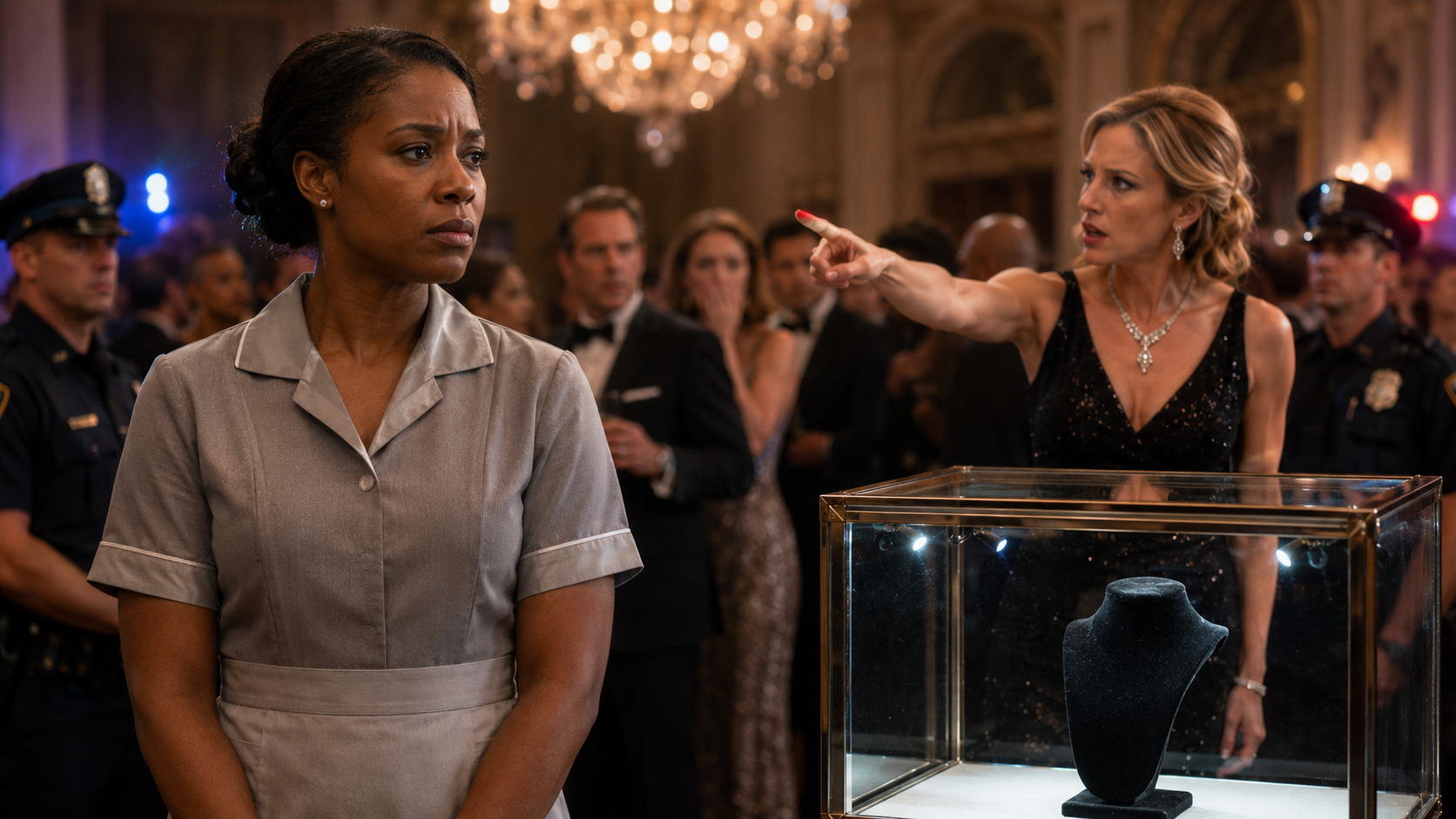
The glass case was open.
The velvet stand inside it was empty.
The Crimson Star, a ruby necklace insured for nearly two million dollars, had disappeared.
“Seal every exit!” shouted Lydia Graves, the director of the charity gala.
The musicians lowered their instruments. Security officers rushed toward the doors. Heavy locks clicked into place, trapping politicians, investors, actors, journalists, and hotel employees beneath the golden chandeliers.
Near the service corridor, Maeve Rowan stopped pushing her cart.
She wore the silver-gray uniform of Bellweather Hall’s temporary alterations staff. A measuring tape hung around her neck, and a small sewing kit rested beside folded tablecloths on the cart.
Her eleven-year-old son, Oliver, was waiting in the employee lounge downstairs. His school had closed early because of a heating failure, and Maeve had been unable to find anyone to watch him.
She had promised him they would leave before ten.
It was already nine forty-five.
Maeve looked at the empty display and felt a cold pressure tighten around her ribs.
Only fifteen minutes earlier, she had been called to the private gallery to repair a torn evening gown. A voice over the staff intercom had told her that a guest needed immediate assistance.
When Maeve reached the gallery, no one was there.
She had waited for less than a minute before returning backstage.
Now the necklace was gone.
“Check every employee,” Lydia ordered. “Bags, lockers, carts—everything.”
Her voice carried across the room with the sharp confidence of someone accustomed to being obeyed.
Lydia was tall, elegant, and dressed in a black gown covered with tiny crystals. The light from the chandeliers followed her whenever she moved. She had organized the gala, selected the guest list, supervised the security arrangements, and personally announced that the Crimson Star would be displayed for one night only.
The necklace had once belonged to a European actress. Its sale was supposed to fund a new children’s hospital wing.
At least, that was what the guests had been told.
A security officer approached Maeve.
“Step away from the cart.”
Maeve obeyed.
“What’s happening?” she asked.
“We’re conducting a search.”
“I can see that. I’m asking why you’re looking at me.”
The officer did not answer.
Another guard opened the drawers of her cart. He lifted scissors, needles, spools of thread, replacement buttons, fabric glue, and two unfinished sleeves.
Then he found a white plastic card beneath a roll of black silk.
He held it up.
Lydia saw it from across the ballroom.
“What is that?”
The guard examined the card.
“Master access key.”
The room seemed to contract around Maeve.
“That isn’t mine,” she said.
Lydia walked toward her slowly.
The guests moved aside, creating a path.
“The gallery display can only be opened with a master key,” Lydia said. “Where did you get it?”
“I didn’t.”
“It was inside your cart.”
“I have never seen that card before.”
Lydia’s expression was almost sympathetic.
Almost.
“Maeve, this will be much easier if you return the necklace now.”
“I don’t have it.”
“Perhaps you panicked. Perhaps you saw something valuable and made a terrible decision.”
Maeve looked at the watching guests.
Some appeared shocked. Others seemed fascinated. Several had already raised their phones.
“I was called to the gallery,” Maeve said. “Someone requested a clothing repair.”
“Who?”
“I don’t know. The message came through the staff intercom.”
Lydia turned toward the hotel supervisor.
“Was a repair requested?”
The supervisor shook his head.
“No request was logged.”
“That’s impossible,” Maeve said. “I heard the message myself.”
Lydia sighed.
“Search her.”
Two female security officers escorted Maeve behind a decorative partition. They checked her pockets, shoes, sewing pouch, and uniform.
They found nothing.
When Maeve stepped back into the ballroom, two police officers were entering through the main doors.
Behind them stood Oliver.
His backpack hung from one shoulder. His dark hair was untidy, and fear had drained the color from his face.
“Mom?”
Maeve’s heart dropped.
“Oliver, you were supposed to stay downstairs.”
“A guard came into the lounge. Everyone was running. They said something was stolen.”
He hurried toward her, but a security officer blocked his path.
“Let him through,” Maeve said.
The officer hesitated.
“He is my son.”
Oliver slipped around the guard and wrapped both arms around Maeve’s waist.
“You didn’t steal anything,” he said loudly.
Several guests looked away.
Maeve placed a hand on the back of his head.
“No, sweetheart. I didn’t.”
Lydia watched them with a composed expression.
“The police will decide that,” she said.
One of the officers introduced himself as Detective Aaron Pike. He was in his early fifties, with tired eyes and a voice that remained calm even when everyone around him was shouting.
He examined the master key.
“Who had access to cards like this?”
“Senior management and security,” answered Lydia. “Temporary employees are never issued master access.”
“Then how did it end up in her cart?”
“That is what we all want to know.”
Detective Pike looked at Maeve.
“Were you near the display tonight?”
“I walked through the private gallery after someone called me there. I did not touch the case.”
“Approximately what time?”
“Nine fifteen. Maybe a few minutes earlier.”
Lydia folded her arms.
“The necklace was discovered missing at nine thirty-eight.”
“I returned backstage immediately.”
“Can anyone confirm that?”
Maeve opened her mouth and then stopped.
The backstage preparation room had been empty when she returned. Most of the staff had been serving dinner or clearing tables.
Lydia noticed her hesitation.
“No witnesses,” she said.
Detective Pike raised one hand.
“I will ask the questions.”
Lydia gave him a restrained smile.
“Of course.”
The detective turned back to Maeve.
“Do you have any reason to believe someone might want to implicate you?”
Maeve looked toward Lydia.
Three weeks earlier, Maeve had repaired the protective lining inside the necklace’s transport case. While working, she had noticed that the identification number stitched into the lining did not match the number on the insurance documentation.
She had mentioned it to Lydia.
Lydia had dismissed the discrepancy as a clerical error.
The next morning, Maeve’s regular contract had been unexpectedly canceled. She had only been invited back tonight because the gala required additional staff.
At the time, she had told herself it was a coincidence.
Now she was no longer certain.
“I noticed something unusual about the necklace case,” Maeve said.
Lydia’s eyes sharpened.
“What exactly?”
“The identification numbers didn’t match.”
A murmur passed through the room.
Lydia laughed softly.
“She is a seamstress, Detective, not an insurance investigator.”
“I am a textile conservator,” Maeve replied. “Or I was, before the museum closed its restoration department. I know how valuable objects are cataloged and transported.”
“You repair dresses in a hotel.”
“Because repairing dresses pays my rent.”
The words landed harder than Maeve intended.
Lydia’s smile disappeared.
Detective Pike looked between them.
“Tell me about the identification numbers.”
Before Maeve could answer, the head of security approached.
“We have footage.”
Every conversation stopped.
Lydia turned toward him.
“From the gallery?”
“Yes.”
“Play it here.”
A large screen above the orchestra stage had displayed photographs of hospital plans throughout the evening. A technician connected the security system, and grainy black-and-white footage appeared.
The timestamp read 9:13 p.m.
Maeve entered the private gallery carrying her sewing kit.
She walked past the display case and disappeared beyond the camera’s viewing angle.
Forty seconds later, the image flickered.
The screen became black.
When the picture returned, the gallery was empty.
The timestamp read 9:21 p.m.
Lydia faced the detective.
“Eight missing minutes.”
“I left almost immediately,” Maeve said.
“The recording says otherwise.”
“The recording does not show me stealing anything.”
“It shows you entering the gallery just before the necklace vanished.”
Maeve studied the screen.
Something about the footage felt wrong.
She had entered through the eastern service door. She remembered checking the wall clock as she passed because she was worried about catching the last bus home.
The clock had shown 9:17.
But the footage placed her inside the gallery four minutes earlier.
“The timestamp is wrong,” she said.
The security chief shook his head.
“The system synchronizes automatically.”
“I entered at nine seventeen.”
“You cannot know that precisely.”
“There is a clock beside the service entrance. I looked directly at it.”
Lydia stepped closer.
“Or you are changing your story because the video exposed you.”
Oliver tightened his grip on Maeve’s arm.
“Stop talking to her like that.”
A few guests whispered.
Lydia glanced down at him.
“Children should not interfere in adult matters.”
“And adults shouldn’t lie.”
“Oliver,” Maeve said quietly.
But the room had already heard him.
Lydia’s cheeks colored.
Detective Pike asked the security chief to replay the footage.
Again, Maeve entered.
Again, the image failed.
Again, eight minutes disappeared.
“This camera malfunctioned at a convenient moment,” Lydia said.
“It might have been deliberately interrupted,” the detective replied.
“That would require technical knowledge.”
“And system access.”
Lydia’s expression tightened.
“I hope you are not suggesting that someone on my team was involved.”
“I am not suggesting anything yet.”
A guard arrived carrying Maeve’s canvas handbag.
“We found this in the employee locker room.”
Lydia pointed toward a nearby table.
“Open it.”
Detective Pike took the bag himself.
Inside were Maeve’s wallet, a bus pass, a small umbrella, a paperback novel, Oliver’s asthma inhaler, and a metal lunch container.
Beneath the container, wrapped in a piece of green cloth, was a ruby pendant.
The ballroom erupted.
Oliver stared at the jewel.
Maeve did not understand what she was seeing.
“That is not the necklace,” she said.
Lydia stepped forward.
“It is part of it. The central stone can be detached from the chain.”
“I have never seen that pendant.”
The detective lifted the cloth without touching it directly.
“Who brought this bag upstairs?”
“The guard,” Maeve said. “It was in my locker.”
“Was the locker secured?”
“Yes.”
“Who has access to employee lockers?”
“Management,” answered the hotel supervisor.
Lydia’s voice rose.
“This is absurd. The master key was in her cart, the ruby was in her bag, and the security video places her at the scene.”
Oliver looked around the ballroom.
“Someone put it there.”
Lydia ignored him.
Detective Pike requested evidence bags.
Maeve felt every stare in the room pressing against her skin. She had spent years learning to become unnoticed.
She repaired torn hems while wealthy guests continued their conversations.
She removed wine stains while people complained that service was slow.
She restored antique fabric for collectors who never asked her name.
Invisibility had once felt safe.
Tonight it felt like a cage.
Detective Pike spoke quietly.
“Mrs. Rowan, I need you to come with us while we investigate.”
Oliver stepped between them.
“No.”
“Oliver,” Maeve whispered.
“You can’t take her.”
“I am not arresting her at this moment,” Pike said. “But she must answer additional questions.”
“She already answered you.”
Maeve knelt in front of her son.
His eyes were wet, but he was fighting the tears.
“Listen to me. I need you to stay calm.”
“They’re blaming you because of your uniform.”
The words were loud enough for the nearest guests to hear.
Maeve touched his cheek.
“They can accuse me. That does not make them right.”
“What if nobody believes you?”
“Then we make them look at the truth until they do.”
A new voice came from the ballroom entrance.
“What exactly is happening in my hotel?”
Sebastian Mercer, the owner of Bellweather Hall, walked into the room.
He had arrived directly from the airport, still wearing a dark traveling coat. Beside him was his daughter, Camille, a university student who had helped design the gala’s digital art installation.
Lydia crossed the ballroom to meet him.
“Sebastian, thank goodness. The Crimson Star has been stolen.”
His eyes moved toward the empty case, the police, and Maeve standing beside her frightened son.
“Who opened the display?”
“We believe she did.”
Lydia pointed.
Sebastian knew Maeve. Two months earlier, she had restored a fire-damaged tapestry that had hung in his family’s hotel for almost a century.
He looked at the ruby pendant being sealed inside an evidence bag.
“What does Maeve say?”
“That she was framed,” Lydia replied.
“I asked what Maeve says.”
Maeve stood.
“Someone called me to the gallery. The security recording is missing eight minutes. A master key appeared in my cart, and that pendant appeared inside my locked bag.”
Sebastian turned to the security chief.
“Why is the recording incomplete?”
“We are checking the system.”
Camille had been staring at the large screen.
“That footage isn’t original,” she said.
The security chief frowned.
“What do you mean?”
“It has been exported.”
“Of course it was exported. We transferred it to the presentation system.”
“No. The compression artifacts are already embedded. This file was exported before you brought it here.”
Lydia gave an impatient sigh.
“Camille, this is not one of your university projects.”
Camille ignored her and approached the technician.
“Show me the file properties.”
The technician opened a panel on the screen.
Camille studied the information.
“This copy was created at nine twenty-nine.”
The necklace had not been reported missing until nine thirty-eight.
Detective Pike looked at the security chief.
“Who exported it?”
“I didn’t.”
“Who could?”
“Anyone with administrative access.”
The detective turned toward Lydia.
“You have administrative access?”
“As event director, yes. So do several other people.”
Camille examined the screen again.
“The timestamp was modified too.”
Maeve felt Oliver’s hand close around hers.
“I told you,” he whispered.
Lydia shook her head.
“This proves only that the system is unreliable.”
“No,” Camille said. “It proves someone prepared this video before the theft was announced.”
Sebastian removed his coat.
“Find the original recording.”
The security chief began typing.
After several seconds, his face changed.
“It has been deleted from the primary server.”
“Backups?” asked Detective Pike.
“Also deleted.”
Lydia spread her hands.
“Then we may never know what happened during those eight minutes.”
Camille looked toward the ceiling.
“The gallery camera was not the only thing recording.”
Everyone followed her gaze.
Above the center of the ballroom hung an enormous mirrored sculpture made of rotating metal panels. Throughout the gala, hidden projectors had cast moving patterns across its surface. Small cameras positioned around the sculpture tracked the room and adjusted the light in response to the guests’ movements.
“It records spatial data,” Camille explained. “The images are low resolution, but the system stores continuous visual reference files.”
Lydia went still.
“That installation faces the ballroom.”
“One of the tracking cameras faces the private gallery entrance.”
“Those files are not security footage.”
“They do not need to be.”
Camille connected her laptop to the display system.
Lydia walked toward Sebastian.
“This is becoming a spectacle. The police already have physical evidence.”
“They have evidence that may have been planted,” Sebastian said.
“You cannot seriously believe a temporary employee over me.”
Sebastian looked at her for a long moment.
“I believe evidence over everyone.”
Camille opened a sequence of files.
The image was distorted by reflections from the mirrored sculpture, but the gallery entrance was visible in the background.
At 9:16, Maeve appeared beside the eastern door.
She entered the gallery.
Less than a minute later, she came out again.
She had told the truth.
At 9:19, another figure entered through the western door.
A man wearing a waiter’s jacket.
He looked toward the ballroom, removed a card from his pocket, and opened the display case.
The guests began murmuring.
Lydia’s assistant, Kellan Frost, stood near the stage.
His face turned gray.
On the screen, the man removed the necklace and placed it inside a silver catering box. Then he closed the display and left through the service passage.
All eyes moved toward Kellan.
He took one step backward.
Detective Pike blocked his path.
“Do not move.”
Kellan looked at Lydia.
She did not look back.
The detective searched his jacket and found no necklace, but Camille continued playing the recording.
At 9:24, Kellan entered the employee preparation room carrying the silver box.
At 9:27, Lydia joined him.
The camera angle did not reveal what happened inside the room, but Lydia emerged holding something wrapped in green cloth.
The same shade of cloth found in Maeve’s handbag.
Lydia’s composure finally cracked.
“This recording is distorted. You cannot identify anyone from those images.”
Camille enlarged the frame.
The mirrored panels had captured Lydia’s face from two separate angles.
Her crystal-covered gown reflected light like a field of stars.
There was no possibility of mistaking her.
Detective Pike faced Kellan.
“Where is the necklace?”
Kellan swallowed.
“I don’t know.”
“Think carefully.”
“I only did what I was told.”
Lydia spun toward him.
“Be quiet.”
The detective’s voice remained calm.
“What were you told to do?”
Kellan’s eyes moved around the ballroom.
The guests who had admired him an hour earlier now watched him as though he were something trapped beneath glass.
“Lydia said the necklace was already a replica,” he whispered.
A shocked silence followed.
Sebastian stepped closer.
“What did you say?”
Kellan’s voice trembled.
“The real necklace was removed before the gala. She said the museum’s insurance policy would cover the loss. Tonight’s theft was supposed to make everything look believable.”
Lydia laughed, but the sound was thin and unsteady.
“He is trying to protect himself.”
“You promised nobody would be hurt,” Kellan continued. “You said Maeve would be questioned and released.”
Maeve stared at him.
“You put the key in my cart.”
Kellan lowered his head.
“Yes.”
“And the pendant in my bag?”
“Yes.”
Oliver moved closer to his mother.
His small face hardened with an anger that looked too old for him.
Lydia pointed at Kellan.
“He planned this. He had access to the gallery.”
“Because you gave me access.”
“Stop lying!”
“You chose Maeve because she noticed the transport numbers,” Kellan said. “You were afraid she would tell the museum that the necklace had been replaced.”
The detective turned to Lydia.
“Where is the original Crimson Star?”
She did not answer.
Sebastian looked at her with disbelief.
“How long?”
Her silence was answer enough.
“How long have you been stealing from the foundation?” he demanded.
Lydia’s shoulders dropped.
The perfect posture disappeared. The polished public figure seemed to collapse inward, revealing someone exhausted and furious.
“You have no idea what it costs to maintain a life like mine.”
Sebastian stared at her.
“The foundation paid you extremely well.”
“The salary was nothing compared with the expectations. The houses, the dinners, the donations, the clothes—everyone wanted Lydia Graves to look successful.”
“So you stole money intended for sick children?”
“I borrowed it.”
“You replaced a historic necklace with a copy.”
“I was going to fix everything after the insurance payment.”
Maeve spoke for the first time.
“And what were you going to do to me?”
Lydia looked at her.
For a moment, there was no ballroom, no audience, no police. Only two women standing a few feet apart.
One wore a crystal gown.
The other wore a silver work uniform.
“You were supposed to take a settlement,” Lydia said. “The hotel would have paid you to remain silent.”
“You expected me to confess to something I did not do.”
“I expected you to be practical.”
“You expected me to be powerless.”
Lydia’s face hardened.
“You repair clothing for strangers. Do not pretend you understand my position.”
Maeve stepped closer.
“I understand it perfectly. You believed that because people rarely notice me, nobody would notice what happened to me.”
Oliver looked at the phones held by the guests.
“They notice now.”
Detective Pike instructed Lydia to turn around.
She did not move.
“You cannot arrest me on the word of a frightened assistant and a broken art camera.”
“We also have an altered security file, deleted backups, a planted access card, a planted ruby, multiple witnesses, and your recorded presence with Mr. Frost.”
Lydia looked toward Sebastian.
“Tell them this is a misunderstanding.”
Sebastian’s expression contained no sympathy.
“You turned my hotel into a crime scene. You used a charity for children to finance your lies. And you selected an innocent woman because you thought her life was less valuable than yours.”
The detective repeated his instruction.
This time, Lydia turned around.
The click of the handcuffs sounded louder than the orchestra had.
Guests moved aside as the police escorted Lydia and Kellan toward the exit. No one applauded. No one spoke.
The ballroom had become unnaturally quiet.
Maeve looked at the empty display case.
A few minutes earlier, it had seemed to contain the most important object in the room.
Now it was only glass and velvet.
Oliver leaned against her.
“Can we go home?”
Maeve placed an arm around his shoulders.
“Yes.”
Sebastian approached them.
“Maeve, wait.”
She stopped but did not turn immediately.
“I am sorry,” he said.
She faced him.
“You did not accuse me.”
“I employed people who did. They searched you in front of strangers. They frightened your son. That happened inside my hotel.”
Maeve looked across the ballroom.
Some of the guests avoided her eyes. Others appeared eager to apologize now that apologizing was safe.
A journalist lowered her phone.
One of the security officers who had searched Maeve’s cart quietly removed his hat.
Sebastian continued.
“The police will need your statement, but my legal team will make sure you are protected. You will also receive compensation.”
“Money will not erase what Oliver saw.”
“No,” Sebastian said. “It will not.”
Camille joined them.
“The city museum is reopening its conservation department next month,” she said. “My professor is leading the textile division. I showed her photographs of the Bellweather tapestry you restored. She asked who had done the work.”
Maeve looked at her.
“What did you tell her?”
“The truth. That the most qualified conservator in the building was repairing cocktail dresses because no one had bothered to look at her résumé.”
For the first time that night, Maeve almost smiled.
Camille handed her a card.
“This is not charity. It is an interview.”
Maeve accepted it.
Oliver studied the card.
“Does that mean you won’t have to work at parties anymore?”
“It means your mother will decide where she works,” Maeve said.
They walked through the ballroom together.
The locked doors had been opened. Cool night air entered from the stone terrace, carrying the scent of rain.
Outside, police lights moved across the hotel walls.
Oliver stopped beneath the entrance canopy.
“Mom?”
“Yes?”
“Why did everyone believe her?”
Maeve looked back through the glass doors.
Lydia’s abandoned champagne glass remained on a table. Her name was still printed across the gala programs. Her photograph appeared beside the foundation’s logo on the enormous screen.
Maeve considered telling Oliver that people were cruel.
It was sometimes true.
She considered telling him that wealthy people could buy trust.
That was sometimes true as well.
Instead, she knelt beside him.
“People often believe the version of a story that asks the least from them,” she said. “Believing Lydia required them to do nothing. Believing me required them to question someone important.”
Oliver thought about this.
“So the camera made them brave?”
“No. The camera made it impossible for them to remain comfortable.”
Rain began tapping against the canopy.
Maeve opened her umbrella, and they walked toward the bus stop.
Six weeks later, police recovered the real Crimson Star from a private storage facility registered under a false company name. Investigators also uncovered years of missing foundation funds, fabricated invoices, and secret payments.
Lydia Graves was charged with fraud, theft, evidence tampering, and conspiracy.
Kellan Frost cooperated with investigators and admitted his role in the plan.
The hospital foundation was reorganized under independent supervision. Several wealthy donors who had once praised Lydia publicly claimed they had never trusted her.
Maeve ignored every interview request.
She did not want to become famous for being accused.
She wanted to be known for what she could do.
The city museum offered her a position in its newly restored conservation department. On her first morning, she entered through the front doors rather than the service entrance.
There was no silver uniform waiting for her.
Instead, she received a white laboratory coat, an identification badge bearing the title Senior Textile Conservator, and a set of keys to the restoration archive.
Oliver visited after school.
He found his mother leaning over a centuries-old embroidered panel beneath a circle of bright lamps. Fine tools lay beside her hands. Every movement was careful and certain.
“This is where you belong,” he said.
Maeve smiled.
“I belonged everywhere I worked.”
“You know what I mean.”
She did.
A year later, Bellweather Hall invited Maeve to attend the next hospital gala as an honored guest. She accepted on one condition: the hotel would establish a permanent fund for vocational training and legal support for contract workers.
Sebastian agreed.
During the gala, Maeve stood beneath the same chandeliers wearing a dark blue dress she had designed herself.
The central display case contained no jewels.
Instead, it held the restored piece of embroidery she had been working on when Oliver visited the museum. The fabric had survived fire, water, careless storage, and nearly two hundred years of neglect.
A small group gathered as Maeve explained the restoration process.
Oliver watched from the front row.
When she finished, the audience applauded.
Maeve glanced toward the mirrored sculpture above the ballroom.
Its panels turned slowly, catching fragments of every face beneath them.
Once, those reflections had revealed a crime.
Tonight, they showed something quieter.
A woman who had been treated as invisible now stood in the center of the room, not because someone had rescued her, but because the truth had finally forced the world to see what had always been there.
FOUR SEEDANCE VIDEO TRAILER PROMPTS
1
Create a cinematic 15-second dramatic thriller trailer inside an opulent hotel ballroom during a luxury charity gala. Begin with a close-up of an empty velvet necklace stand inside an open glass display case, then whip-pan to shocked wealthy guests and security officers locking the doors. Maeve, a dignified working-class woman in a silver alterations uniform, stands beside her frightened eleven-year-old son Oliver. Lydia, an elegant gala director in a black crystal gown, points at Maeve and says with cold authority: “The ruby was found in her bag.” Maeve looks directly at her and replies: “Then someone wanted you to find it.” End with police lights flashing across the mirrored ballroom and Oliver gripping his mother’s hand. Realistic spoken dialogue, tense orchestral sound design, dramatic cinematic lighting, natural lip synchronization, no subtitles, no captions, no logos, no titles, no written words anywhere in the video.
2
Create a fast-paced 15-second mystery trailer set in the security control area of a historic luxury hotel. Start with Maeve in a silver staff uniform watching grainy surveillance footage that appears to show her entering a private gallery. Lydia stands behind her with a confident smile and says: “The camera places you at the scene.” Maeve points at the screen and answers firmly: “That clock is four minutes wrong.” The image suddenly glitches, Camille rushes to a laptop, and a hidden mirrored-camera recording reveals Lydia carrying an object wrapped in green cloth. Camille says: “This footage was altered before the theft was reported.” End on Lydia’s terrified face reflected in several rotating mirrors. Suspenseful editing, realistic English dialogue, synchronized lips, pulsing cinematic music, no subtitles, no captions, no titles, no logos, no visible text or interface labels.
3
Create an emotional 15-second cinematic trailer outside a grand hotel ballroom filled with police, reporters, and frightened guests. Maeve’s eleven-year-old son Oliver runs through the crowd and hugs his mother while a detective prepares to escort her away. Oliver cries: “They’re blaming you because of your uniform.” Maeve kneels, holds his face gently, and says: “They can accuse me, but they cannot change the truth.” Cut rapidly to a master key being discovered in a sewing cart, a ruby pendant inside a handbag, a security video glitching to black, and a mysterious man removing a necklace from a glass case. End with Maeve staring toward the ballroom doors as they slam shut. Strong emotional performances, realistic English speech, accurate lip synchronization, dramatic camera movement, cinematic thriller atmosphere, no subtitles, no captions, no titles, no logos, no written words on screen.
4
Create a powerful 15-second justice-reversal trailer in a luxurious ballroom beneath rotating mirrored sculptures. Begin with Lydia in a glittering black gown shouting: “She stole the necklace!” Cut to Maeve standing silently beside her son while guests record with their phones. A giant screen suddenly shows Lydia and her assistant planting evidence in Maeve’s belongings. The detective steps forward and says: “Lydia Graves, turn around.” Lydia whispers in disbelief: “You cannot be serious.” Maeve answers calmly from across the room: “You chose me because you thought no one would look closely.” End with handcuffs closing around Lydia’s wrists as the ballroom falls completely silent. Cinematic realism, intense dramatic pacing, natural English dialogue, precise lip synchronization, orchestral impact sound, no subtitles, no captions, no titles, no logos, no written text anywhere in the video.

