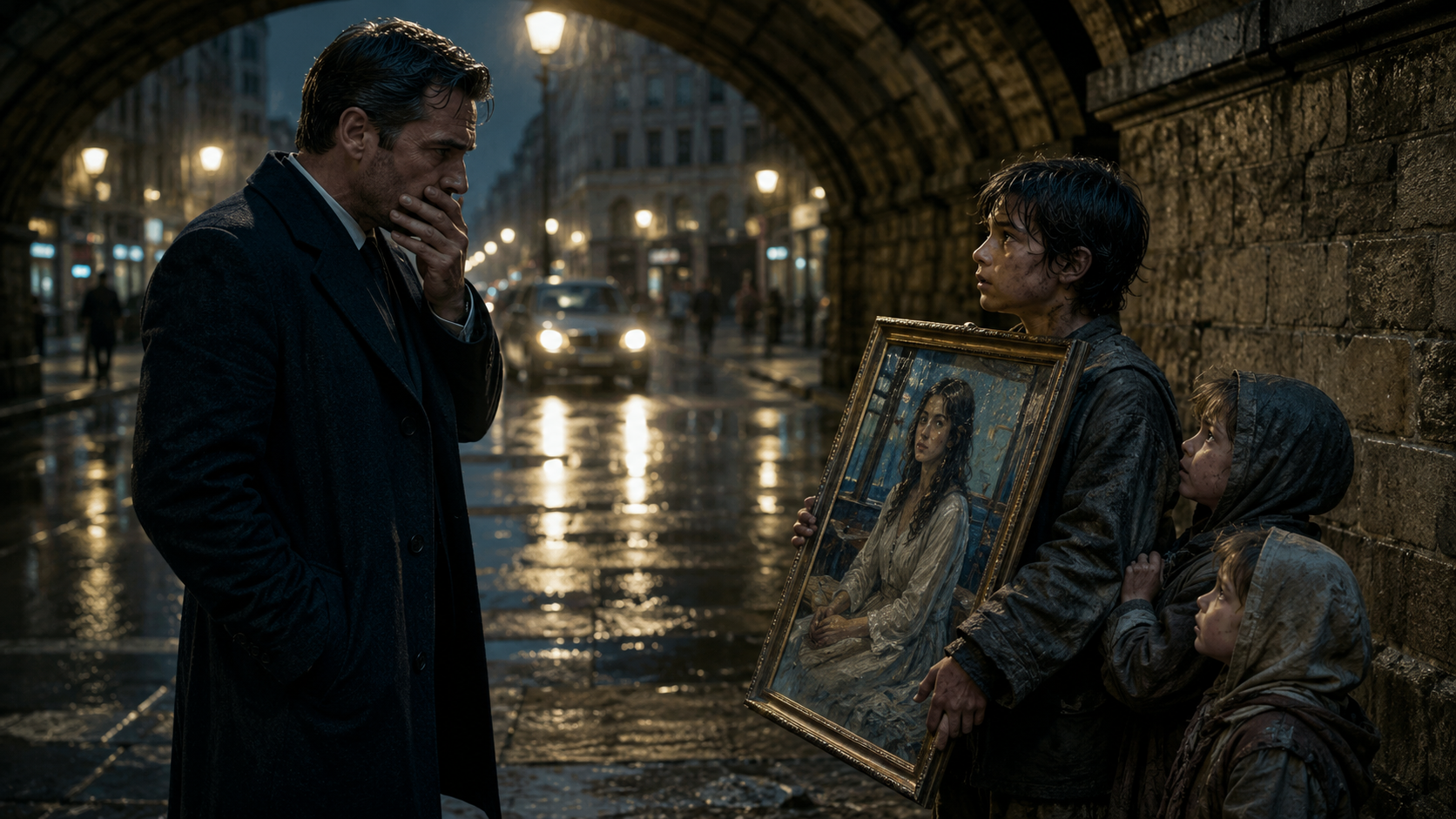
Toby started calling Julian “Dad” accidentally, then deliberately, then constantly when he wanted something.
Nell decided Julian needed more color in his wardrobe and began selecting his ties. This led to several board meetings where the most feared man in New York wore a purple tie covered in tiny rabbits.
Kit recovered fully and became convinced that all doctors were secretly soup experts.
And Mara painted.
Not because hunger demanded it.
Not because fear needed money.
Because her hands remembered beauty, and beauty had waited patiently for her return.
One year after the night beneath the railway arch, Julian found her in the rebuilt Glasshouse standing before the original portrait.
The rain-stained painting had been cleaned but not repaired too perfectly. Mara had insisted the cracks remain visible.
“Proof,” she said.
“Of what?”
“That broken things still tell the truth.”
Julian stood beside her.
The portrait no longer frightened him. The woman in it was not dead, not lost, not trapped in the worst night of their lives.
She had been a message.
A door.
A miracle sold for ten dollars by a starving boy brave enough to protect his family.
Julian reached for Mara’s hand, slowly enough that she could refuse.
She did not.
Their fingers intertwined.
“I missed you,” he said.
Mara looked at the portrait.
Then at the children across the room, where Toby was teaching Kit how to mix green and Nell was telling a volunteer that hair was not rope.
Finally, Mara looked at Julian.
“You found us.”
“I should have found you sooner.”
“Yes,” she said.
The answer hurt.
Then she squeezed his hand.
“But you found us.”
That evening, when the center opened its doors for the first time, Mara hung a small card beneath the portrait.
It did not list a price.
It did not list a donor.
It said only:
The Woman at the Blue Window
Painted in hiding.
Found in the rain.
Never buried.
Julian read it twice.
Then he turned away before the children could tease him for crying.
But Toby saw.
Of course Toby saw.
He came over, slipped his small hand into Julian’s, and leaned against him like it was the most natural thing in the world.
Julian looked down at his son.
“Hungry?” he asked.
Toby grinned.
“Always.”
Across the room, Mara laughed.
And for the first time in seven years, the sound did not feel like memory.
It felt like home.