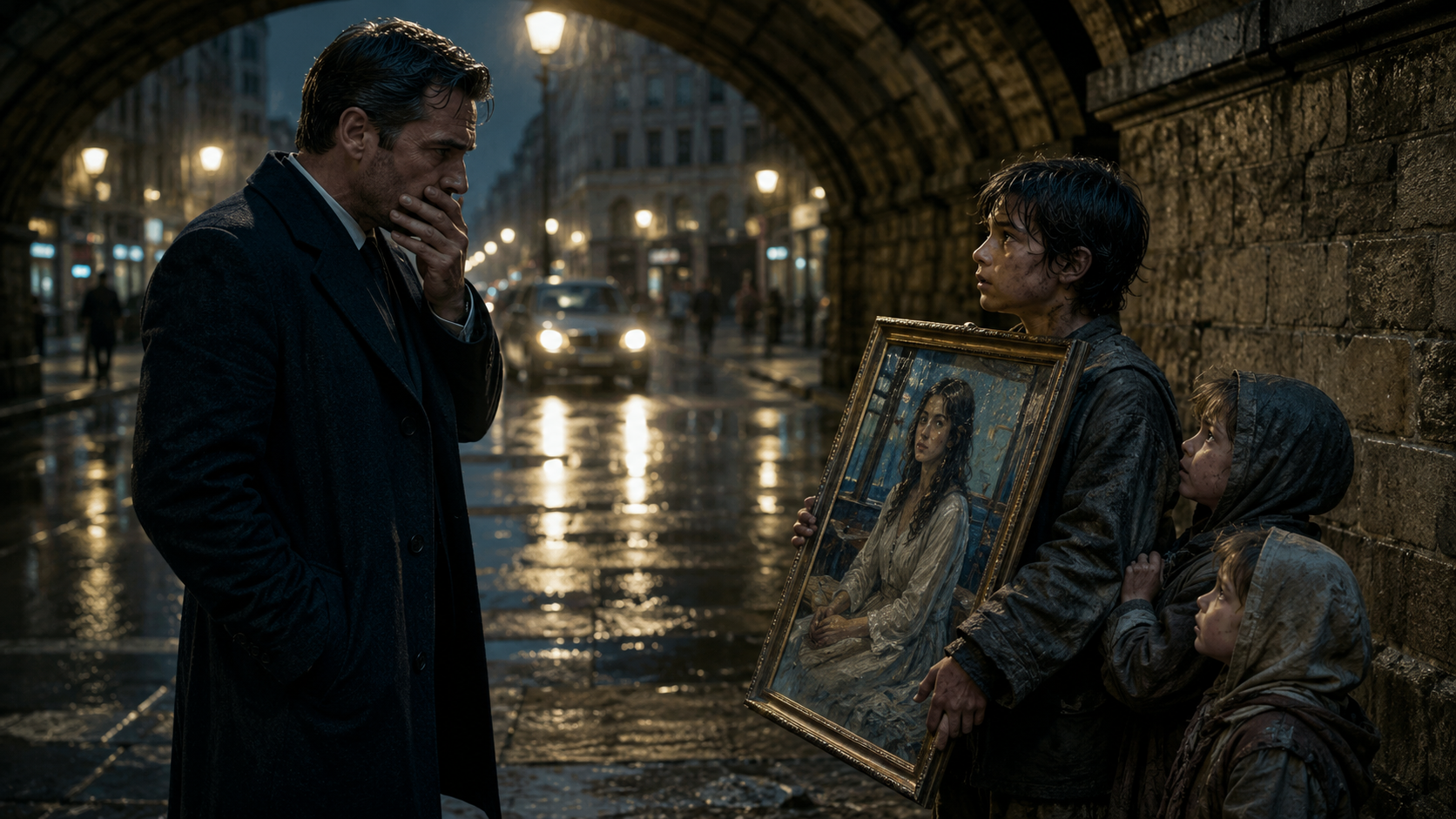
Julian held the bill toward Toby again. “Take it. Buy food. Something warm.”
Toby’s pride fought a losing battle with his hunger. At last he snatched the bill, shoved the painting into Julian’s hands, and grabbed the younger children.
“Come on.”
Julian stood.
“Wait.”
Toby stopped but did not turn around.
“Where can I find your mother?”
The boy looked back then.
His eyes were hazel.
Not brown. Not green.
Hazel, with a ring of gold near the pupil.
Julian nearly forgot how to breathe.
Toby said, “You can’t.”
Then he ran.
The girl and the little boy ran after him, their thin shoes splashing through dirty water, their shadows swallowed by the crowd.
Julian did not chase them.
Not with his own feet.
He turned toward the black sedan at the curb. His driver opened the door, but Julian did not get in.
“Mr. Calder?” the driver asked.
Julian handed him the painting with both hands, as if it might vanish.
“Call Elise.”
His driver blinked. “Your security director?”
“Now.”
“And the meeting?”
Julian looked at the portrait again.
Mara’s painted eyes looked back at him from behind rain-blurred glass.
“Cancel everything.”
By nightfall, Julian had watched the security footage from six nearby stores, two traffic cameras, and a pawnshop whose owner changed his mind about cooperation after receiving a call from Julian’s attorney.
The children had not gone far.
They moved through the city like ghosts who knew which corners belonged to danger. Toby kept to alleys. The girl carried Kit when he began limping. They stopped once behind a restaurant, where Toby traded something with a kitchen worker for a paper bag. Then they disappeared through a broken side gate behind an abandoned botanical conservatory near the river.
Julian knew the building.
Everyone in the city knew it. The old Glasshouse had once been a public winter garden, a palace of iron ribs and glass panels where families came to see orange trees bloom in January. After a developer bought the land and went bankrupt, the structure had been left to rot behind temporary fencing that was no longer temporary.
“Homeless encampments come and go there,” Elise Warren said, standing beside him in the security room of Calder Tower. Elise had worked for Julian for twelve years and lied to him only when it protected him from wasting time. “It’s unstable. Half the roof is broken. We should send a team.”
“No uniforms.”
“Julian.”
“No police. No city agencies. No one who might scare them.”
Elise studied him.
She had been at Mara’s funeral. She had stood three steps behind him when he failed to cry because grief had turned him into something harder than tears.
Now she looked at the painting propped against the wall.
For once, Elise had no answer ready.
“It could be a coincidence,” she said carefully.
Julian did not reply.
“An artist may have copied her from an old photograph.”
“No.”
“You don’t know that.”
“Yes,” Julian said. “I do.”
Because no photograph had ever captured Mara like that.
The woman in the portrait was not smiling. She was not posed. She was tired, guarded, alive in a way no photograph of his wife had been allowed to be after death. Whoever painted that picture had sat across from her long enough to understand how she looked when she was trying not to break.
Julian touched the frame.
On the lower right corner, the artist had signed a single letter.
M.
His throat tightened.
“Prepare food,” he said. “Blankets. A doctor, but keep them back until I say. I’m going inside alone.”
Elise laughed once, humorless. “Absolutely not.”
“Elise.”
“You are worth too much money to enter an abandoned structure at night without protection.”
Julian turned to her. “If she is in there and sees guards, she’ll run.”
Elise held his gaze.
He could see the moment she stopped arguing as an employee and began worrying as the closest thing he had left to family.
“You think Mara is alive.”
“I think if I say that out loud, and I’m wrong, it will kill me.”
Elise’s expression softened.
Then she nodded. “I’ll be twenty steps behind you.”
“Fifty.”
“Thirty.”
Julian almost smiled.
“Fine.”
The Glasshouse smelled of wet leaves, rust, and old ash.
Moonlight entered through missing panes in the high curved roof. Vines crawled over shattered tile. The skeletons of dead tropical plants stood in cracked stone planters, their dry branches clicking faintly in the wind.
Julian stepped carefully through the side entrance, carrying two paper bags from a diner and one thermos of soup.
He heard movement before he saw anyone.
A whisper.
A quick scrape.
Then Toby appeared from behind a fallen display sign, holding a piece of broken pipe like a weapon.
“Don’t come closer.”
Julian stopped immediately.
“I won’t.”
“You followed us.”
“Yes.”
Toby’s face tightened. “Then you’re bad.”