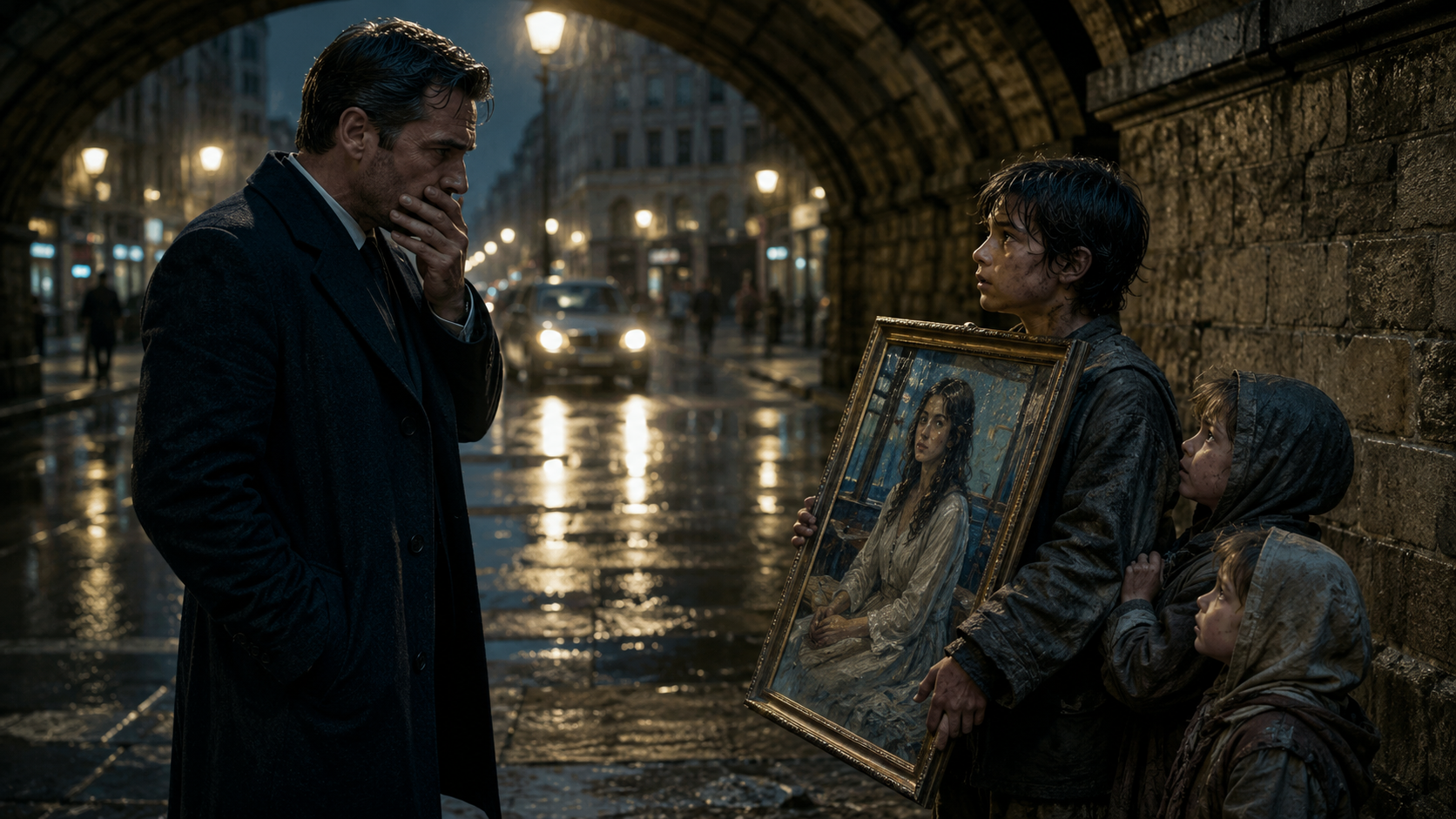
The first thing Julian Calder noticed was not the painting.
It was the boy’s hands.
They were small, red from cold, and wrapped around a wooden picture frame as if it were the last solid thing left in the world. Rain ran down the boy’s temples and dripped from the end of his nose. His jacket was too thin for November, one sleeve shorter than the other, and the soles of his shoes had begun to peel away from the leather.
Beside him stood two younger children.
A girl with tangled brown curls held a paper cup that contained three coins and a button. A little boy, no older than four, pressed himself against her side and stared at the bakery window across the street with the desperate stillness of a child who had learned not to ask for food out loud.
Julian had been on his way to a board meeting he did not want to attend.
His driver waited at the curb with the engine running. His assistant had already called twice. Somewhere twelve floors above Midtown, a room full of men in expensive suits were preparing to explain why closing two community clinics would improve quarterly returns.
Julian had planned to listen, nod once, and make them all regret opening their mouths.
Then he saw the children beneath the railway arch.
The boy lifted the painting whenever someone passed.
“Please,” he said, voice shaking but polite. “Original painting. My mother made it. Ten dollars.”
Most people did not look.
Some looked and looked away quickly, as if poverty were contagious.
A woman dropped a coin without stopping. A man in a camel coat muttered, “Shouldn’t be allowed to beg here,” and stepped around them.
Julian stopped.
The boy straightened immediately, hope and fear fighting across his face.
“Ten dollars, sir,” he said. “It’s real paint. Not printed. We can wrap it in newspaper.”
Julian looked at the frame.
At first, all he saw was a rain-stained portrait of a woman seated near a cracked blue window. She was turned slightly away, one hand resting near her throat, her hair falling loose over one shoulder. The brushwork was rough in places, almost hurried, but the face had been painted with aching tenderness.
Then the world narrowed.
The noise of traffic dissolved.
The rain seemed to stop moving.
Julian reached toward the painting, then froze before touching it.
The woman in the portrait had Mara’s eyes.
Not similar eyes. Not the vague resemblance that grief can invent when a man has spent too many years seeing his dead wife in strangers at airports and restaurants and across crowded streets.
These were Mara’s eyes.
Dark hazel with a ring of gold near the pupil.
The left eyebrow had the tiniest break in the arch, exactly where a childhood scar had interrupted the hair. The mouth held the same quiet sadness she wore when she pretended she was not hurt. Even the tilt of her head was familiar.
Julian felt seven years collapse inside his chest.
“What did you say?” he asked.
The boy swallowed. “Ten dollars, sir.”
“No.” Julian’s voice came out too low. “Who painted this?”
The girl took one step back. The little boy hid behind her.
The older boy tightened his grip on the frame. “My mother.”
“Her name.”
The boy’s face changed. Whatever hunger had made him brave disappeared beneath caution.
“We don’t tell strangers that.”
Julian stared at the portrait.
Mara Calder had been buried seven years ago in a sealed white casket after a car fire outside Hollow Creek. The police report said the body could not be viewed. The medical examiner confirmed identity through records Julian had been too destroyed to question. His wife’s ring had been returned to him in a velvet envelope.
He had placed that ring in a marble mausoleum.
He had stood in the rain while the priest spoke of ashes and eternity.
He had spent seven years living as if the best part of him had been nailed beneath stone.
And now three hungry children were selling his dead wife’s face for ten dollars beneath a railway bridge.
Julian took out his wallet.
The boy’s eyes widened when he saw the cash.
Julian removed a hundred-dollar bill, then another, then stopped. Something about the boy’s posture warned him. Too much money would frighten him. Too many questions would send him running.
So Julian folded one bill and held it out.
“I’ll buy it.”
The boy stared. “It’s only ten.”
“I know.”
“That’s too much.”
“Then keep the change for your mother.”
The boy did not move.
The girl whispered, “Toby, we need bread.”
Toby looked at her sharply, embarrassed by the truth.
Julian crouched, lowering himself until he was not towering over them.
“What are your names?”
The girl pressed her lips together.
The smallest boy whispered, “Kit.”
Toby gave him a panicked look.
Julian pretended not to notice.
“Kit,” he repeated gently. “That’s a good name.”
The girl said nothing, but her eyes remained fixed on the money.
Julian held the bill toward Toby again. “Take it. Buy food. Something warm.”
Toby’s pride fought a losing battle with his hunger. At last he snatched the bill, shoved the painting into Julian’s hands, and grabbed the younger children.
“Come on.”
Julian stood.
“Wait.”
Toby stopped but did not turn around.
“Where can I find your mother?”
The boy looked back then.
His eyes were hazel.
Not brown. Not green.
Hazel, with a ring of gold near the pupil.
Julian nearly forgot how to breathe.
Toby said, “You can’t.”
Then he ran.
The girl and the little boy ran after him, their thin shoes splashing through dirty water, their shadows swallowed by the crowd.
Julian did not chase them.
Not with his own feet.
He turned toward the black sedan at the curb. His driver opened the door, but Julian did not get in.
“Mr. Calder?” the driver asked.
Julian handed him the painting with both hands, as if it might vanish.
“Call Elise.”
His driver blinked. “Your security director?”
“Now.”
“And the meeting?”
Julian looked at the portrait again.
Mara’s painted eyes looked back at him from behind rain-blurred glass.
“Cancel everything.”
By nightfall, Julian had watched the security footage from six nearby stores, two traffic cameras, and a pawnshop whose owner changed his mind about cooperation after receiving a call from Julian’s attorney.
The children had not gone far.
They moved through the city like ghosts who knew which corners belonged to danger. Toby kept to alleys. The girl carried Kit when he began limping. They stopped once behind a restaurant, where Toby traded something with a kitchen worker for a paper bag. Then they disappeared through a broken side gate behind an abandoned botanical conservatory near the river.
Julian knew the building.
Everyone in the city knew it. The old Glasshouse had once been a public winter garden, a palace of iron ribs and glass panels where families came to see orange trees bloom in January. After a developer bought the land and went bankrupt, the structure had been left to rot behind temporary fencing that was no longer temporary.
“Homeless encampments come and go there,” Elise Warren said, standing beside him in the security room of Calder Tower. Elise had worked for Julian for twelve years and lied to him only when it protected him from wasting time. “It’s unstable. Half the roof is broken. We should send a team.”
“No uniforms.”
“Julian.”
“No police. No city agencies. No one who might scare them.”
Elise studied him.
She had been at Mara’s funeral. She had stood three steps behind him when he failed to cry because grief had turned him into something harder than tears.
Now she looked at the painting propped against the wall.
For once, Elise had no answer ready.
“It could be a coincidence,” she said carefully.
Julian did not reply.
“An artist may have copied her from an old photograph.”
“No.”
“You don’t know that.”
“Yes,” Julian said. “I do.”
Because no photograph had ever captured Mara like that.
The woman in the portrait was not smiling. She was not posed. She was tired, guarded, alive in a way no photograph of his wife had been allowed to be after death. Whoever painted that picture had sat across from her long enough to understand how she looked when she was trying not to break.
Julian touched the frame.
On the lower right corner, the artist had signed a single letter.
M.
His throat tightened.
“Prepare food,” he said. “Blankets. A doctor, but keep them back until I say. I’m going inside alone.”
Elise laughed once, humorless. “Absolutely not.”
“Elise.”
“You are worth too much money to enter an abandoned structure at night without protection.”
Julian turned to her. “If she is in there and sees guards, she’ll run.”
Elise held his gaze.
He could see the moment she stopped arguing as an employee and began worrying as the closest thing he had left to family.
“You think Mara is alive.”
“I think if I say that out loud, and I’m wrong, it will kill me.”
Elise’s expression softened.
Then she nodded. “I’ll be twenty steps behind you.”
“Fifty.”
“Thirty.”
Julian almost smiled.
“Fine.”
The Glasshouse smelled of wet leaves, rust, and old ash.
Moonlight entered through missing panes in the high curved roof. Vines crawled over shattered tile. The skeletons of dead tropical plants stood in cracked stone planters, their dry branches clicking faintly in the wind.
Julian stepped carefully through the side entrance, carrying two paper bags from a diner and one thermos of soup.
He heard movement before he saw anyone.
A whisper.
A quick scrape.
Then Toby appeared from behind a fallen display sign, holding a piece of broken pipe like a weapon.
“Don’t come closer.”
Julian stopped immediately.
“I won’t.”
“You followed us.”
“Yes.”
Toby’s face tightened. “Then you’re bad.”
“I bought your painting.”
“You asked too many questions.”
“Because I knew the woman in it.”
The pipe trembled in the boy’s hands.
From deeper inside the conservatory, the girl’s voice whispered, “Toby?”
“Stay there, Nell.”
Julian slowly set the bags on the floor.
“Food,” he said. “Nothing else. I’ll leave it here.”
Toby looked at the bags as if they were traps.
Kit appeared behind a stone planter, pale and wide-eyed. Nell pulled him back, but not before Julian saw the child’s lips had a faint bluish tint from cold.
Julian forced himself not to move toward him.
“Toby,” he said, “is your mother here?”
The boy’s jaw clenched.
Behind him, something shifted in the dark.
A woman’s voice said, “Who are you?”
Julian closed his eyes.
The sound went through him like a blade made of memory.
Not exactly as he remembered. Thinner. Rougher. Worn down by fear and winter. But beneath it was the voice that had once filled their kitchen with songs in the morning. The voice that had argued with museum directors, charmed gardeners, whispered his name in sleep.
He opened his eyes.
She stepped into a strip of moonlight.
Mara.
Her hair was longer, darker at the roots, tied back with a piece of cloth. Her cheeks were hollow. She wore a man’s coat too large for her and held one arm protectively across her body. A scar Julian did not remember ran along the side of her neck and disappeared beneath her collar.
But she was there.
Breathing.
Standing twenty feet away from him in the ruins of a glass garden.
Julian tried to say her name and failed.
Mara saw his face.
The color drained from hers.
She grabbed Toby’s shoulder and pulled him behind her.
“No,” she whispered.
Julian took one step forward.
She flinched so violently he stopped as if struck.
“Mara.”
“Don’t.” Her voice broke. “Please don’t say it like that.”
Julian’s hands opened at his sides. “I thought you were dead.”
She shook her head, tears already forming, but her face was not relieved.
It was terrified.
“You’re not supposed to be here.”
“I saw the painting.”
Her eyes darted to Toby.
The boy looked ashamed.
“I told you not to sell that one,” she whispered.
“We needed food,” Toby said, his voice cracking. “Kit was hungry.”
Mara closed her eyes for one second, and that second aged her.
Julian looked from her to the three children.
Toby. Nell. Kit.
The right ages.
The right eyes.
The same stubborn chin Mara used to lift whenever she was afraid and refused to show it.
Julian felt the ground shift beneath him.
“Mara,” he said carefully, “are they mine?”
Mara’s face crumpled.
She reached back, gathering the children closer.
“Please,” she said. “Whatever you came to do, do it to me. Not them.”
The words made no sense.
Then they made terrible sense.
Julian’s voice dropped. “What did they tell you about me?”
Mara pressed her lips together.
Toby lifted the pipe again. “Leave her alone.”
Julian looked at the boy and saw himself reflected back as a monster.
He lowered himself to one knee.
Not because he was weak.
Because the child deserved to look down at him for once.
“Toby,” he said, “I am not here to hurt your mother.”
“That’s what bad men say.”
“Yes,” Julian said. “Sometimes.”
Toby blinked, unsettled by the honesty.
Julian turned back to Mara.
“I buried you.”
A sound escaped her, half sob, half bitter laugh.
“I know. I saw the announcement.”
“I went to your funeral.”
“I know.”
“I kept your studio untouched for seven years.”
Mara stared at him.
For the first time, terror cracked enough to let confusion through.
“No,” she whispered.
“Yes.”
Her hand tightened on Nell’s shoulder.
“That’s not what Elias said.”
Julian became very still.
Elias.
Elias Voss had been his father’s closest adviser, the chairman of the Calder Foundation, the man who had handled every legal document after Mara’s death. He had selected the medical examiner. He had arranged the private funeral. He had taken Julian’s phone away when grief made him unreachable and said, “Let me carry the practical things, son.”
Julian had trusted him because Elias had been in his life since childhood.
Mara’s next words froze the blood in his veins.
“He said you ordered the crash.”
Nell began to cry softly.
Mara pulled her closer.
“He said you found out I was pregnant and thought the children weren’t yours. He said you wanted the scandal buried. He showed me papers. Messages. Recordings.” Her voice grew frantic. “He said if I stayed dead, he would let us live. If I came back, you would finish what you started.”
Julian did not speak.
He was afraid that if he opened his mouth, something inside him would come out that the children should not see.
Finally, he said, “I never knew you were pregnant.”
Mara stared at him.
“I never ordered a crash. I never saw your body. I never heard your voice after that night.” His throat tightened painfully. “I thought I lost you.”
For a long moment, only the rain could be heard tapping on broken glass overhead.
Then Kit coughed.
It was not a small cough.
It rattled through his little body and left him gasping.
Mara turned instantly. “Kit, breathe. Slowly, sweetheart.”
Julian stood, every other question pushed aside.
“He needs a doctor.”
“No hospitals.” Mara’s fear returned at once. “No records.”
“He’s sick.”
“I know that.”
“He needs care.”
“I know that!” she cried. “Do you think I don’t know? Do you think I haven’t watched him cough all night and prayed the morning would come before he stopped breathing?”
Her shame filled the space between them.
Julian softened his voice.
“I have a doctor outside. No police. No ambulance unless you agree. She can come in here, examine him, and leave if you tell her to.”
Mara looked toward the entrance.
“You brought people?”
“People I trust.”
“I don’t trust your people.”
“Then trust this,” Julian said. “If I wanted to hurt you, I would not be asking permission.”
Toby looked at his mother.
Kit coughed again.
That decided her.
Mara nodded once.
“Only the doctor.”
Julian turned slightly and called, “Elise.”
A moment later, Elise entered with Dr. Hannah Reeve, a pediatric physician who had worked in refugee clinics and knew how to make herself small in rooms full of fear.
Elise stopped when she saw Mara.
Her face went white.
“Mara,” she breathed.
Mara stepped back.
Julian lifted a hand.
“Elise. Slowly.”
Elise pressed one hand to her mouth, fighting tears with military discipline.
Dr. Reeve crouched near Kit.
“Hi,” she said gently. “My name is Hannah. I’m going to ask before I touch you, all right?”
Kit hid his face in Mara’s coat.
Nell whispered, “He likes soup.”
Dr. Reeve smiled. “That is excellent information. Soup is very important medicine.”
It took twenty minutes before Kit allowed the doctor to listen to his chest.
It took thirty before Toby put down the pipe.
It took forty before Mara sat on an overturned crate because her legs would no longer hold her.
Julian remained where she could see him.
Not too close.
Never too close.
Dr. Reeve’s verdict was careful but urgent. Kit had pneumonia. Nell was underweight and feverish. Toby’s left foot was infected from a cut that had not healed. Mara herself was running a fever so high that Dr. Reeve’s calm expression faltered.
“They need warmth tonight,” the doctor said quietly to Julian. “All of them. Real beds. Medication. Food given slowly. If the little one worsens, he’ll need oxygen.”
Mara heard enough.
“No separation,” she said.
Julian turned to her immediately. “No separation.”
“No locked doors.”
“No locked doors.”
“No Elias.”
At that name, Julian’s expression changed.
“No,” he said. “Not Elias.”
Mara searched his face.
She had spent seven years imagining him as the villain of her life.
Now he stood in front of her looking like a man who had just discovered the map of his grief had been drawn by a thief.
“Where would we go?” she asked.
Julian could have said his penthouse. His estate. Any building he owned.
Instead he said, “A small private clinic in Westbrook. Quiet. No press. Elise can arrange it under another name. You decide who enters the room.”
Mara looked at Toby.
The boy was trying not to sway from exhaustion.
She looked at Nell, who had fallen asleep sitting up.
She looked at Kit, whose breathing whistled in the cold.
At last, Mara closed her eyes.
“All right,” she whispered.
Julian exhaled for the first time in what felt like seven years.
The clinic smelled of clean sheets, lavender soap, and antiseptic.
Mara distrusted all of it.
She distrusted the warm blankets because comfort could make a person careless. She distrusted the nurses because kind voices had lied to her before. She distrusted the locked medicine cabinet, the security cameras in the hallway, the soft slippers placed beside her bed.
Most of all, she distrusted Julian Calder sitting outside the glass wall of the children’s room at three in the morning, still wearing his rain-dark suit, his elbows on his knees, his face in his hands.
He did not sleep.
He did not demand answers.
He did not call lawyers into her room or ask the children to call him father.
He waited.
That was harder to understand than anger.
At dawn, Mara woke to find Toby sitting beside her bed.
“Did he leave?” she whispered.
Toby shook his head. “No.”
“Did he come in?”
“No.”
“Did he talk to you?”
Toby looked toward the doorway. “He asked if I wanted breakfast.”
“What did you say?”
“I asked if he poisoned it.”
Mara’s eyes filled with tired tears. “Toby.”
“He said no. Then he ate half my eggs first.”
Despite everything, Mara almost laughed.
Toby leaned closer.
“Is he really the man from the picture box?”
The picture box was what the children called the small tin where Mara kept the few things she had not been able to burn: a wedding photograph folded into quarters, a museum ticket from their first date, and a note Julian had once written on hotel stationery that said, Come home whenever the world gets too loud.
Mara swallowed.
“Yes.”
“Is he our father?”
The question had been waiting six years to become words.
Mara reached for his hand.
“I don’t know who he is anymore.”
Toby frowned. “That’s not an answer.”
“No,” she whispered. “It isn’t.”
From the doorway, Julian’s voice came softly.
“He is allowed to ask.”
Mara turned.
Julian stood outside the threshold, one hand visible, as if approaching a frightened animal.
“I can leave,” he said.
Toby looked between them.
Mara shook her head. “Stay there.”
Julian obeyed.
That obedience unsettled her.
The Julian she had been taught to fear would have entered anyway.
Toby sat straighter. “Are you our father?”
Julian looked at Mara first.
She gave the smallest nod, though it cost her.
Julian crouched in the hallway so Toby would not have to look up.
“I believe I am,” he said.
“Believe?”
“I need tests to know the way courts and doctors know. But here—” He touched his chest. “I knew before anyone told me.”
Toby studied him with suspicion far older than six.
“If you’re our father, why didn’t you find us?”
The question struck exactly where it should.
Julian did not defend himself.
“Because I believed a lie.”
Toby’s mouth tightened. “That’s stupid.”
“Yes.”
“Grown-ups should know better.”
“Yes.”
Mara looked away.
Julian’s voice roughened. “You’re right to be angry.”
“I’m not angry.”
“You’re holding the blanket like you want to throw it at me.”
Toby glanced down at his fists twisted in the blanket.
After a moment, he said, “Maybe a little.”
Julian nodded gravely. “That seems fair.”
Nell woke next, crying because she did not know where she was.
Kit woke last and asked if soup lived in hospitals.
By midmorning, all three children had eaten warm oatmeal with bananas. Toby pretended not to like it and then scraped the bowl clean. Nell fell asleep again with a stuffed rabbit Elise had bought from a pharmacy gift shelf. Kit let Dr. Reeve place an oxygen tube under his nose after Julian told him it made him look like a small astronaut.
Mara watched all of it with a heart divided against itself.
Every tender thing Julian did made the old story weaker.
And if the old story was false, then what had she done?
She had hidden his children from him.
She had let them go hungry.
She had taught them to fear the sound of his name.
She had survived because she believed she had no other choice, but survival did not erase the damage done in its name.
That afternoon, Julian entered only after she said he could.
He placed a folder on the table between them.
“I started looking at the accident.”
Mara stiffened.
“I won’t push you,” he said. “But I need to know what you remember.”
She looked at the folder as if it might bite.
“I remember headlights.”
Julian sat very still.
“I was driving to meet you at the museum benefit,” she continued. “I had the envelope with the foundation records. I wanted to show you before I accused anyone. Then a black truck came too fast from the side road. I swerved. The guardrail broke. I remember rolling. I remember smoke.”
Her hand went to the scar on her neck.
“When I woke up, Elias was there.”
Julian’s jaw tightened.
“He said you had already been told I was dead. He said the funeral would happen quickly. He said he could save me only if I disappeared. I didn’t believe him at first. Then he played the recording.”
“What recording?”
Mara’s eyes filled.
“Your voice.”
Julian went cold.
“You said you knew about the pregnancy. You said you would never let a bastard inherit Calder blood. You said if I came near you, I would vanish for good.”
Julian stood abruptly and walked to the window.
For a moment, Mara saw the man the world knew: controlled, merciless, carved from wealth and will.
Then he pressed one hand against the glass, and she saw the tremor in his fingers.
“That was not me.”
“I know that now.”
He turned.
The words had escaped her before she understood their meaning.
His face changed.
Not relief.
Hope, which was far more dangerous.
Mara looked down. “I’m beginning to know.”
Julian returned to his chair slowly, as if sudden movement might frighten the truth away.
“Elias had access to archived calls,” he said. “Private recordings. Boardroom audio. Security files. He could have built anything.”
“He gave me papers too. Legal forms. Your signature.”
“I signed many things after the funeral without reading them.” His voice dropped. “I trusted him with my grief.”
“He used mine.”
“Yes.”
For the first time, their eyes met without the full wall of seven years between them.
Not gone.
But cracked.
Elias Voss did not know he was being hunted until the trap was already closing.
He sat in his private office on the top floor of the Calder Foundation building, drinking tea from a porcelain cup and reviewing the guest list for the annual winter gala. He still enjoyed paper lists. Digital systems could be altered, traced, subpoenaed. Paper had a pleasing finality when burned.
His assistant entered.
“Mr. Calder requested the foundation archives from the Hollow Creek year.”
Elias did not look up.
“Did he?”
“Yes, sir.”
“Give him the public set.”
“He asked for the restricted set.”
Now Elias looked up.
His assistant lowered her voice. “He also requested the old medical examiner contract.”
The porcelain cup paused halfway to his mouth.
“Why?”
“He didn’t say.”
Elias smiled faintly.
Julian had always been dangerous in business but sentimental in blood. That had been his weakness. Men who loved deeply could be blinded deeply. Seven years ago, Elias had not needed to defeat Julian. He had only needed to break him and offer to hold the pieces.
Still, loose threads irritated him.
“Send a message to our friends near the river,” Elias said. “Ask if the Glasshouse has been cleared.”
His assistant hesitated. “Cleared?”
Elias looked at her.
She left without another question.
That evening, two men arrived at the abandoned conservatory and found it empty except for old blankets, a cold fire pit, and a child’s broken shoe.
Within an hour, Elias knew enough.
Mara was alive.
The children were gone.
Julian was asking questions.
For the first time in years, Elias Voss felt something close to fear.
Then he remembered that fear, like grief, could be weaponized.
Julian built his case in silence.
Not with rage, though rage was there.
Not with revenge, though revenge waited patiently at the edge of every breath.
He built it with bank records, forged signatures, witness statements, altered audio files, death certificates, insurance documents, and the testimony of a retired nurse in Albany who burst into tears when Elise showed her Mara’s photograph.
“I knew that woman wasn’t being protected,” the nurse said. “I knew it. But they told us her husband was violent. They said powerful people were searching for her.”
“Who told you?” Elise asked.
The nurse pointed at a photograph of Elias.
“That man.”
The old police report collapsed next.
The officer who signed it had accepted a “consulting fee” from a shell company tied to the foundation. The burned body identified as Mara Calder had belonged to an unidentified woman from a morgue two counties away. The dental confirmation had been fabricated by a medical examiner who died three years later with debts mysteriously paid in full.
Then came the money.
Mara had been right seven years ago.
The Calder Foundation had been bleeding funds through fake housing initiatives. Millions intended for shelters, clinics, and food programs had been redirected through nonprofit fronts and into accounts controlled by Elias.
Mara had found the first thread.
Elias had burned down her life to keep her from pulling it.
Julian read the final report alone in his study at 4:12 a.m.
At 4:18, he walked into the room where Mara sat awake beside Kit’s bed.
She looked up.
“What happened?”
Julian could not hide it from her.
Not this.
“You were right.”
Mara closed her eyes.
The words did not heal her.
They confirmed the size of the wound.
“How much?” she asked.
“Enough to ruin him. Enough to send him to prison for the rest of his life if the prosecutors do their jobs.”
“And if they don’t?”
Julian’s expression was quiet and terrible.
“They will.”
Mara looked at the sleeping children.
For years, she had imagined justice as a door opening, sunlight pouring in, fear evaporating.
But justice arrived with nausea.
With the knowledge that all her suffering had been useful to someone.
With the understanding that her children’s hunger had helped preserve a rich man’s reputation.
She covered her mouth.
Julian moved instinctively, then stopped himself.
“May I?” he asked.
The question broke something in her.
She nodded.
He sat beside her, not touching until she leaned forward first.
Then Mara Calder, who had survived a staged death, a false name, a winter in a basement apartment, childbirth without family, and seven years of looking over her shoulder, bent into her husband’s arms and made a sound too exhausted to be called crying.
Julian held her carefully.
As if she were not fragile.
As if she were sacred.
“I’m sorry,” he whispered.
Mara gripped his shirt.
“I believed him.”
“You were alone.”
“I taught them to hide from you.”
“You kept them alive.”
“Barely.”
He closed his eyes. “Still alive.”
That was the first mercy.
Not forgiveness.
Not yet.
But mercy.
The children learned Julian in pieces.
Toby learned first that Julian did not shout.
This confused him because every man Toby had known who owned clean shoes shouted eventually. Julian did not. Even when a nurse spilled coffee on a stack of legal papers, even when Elise argued with him in the hallway, even when reporters began gathering outside Calder Tower after rumors leaked, Julian’s voice remained low.
“Maybe he yells in a special room,” Toby told Nell.
Nell considered this. “Maybe rich people have yelling rooms.”
Kit, wearing dinosaur socks Julian had purchased in six different sizes because he did not know how children’s feet worked, announced, “I want a soup room.”
Julian, standing outside the door with breakfast trays, said, “That can be arranged.”
The children went silent.
Then Kit whispered, “Can it?”
Julian looked at Mara.
For the first time, she almost smiled.
Nell learned that Julian knew how to braid hair badly but was willing to be instructed.
“No, not like rope,” she said, standing between his knees while he tried to separate her curls into three uneven sections. “Hair is not rope.”
“I see.”
“You don’t.”
“I don’t,” Julian admitted.
Toby watched from the window seat, pretending not to care.
Kit learned that Julian could draw terrible horses. This delighted him.
“That dog has long legs,” Kit said.
“It’s a horse.”
“No.”
Julian examined the paper. “You may be right.”
Mara watched these small failures with a pain sharper than distrust.
He should have learned all this years ago.
He should have held them as babies. He should have walked the floor with them at night, learned their cries, complained about lost sleep, known which songs calmed them. The theft was not only that he had lost Mara.
He had lost first steps.
First words.
First fevers.
First birthdays.
A thousand ordinary miracles stolen and spent by another man.
One evening, Toby found Julian in the clinic garden, sitting alone beneath a bare maple tree.
“Are you mad?” the boy asked.
Julian looked up. “Yes.”
Toby’s shoulders stiffened.
Julian added, “Not at you.”
“At Mom?”
“No.”
“At who?”
“At the man who hurt all of you.”
Toby came closer. “Are you going to kill him?”
Julian was silent long enough that Toby understood the truth was complicated.
“No,” Julian said at last. “That would be too quick.”
Toby sat on the bench, leaving a careful foot of space between them.
“What are you going to do?”
“Take away every lie he used as a house. Then let him live inside the truth.”
Toby frowned. “That sounds like grown-up talk.”
“It is.”
“Does it mean prison?”
“Yes.”
“Good.”
Julian looked at him.
Toby stared at the ground. “Bad people should be put somewhere they can’t come back.”
Julian’s chest hurt.
“Yes,” he said. “They should.”
After a moment, Toby leaned sideways. Not fully. Just enough for his shoulder to touch Julian’s sleeve.
Julian did not move.
He barely breathed.
But when Toby did not pull away, Julian looked up at the darkening sky and whispered a thank-you to no one in particular.
The winter gala of the Calder Foundation had always been a performance of generosity.
Cameras loved it. Donors loved it. Politicians loved it most of all. There were white flowers, champagne towers, string quartets, and enormous photographs of smiling children whose names the board members never learned.
This year, Elias Voss arrived wearing a black tuxedo and the calm expression of a man who had already arranged three escape routes.
He expected Julian to attack privately.
Julian did not.
He let Elias stand onstage beneath the foundation’s gold emblem. He let him speak about trust, stewardship, legacy, and “the sacred duty of protecting the vulnerable.”
Then Julian walked onto the stage.
The applause changed when people saw his face.
Elias turned smoothly.
“Julian,” he said warmly. “We weren’t expecting remarks tonight.”
“No,” Julian said. “I imagine not.”
A ripple moved through the room.
At the back entrance, federal agents waited with Elise.
In a private room upstairs, Mara watched through a secure feed with Dr. Reeve beside her and the children asleep under guard. She had chosen not to stand in that ballroom. Not yet. Her survival did not need to be displayed to be real.
Julian faced the audience.
“Seven years ago, my wife, Mara Calder, was declared dead.”
The room went silent.
Elias’s smile remained, but the muscles near his eyes tightened.
“I mourned her publicly. I buried an empty casket privately. I trusted the people who told me there was nothing to question.”
A photographer lowered his camera.
Julian continued.
“That trust was used to hide crimes committed through this foundation. Money meant for clinics, housing, and children’s food programs was stolen. Evidence was destroyed. Officials were bribed. A death was staged.”
Elias stepped toward him.
“Julian, this is not the place—”
Julian turned.
“No. This is exactly the place.”
The screen behind them lit up.
Documents appeared.
Bank transfers.
Forged reports.
Audio analysis.
Witness statements.
Elias’s name surfaced again and again, cold and undeniable.
Gasps spread through the ballroom.
Elias looked not at the evidence, but at Julian.
“You ungrateful boy,” he said softly, too softly for the audience but not for Julian. “I built the ground beneath your feet.”
Julian stepped closer.
“You buried my family under it.”
For one second, Elias’s mask slipped.
There he was.
Not the patron. Not the adviser. Not the elegant old guardian of the Calder name.
Just a thief who had mistaken patience for weakness.
“You can’t prove all of it,” Elias whispered.
Julian’s eyes were empty of mercy.
“I don’t need all of it tonight.”
Elise signaled.
The agents moved.
Elias turned toward the side exit, but it was already blocked.
The cameras caught everything: his panic, his fury, his hands being pulled behind his back, his voice rising as he called Julian a fool, a liar, a sentimental child.
Julian did not respond.
He looked past him to the giant foundation emblem and felt, for the first time in seven years, that Mara’s grave had opened and released him.
Mara watched Elias dragged from the ballroom without satisfaction.
She had expected triumph.
Instead, she felt tired.
When the screen went dark, Toby appeared behind her, rubbing his eyes.
“Is he gone?” he asked.
Mara turned quickly. “You were supposed to be asleep.”
“Kit snores.”
Dr. Reeve discreetly left the room.
Mara opened her arms, and Toby came into them.
“Yes,” she said. “He’s gone.”
“For always?”
She hesitated.
Then Julian entered.
His bow tie was undone. His face looked older than it had that morning.
“For as long as the law can keep him,” he said. “And after that, I’ll still be watching.”
Toby considered this.
Then he nodded once, accepting the answer.
Mara looked at Julian.
“What happens now?”
The question contained more than logistics.
Julian understood.
Now that the villain had a name and handcuffs, they still had to live inside what he had done. They still had to decide whether love could survive seven years of manufactured fear. They still had to become a family without pretending the missing years had not mattered.
Julian removed Mara’s wedding ring from his pocket.
She stared at it.
“I carried it tonight,” he said. “I don’t know why. Maybe because I wanted him to see he didn’t get to keep everything he stole.”
Mara’s eyes shone.
Julian did not reach for her hand.
He placed the ring on the table.
“This is yours,” he said. “Whatever you choose to do with it.”
Mara looked at the ring for a long time.
Then she touched the chain around her neck and pulled out a thin cord.
On it hung Julian’s old wedding band.
His breath caught.
“I kept it,” she said. “Elias told me to sell it. I couldn’t.”
Julian looked at the ring, then at her.
Neither of them moved.
Toby sighed with the impatience of a child surrounded by adult pain.
“So are we going home or not?”
Mara gave a broken laugh.
Julian looked at her carefully. “Where is home?”
For seven years, home had been wherever the children could sleep without being found.
For Julian, home had been a penthouse full of untouched rooms and expensive silence.
Mara looked at Toby.
Then toward the hallway where Nell and Kit slept.
Then back at Julian.
“I don’t know yet.”
Julian nodded.
“Then we’ll start with safe.”
Spring came slowly.
The Glasshouse was not demolished.
Julian bought the land through a public trust and gave it back to the city under one condition: it would become a shelter and arts center for families who had nowhere else to go.
No one would ever again sleep there behind broken glass because they were afraid of asking for help.
Mara designed the first mural.
She painted a garden at sunrise, not perfect, not sweet, but alive in every corner. Toby painted a crooked blue bird in the lower left. Nell added yellow flowers taller than people. Kit painted soup bowls in the sky and insisted they were planets.
Julian funded the project but did not put his name on the wall.
Mara noticed.
“You hate not putting your name on buildings,” she said.
“I’m healing.”
She laughed.
It surprised both of them.
The children began spending weekends at Julian’s house outside the city. At first, Mara came too and slept in the room closest to theirs with a chair under the handle. Then, after many months, she stopped using the chair.
Toby started calling Julian “Dad” accidentally, then deliberately, then constantly when he wanted something.
Nell decided Julian needed more color in his wardrobe and began selecting his ties. This led to several board meetings where the most feared man in New York wore a purple tie covered in tiny rabbits.
Kit recovered fully and became convinced that all doctors were secretly soup experts.
And Mara painted.
Not because hunger demanded it.
Not because fear needed money.
Because her hands remembered beauty, and beauty had waited patiently for her return.
One year after the night beneath the railway arch, Julian found her in the rebuilt Glasshouse standing before the original portrait.
The rain-stained painting had been cleaned but not repaired too perfectly. Mara had insisted the cracks remain visible.
“Proof,” she said.
“Of what?”
“That broken things still tell the truth.”
Julian stood beside her.
The portrait no longer frightened him. The woman in it was not dead, not lost, not trapped in the worst night of their lives.
She had been a message.
A door.
A miracle sold for ten dollars by a starving boy brave enough to protect his family.
Julian reached for Mara’s hand, slowly enough that she could refuse.
She did not.
Their fingers intertwined.
“I missed you,” he said.
Mara looked at the portrait.
Then at the children across the room, where Toby was teaching Kit how to mix green and Nell was telling a volunteer that hair was not rope.
Finally, Mara looked at Julian.
“You found us.”
“I should have found you sooner.”
“Yes,” she said.
The answer hurt.
Then she squeezed his hand.
“But you found us.”
That evening, when the center opened its doors for the first time, Mara hung a small card beneath the portrait.
It did not list a price.
It did not list a donor.
It said only:
The Woman at the Blue Window
Painted in hiding.
Found in the rain.
Never buried.
Julian read it twice.
Then he turned away before the children could tease him for crying.
But Toby saw.
Of course Toby saw.
He came over, slipped his small hand into Julian’s, and leaned against him like it was the most natural thing in the world.
Julian looked down at his son.
“Hungry?” he asked.
Toby grinned.
“Always.”
Across the room, Mara laughed.
And for the first time in seven years, the sound did not feel like memory.
It felt like home.

