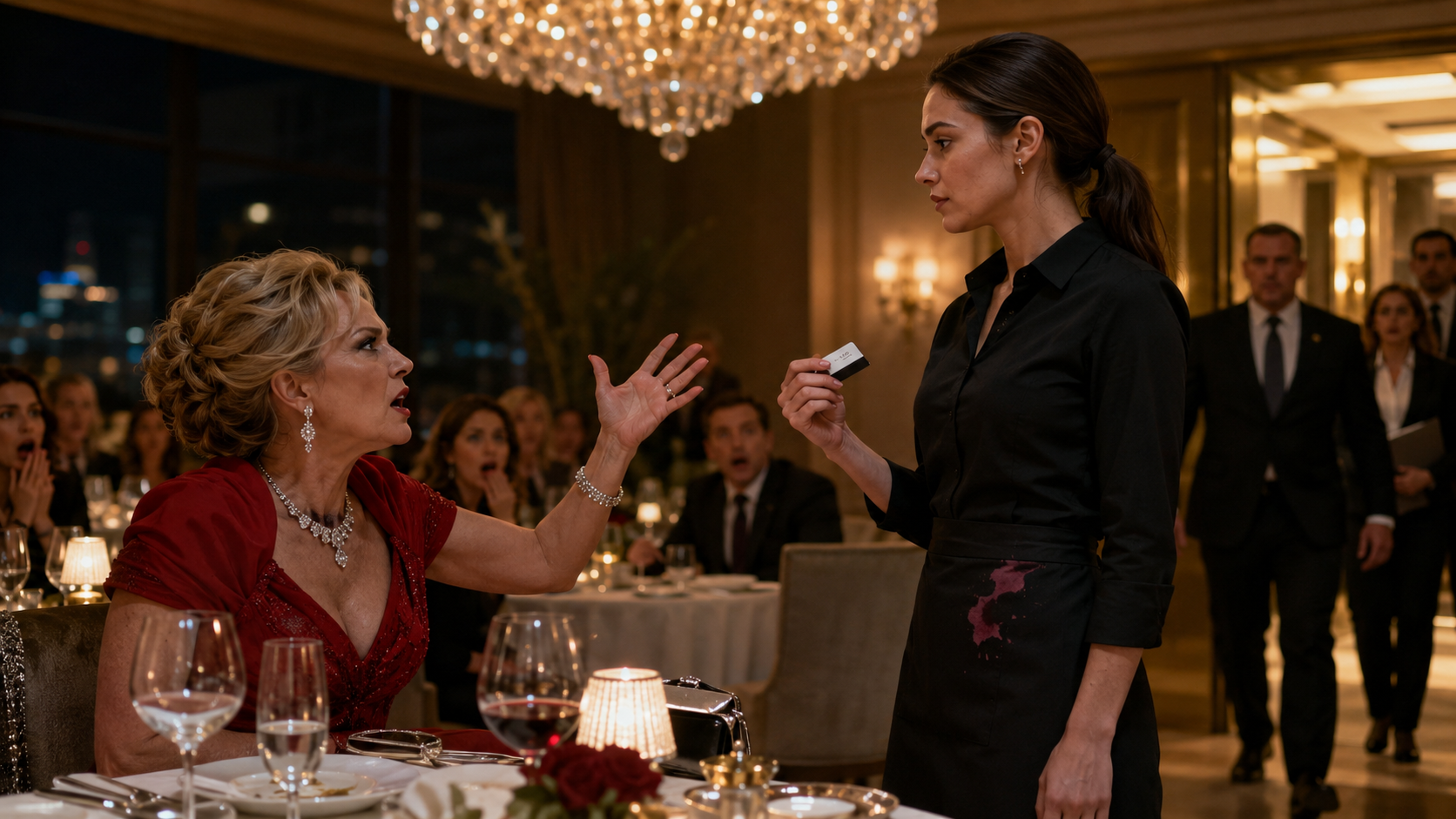
Celeste lifted her chin.
“You have no idea how much influence I have.”
“I know exactly how much you had,” Elena said. “Had is the important word.”
The legal director placed a document on the table.
“Elena,” she said quietly, “the board has already approved the ban notice.”
Celeste stared at the paper.
“What is that?”
Elena answered.
“You are no longer welcome in this restaurant. Or any restaurant under the Vale Hospitality Group.”
Celeste’s mouth tightened.
“You cannot do that.”
“I own them.”
The words landed cleanly.
No shouting.
No drama.
Just fact.
Celeste looked around the room, searching for someone who would rescue her. Her friends avoided her eyes. The man beside her suddenly checked his watch. Her assistant stood frozen near the wall, pretending not to exist.
Elena almost pitied her.
Almost.
Then Lily sniffed behind her, trying not to cry, and the pity vanished.
Celeste leaned closer, lowering her voice.
“You think this makes you better than me?”
Elena looked down at her wine-stained shirt.
“No. I think how we treat people when we don’t need anything from them tells the truth.”
Celeste’s lips parted, but nothing came out.
For the first time all night, she had no audience that belonged to her.
The security director stepped forward.
“Mrs. Arden, I’ll escort you out.”
Celeste snatched the ban notice from the table and crushed it in her fist.
“You will regret this.”
Elena nodded.
“I doubt it.”
As Celeste passed through the dining room, no one stood. No one apologized. No one rushed to soften the blow.
That, more than anything, seemed to wound her.
She had expected resistance.
She had expected fear.
She had not expected to become ordinary.
When the front doors closed behind her, the restaurant remained silent.
Elena turned to the staff.
The wine had dried cold against her skin.
Her uniform was ruined.
Her hands were steady.
“I owe you an apology,” she said.
No one seemed to know what to do with that.
Owners did not apologize often.
Power rarely did.
“I built this place to be excellent,” Elena continued. “Somewhere beautiful. Somewhere disciplined. Somewhere people would remember. But somewhere along the way, I allowed beauty to become an excuse for cruelty, and discipline to become a weapon used against the wrong people.”
Lily wiped her face.
Mateo stared down at the floor.
Elena’s voice softened.
“I should have seen it sooner.”
The legal director stepped beside her.
“Beginning tomorrow, every complaint will go directly to an independent employee advocate. Managers will no longer have authority to erase, bury, or discourage reports. Anyone who resigned after filing a complaint will be contacted. Anyone who wants to speak privately tonight can do so with legal present.”
Julian made a broken sound from the chair.
No one looked at him.
Elena took a breath.
“And every person working tonight will be paid for the full shift, plus the week. The restaurant will close for three days.”
That got a reaction.
A murmur.
Surprise.
Confusion.
Elena continued.
“Not as punishment. As repair. Training will happen. Interviews will happen. Changes will happen before another guest sits at these tables.”
The chef appeared at the kitchen entrance, arms folded, eyes wet.
Elena had known him for seven years.
He nodded once.
It nearly undid her.
Then a guest near the window stood.
An older woman in a navy suit.
She placed her napkin on the table.
“I would like to pay my bill,” she said.
Elena turned.
“Of course.”
“And I would like the service charge doubled and divided among the staff.”
Another guest stood.
“Same for my table.”
Then another.
“And ours.”
Soon the room was moving again, but differently now. Not with the old polished rhythm. Something human had entered the space and ruined the performance.
Or saved it.
Elena looked at the name tag still lying on Celeste’s table.
Nora.
A fake name.
A real witness.
Mateo approached quietly.
“Ms. Vale?”
“Elena,” she said.
He hesitated.
“Elena. What happens to her?”
“To Celeste?”
He nodded.
Elena looked toward the doors.
“That depends on how many people she threatened outside this room.”
Lily stepped forward.
“I know two.”
The hostess’s voice was small.
But it did not shake this time.
Elena met her eyes.
“Then we start there.”
Later, long after the guests left and the candles burned low, Elena stood alone in the dining room.
The chandelier still looked like frozen rain.
The tables were half-cleared.
The piano was silent.
Her ruined uniform hung from her shoulders like proof.
The legal team had taken statements. Julian had left through the service entrance without saying goodbye. Celeste’s assistant had stayed behind and asked, in a whisper, whether threats made by text counted as evidence.
They did.
Elena picked up the plastic name tag from table seven.
For a moment, she thought about throwing it away.
Instead, she slipped it into her pocket.
Not as a disguise.
As a reminder.
Because tomorrow she would return in her own clothes. People would call her Ms. Vale. They would open doors. They would bring reports. They would speak carefully.
That was the danger of power.
It made truth quieter around you.
She looked once more at the room she had built.
Then she turned off the last lamp.
At the door, Lily waited with her coat on.
“Elena?”
“Yes?”
“Why did you really do it yourself? You could have sent someone.”
Elena thought about that.
Because she could have.
She could have hired investigators. Read reports. Held meetings. Fired Julian from a distance and called it leadership.
But she had needed to feel it.
The heat of the wine.
The weight of the silence.
The particular loneliness of being humiliated in a room full of people waiting for you to disappear.
So she told the truth.
“Because I needed to remember what invisible feels like.”
Lily looked at her for a long moment.
Then she nodded.
Outside, the city moved on, bright and careless.
Inside The Marlow House, something had ended.
And something better, though fragile, had begun.