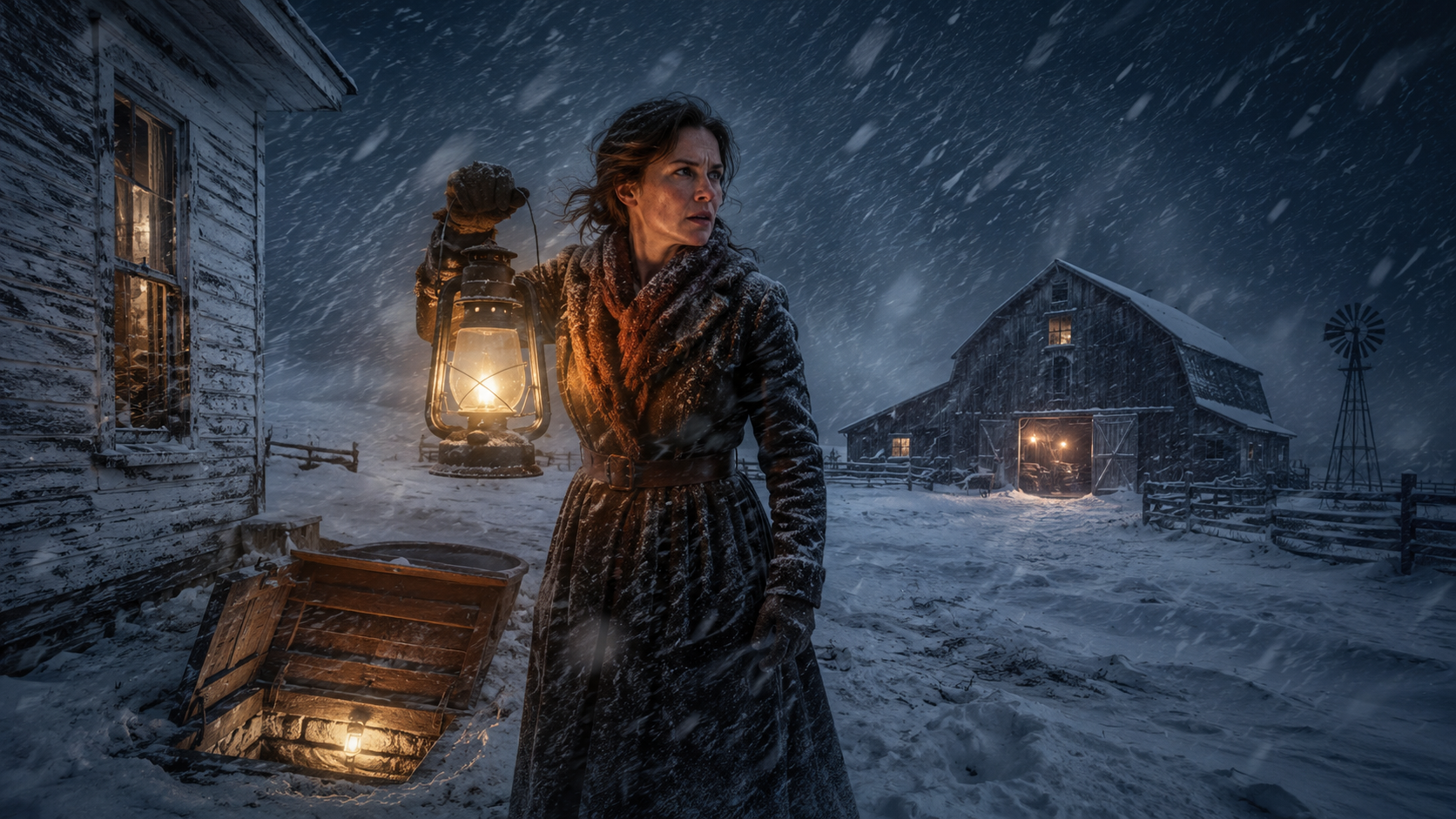
THE WINTER PASSAGE

The first time Clara Vale nearly died between her kitchen door and the horse barn, the distance was only thirty-seven yards.

Thirty-seven yards in July meant nothing. It was three breaths across a sunlit yard, a quick walk with a pail in each hand, a place where chickens scratched dust and the old hound slept belly-up beneath the chopping block.

But in January, on the north ridge above Blackpine Valley, thirty-seven yards could become a white ocean with no shore.

That morning, Clara stepped out with a bucket of soaked grain balanced against her hip and a wool scarf pulled high over her mouth. The storm had been blowing since before dawn, but the horses had to eat. The pregnant mare had to be checked. The barn stove had to be fed. Animals did not understand bad weather. They understood hunger, pain, thirst, and the sound of a human hand on a latch.

Clara tied a rope around her waist and fastened the other end to the iron ring beside the kitchen door.

She had done everything right.

Still, ten steps from the house, the wind turned.

Snow struck her face so hard she lost the world.

The barn vanished. The house vanished. Her own boots vanished beneath her. The rope snapped tight at her waist, but the gust twisted her sideways, and for one terrible minute she could not tell whether she was facing forward, backward, or down.

She called out, though no one could hear.

The bucket slipped from her hand. Grain scattered into the snow. She dropped to her knees and crawled, feeling for the rope, for a wall, for anything solid. Her glove brushed wood at last, and she sobbed once in relief before realizing it was not the barn door.

It was the side wall.

She had missed the entrance by almost twenty feet.

Inside, the horses were restless and stomping. Clara found the door by touch, slid through, and leaned against the boards until her heartbeat stopped hammering in her ears. The mare watched her from the far stall, sides heavy, eyes bright with animal suspicion.

“I know,” Clara whispered. “This is no way to live.”

She fed them with what she could find in the barn and waited nearly two hours before trying to return to the house.

When she finally made it back, crawling along the rope like a wounded thing, she found the spilled bucket lying half buried near the barn wall.

She had walked past it blind.

That night, Clara slept on the kitchen floor because she did not have the strength to climb the stairs.

The stove had burned low. Frost feathered the inside of the windowpanes. Under the floorboards, however, there was a faint softness in the cold, a breath of warmth that seemed to rise from the earth itself.

Clara lay still.

She remembered her grandfather’s root cellar in Vermont, the stone walls damp and dark, the apples stored in straw, the way winter could scream aboveground while potatoes slept safely beneath it.

Earth did not make mercy.

But it held whatever mercy people were clever enough to hide inside it.

Clara sat up before dawn.

By lamplight, she spread an old flour sack on the table and began to draw.

A trapdoor beside the stove. Steps down. A sloped passage under the yard. Timber braces. Packed clay walls. A narrow walking space, not tall enough for pride, only survival. A hatch rising inside the barn. Drainage along one side. A vent pipe hidden behind the woodpile. A second exit, because no door should be trusted when winter had hands.

She did not draw a tunnel because she wanted one.

She drew it because the space between the house and the barn had become a loaded gun.

By sunrise, she had measured the yard with twine and marked the first cut with ash.

By noon, half of Blackpine Valley knew.

By supper, Owen Strake had heard.

Strake owned the feed store, the fuel tanks, the grain elevator, and every second mortgage within fifty miles. He did not own Clara’s farm yet, but he had been circling it for months on behalf of Victor Sloane, the billionaire developer who wanted the entire ridge cleared for a private winter resort.

Sloane had money, attorneys, surveyors, and patience.

Clara had a shovel.

When she came to town for nails, lamp oil, and two more digging spades, Strake read every item aloud as he wrote them in his ledger.

“Nails,” he said. “Oil. Two spades.” He looked over his glasses. “No hay?”

The men beside the stove went quiet.

“Not today,” Clara said.

“Horses don’t eat tunnels, Mrs. Vale.”

“They don’t eat your opinions either, but you keep serving them.”

A cough of laughter came from somewhere near the stove. Strake’s pencil stopped moving.

He was a soft man with cold eyes, always clean, always warm, always waiting for other people to become desperate enough to sell. He smiled as though kindness had been another item in his inventory.

“I’m trying to save you from yourself,” he said. “Mr. Sloane’s offer is still open. Sell the ridge. Pay your debts. Move somewhere winter doesn’t chew through walls.”

Clara placed coins on the counter. “Winter has never lied to me.”

“No,” Strake said. “It just buries people who think they’re smarter than it is.”

She picked up the bundle.

At the door, he called after her, loud enough for the stove men to hear.

“Keep digging, Clara. Maybe you’ll finish your own rich man’s grave before Christmas.”

The words followed her all the way home.

That evening, she drove the first shovel into frozen ground.

For the first week, the trench looked like a mistake.

For the second, it looked like a punishment.

The soil fought her in layers. The topsoil yielded easily, as if pretending to cooperate. Beneath it, the clay gripped the blade and sucked at her boots. Gravel tore her palms through her gloves. Roots snagged the shovel edge like old fingers refusing to let go.

Every night she dragged herself inside, washed mud from her wrists, wrapped new cloth over fresh blisters, and heated water for tea she was too tired to drink.

On the ninth day, a woman named Hester Rowe arrived at the edge of the trench.

Hester was seventy-two, narrow as a fence post, and tougher than the iron hinges on Clara’s barn. She had built storm cellars with her brothers in Nebraska before she was old enough to vote. Later, she delivered babies, set broken bones, and outlived two husbands who had both thought she was stubborn until they discovered she was simply correct.

She looked down at Clara’s work and said nothing for so long that Clara wanted to throw the shovel at her.

Finally, Hester said, “You’re making it too wide.”

“I need room to carry feed.”

“You need room to live. Those are not always the same thing.”

Clara wiped sweat from her forehead with the back of her wrist. “Are you here to stop me?”

“No.”

“To help me?”

“No.”

“Then why are you here?”

Hester climbed carefully into the trench, pressed her palm to the clay wall, and sniffed the damp earth like a cook judging bread dough.

“I’m here to keep you from building a coffin with a door at each end.”

After that, she came every afternoon.

She taught Clara to crown the roof so weight would slide instead of crush. She showed her how to cut small side drains, how to pack gravel under the walking path, how to leave the walls narrow enough to hold their own shape. She made Clara rebuild six feet of bracing because the posts were set too far apart.

Clara argued once.

Hester pointed to the wall and said, “The ground does not care about your schedule.”

So Clara rebuilt it.

People came to stare.

Some brought advice. Most brought ridicule.

Owen Strake’s boys rode by twice, laughing from the road. Someone left a broken shovel stuck upright in the yard like a grave marker. One morning Clara found a note nailed to the barn door.

SELL BEFORE THE SNOW SELLS YOU.

She burned it in the stove and used the ash to mark the next ten feet of tunnel.

By late November, the trench stretched from kitchen to barn like a scar across the yard. Clara worked by lantern before sunrise and after dark. Hester inspected the walls. A quiet neighbor named Eli Mercer brought a wagonload of flat stone and claimed it had been “in his way.”

Clara looked at the neat stack of stones. “Your creek bed was in your way?”

“Terrible inconvenience,” Eli said.

“You loaded all this by hand.”

“I was deeply annoyed.”

She almost smiled.

They worked side by side until the moon rose.

Eli was a widower with a careful voice and a habit of helping without asking permission. He had known Clara’s late husband, Daniel, though not well. After Daniel’s funeral, Eli had left a sack of potatoes, a jar of honey, and a coil of rope on Clara’s porch, then disappeared before she could thank him.

Now he tamped gravel into the tunnel floor while Clara set stone along the drainage channel.

“You still think this is foolish?” she asked.

Eli rested both hands on the shovel handle. “I think winter kills foolish people and proud people at about the same rate.”

“That isn’t an answer.”

“No,” he said. “It’s a warning.”

She looked at him sharply.

He met her eyes. “Finish it strong, Clara. Don’t finish it fast.”

The passage was completed four days before the first true blizzard.

It was not pretty.

It was narrow, low, damp, and smelled of clay, horse breath, cold stone, and smoke. The kitchen trapdoor sat beside the stove, hidden under a braided rug. A set of rough wooden steps led down to the passage floor. Overhead, cottonwood beams arched beneath packed earth. The barn hatch opened behind the tack room, where warm animal air gathered in the rafters.

Clara walked through it alone the first time.

Lantern in hand, shoulders brushing the walls, she moved beneath the frozen yard while the wind scraped over the roof of the world.

Halfway through, she stopped.

Above her was the place where she had once lost her way in the whiteout.

Below it, there was silence.

Not safety, exactly.

Something better.

A chance.

The horses learned the sound of the barn hatch within three days. When Clara came up from below, they turned their heads instead of startling. The mare, heavy with her foal, seemed especially pleased that Clara no longer dragged the storm in with her every time she entered.

Water no longer froze solid in the kitchen bucket. The floor near the stove stayed cold but not cruel. The barn kept its warmth longer because Clara did not have to open the main doors against the wind.

Hester inspected the finished work and gave one sharp nod.

“That will do.”

From Hester Rowe, it was a standing ovation.

Then January arrived with teeth.

The storm began at sunset beneath a sky so clear Clara could see the first stars.

By eight, the wind had shifted.

By nine, the stovepipe groaned.

By ten, the world outside the windows was gone.

Snow did not fall. It attacked sideways. It rose from the ground in spinning sheets. It struck the house hard enough to make the walls creak. Clara opened the kitchen door one inch and saw nothing beyond her own hand.

Hester, who had stayed because her cough had worsened, sat upright on the cot.

“Close that door.”

“I have to check the barn.”

“You built a way.”

Clara shut the door and lifted the rug.

Warm air breathed up from the trapdoor.

Not warm like comfort.

Warm like life refusing to leave.

She took the lantern, a feed pail, and a short-handled axe, then descended.

The tunnel held.

Above her, the storm hammered the earth. Snow packed over the buried beams. Once, the roof gave a low wooden groan, and Clara froze in the passage, listening.

No crack.

No slide.

Only the sound of weight being carried.

“Hold,” she whispered.

The barn was chaos.

The horses stamped and blew steam into the dim light. Snow had forced itself through cracks in the boards. The mare stood in her stall with sweat darkening her neck, tail lifted, sides trembling.

“No,” Clara breathed. “Not tonight.”

But the foal had chosen its hour.

Clara worked by lantern while the blizzard tried to tear the barn apart.

She fed the other horses first because panic spread faster than fire. She checked the water, cleared ice from the buckets, and wedged the vent so air could move without letting the storm pour in. Then she rolled up her sleeves, knelt in straw, and helped the mare bring a new life into a night that seemed determined to take everything.

The foal came wrong at first.

One leg folded back.

Clara swallowed fear, reached carefully, found the small hoof, and eased it forward while the mare groaned and leaned against the stall wall.

“Come on,” Clara whispered. “You picked a hard night, little one. Now earn it.”

When the foal finally slid free, it lay silent.

Clara cleared its nose, rubbed its ribs with a feed sack, and bent close.

“Breathe.”

Nothing.

“Breathe, you stubborn scrap.”

The foal coughed.

The sound broke something open inside her.

By midnight, the foal was alive, the mare was standing, Hester’s cough had eased, and Clara had made three trips through the passage without once opening the house to the storm.

Then came the pounding.

Not from the barn.

From above.

Clara was halfway through the tunnel when she heard it: faint, frantic, irregular.

Someone was beating on the outside cellar hatch near the woodpile.

She ran back to the house, threw open the inner latch, and lifted the small emergency door.

A man fell through in a burst of snow.

Then another.

Then Owen Strake.

His face was gray. His eyebrows were iced white. Blood ran from a cut at his temple. Behind him, two of Sloane’s survey men crawled in shaking so hard they could not speak.

Clara stared.

Strake tried to stand and failed.

“Our truck went into the ditch,” he gasped. “We saw your vent pipe. We followed the fence by touch. Please.”

The word seemed to hurt him more than the cold.

Please.

Hester wrapped a blanket around one of the men and looked at Clara.

Clara could have said a dozen things.

She could have reminded Strake of the broken shovel in her yard. She could have asked whether horses ate tunnels. She could have told him to keep digging his own grave.

Instead, she stepped aside.

“Get in.”

They dragged the men down through the passage because the kitchen could not warm them fast enough. The barn held more heat. Animal bodies, hay, and earth had made a pocket of survival under the storm.

At the barn hatch, Eli Mercer appeared from the white darkness with a boy half-carried over his shoulder.

“Found him near the lower fence!” Eli shouted.

Clara helped pull them inside. The boy was no more than nineteen, one of Strake’s clerks. His hands were waxy with cold.

More pounding came.

Then voices.

All night, the tunnel became a throat between death and shelter.

Clara moved people from the emergency hatch to the kitchen, from kitchen to barn, from barn to the warmest stalls. Eli brought in two ranch hands who had been trapped on the road. Hester heated water and cursed everyone back to consciousness. Strake sat wrapped in a horse blanket, watching Clara vanish into the passage again and again.

Near dawn, when the worst of the wind began to weaken, a final figure stumbled through the emergency hatch.

Victor Sloane himself.

The billionaire had come to the ridge to inspect the property line before the storm trapped his convoy. His expensive coat was torn. His polished boots were packed with snow. One of his men had tied a scarf around his arm to stop bleeding from a broken window.

He looked smaller without the distance money usually built around him.

Clara stood over the open hatch, lantern in hand.

For a moment, neither spoke.

Then Sloane looked past her into the passage, at the clay walls, the timber braces, the gravel floor, the warm breath rising from below.

“You built this?”

Clara’s face was streaked with mud, blood, soot, and birth straw.

“Yes.”

Sloane swallowed. “Mrs. Vale, we need shelter.”

Behind him, the storm still screamed.

Clara thought of Daniel. Of the debt papers. Of Strake laughing in town. Of survey flags planted like insults along her fence line. Of every man who had measured her land before measuring her will.

Then she thought of the foal breathing in the straw.

“Come down,” she said. “Carefully. The roof holds because it was built right.”

By morning, fourteen people, eight horses, one mare, one newborn foal, Hester Rowe, Eli Mercer, Owen Strake, and Victor Sloane were alive because Clara Vale had refused to be embarrassed out of saving herself.

The storm passed after thirty-six hours.

When the door finally opened, the yard had disappeared beneath sculpted drifts taller than a man. The road was gone. The fence line was gone. The broken shovel grave marker, buried somewhere under ten feet of snow, was gone too.

But the tunnel mouth opened clean.

The barn stood.

The house stood.

Clara stood between them with a lantern in one hand and mud on her boots.

Strake approached her near the woodpile. He had found his hat, though it had lost its shape.

“I owe you an apology,” he said.

“You owe me corrected ledgers.”

His mouth opened, then closed.

Hester snorted from the porch. “Start with the apology. It is smaller and you may be able to lift it.”

Strake lowered his eyes. “I was wrong.”

Clara waited.

“And cruel.”

She waited.

“And I shorted your account twice.”

“There it is,” Clara said.

Victor Sloane left two days later, after the road was cleared.

Before he went, he stood in Clara’s yard looking at the faint raised line where the underground passage ran beneath the snow.

“I could buy engineering like that,” he said.

“No,” Clara replied. “You could buy engineers. That isn’t the same thing.”

He studied her for a long moment.

Then he removed a folded paper from his coat.

It was not a contract.

It was a withdrawal notice.

His company would no longer pursue the ridge.

“You made this land inconvenient,” he said.

Clara took the paper. “Good.”

Sloane gave a tired smile. “You understand, Mrs. Vale, I have lost larger deals than this.”

“I understand that men like you call it losing only when money fails.”

“And what do you call it?”

She looked toward the barn. The foal was outside for the first time, wobbling beside its mother in the pale sun.

“I call it staying.”

By spring, people stopped calling it madness.

They called it the Winter Passage.

Neighbors came to see the drainage, the roof, the emergency hatch, the way warm air moved between house and barn. Some asked Clara to help design storm shelters. Some asked Hester. Hester told them she charged double for men who began sentences with, “I don’t mean to question you, but…”

Eli came often with stone, hinges, coffee, and no explanations.

One evening, after the thaw began, Clara found him at the barn hatch, looking down the passage.

“You still think winter doesn’t forgive clever?” she asked.

Eli glanced at her. “I think winter doesn’t forgive carelessness.”

“And clever?”

His mouth softened. “Clever, done properly, gets invited to supper.”

Clara smiled for the first time in what felt like years.

Below them, the tunnel waited in the earth, narrow and dark and strong.

It was not a miracle.

It was not luck.

It was a woman’s answer to every voice that had told her survival should look more respectable.

Aboveground, storms would come again. Men with money would come again. Doubt would come again, wearing different coats and speaking in different voices.

But beneath Clara Vale’s yard, there was now a way through.

And winter, which respected nothing easily, had respected that.