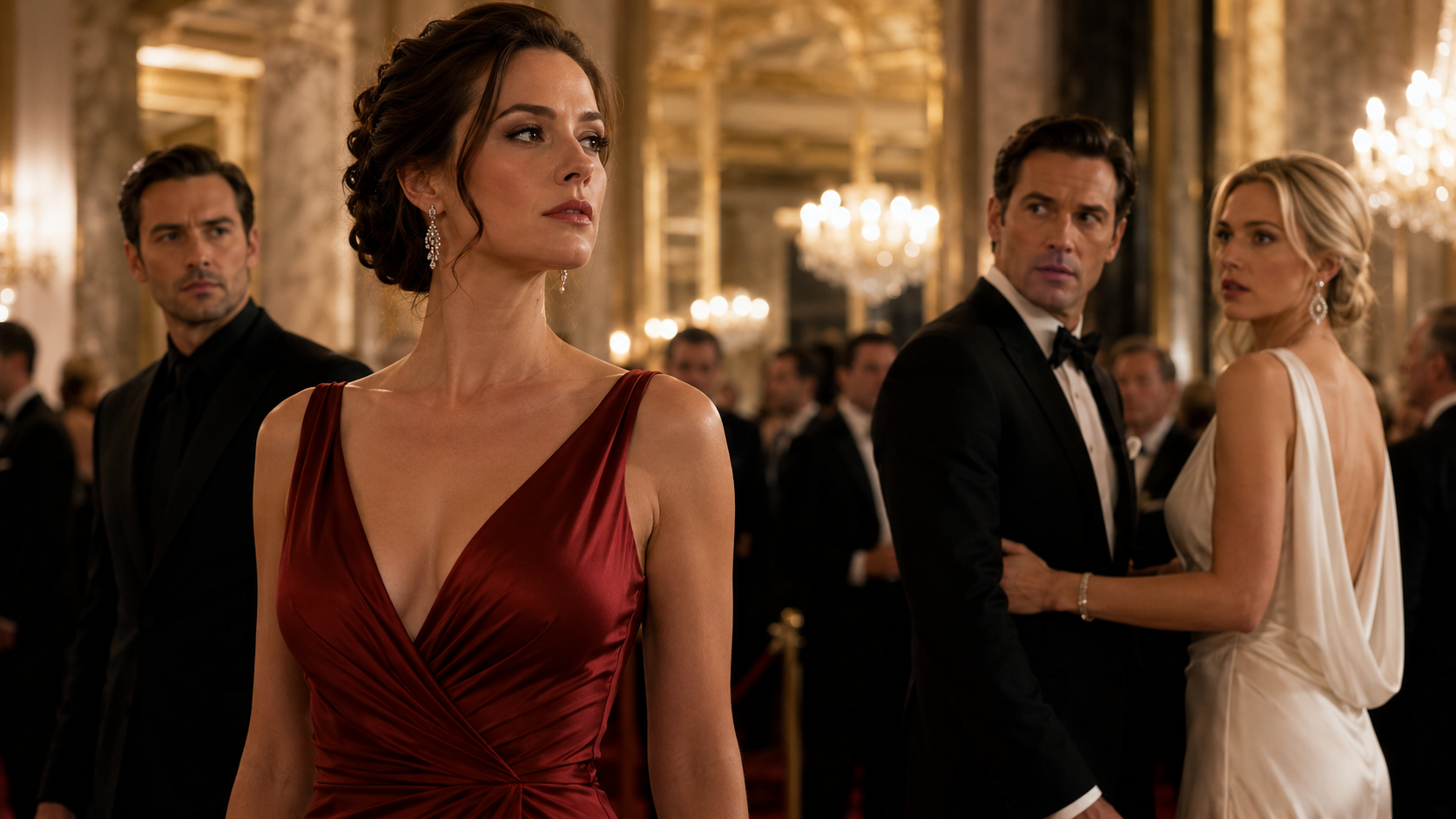
Meridian House had been built by a railroad family and restored by billionaires who liked their charity served under chandeliers. Marble stairs rose to an entry hall filled with white flowers. Violins played from a balcony. Waiters moved between guests with champagne, silent as ghosts.
Cameras flashed when Everett stepped from the car.
Lena stepped out after him.
The red dress caught the light.
For one second, every conversation near the entrance seemed to falter.
Everett leaned toward her, smiling for the cameras.
“Careful,” he whispered. “Red can make a woman look guilty.”
Lena turned her face slightly toward him.
“Then it suits the room.”
His smile froze.
Before he could answer, a man’s voice said from behind them, “That depends on who committed the crime.”
Lena looked over her shoulder.
A man stood at the foot of the stairs, one hand in the pocket of his black coat, the other holding a folded invitation. He was not as polished as Everett. His suit was expensive but worn as if he had forgotten it mattered. His dark hair was threaded with gray, and his eyes looked tired in the way honest men look tired when they have stopped sleeping for a reason.
Rowan Hale.
Lena recognized him immediately, though they had met only twice. He was Bianca Vale’s husband, a forensic accountant whose quiet reputation made louder men nervous. At every event, Bianca drifted away from him by the second glass of champagne, leaving him to make polite conversation near the edges of rooms.
Everett’s hand tightened at Lena’s lower back.
“Rowan,” he said. “Didn’t realize you were coming tonight.”
Rowan looked at Lena.
“You look very brave, Mrs. Langford.”
Everett laughed once. “It’s just a dress.”
“No,” Rowan said. “I don’t think it is.”
That was the first crack.
Small. Almost invisible.
But Lena heard it.
And across the entrance hall, Bianca Vale heard it too.
She stood beneath an arch of white roses, dressed exactly as her message had promised: white silk, diamonds, soft curls, the expression of a woman used to being admired from every angle. When she saw Lena in red, her mouth parted. When she saw Rowan standing beside her, her eyes changed.
Not jealousy.
Fear.
Everett felt it too. Lena knew because his hand dropped away from her back.
“Shall we go inside?” she asked.
Her voice was steady.
Everett stared at her.
Rowan offered his arm.
Lena took it.
That was when the room truly began to whisper.
Not because a married woman was entering a ball on another man’s arm. Rich people tolerated almost anything if it was done beautifully.
They whispered because Lena Langford had never done anything unexpected in public.
For thirteen years, she had stood beside Everett like a candle protected by glass. She remembered names. She remembered wives’ allergies. She sent flowers after surgeries and handwritten notes after funerals. She wore cream, navy, gray, champagne. She laughed at the correct volume. She sat at Everett’s left hand and made donors feel seen while never demanding to be seen herself.
Tonight, she walked into the ballroom in red.
And she did not look at him for permission.
The ballroom was enormous, flooded with gold light. Beneath the chandeliers, men who controlled banks embraced men who controlled newspapers. Women in gowns leaned close and exchanged information disguised as compliments. At the far end of the room, a stage waited with a podium bearing the Langford Foundation crest.
Lena looked at it and felt the old nausea rise.
The foundation had been her father’s dream before his stroke took his speech and then his life. He had believed money should move toward people who had been denied choices: women leaving dangerous homes, students aging out of foster care, families drowning in medical bills. When he died, Everett helped Lena “professionalize” the foundation.
That was the word he used.
Professionalize.
He moved the accounts to his firm’s preferred advisors. He hired consultants. He gave her documents to sign while praising her generosity. He told her the legal details were too tedious for her to carry alone.
“You should focus on the mission,” he would say. “Let me handle the machinery.”
She had believed him.
Until three nights ago.
Three nights ago, after seeing Bianca’s messages, Lena had done something she had never done in her marriage.
She called the other betrayed spouse.
Not immediately. First, she spent two hours on the bathroom floor, scrolling through Bianca Vale’s public life. Photos at galas. Photos at fundraisers. Photos beside Everett, always laughing, always near enough to look accidental. Photos with Rowan, too, though in those she seemed arranged rather than alive.
Lena found Rowan’s accounting firm. Then his office number. Then his email.
She wrote one sentence, deleted it, wrote another, deleted that too.
At dawn, she sent: