“Agreed.”
“That quickly?”
“I have spent three years learning that a locked door is not a small thing.”
Mara nodded once. “Then tell the reverend I will marry you.”
Gideon stared.
Mara lifted an eyebrow. “Unless you expected me to swoon.”
“No,” he said quietly. “But I expected you to hate me.”
“I may yet.”
The wedding took place the next morning in the downstairs parlor. Silas stood by the mantel. Reverend Hale read from his book. The maid, Elsie, served as witness and looked as though she wanted to apologize for every board in the house.
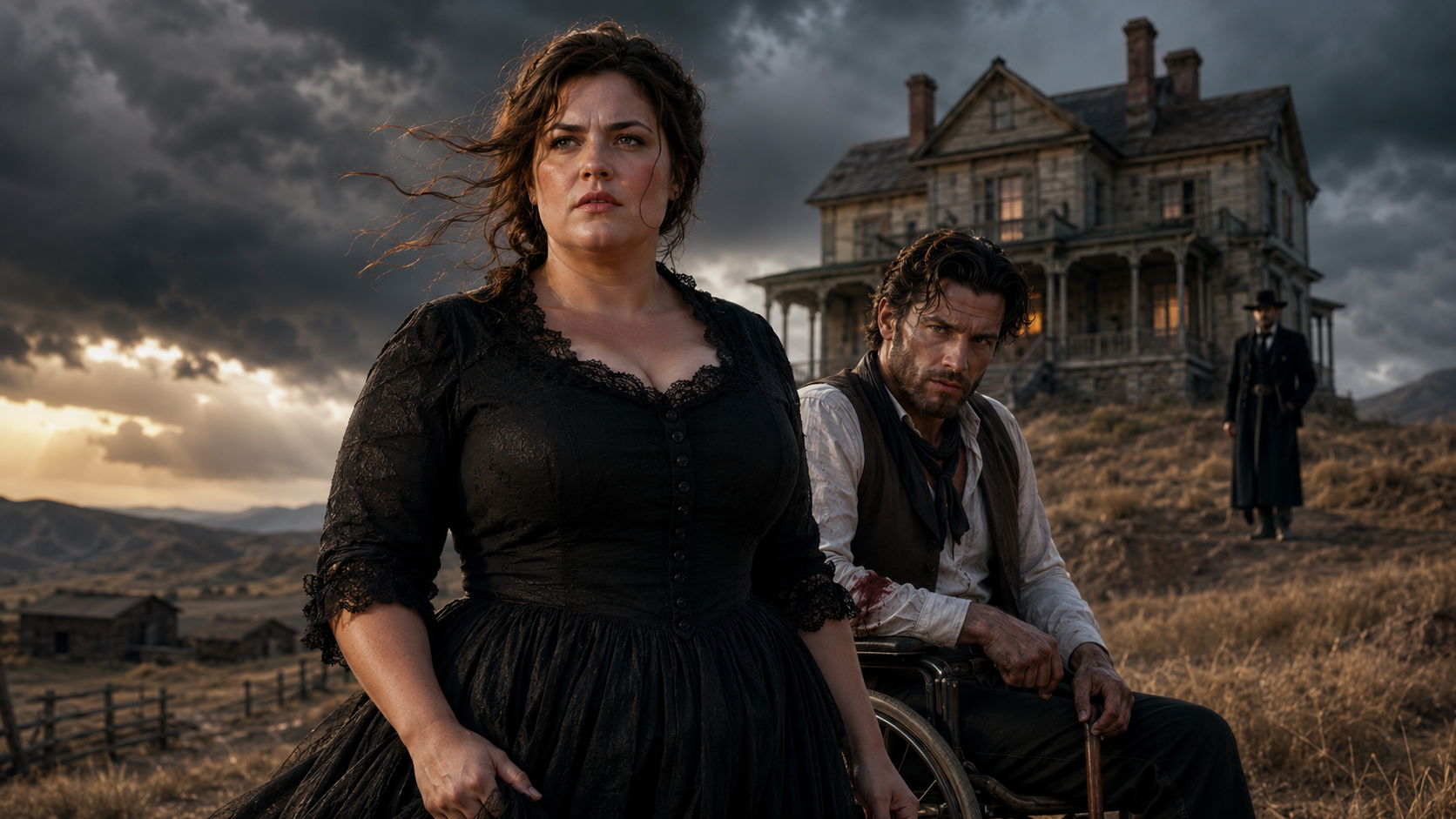
Mara wore black. Gideon wore a dark coat and sat in his wheeled chair with his cane across his knees. When Reverend Hale pronounced them husband and wife, he hesitated.
“You may kiss the bride,” he said.
Gideon looked at Mara.
Mara said, “No, he may not.”
The reverend turned red.
Silas laughed softly. “A promising start.”
Gideon’s eyes never left Mara. “The most honest start I have seen.”
That night, Mara lay awake in her new room. The bed was wide. The sheets were clean. The lock on the door turned smoothly under her fingers.
Still, she did not sleep.
The house made sounds after midnight. Pipes groaned. Wind worried the shutters. A branch scratched the glass like a fingernail. Then came another sound, low and human.
A breath forced through pain.
Mara sat up.
Another sound followed. A dull thud.
She lit a lamp, wrapped her shawl around her shoulders, and opened her door. Light spilled from Gideon’s room.
“I am fine,” he said before she knocked.
“No man says that convincingly from the floor.”
Silence.
Mara entered.
Gideon lay beside his chair, one arm hooked uselessly over the wheel, his face damp with sweat. The blanket had twisted around his legs. His pride filled the room more fiercely than his pain.
“Leave,” he said.
“No.”
“I do not want pity.”
“Good. I left mine downstairs.”
His eyes flashed. “Do not mock me.”
“I am not. I am deciding whether you want help into the chair, or whether you would prefer to be discovered by your brother at breakfast.”
The anger went out of him so suddenly it looked like grief.
Mara set the lamp down. “I know something about floors. They do not care how proud we are.”
After a long moment, Gideon nodded.
Mara was strong. She had always been strong. Men had laughed at her size while benefiting from the work it could do. She braced her feet, counted under her breath, and helped Gideon haul himself into the chair. By the time he settled, both of them were shaking.
“Thank you,” he said, voice scraped raw.
“You are welcome.”
As she turned to leave, he spoke again.
“Why did you accept?”
Mara paused in the doorway. “Because Ironford offered me cages and called them mercy. You were the only man rude enough to admit yours had bars.”
For the next month, their marriage became a wary partnership.
Mara took breakfast in Gideon’s room because he disliked the dining room and she disliked eating under Silas’s eyes. Gideon drank his coffee black. Mara took hers with cream when there was cream and without complaint when there was not. They read the newspapers aloud and argued over nearly every editorial.
“You enjoy disagreeing,” Gideon said one morning.
“I enjoy being allowed to finish a sentence.”
He looked at her over his cup. “A low standard.”
“One men still fail.”
A smile touched his mouth, brief but real.
Silas came every afternoon. He never knocked. He brought papers for Gideon to sign, reports from ranch hands, letters opened before they reached their owner. Sometimes he spoke to Gideon as if Mara were furniture. Sometimes, worse, he spoke to Mara as if she were a slow child.
“How are you finding married life?” he asked one day while she was making bread in the kitchen.
Mara pressed her fists into the dough. “Cleaner than widowhood. Less crowded than marriage.”
Silas leaned on the table. “My brother’s moods can be tiring.”
“So can flies.”
His smile cooled. “You think yourself very clever.”
“No. I think you are used to women pretending not to be.”
He stepped too close. “Be careful, Mrs. Harrow. Gideon’s protection is mostly sentimental.”
Mara lifted flour-covered hands. “Then it is still more than yours.”
That evening, she asked Gideon for the household ledgers.
He looked at her for so long that the fire snapped twice before he answered.
“They are in the west office.”
“Locked?”
“Yes.”
“Silas has the key?”
“One key.”
“And the other?”
For the first time, Gideon’s smile looked almost wicked. “Inside the broken clock in the hall.”
Mara found it behind the clock face, wrapped in oilcloth.
The west office smelled of tobacco, dust, old leather, and Silas Harrow’s certainty. Mara waited until he rode out toward the cattle pens before she unlocked the door.
The ledgers were arranged too neatly. That was the first thing she noticed. Honest accounts grew scars. These looked groomed.