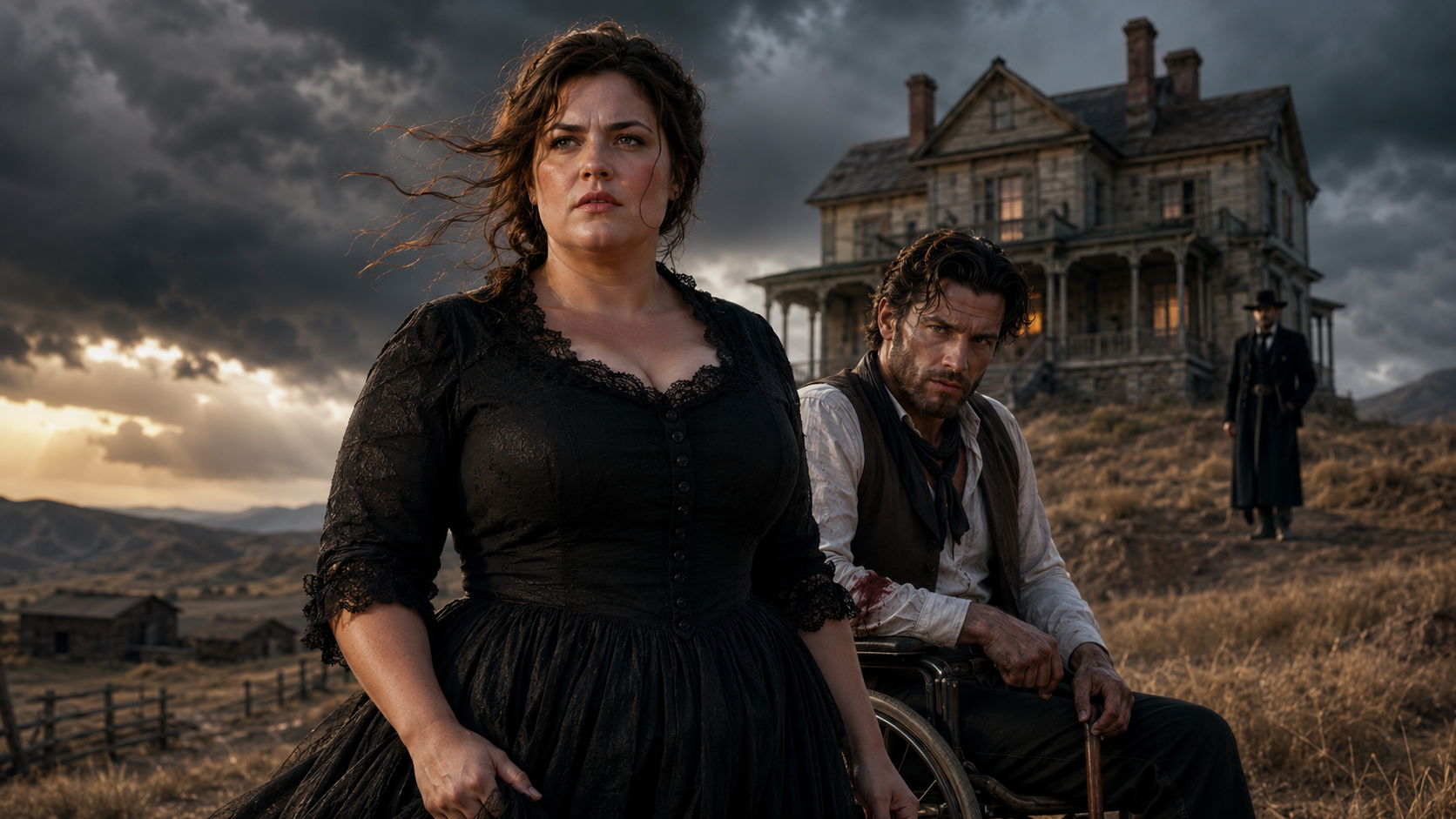
The Widow Who Would Not Vanish

When Mara Whitcomb entered the meeting room above the Ironford grain exchange, every man in town found a reason to look somewhere else.

A chair scraped. A throat cleared. Someone coughed into a fist. Mr. Peller, who owned the dry goods store and never trusted silence unless he was the one selling it, folded his hands over his stomach and stared at the lamp.

Mara stood in the doorway in her black mourning dress, the same dress she had worn when they buried her husband three weeks earlier. It was too tight at the sleeves, too faded at the hem, and too honest about the body inside it. She was a broad woman, soft in the places men liked to judge, strong in the places they preferred not to notice. She had carried sacks of meal, split winter wood, hauled water, dragged her drunk husband off the road more times than the sheriff had ever helped him. Yet in Ironford, strength only counted when it wore boots and a beard.

“Mrs. Whitcomb,” Reverend Hale said gently. “Thank you for coming.”

Mara looked around the room. “You made it sound less like an invitation and more like a sentence.”

A few eyes lifted. One man snorted before catching himself.

At the far end of the table sat Silas Harrow, clean-shaven, silver-haired at the temples, dressed as though dust had never dared touch him. Ironford belonged to men like him, and most days it behaved accordingly. He smiled at Mara with the polished sympathy of a banker refusing a widow credit.

“No one is sentencing you,” Silas said. “We are trying to prevent further hardship.”

“Hardship,” Mara repeated. “That is a pretty word for hunger.”

Reverend Hale winced.

Mara’s husband, Tobin Whitcomb, had left her nothing but two debts, a cracked stove, and a name the town had already decided was not worth much. Tobin had been a gambler when he had money, a beggar when he did not, and cruel in every season. His death in a flooded culvert outside the south road had not surprised anyone. The surprise was that Mara had survived him and still looked people in the eye.

Mr. Peller unfolded a paper. “Mrs. Whitcomb, the creditors have agreed not to seize your remaining household goods if suitable arrangements can be made.”

“My remaining household goods,” Mara said. “You mean the bed, the stove, and my mother’s trunk.”

“It is not personal.”

“It never is, when someone else is losing.”

Silas leaned back, still smiling. “There may be a solution.”

Mara looked at him then. She had disliked Silas Harrow before he opened his mouth. The man made the air feel rented.

“What solution?”

Silas tapped one finger against the table. “My brother requires a wife.”

The room changed. Not loudly. No one gasped. But chairs tightened under men who suddenly wished to appear innocent of hearing.

Mara stared at him.

“Gideon Harrow,” she said.

Silas’s smile thinned. “My brother, yes.”

“Your brother who hasn’t left Thornfield Ranch in three years.”

“He has injuries.”

“Your brother people say is mad.”

“People say many things when they are bored.”

“Your brother people say you keep locked upstairs.”

Silas stopped tapping the table.

Reverend Hale spoke quickly. “Gideon is a troubled man, but not a cruel one. He is in need of companionship, order, care—”

“A nurse,” Mara said.

“A wife,” Silas corrected.

Mara laughed once, without humor. “Why me?”

Nobody answered fast enough.

She looked from face to face and understood. A thin young widow would have been called delicate. A wealthy widow would have been protected. A pretty widow would have been negotiated over like a prize mare. But Mara was none of those. She was poor, large, tired, and inconvenient. That made her useful.

Silas finally said, “You need security. Gideon needs someone in the house. The arrangement benefits you both.”

“Does Gideon know about this arrangement?”

His eyes flickered. “He has agreed in principle.”

“In principle,” Mara said. “That means he agreed before you put my name in it.”

A small, bitter voice from the back of the room muttered, “Beggars are picky now.”

Mara turned slowly.

The man who had spoken, a wagon driver named Hoke, looked down at his boots.

Mara stepped toward the table. “Let me be plain, since everyone has been so careful not to be. You want to send the fat widow to the ruined rancher because nobody else wants either of us.”

“Mara,” Reverend Hale whispered.

“No. Let the room breathe honest air for once.”

Silas rose. “You may refuse, of course.”

“May I?”

“Certainly.”

“And then?”

Mr. Peller shifted. “The creditors would proceed.”

“My stove goes. My trunk goes. My bed goes. And by winter I sleep where?”

No one answered.

Mara smiled, and several men found it more frightening than tears.

“I will meet him,” she said.

Silas blinked. “Pardon?”

“I will not be handed from one man’s grave to another man’s house like unpaid livestock. If your brother wants a wife, he can ask me himself.”

“That may be difficult.”

“I imagine many things are.”

For the first time, Silas Harrow’s fine manners showed a crack.

At Thornfield Ranch, the wind carried the smell of rain and horses. The house sat on a rise above the valley, all gray stone, dark shutters, and old money trying to look humble. Mara had passed it from a distance many times. Up close, it looked less like a home than a courthouse for ghosts.

Silas led her inside.

The entry hall was polished, cold, and too quiet. A maid appeared, saw Mara, and disappeared again. Somewhere above them, a floorboard creaked.

“Gideon can be difficult,” Silas said as they climbed the stairs. “He resents pity.”

“So do I.”

“He speaks sharply.”

“So do I.”

“He has suffered.”

Mara stopped on the landing. “Do you rehearse this voice in mirrors?”

Silas turned.

“The voice that makes every insult sound like concern,” Mara said. “It must take practice.”

Something ugly crossed his face, quick as lightning behind clouds.

Then he smiled. “You are sharper than you look, Mrs. Whitcomb.”

“I have had to be.”

He opened a door. “Gideon, your visitor is here.”

The room beyond was dim, though the curtains were open. A fire burned low. Books crowded the shelves. Papers covered a desk near the window. Beside that window, in a wheeled chair with one hand wrapped around a cane, sat Gideon Harrow.

He was younger than Mara expected, perhaps thirty-eight, with dark hair grown too long and a face hollowed by pain. One side of his body looked carved from stubbornness; the other looked like it had been abandoned by God halfway through. His legs were covered by a wool blanket. His eyes, gray and sharp, went first to Silas, then to Mara.

“So this is the widow,” Gideon said.

“And this is the invalid,” Mara replied.

Gideon’s mouth twitched.

Silas frowned. “There is no need for vulgarity.”

“Then leave,” Gideon said. “You always bring it with you.”

Silas’s smile did not move, but his jaw tightened. “I will be downstairs.”

When the door closed, silence settled.

Mara remained standing. “Did you ask for me?”

“No.”

“Did you ask for any wife?”

“No.”

“Then why am I here?”

Gideon looked at the fire. “Because my brother wants me surrounded by witnesses he can choose.”

Mara studied him. “And what do you want?”

His laugh was dry and almost cruel. “A witness he cannot.”

The room seemed colder.

Mara stepped closer. “You want me to watch him.”

“I want you to live here long enough that, if I die, someone honest can say how it happened.”

“That is not a proposal. That is a confession.”

“I never claimed to be romantic.”

“Good. I have had enough romance to last me through one bad marriage and into the grave.”

His eyes returned to her. “Your husband was Tobin Whitcomb.”

“Yes.”

“He owed half the town.”

“He owed more than that. He owed apologies he never paid.”

Gideon gripped the cane harder. “Silas will pay your debts if you marry me. He thinks it buys him leverage. He thinks you will be grateful, timid, and easily guided.”

“And what do you think?”

“I think any woman who looked my brother in the face and called his manners a costume is not easily guided.”

Mara did not smile, though she wanted to.

“What happened to you?” she asked.

“My horse threw me.”

“That is the story.”

“It is.”

“And the truth?”

Gideon looked toward the closed door. “The cinch was cut almost through. The south fence had been loosened. A snake was dropped in the grass near the mare’s feet. She bolted. I went down. My spine did not break, but something inside never found its way back together.”

“Silas?”

“Yes.”

“Can you prove it?”

“No.”

“Then why are you still alive?”

“Because my father wrote the ranch trust badly for villains. Silas can manage Thornfield while I am impaired, but he cannot sell the north grazing rights, the mineral claims, or the valley lease without either my consent or a court declaring me unfit.”

Mara walked to the window. Below, Silas crossed the yard as if the land had signed itself into his pocket.

“You need a wife because a wife complicates a court petition.”

“I need a wife because a lonely cripple is easy to bury in paperwork.”

She looked back at him. “What do I get besides debt paid by a man I dislike and danger from another man I dislike more?”

“A room with a lock. Food. Wages, if you will keep the household books. Your own money. No claim on your body. No forced affection. And if you wish to leave after six months, I will give you enough to go wherever Ironford cannot reach.”

Mara heard the trap. She also heard the door inside it.

“I have terms.”

“I assumed you would.”

“My room stays mine. You do not enter it. I manage my own correspondence. You do not speak to me as if rescue makes me property. If you lie to me, I leave. If your brother lays a hand on me, I decide what happens next.”

Gideon’s expression changed. Not softer. More careful.

“Agreed.”

“That quickly?”

“I have spent three years learning that a locked door is not a small thing.”

Mara nodded once. “Then tell the reverend I will marry you.”

Gideon stared.

Mara lifted an eyebrow. “Unless you expected me to swoon.”

“No,” he said quietly. “But I expected you to hate me.”

“I may yet.”

The wedding took place the next morning in the downstairs parlor. Silas stood by the mantel. Reverend Hale read from his book. The maid, Elsie, served as witness and looked as though she wanted to apologize for every board in the house.

Mara wore black. Gideon wore a dark coat and sat in his wheeled chair with his cane across his knees. When Reverend Hale pronounced them husband and wife, he hesitated.

“You may kiss the bride,” he said.

Gideon looked at Mara.

Mara said, “No, he may not.”

The reverend turned red.

Silas laughed softly. “A promising start.”

Gideon’s eyes never left Mara. “The most honest start I have seen.”

That night, Mara lay awake in her new room. The bed was wide. The sheets were clean. The lock on the door turned smoothly under her fingers.

Still, she did not sleep.

The house made sounds after midnight. Pipes groaned. Wind worried the shutters. A branch scratched the glass like a fingernail. Then came another sound, low and human.

A breath forced through pain.

Mara sat up.

Another sound followed. A dull thud.

She lit a lamp, wrapped her shawl around her shoulders, and opened her door. Light spilled from Gideon’s room.

“I am fine,” he said before she knocked.

“No man says that convincingly from the floor.”

Silence.

Mara entered.

Gideon lay beside his chair, one arm hooked uselessly over the wheel, his face damp with sweat. The blanket had twisted around his legs. His pride filled the room more fiercely than his pain.

“Leave,” he said.

“No.”

“I do not want pity.”

“Good. I left mine downstairs.”

His eyes flashed. “Do not mock me.”

“I am not. I am deciding whether you want help into the chair, or whether you would prefer to be discovered by your brother at breakfast.”

The anger went out of him so suddenly it looked like grief.

Mara set the lamp down. “I know something about floors. They do not care how proud we are.”

After a long moment, Gideon nodded.

Mara was strong. She had always been strong. Men had laughed at her size while benefiting from the work it could do. She braced her feet, counted under her breath, and helped Gideon haul himself into the chair. By the time he settled, both of them were shaking.

“Thank you,” he said, voice scraped raw.

“You are welcome.”

As she turned to leave, he spoke again.

“Why did you accept?”

Mara paused in the doorway. “Because Ironford offered me cages and called them mercy. You were the only man rude enough to admit yours had bars.”

For the next month, their marriage became a wary partnership.

Mara took breakfast in Gideon’s room because he disliked the dining room and she disliked eating under Silas’s eyes. Gideon drank his coffee black. Mara took hers with cream when there was cream and without complaint when there was not. They read the newspapers aloud and argued over nearly every editorial.

“You enjoy disagreeing,” Gideon said one morning.

“I enjoy being allowed to finish a sentence.”

He looked at her over his cup. “A low standard.”

“One men still fail.”

A smile touched his mouth, brief but real.

Silas came every afternoon. He never knocked. He brought papers for Gideon to sign, reports from ranch hands, letters opened before they reached their owner. Sometimes he spoke to Gideon as if Mara were furniture. Sometimes, worse, he spoke to Mara as if she were a slow child.

“How are you finding married life?” he asked one day while she was making bread in the kitchen.

Mara pressed her fists into the dough. “Cleaner than widowhood. Less crowded than marriage.”

Silas leaned on the table. “My brother’s moods can be tiring.”

“So can flies.”

His smile cooled. “You think yourself very clever.”

“No. I think you are used to women pretending not to be.”

He stepped too close. “Be careful, Mrs. Harrow. Gideon’s protection is mostly sentimental.”

Mara lifted flour-covered hands. “Then it is still more than yours.”

That evening, she asked Gideon for the household ledgers.

He looked at her for so long that the fire snapped twice before he answered.

“They are in the west office.”

“Locked?”

“Yes.”

“Silas has the key?”

“One key.”

“And the other?”

For the first time, Gideon’s smile looked almost wicked. “Inside the broken clock in the hall.”

Mara found it behind the clock face, wrapped in oilcloth.

The west office smelled of tobacco, dust, old leather, and Silas Harrow’s certainty. Mara waited until he rode out toward the cattle pens before she unlocked the door.

The ledgers were arranged too neatly. That was the first thing she noticed. Honest accounts grew scars. These looked groomed.

She began with feed orders. Then wages. Then fence repairs. Then livestock purchases. Numbers repeated where they should not. Receipts matched invoices too perfectly. Payment dates circled back on themselves. A barn roof had been repaired three times in one year, though Mara had seen the barn from the road and knew the roof still sagged open like a broken mouth.

By dusk, she had a list.

By the next morning, she had a pattern.

By the third day, she found the blue folder.

It was hidden behind a false panel in the lower cabinet. Inside were two agreements for the same strip of land near the north ravine. One agreement named a survey company and promised a fortune for water access. The other transferred the same land to a holding firm for almost nothing.

The holding firm’s owner was hidden behind initials, but Mara had been married to a liar long enough to know when initials wore a man’s boots.

Silas meant to steal the north ravine before Gideon learned what it was worth.

Mara slid the papers under her blouse.

The office door opened.

Silas stood in the doorway.

For once, he did not smile.

“What are you doing?” he asked.

“Dusting.”

His eyes moved to the open cabinet. “What did you take?”

“An education.”

He closed the door behind him.

Mara’s mouth went dry, but she did not move.

Silas crossed the room slowly. “You have mistaken your position in this house.”

“I know my position exactly. That is what worries you.”

His hand shot out and caught her wrist.

Pain flashed up her arm. For one instant she was back in Tobin’s kitchen, with whiskey breath in her face and a man explaining that his violence was her fault.

Then the instant passed.

Mara brought her other hand up and slapped Silas so hard his head turned.

He stared at her, stunned.

She drove her knee into his stomach.

Silas doubled over, and Mara ran.

She reached Gideon’s room with the papers crushed against her chest. He was already halfway out of his chair, as if the house itself had warned him.

“Silas,” she gasped.

The door slammed open behind her.

Silas filled the frame, face dark with fury. “Give me those papers.”

Gideon gripped his cane. “Get out.”

Silas laughed. “Or what? You’ll stand?”

Gideon’s knuckles whitened.

Mara stepped between them. “I found the land contracts. The false repairs. The missing wages. The holding company.”

Silas looked at the papers. Then he smiled again, and Mara hated that smile more than his rage.

“Stolen documents,” he said. “Taken by a desperate woman who cannot read accounts well enough to understand them.”

“I understand theft.”

“Do you understand courts?” Silas asked. “Do you understand doctors? Judges? Competency hearings? Do you understand what happens when a dependent wife supports the delusions of a crippled man with laudanum in his blood?”

Mara turned slowly toward Gideon.

His face gave him away.

Silas saw it and pressed the knife deeper. “He did not tell you? Our noble Gideon? Ask him how many nights he begs for the bottle. Ask him how many prescriptions Dr. Merrow refused. Ask him whether he can sit upright without being drugged.”

Gideon looked as if Silas had struck him.

Mara held the papers tighter.

Silas stepped back. “Tomorrow I bring Sheriff Lyle, Dr. Merrow, and Judge Ansel’s clerk. Gideon will sign authority over to me, or he will be declared unfit. As for you, Mrs. Harrow—widows who wander into locked offices often wander out of town.”

When he left, Gideon sank into the chair as though every bone had given up.

Mara stood in the middle of the room, breathing hard.

“Is it true?” she asked.

“Yes.”

“The medicine?”

“Yes.”

“The prescriptions?”

“Yes.”

“Why did you not tell me?”

Gideon’s laugh broke before it became sound. “Because I saw how you spoke of Tobin. I did not want to become another ruined man you had to survive.”

“Tobin drank to disappear. You take medicine to stay.”

“Lies make the difference smaller.”

Mara flinched because he was right.

“I asked you for truth,” she said.

“I know.”

“You promised.”

“I know.”

The silence between them was heavier than shouting.

Then Gideon said, “There is more.”

Mara felt cold before he spoke.

“What?”

“I knew Tobin.”

The room seemed to tilt.

Mara stared at him. “What do you mean, you knew him?”

“He did jobs for Silas. Small things at first. Deliveries. Signatures. Witnessing agreements. After my accident, I heard his name. I thought he might have seen something.”

Mara took a step back. “Is that why you married me?”

Gideon closed his eyes.

The answer came before the words.

“At first,” he said.

“At first.”

“I needed a witness in the house. I also hoped Tobin had left proof. A letter. A receipt. Anything.”

Mara’s laugh was soft and ruined. “You bought my debts because my dead husband might still be useful.”

“No.”

“No?”

“I bought your debts because you needed a way out and I needed someone brave enough to stand inside a lie without becoming part of it. But I should have told you everything.”

“Yes,” Mara said. “You should have.”

She left him there.

That night, Mara packed her mother’s trunk.

She had nowhere to go. That did not matter. Sometimes a woman packed not because she had a road, but because she needed proof that her hands still belonged to her.

At the bottom of the trunk lay Tobin’s old work coat. She had kept it only because the lining could be cut into patches. When she lifted it, something knocked against the wood.

Mara searched the lining and found a seam sewn shut with black thread.

Inside was a small brass claim tag from the Ironford Savings Bank.

On the back, scratched crookedly, were five words:

MARA, TAKE THIS TO LIGHT.

She sat on the floor until dawn with the tag in her palm.

By morning, the storm arrived.

Rain hammered the roof and turned the yard to black mud. Gideon came downstairs despite the pain, pale and sweating, his cane biting into the floor with each step. Mara did not tell him about the tag. Trust was not a door that opened because someone knocked once.

At noon, Silas arrived with Sheriff Lyle, Dr. Merrow, a clerk from Judge Ansel’s office, and two ranch hands carrying rifles under their coats.

Mara met them on the porch.

Silas removed his gloves. “This ends today.”

“Most men say that right before they start losing,” Mara said.

The clerk unfolded a paper. “Mr. Gideon Harrow is to be examined for temporary guardianship due to physical incapacity, suspected narcotic dependence, and paranoid delusion.”

Gideon stood behind Mara, one hand on his cane, the other on the porch rail.

Dr. Merrow would not meet his eyes. “Gideon, this may be for your own good.”

Mara turned on him. “How often does his own good arrive with armed men?”

Silas sighed. “You see? She encourages his condition.”

“I encourage his breathing. You seem opposed.”

Sheriff Lyle shifted uncomfortably. “Mrs. Harrow, step aside.”

“No.”

“Mara,” Gideon said softly.

“No,” she repeated. “I stepped aside when Tobin sold my wedding china. I stepped aside when creditors counted my blankets. I stepped aside when this town decided I was too large to pity and too poor to protect. I will not step aside while a thief puts a pen in your hand and calls it law.”

Silas’s mouth hardened. “Very moving. Still useless.”

A voice called from the road.

“Not useless if there are witnesses.”

Everyone turned.

Through the rain came Elsie the maid, holding her skirts above the mud. Behind her walked Mr. Peller, Reverend Hale, old Mrs. Greaves from the laundry, two fence riders, a blacksmith, three wives, four shopkeepers, and nearly half the town Silas thought he owned.

Mara stared.

Elsie climbed the porch steps and stood beside her. The young woman was trembling, but her chin was up.

“I heard Mr. Silas say he would bring papers,” Elsie said. “So I brought people.”

Silas looked at the crowd. “This is private business.”

Mrs. Greaves laughed. “That is what powerful men call public crimes before they are caught.”

Then people began to speak.

The blacksmith spoke of invoices Silas had doubled. A fence rider spoke of being paid once while Silas charged Gideon three times. Mr. Peller, sweating hard, admitted he had extended credit under pressure from Silas and falsified dates to protect him. Elsie said she had seen Silas open Gideon’s mail and burn letters before breakfast.

Sheriff Lyle’s face changed slowly, like a man watching a bridge rot beneath him.

Mara reached into her pocket and lifted the brass tag.

“There is more,” she said.

Silas went still.

The bank was opened under protest. The manager, Mr. Voss, insisted that rules existed for a reason until Mrs. Greaves asked whether hiding evidence for rich men was one of them. The lobby filled with wet coats, muddy boots, and the smell of rain.

Mara handed over the tag.

Mr. Voss took it into the vault. When he returned, he carried a small iron box.

“It was left by Tobin Whitcomb,” he said. “Claimable only by his wife.”

Mara opened it.

Inside were a letter, a receipt, and a pocket ledger.

She read the letter with the whole town watching.

Mara, if I am dead, then I finally crossed a man worse than me. Silas Harrow paid me to cut the cinch and loosen the south fence. He said Gideon would be frightened, maybe hurt, not ruined. I was a coward and a fool. Afterward he paid me to keep quiet. When I asked for enough money to take you away, he threatened me. If I turn up drowned, drunk, or gone, believe none of it. The ledger has names, dates, payments, and the north ravine plan. I cannot fix what I did. I can only leave you the match.

Mara could not breathe.

Gideon’s hand covered hers, not to take the letter, only to steady it.

The receipt bore Silas’s signature. Payment to Tobin for south fence labor, dated the morning of Gideon’s accident.

The ledger was worse. Names. Bribes. False witnesses. Payments for silence. A final note at the back:

Survey confirms water access under north ravine. Rail company will pay high. Silas plans transfer before Gideon learns.

Sheriff Lyle read the pages twice. By the time he finished, he looked older and smaller.

“Silas Harrow,” he said, voice rough, “you are under arrest for fraud, conspiracy, assault, and attempted unlawful guardianship, pending further charges related to the injury of Gideon Harrow and the death of Tobin Whitcomb.”

Silas laughed.

It started softly, then rose until it filled the bank.

“You think this town survives without me?” he shouted as the sheriff took his arm. “You eat because men like me make hard choices. You borrow from me. You work for me. You crawl to me when weather fails and cattle die. I built Ironford.”

Mara stepped close enough for him to see her clearly.

“No,” she said. “You trained people to kneel and called it building.”

His eyes burned. “You are nothing.”

Mara smiled.

She was frightened. Of course she was. Courage did not remove fear. It only taught fear to walk beside you.

“I know,” she said. “That is why you never watched me.”

The trial lasted twenty-two days.

Silas had money, friends, and a judge who sweated through his collar whenever certain names were mentioned. He had men willing to forget, men willing to soften, men willing to swear that memory was a slippery thing. But he also had ledgers, receipts, witnesses, duplicate contracts, and Mara.

She testified for nearly three hours.

Silas’s lawyer tried to make her small. He called her desperate. He asked whether she had married Gideon for money. He asked whether a woman of her appearance might be jealous of respectable men. He asked whether grief had disturbed her mind.

Mara waited until he finished.

Then she said, “Sir, I have been large all my life. Men like you taught me early that when you cannot defeat a woman’s words, you point at her body and hope the room forgets what she said. I am happy to repeat every fact slowly.”

The courtroom erupted.

Gideon laughed so hard Dr. Merrow had to steady him.

Silas was convicted of fraud, conspiracy, assault, and coercion. The charge concerning Tobin’s death remained unresolved, and the injury to Gideon could not be proven beyond every doubt the law required. That hurt Mara more than she admitted.

Still, when Silas was sentenced to sixteen years in prison, something inside Ironford shifted.

Not healed.

Awakened.

Thornfield Ranch did not become peaceful overnight.

Real things never do.

The ledgers had to be corrected. Wages had to be paid. Contracts had to be challenged. Men who had once feared Silas now had to learn how to speak without asking permission. Elsie took charge of the household staff and discovered she enjoyed giving orders when the orders were fair. Mr. Peller spent three months apologizing badly before Mara told him to stop apologizing and start charging honest prices.

Gideon’s recovery came in stubborn inches.

Some days he walked from the bedroom to the porch with a cane. Some days pain sent him back to the chair before breakfast. He reduced the laudanum under Dr. Merrow’s care, and there were nights when the need for it made him silent and sharp. On those nights, Mara sat outside his door.

Once he said, “You do not have to stay there.”

She answered, “I know.”

Another night, he said, “I do not deserve your patience.”

She replied, “Probably not. But I am practicing being patient for myself.”

Trust returned the same way strength returned to Gideon’s legs.

Slowly. Unevenly. With setbacks.

Six months after the trial, Mara found him in the stable beside the mare that had thrown him. The animal was old now, gray around the muzzle, gentle-eyed and uncertain.

“I hated her,” Gideon said.

Mara leaned against the stall. “She was frightened.”

“So was I.”

“That does not make either of you guilty.”

He looked at her then, understanding the words beneath the words.

“Tobin was guilty,” he said.

“Yes.”

“And Silas.”

“Yes.”

“And me, for using your need before I trusted your heart.”

Mara took a long breath. “Yes.”

He closed his eyes.

“But guilt is not the same as ending,” she said. “It is a debt. Pay it by doing better.”

He opened his eyes. “Is that forgiveness?”

“No. It is a road. Walk it.”

A year after Mara stood in the grain exchange with no roof safe above her head, Thornfield Ranch held a harvest supper.

Tables stretched from the porch into the yard. Lanterns burned along the fence. Children chased each other through hay dust. Music spilled from a fiddle. The north ravine became a lease, not a sale, and Mara negotiated it herself with the rail company. The man from the company called her “dear lady” once. Only once.

Gideon stood near the gate, leaning on his cane, watching her review the final figures with Mr. Peller.

“You look pleased with yourself,” Mara said when she joined him.

“I married a witness and accidentally acquired a manager.”

“You should be grateful.”

“I am terrified. Gratitude seems too small.”

She laughed.

He held out a horseshoe. “Throw?”

“You can barely stand.”

“I can stand enough to lose.”

“You will lose.”

“Then do not be cruel when you win.”

“I make no promises.”

He threw first. The horseshoe struck the stake and rang clean in the evening air. The yard cheered.

Mara rolled her eyes, took the next iron shoe, and felt its weight settle into her palm.

Her body was still broad. Her arms were still thick. Her hips still brushed doorframes and chair backs and the narrow opinions of the world. But she no longer confused size with shame. This body had survived hunger, marriage, widowhood, fear, rage, rain, and truth. It had lifted Gideon from the floor. It had stood between a thief and a stolen life. It had refused to vanish.

She threw.

The horseshoe flew crooked, wild, and perfect.

It struck the stake with a ringing note.

For one heartbeat, the yard went silent.

Then Gideon shouted with delight, and everyone laughed.

Later, when the guests had gone and the lanterns burned low, Mara stood at the porch rail looking over the dark fields. Gideon came to stand beside her, leaning more heavily on the cane now that no one was watching.

“Do you ever think about leaving?” he asked.

“Ironford?”

“All of it. The town. The ranch. The place where people failed you.”

Mara watched the moon silver the north ravine. “Sometimes. When I pass the grain exchange. When someone praises me now and I remember how easily they would have let me freeze. When kindness arrives late and expects a medal.”

Gideon nodded.

“Do you?” she asked.

“Sometimes. When my legs give out. When I dream of the fall. When I remember Silas was my brother before he became my enemy.”

Mara took his hand.

“Then why stay?” he asked.

She looked at the repaired barn, the lit windows, the fields that had nearly been stolen, and the road that had once brought her here like a punishment.

“Because leaving would let Silas decide what this place means,” she said. “I will not give him that.”

Gideon turned toward her. “And what does it mean?”

Mara leaned against him, careful of his balance, trusting him with some of hers.

“It means I was not rescued,” she said. “I chose. I fought. I stayed. I built.”

“And me?”

She smiled. “You are part of what I built.”

“Only part?”

“A troublesome part.”

His laugh was quiet and warm. “Mara Harrow, I am grateful every day you became more than my witness.”

She looked at him then, this stubborn man with his pain, his pride, his remorse, and his steady hand in hers. Love had not arrived like lightning. It had come like weather after drought, slow and difficult and real.

“I love you,” she said.

“I love you too.”

Below them, the horseshoe stake caught the moonlight.

Mara thought of the day Ironford tried to trade her future for convenience. She thought of the room where men called hunger hardship and cages mercy. She thought of the locked door Gideon gave her, the truth he withheld, the truth she forced into daylight.

Beginnings did not have to be clean to become beautiful.

Seeds went into dirt. Bread began under fists. Iron had to be heated before it could be shaped.

Mara had spent years waiting for someone to decide she was worth keeping.

Now she knew better.

Worth was not granted by a husband, a town, a judge, a church, a body, or a name on a deed.

Worth was the quiet fact of being alive.

And sometimes, if a woman was angry enough, brave enough, and tired enough of being handed cages, she could take the bars apart and build a home from them.

Mara stood beside Gideon until the last lantern burned low.

For the first time in her life, she did not feel like a woman waiting to be chosen.

She felt like a woman who had chosen herself.

And that was enough.