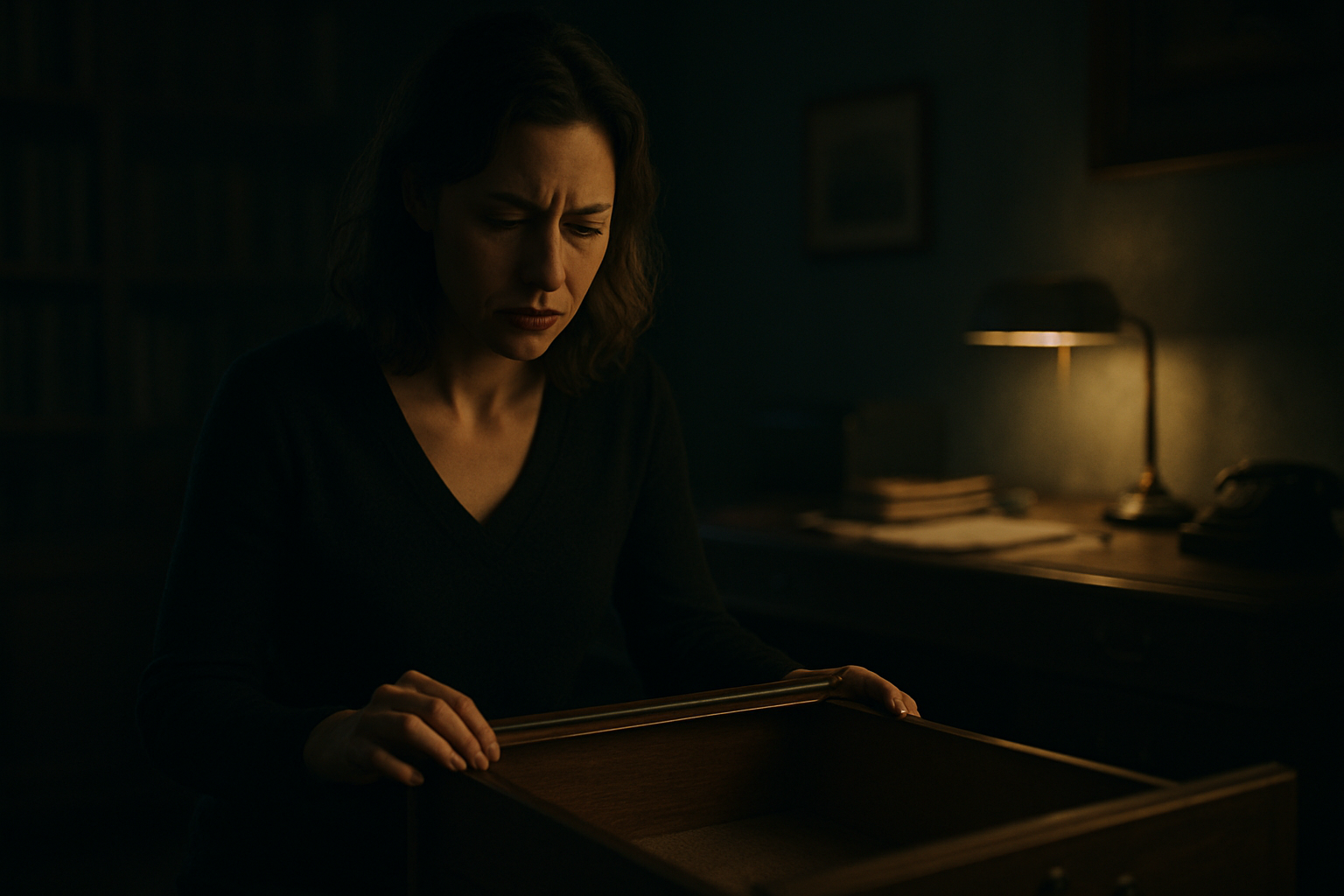
Not give in.
Just stop defending my own life.
I wanted Thomas to be there, angry on my behalf. I wanted Peter to be ten again so I could begin differently. I wanted Lenora to call and say she had been jealous, foolish, afraid—anything that made her betrayal smaller.
Instead, the house stayed quiet.
I walked into Thomas’s office. The drawer was still empty.
Then I remembered the coffee table.
Years earlier, after a rash of burglaries, Thomas had built a hidden compartment beneath it for emergency cash. We had laughed about it. I had forgotten.
I knelt beside the table, my knees complaining, and felt beneath the carved edge.
There it was.
A tiny latch.
Inside was a flash drive wrapped in a note.
Ruth,
If Helena does not already have the copies, give this to her. I hope you never need it.
T.
I laughed.
A shaky, wild laugh.
Thomas had hidden the truth in the room where Cassandra had stood and told me to leave.
Helena came within the hour.
The drive held audio files, scanned papers, and a video Thomas recorded three weeks before his death.
In the video, he sat thin and pale near a hospital window.
“My name is Thomas Mercer,” he began. “I make this statement voluntarily, fully aware of my condition and my estate decisions.”
He explained the trust.
He explained Peter’s debts.
He explained Cassandra’s pressure.
He said clearly that no one influenced him. He wanted me protected.
Then he looked into the camera.
“Ruth, if you see this, I am sorry I left you to fight people I should have confronted sooner. I thought keeping peace was kindness. It was not. It only taught our son that truth could be postponed until someone else paid the cost.”
Helena reached for a tissue and pretended it was for me.
The audio files were worse.
Thomas confronting Peter.
Peter denying, then admitting enough.
Thomas speaking to Lenora.
“You confuse kindness with weakness,” he told her, “because you have spent your life resenting both.”
Then Cassandra.
Her voice was smooth.
“You can’t expect Peter to watch everything go to Ruth while he struggles.”
“My wife is not an obstacle between my son and my money,” Thomas answered. “She is the woman who made every decent part of my life possible.”
“You think she’ll know what to do with that kind of money?”
“I think she will know better than people who see it before they see her.”
Then Cassandra said softly, “People get confused at the end. Families challenge wills all the time.”
Thomas’s voice weakened, but did not shake.
“Try it, and you will prove every fear I had about you.”
The hearing came in late March, almost three months after the funeral.
I wore the navy suit again.
Outside the courthouse, Peter stood alone. Cassandra stood with her attorney. Lenora stood beside her in pearls, wearing wounded dignity like perfume.
When Lenora saw me, she looked away first.
That hurt too.
In court, Cassandra’s attorney tried to make Thomas sound weak and manipulated.
Helena answered with medical records, attorney notes, bank verification, the video, and parts of the recordings.
Hearing Thomas’s voice in that courtroom was comfort and torture.
Peter cried silently when his recording played.
Lenora turned gray.
Cassandra stared straight ahead, as if refusing to react could erase her own voice.
Then Helena called Paige Rowan.
Paige testified about Cassandra’s failed business, unpaid vendors, falsified invoices, and messages about my house.
When Helena presented the text about “unlocking the old lady’s house money,” Cassandra finally moved.
The judge denied the challenge.
He upheld Thomas’s amendment, recognized my authority as trustee, and referred the forged documents and exploitation concerns to the proper authorities.
Outside the courtroom, Cassandra came toward me.
Helena stepped between us.
“Are you happy now?” Cassandra snapped.
I looked at her perfect lipstick and blazing eyes.
“No,” I said. “Happy is not what this feels like.”
“You ruined us.”
“No. I stopped paying the cost of your pretending.”
Peter approached.
Cassandra turned on him.
“You did this, you weak coward.”
He closed his eyes.
Months earlier, that tone would have folded him.
This time, he opened his eyes and said, “Yes. I was weak. That’s why we’re here.”
For the first time, Cassandra looked afraid of him.
Then she walked away, Lenora trailing behind.
Peter stood before me.
“I’m moving out,” he said. “Helena gave me the papers. I’ll sign.”
“And Cassandra?”
“She won’t.”
“Then the court will handle it.”
He looked toward the steps.
“I filed for separation.”
I had expected many things.
Not that.
“Because of the case?”
“Because I heard Dad’s recording,” he said. “And because when I listened to myself, I realized I kept waiting for someone else to become the person I should have been.”
It did not repair anything.
But it opened a door.
The eviction notice landed on Cassandra’s front door on a Thursday afternoon.
Three months after she told me to pack my things and find somewhere else to live, a deputy taped legal papers to the glossy black door of the house Thomas had saved.