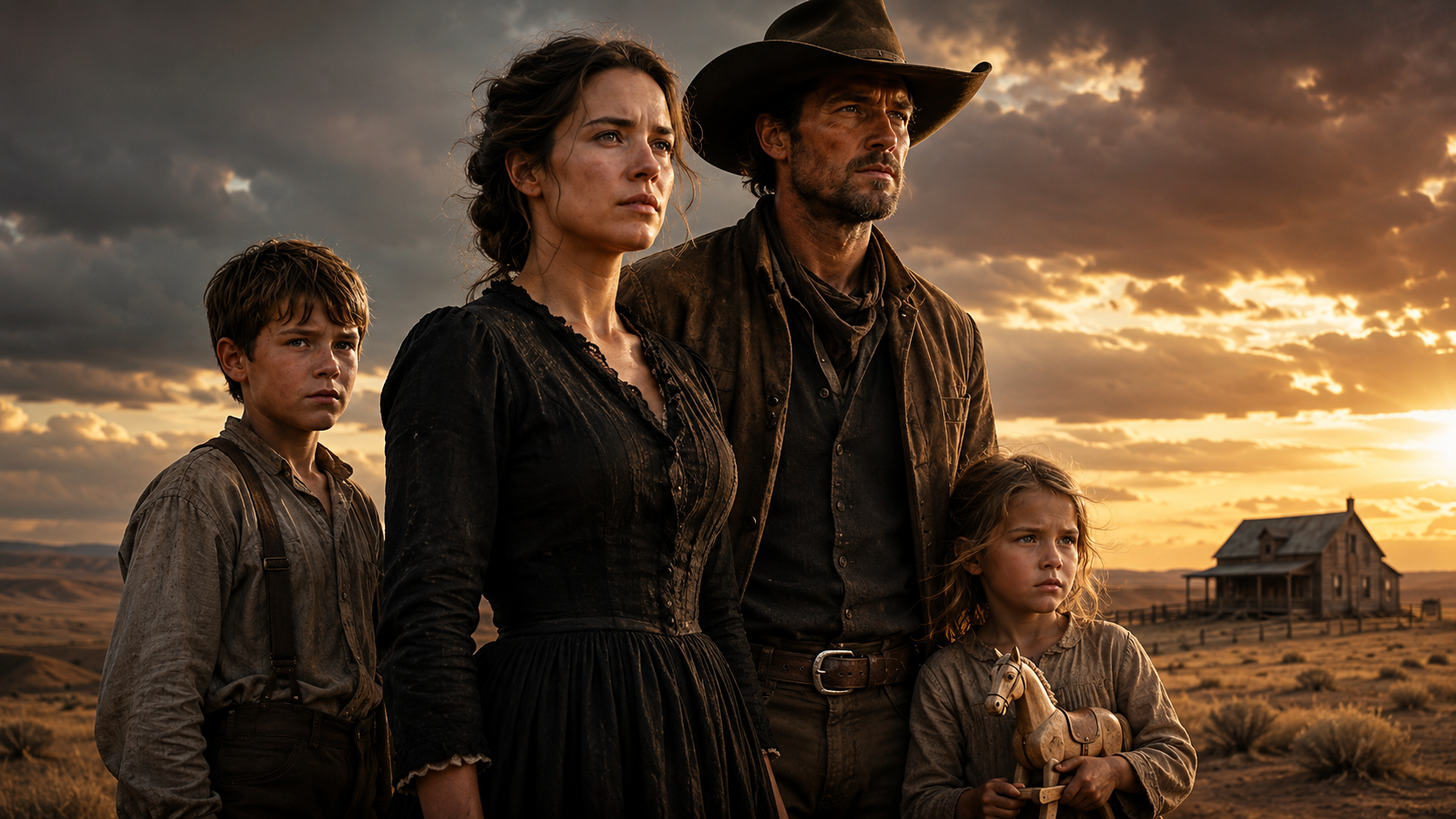
The rain had already turned the road into black soup by the time Nora Bell reached the edge of Briar Creek.
Her boots were split at the seams. Her shawl was soaked through. In one hand, she carried a carpetbag with a broken clasp; in the other, she held the last thing her husband had left her—a brass pocket watch that no longer ticked.
She had walked seven miles since the coachman told her there was no more room, though she had paid for a seat. He had looked at her black dress, her tired face, the mud on her hem, and decided she was the kind of woman people could push aside without consequence.
He was wrong.
Nora simply had not found her consequence yet.
The town was almost asleep. Lanterns burned behind windows. Men laughed inside the saloon. Somewhere, a piano played badly. Nora stopped beneath the awning of a closed mercantile and pressed her back to the wall, trying to gather the strength to decide whether pride or hunger would kill her first.
A wagon rolled to a stop in front of her.
“Ma’am?”
The voice was low, cautious, not soft exactly, but careful.
Nora lifted her chin.
The man holding the reins was broad-shouldered, rain dripping from the brim of his hat. He had the kind of face that looked carved by weather and responsibility. Beside him sat two children. A boy of about twelve watched her with suspicion sharpened into a weapon. A smaller girl, no more than six, stared from beneath a knitted hood, one hand clutching a wooden horse.
“I’m not begging,” Nora said before he could ask.
“I didn’t say you were.”
“I’m waiting.”
“For what?”
She looked down the empty road, then back at him. “For the world to become kinder.”
The corner of his mouth moved, almost a smile, though his eyes remained tired. “That may be a long wait.”
“I’ve had practice.”
The man climbed down from the wagon. “Elias Ward.”
“Nora Bell.”
“Mrs. Bell?”
“For now.”
He understood more than she meant to give away. His gaze moved to the black dress, then to the carpetbag, then to her pale hands curled around the dead watch.
“You have somewhere to stay tonight?” he asked.
Nora’s pride rose, thin and useless. “I have possibilities.”
“Possibilities don’t keep the rain off.”
“No,” she admitted. “But sometimes they’re all a person owns.”
The smaller child whispered, “Papa, she’s shaking.”
The boy snapped, “Lottie, hush.”
Elias turned his head. “Caleb.”
The boy looked away, angry at being corrected and angrier, somehow, at Nora for existing.
Elias faced her again. “My ranch is five miles east. I can offer a roof, supper, and a dry blanket. Nothing more than that unless you ask for it.”
“I can’t pay.”
“I didn’t name a price.”
“Men always do,” Nora said.
For the first time, something hard passed through his expression. Not anger at her. Recognition.
“Some men,” he said. “Not all.”
She should have refused. She should have kept walking until the town ended and the darkness swallowed her with all the other women nobody remembered. But the little girl was still looking at her, and there was something in Elias Ward’s silence that felt less like charity and more like a door being held open.
Nora stepped toward the wagon.
Caleb shifted aside with obvious reluctance.
“I don’t want her sitting near Lottie,” he muttered.
Nora stopped.
Elias’s voice turned quiet. “You will speak with manners in my wagon.”
“She’s a stranger.”
“So was your sister the day she was born. You loved her anyway.”
Caleb’s face hardened, but he said nothing more.
Nora climbed in. Her wet skirt dragged against the wood. Lottie leaned close enough that Nora could see the child’s lashes were clumped with rain.
“Are you cold?” Lottie whispered.
“Yes.”
“I was cold after Mama died.”
The words struck the wagon like a bell.
Elias closed his eyes for half a breath, then took the reins. “Lottie.”
But Nora answered before he could apologize for the child.
“I was cold after my husband died,” she said.
The little girl considered this with solemn understanding. Then she slid the wooden horse into Nora’s lap.
“He doesn’t make you warm,” Lottie said, “but he listens.”
Nora stared at the toy until the road blurred.
For five miles, the rain kept talking where people could not.
The Ward ranch stood beneath a ridge of black pine and pale stone, a lonely house with a sagging porch, a barn leaning into the weather, and acres of land stretching into night. It was not beautiful in the polished way rich men preferred. It was scarred, stubborn, alive.
Inside, the kitchen smelled of smoke, beans, and old grief.
Elias gave Nora a blanket and pointed her toward the stove. Lottie remained close, as though the space beside Nora had become safer than any other place in the room. Caleb sat at the far end of the table and watched every bite Nora took as if she had stolen it from his dead mother’s plate.