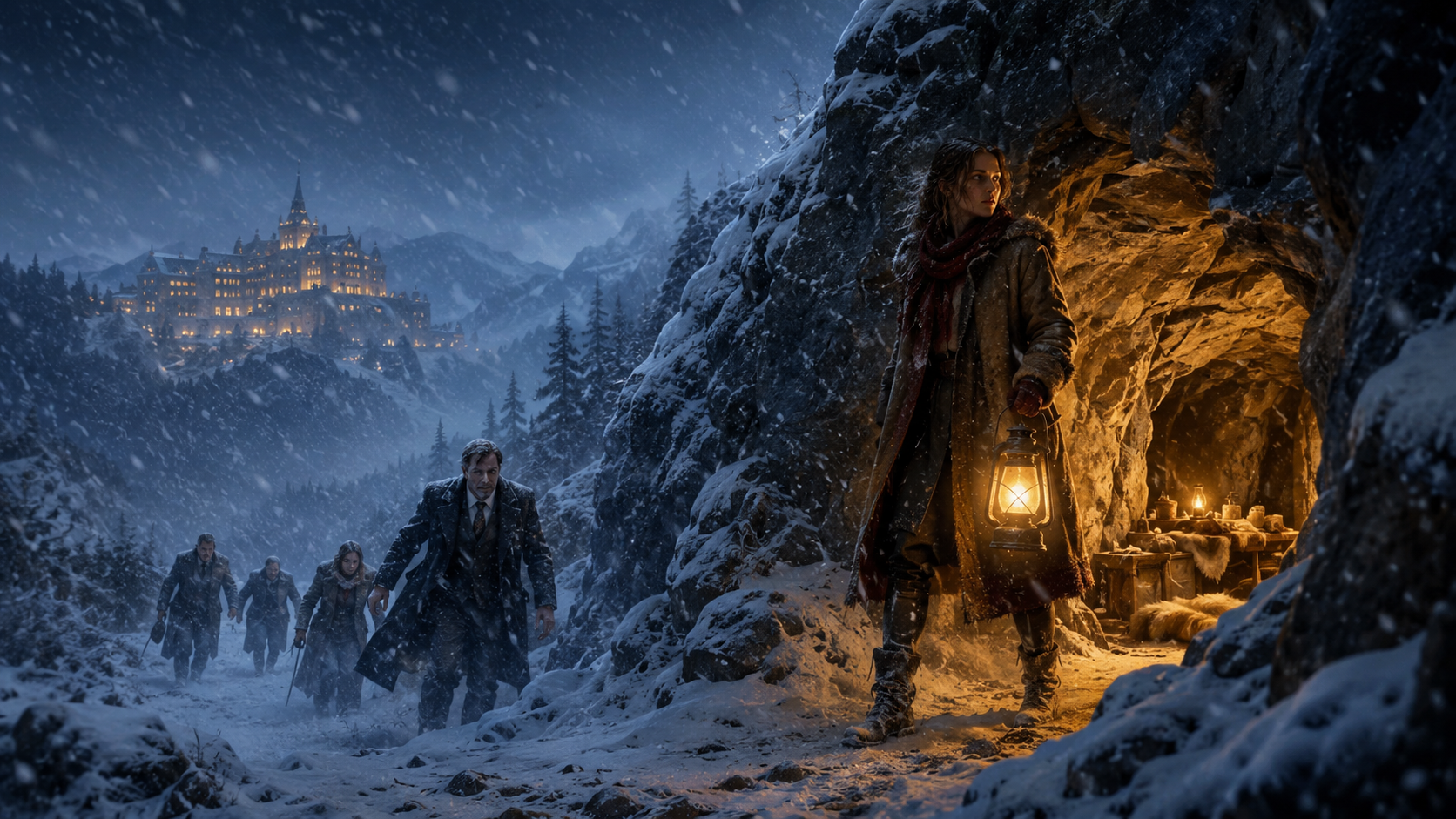
“I thought ownership meant control,” he said. “The lodge, the roads, the land, the people who worked for us. I thought if everything depended on me, that made me powerful.”
“And now?”
He glanced back at the chamber, where Tomas was teaching Noah how to tie a knot and Mrs. Bell was sleeping near the stove.
“Now I think dependence and power are not the same thing.”
Mara folded her arms. “That realization came at a convenient time.”
“I know.”
“You threw me out.”
“I know.”
“You mocked my mother’s promise.”
His face tightened.
“That,” he said quietly, “was unforgivable.”
“Yes.”
“I cannot undo it.”
“No.”
“I can make it legally true.”
Mara stared at him.
Adrian reached into the inner pocket of his torn coat and pulled out a leather document case, warped from melted snow. His hands shook as he opened it. Inside were folded papers, some damp at the edges.
“I brought estate documents when we left,” he said. “I thought… I thought if Grayhaven burned or froze, I needed proof of ownership.”
“Of course you did.”
A shadow of shame crossed his face.
“There is an old conservation trust attached to the north ridge. My father never dissolved it. I ignored it because it limited development.” He held out the papers. “Your mother’s name appears in the correspondence. Mine does too, after inheritance. I can transfer stewardship of this section. Not sell. Not lease. Transfer. To a community trust.”
Mara did not take the papers.
“You expect forgiveness because you found paperwork?”
“No.” He lowered his hand. “I expect nothing. I am telling you what I will do when we get out.”
“When?”
“If,” he corrected.
They stood in silence.
Then Mara took the papers, not as a gift, but as evidence.
“People like you always promise after the fire starts,” she said.
Adrian nodded. “Then do not trust the promise. Trust witnesses.”
He looked toward the others.
Mara understood.
By evening, everyone in Hearthstone knew what Adrian had said.
Tomas insisted on hearing it twice. Mrs. Bell, wrapped in blankets, cried silently. Lina asked sharp questions about legal language. Elise said the trust must include village emergency storage, public winter access, and elected oversight. Dorian, still pale with fever, muttered that Adrian had lost his mind.
Adrian looked at his cousin.
“No,” he said. “I think I misplaced it years ago and am only now noticing.”
That made Tomas laugh so hard he coughed.
They remained in the cave for four more days.
During that time, Mara did not become soft toward Adrian. She gave him chores. Hard ones. He hauled snow for melting until his shoulders trembled. He chopped kindling badly, then better. He cleaned pots. He listened while villagers described years of being priced out, ignored, dismissed, and made dependent on decisions from rooms they were never allowed to enter.
At first, he answered like a man defending a position.
Then, gradually, like a man hearing a verdict.
On the fifth day, the rescue crews broke through.
A convoy from the state emergency service reached the lower road, guided by flares the road brothers had set before coming to Hearthstone. Snow machines climbed the ridge. The first rescuer who entered the cave stopped dead at the sight of twenty-three people warm, fed, organized, and alive inside the mountain.
“Who’s in charge here?” he asked.
Every face turned to Mara.
She hated how that made her throat tighten.
“I suppose I am,” she said.
The story spread faster than thaw.
By December, newspapers called it the Miracle Cave. Reporters wanted photographs. Investors wanted interviews. Adrian’s public relations team wanted to rename it The Vale Emergency Mountain Initiative.
Mara refused all of it.
The legal transfer took longer, but Adrian did not back away. Too many witnesses. Too much public attention. Perhaps, Mara thought, a little real shame too.
The north ridge became Hearthstone Trust before New Year.
Grayhaven Lodge reopened in spring, but not as it had been.
Part of it became a winter response center. Its fuel reserves were audited publicly. Its emergency stores were shared with the village. The luxury cabin project was canceled. Dorian left for the city and complained loudly to anyone who would listen that his cousin had been bewitched by a housemaid in a cave.
Mara did not become a housemaid again.
She became director of the Hearthstone Trust, though she hated the title and preferred “the person with the keys.” She hired local workers, stocked shelters along the ridge, trained volunteers, and made every wealthy donor carry boxes before they were allowed to pose for photographs.
Adrian came often.
At first, people watched him closely. So did Mara. Trust, she believed, was not a door that opened because someone knocked once. It was a path through deep snow, made passable only by walking it again and again.
He walked it.