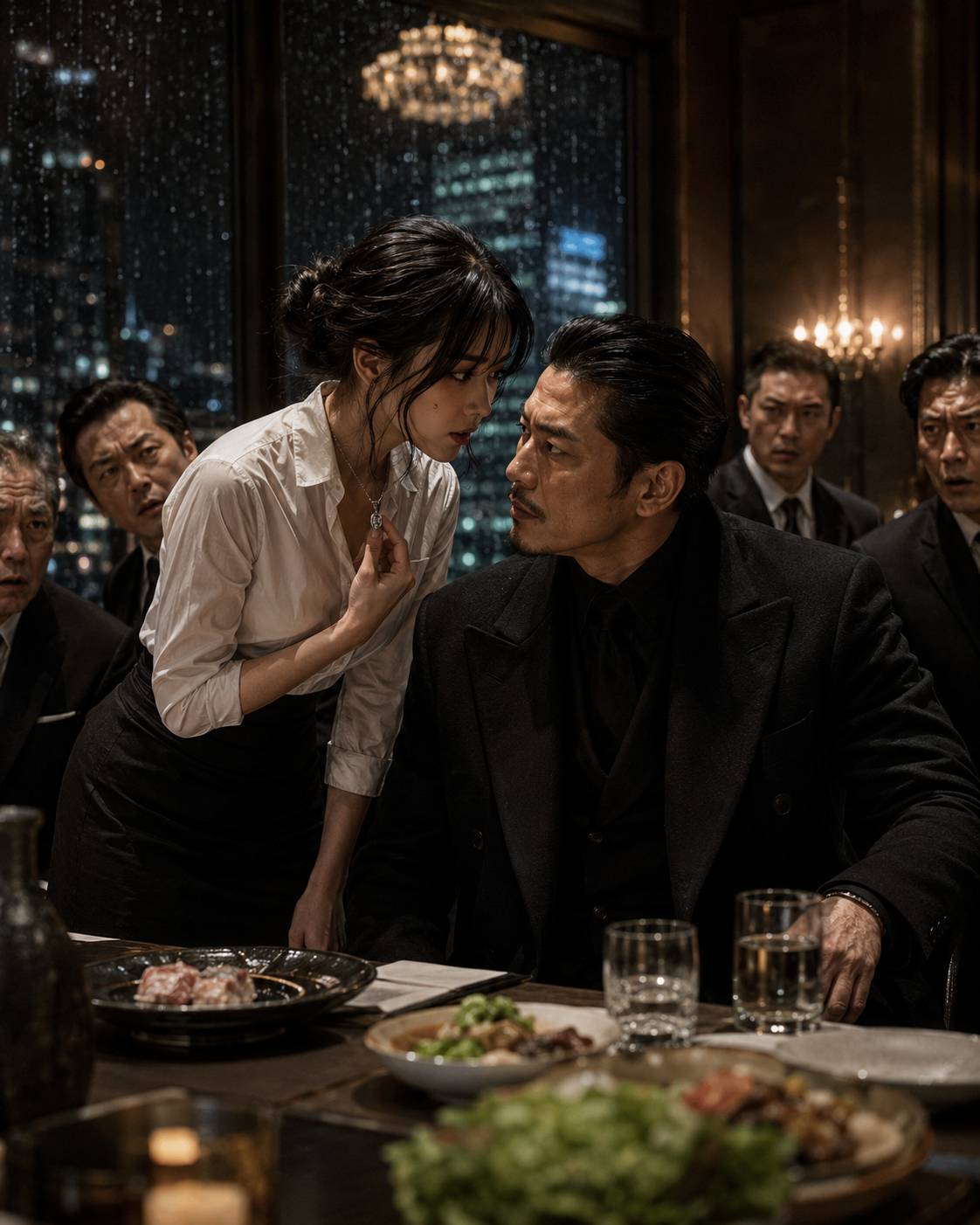
Vescari fell to his knees, stunned and furious.
Kenji stood over him.
The warehouse held its breath.
This was the moment his world expected.
A traitor exposed.
An enemy kneeling.
A clean death waiting.
Clara pressed one hand to her bleeding shoulder and forced herself upright.
“Kenji,” she said.
He did not look at her.
Vescari laughed through pain.
“Do it. Prove you are your father’s son.”
Kenji’s jaw tightened.
Those words were poison.
Prove the lie continues.
Prove mercy is weakness.
Prove blood is the only language power understands.
Clara stepped closer, every movement agony.
“My father died so the truth could reach daylight,” she said. “Not so another body could hide it.”
Kenji’s hand remained steady.
For one terrible second, Clara thought he would choose the old world.
Then he lowered his weapon.
Dante stared.
Vescari stared.
Even Silas, bleeding against the wall, looked unable to believe it.
Kenji turned to Dante.
“Call the federal contact.”
Dante blinked. “Which one?”
“The one Vescari does not own.”
For the first time that night, real fear entered Vescari’s face.
Kenji crouched before him.
“You wanted the old world back,” he said. “You can have its ending.”
By dawn, Chicago had a scandal too large to bury.
The ledger from Warehouse Nine did not go to one agency. Kenji made sure of that. Copies went to federal prosecutors, national newspapers, an independent judge outside the city, and one retired investigator whose daughter had vanished through a shipping route twelve years earlier.
Names surfaced before breakfast.
A deputy commissioner resigned by noon.
A judge was arrested before he could board a flight.
Three shipping executives were taken from their offices while cameras waited outside.
Carlo Vescari survived, which angered many people at first. But by sunset, when he began trading testimony for protection, his survival became more useful than his death.
Silas Ward died in surgery.
Before he died, he gave Dante three names and one apology.
Clara did not know what to do with the apology, so she left it where it was.
Mrs. Rivera recovered with bruises, a fractured wrist, and a fierce insistence that Clara move into her spare room until “all these handsome criminals stop bringing trouble to your door.”
Clara spent two days in a private clinic under a false name. The wound in her shoulder was ugly but not fatal. Kenji visited once the first night and once the second. He brought no flowers. No jewels. No dramatic promises.
He brought her father’s blue mug from her apartment, wrapped carefully in newspaper.
That nearly broke her.
On the third morning, Clara found him by the clinic window, watching sunlight turn the lake gold.
“You could have killed Vescari,” she said.
“Yes.”
“Why didn’t you?”
Kenji looked at her.
“Because you asked me not to before you spoke.”
Clara’s throat tightened.
“I do not want to be the reason you pretend to be good.”
“You are not.”
“Then what am I?”
He took a long time to answer.
“A witness.”
“To what?”
“To the fact that I still have a choice.”
Clara looked down at the bandage on her shoulder.
For years, she had believed survival meant hiding. Staying small. Pouring wine for powerful men and praying none of them looked closely enough to recognize her.
But hiding had not saved her father.
And silence had never protected the innocent.
“What happens to your organization now?” she asked.
Kenji exhaled slowly.
“The old accounts are being closed. The men who profited from trafficking will face their own evidence. My shipping companies become legitimate or they burn. Some men will leave. Some will try to kill me.”
“You say that like weather.”
“In my life, it often is.”
Clara studied him.
He was still dangerous. She would never lie to herself about that. He was not a prince rescued from darkness by one brave woman. He was a man who had done violent things and might do violent things again.
But he had stood over his enemy and chosen daylight.
That mattered.
Kenji placed her repaired pendant on the table beside her bed.
“I believe this belongs to you.”
Clara touched it but did not put it on.
“For years, I thought it meant run.”
“What does it mean now?”
She looked at the engraved word.
Sparrow.
Small bird.
Fragile bones.
Still, it crossed oceans.
“It means return,” she said.
Kenji nodded as if the answer had cost him something.
When Clara left the clinic, she did not return to Sterling Room as an employee. The restaurant reopened weeks later with a remodeled private room and an unspoken rule that no one mentioned the night a waitress stopped a war by speaking Japanese.
Oliver Grant sent her a handwritten apology and a check for the shoes she had ruined.
She returned the check.
She kept the apology.