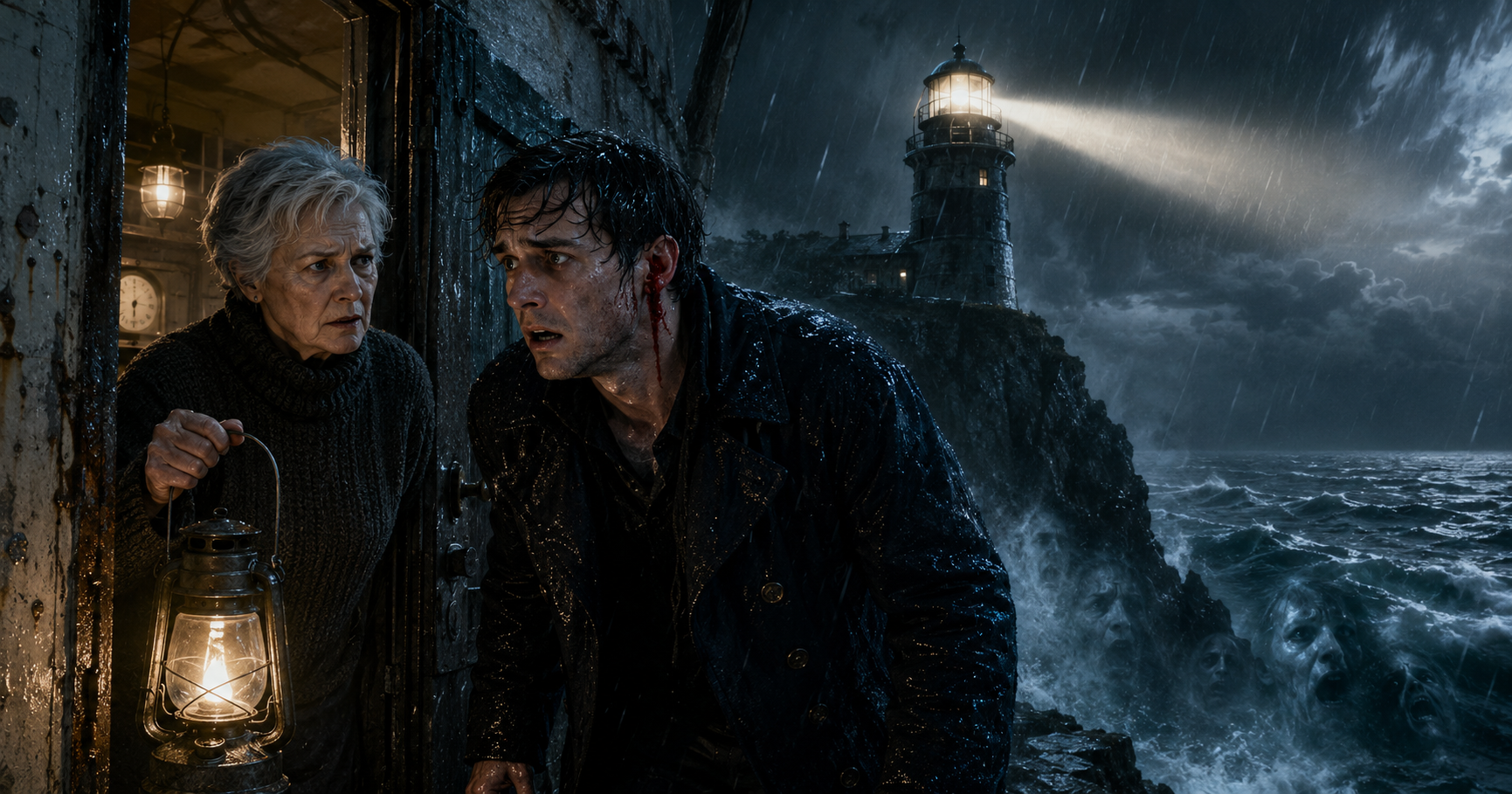
Each voice called for someone who was no longer alive.
The walls answered with faint whispers.
Ellis looked toward the spiral staircase.
“It followed me here because of you.”
“Why me?”
“Platform Nine was only a receiver. This lighthouse was the transmitter.”
Miriam shook her head.
“The old foghorn?”
“Not a foghorn. A signal generator.”
Another deep vibration rose from below.
The dead instruments flickered awake one after another.
Needles swung across gauges.
Warning lamps glowed red.
On the wall, an ancient reel-to-reel machine began turning.
There was no tape mounted on it.
Still, Celia’s voice came from the empty mechanism.
“Miri, open the lower door.”
Miriam backed away.
The sealed lower chambers had remained locked since the evacuation. She possessed the only key.
For twenty-seven years, she had worn it on a chain beneath her clothes.
Now the key felt warm against her chest.
Ellis stared at it.
“It knows you have it.”
“Everyone knew I had it.”
“No. It knows now.”
A metallic knock echoed from the staircase door.
Once.
Then twice.
Then three times.
The same emergency signal used by lighthouse crews when the electrical systems failed.
Miriam’s hand moved toward the key.
Ellis strained against the straps.
“Don’t.”
“Someone may be below.”
“There is no one below.”
The knock came again.
Celia began to cry behind the door.
“Miri, the water is rising.”
Miriam closed her eyes.
She saw her sister as she had been at nineteen: laughing with paint on her hands, angry at the world, brave only when someone else needed her.
“Miri, please.”
Miriam reached for the key.
Ellis tore one hand free of the canvas restraint.
He struck the metal tray beside him.
The crash snapped Miriam back to the room.
“That voice wants you to remember her frightened,” he said. “Was she?”
Miriam looked at him.
“What?”
“Your sister. Was she the kind of person who begged?”
Celia had been many things.
Reckless.
Impatient.
Infuriating.
But when the evacuation sirens sounded, she had helped carry injured officers into the upper tower. The final transmission from the lighthouse had been calm.
Celia had never begged.
Miriam took the key from her neck.
The voice behind the door became hopeful.
“Yes, Miri. Open it.”
Miriam walked to the emergency furnace.
She placed the key inside.
Then she shut the iron grate.
The voice stopped crying.
Its next words came in a deep chorus.
“You were given one purpose.”
The lighthouse shook.
The lower staircase door bulged inward.
Ellis freed his other hand and pulled the remaining straps loose.
“What purpose?” he asked.
Miriam watched the key begin to glow inside the furnace.
“I don’t know.”
“Yes, you do.”
A memory surfaced.
Not from the evacuation.
From three days afterward.
Miriam standing inside this same radio room with blood dried beneath her nose.
A naval officer asking what she had heard during the storm.
Doctors measuring her hearing.
Engineers playing tones through headphones.
Celia’s voice emerging from a test speaker.
Miriam screaming until she lost consciousness.
Then a needle.
A white room.
A signature at the bottom of a document she had never remembered signing.
“They erased something,” Miriam said.
Ellis touched the blood beneath his ear.
“What?”
“My reason for coming back here.”
The reel-to-reel machine accelerated.
A second sonar monitor illuminated.
It displayed a waveform.
Miriam recognized the pattern.
“It’s waiting for a response.”
“What kind?”
“A cancellation frequency. The transmitter was designed to produce an opposing signal.”
“Can you activate it?”
“The controls are in the foghorn chamber.”
“The chamber behind the locked door?”
Miriam looked at the furnace.
The key had begun to melt.
The lower door bent inward again.
Its hinges screamed.
“We don’t need the key anymore.”
The door exploded from its frame.
Beyond it, the spiral staircase descended into red emergency light.
Wet footprints marked the steps.
They began at the bottom and ended at the threshold.
Miriam and Ellis stared into the opening.
From far below, Naomi called his name.
“Ellis?”
He stepped toward the stairs.
Miriam caught his arm.
“That isn’t her.”
“I know.”
“Do you?”
He looked at her.
Tears stood in his eyes.
“No.”
They descended together.
The lower lighthouse smelled of hot metal and seawater. Pipes ran along the stone walls like arteries. With every note from below, they expanded and contracted.
Halfway down, Miriam noticed faces beneath the moisture covering the walls.
Not actual faces.
Impressions.
Foreheads, mouths and closed eyes pressing outward from inside the stone.
Ellis avoided looking at them.
“Keep talking,” he said.
“About what?”
“Anything real.”