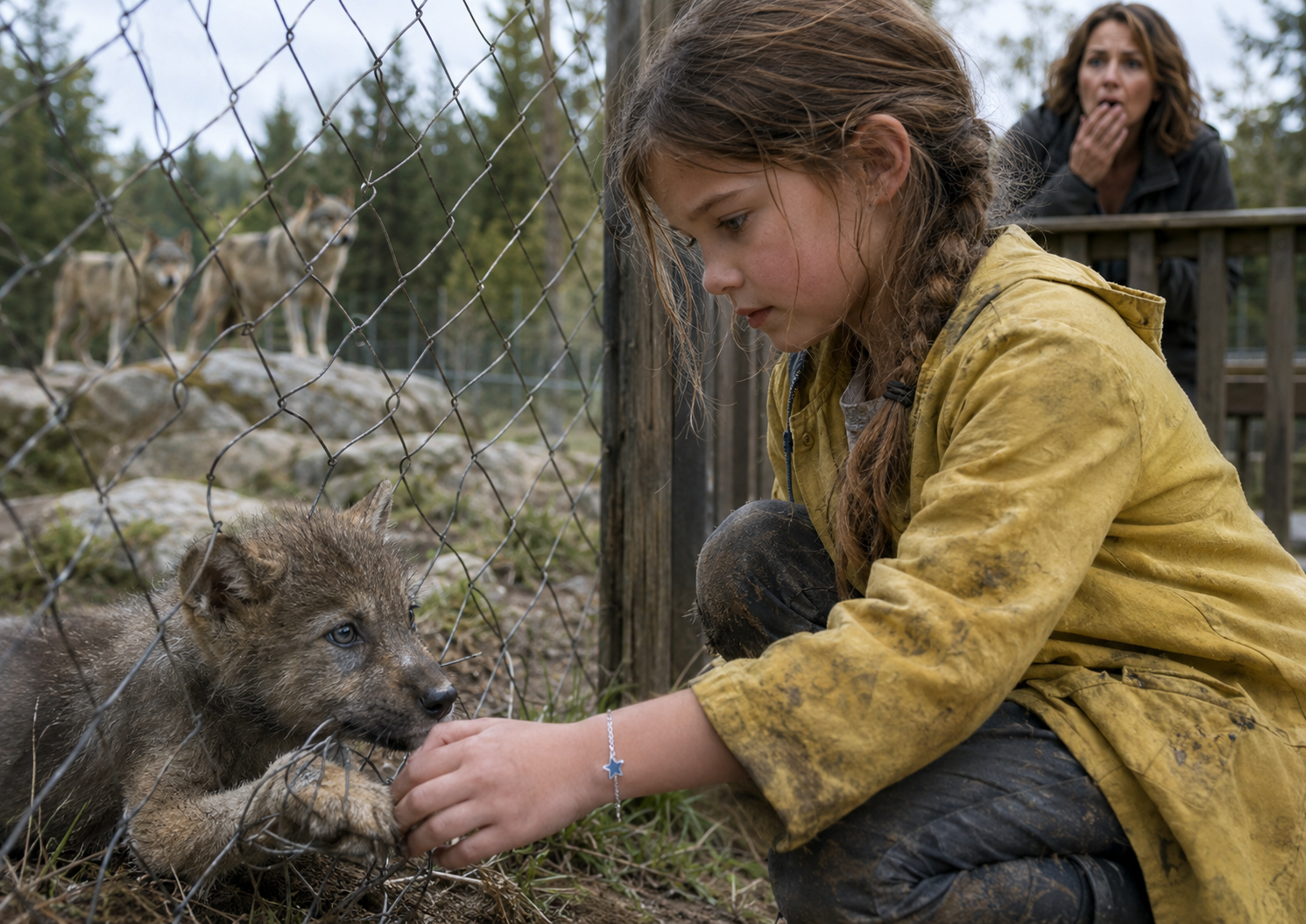
A second earlier, the wolf observation deck had been filled with ordinary weekday sounds: children arguing over binoculars, teachers counting students, parents folding maps, and paper cups being pushed into overflowing bins.
Then a little girl climbed onto the wooden railing.
Someone shouted for her to stop.
Someone else dropped a camera.
Before any adult could reach her, she swung one leg over the barrier, lowered herself as far as she could, and dropped onto the narrow maintenance path below.
The observation deck erupted.
People rushed toward the railing. Phones rose above heads. A teacher pulled several children away while two security officers ran toward the emergency gate.
But the girl did not look back at the crowd.
She had already seen what everyone else had missed.
A wolf cub was trapped against the old service fence.
The cub was small enough that its ears still looked too large for its head. One of its front legs had slipped through a damaged section of wire, and the more it struggled, the tighter the twisted metal pulled around it.
The girl had noticed the cub several minutes earlier.
She had watched it try to free itself.
She had looked toward the adults around her, expecting someone else to see what was happening. But everyone had been watching the adult wolves resting on the ridge or taking photographs near the glass viewing wall.
No one had been looking at the narrow strip of land between the main habitat and the service corridor.
No one except her.
Her name was Lila Rowan.
She was eight years old, although people often guessed she was younger because she was small and wore a faded yellow coat that had clearly belonged to another child before her.
She had arrived at Hawthorne Wildlife Center shortly after it opened. Wednesdays were free for families carrying a regional assistance card, and Lila had learned that the wildlife center was one of the few places where she could spend an entire day without anyone asking why she was still there.
She knew the grounds well.
She knew which indoor building stayed warmest during winter.
She knew when the café placed unsold bread near the employee entrance.
And she knew that the wolves were usually quietest before noon.
When Lila landed on the service path, she bent her knees and remained still.
The adult wolves were separated from her by a reinforced inner fence, but they had already noticed the disturbance. Two of them stood on the rocky rise, watching her with motionless intensity.
Lila did not run.
She did not wave her arms.
Instead, she lowered herself and began moving slowly toward the trapped cub.
“Easy,” she whispered. “I’m not going to hurt you.”
The cub pulled backward.
The wire tightened.
Lila stopped immediately.
“Don’t move,” she said softly. “Please don’t move. I can help you, but you have to stay still.”
The cub’s breathing was fast and shallow. Its free paws scraped at the dirt, but exhaustion had weakened its movements.
Lila crouched several feet away and held out one hand. She waited until the cub stopped pulling before moving closer.
Above her, the crowd continued shouting.
“Get her out of there!”
“Where are the keepers?”
“Someone call emergency services!”
The noise frightened the cub. It twisted again, and the wire cut more deeply into the fur around its leg.
Lila looked up at the people leaning over the barrier.
“Please stop yelling!” she shouted. “You’re scaring him!”
For one brief second, the observation deck became almost silent.
Lila turned back to the cub.
“That’s better,” she whispered. “They’re going to be quiet now.”
She reached the damaged fence and examined the wire.
It had not pierced the cub’s leg, but several sharp loops had wrapped around the joint. Lila had no tools, no gloves, and no idea whether the cub might bite her.
She only knew that leaving it trapped was not an option.
She slid her fingers beneath the first loop and began to turn it.
The metal resisted.
The cub whimpered.
“I know,” Lila said. “I know it hurts. Just give me a little time.”
On the observation deck, the crowd had rearranged itself around the crisis. People pressed against the railings while others stood on benches to see.
Two security officers spoke urgently into their radios. A third ran toward the locked service entrance.
Near the rear of the crowd stood Evelyn Mercer.
She was forty-five and had come to the wildlife center with her sister’s son, Noah. Ten minutes earlier, Noah had been beside her, describing every animal he hoped to see. Now he was somewhere near the lynx exhibit with his school friend’s family.
Normally, Evelyn would have gone after him immediately.
But she could not move.
She was staring at the little girl below.
More precisely, she was staring at the girl’s wrist.