Vivian left before the room was done turning against her.
No one offered her a carriage.
Outside, the snow had softened into rain.
Tessa stood beneath the courthouse awning, holding her father’s bill of sale in both hands.
Caleb came to stand beside her.
“You came back,” she said.
“I said I would.”
“You were late.”
“Yes.”
She looked at the mud on his coat. “You dragged an old man through rain?”
“He insisted on the dragging.”
Despite everything, Tessa laughed.
Caleb looked at her as if the sound had struck something deep in him.
Then he said, “I was afraid.”
That stopped her.
“You?”
He nodded once.
“On the ride back. I thought I might be too late. I thought you might be sitting in that room alone, believing I had left.”
Tessa looked toward the muddy street.
“I did not believe it.”
“Not even a little?”
She was quiet.
“Maybe a little.”
Caleb accepted the truth without flinching.
“I have lived alone a long time,” he said. “Long enough that people made stories out of my silence. I let them. It was easier. But I do not want you guessing what my silence means.”
Tessa turned to him.
“What does it mean?”
“Usually that I am thinking.”
“And now?”
His gaze held hers.
“Now it means I am trying not to ask for something before I have earned the right.”
Tessa’s fingers tightened around the paper.
“What thing?”
Caleb removed his hat.
“I asked you once to let me help. That was practical. I would like to ask something impractical.”
Her heart beat hard.
“Caleb.”
“I would like to court you properly.”
“You are aware half the town thinks you already have.”
“I don’t care what half the town thinks.”
“The other half thinks I trapped you.”
“I care even less about fools.”
She tried not to smile.
“I have work.”
“I know.”
“My mother will interfere.”
“She already does.”
“I am not delicate.”
“I never wanted delicate.”
“I am not small.”
“No,” Caleb said softly. “You are not.”
The words could have been cruel in another mouth.
In his, they sounded like reverence.
Tessa looked down at her hands, then at his. Both scarred. Both rough. Both made for weathering.
“You may court me,” she said. “Slowly.”
Caleb’s face changed.
Not much.
Enough.
“Slowly,” he agreed.
Spring came late to Bramble Ford.
By then, Warde Holdings had lost three lawsuits, two clerks had resigned, and Vivian had gone east “for business,” though no one believed business had anything to do with it.
Tessa kept her shop.
She painted the sign herself.
MARLOWE REPAIR
BOOTS, HARNESS, SADDLES, AND FINE LEATHERWORK
Caleb stood beneath it for a long time.
“Your name looks good up there,” he said.
“It always belonged there.”
“Yes.”
Mara, sitting near the open window with a quilt over her knees, called out, “That may be the first sensible thing a mountain man has said all week.”
Caleb tipped his hat to her.
Tessa laughed again.
In later years, Bramble Ford told the story many ways.
Some said it began when Vivian Warde tried to buy a mountain road with a wedding ring.
Some said it began when Caleb Rusk refused every rich widow in the valley.
Some said it began in court, when a quiet bootmaker opened a false ledger and pulled the truth from under its skin.
But the old people, the ones who remembered the frost on the windows and the gossip in the dry goods store, knew better.
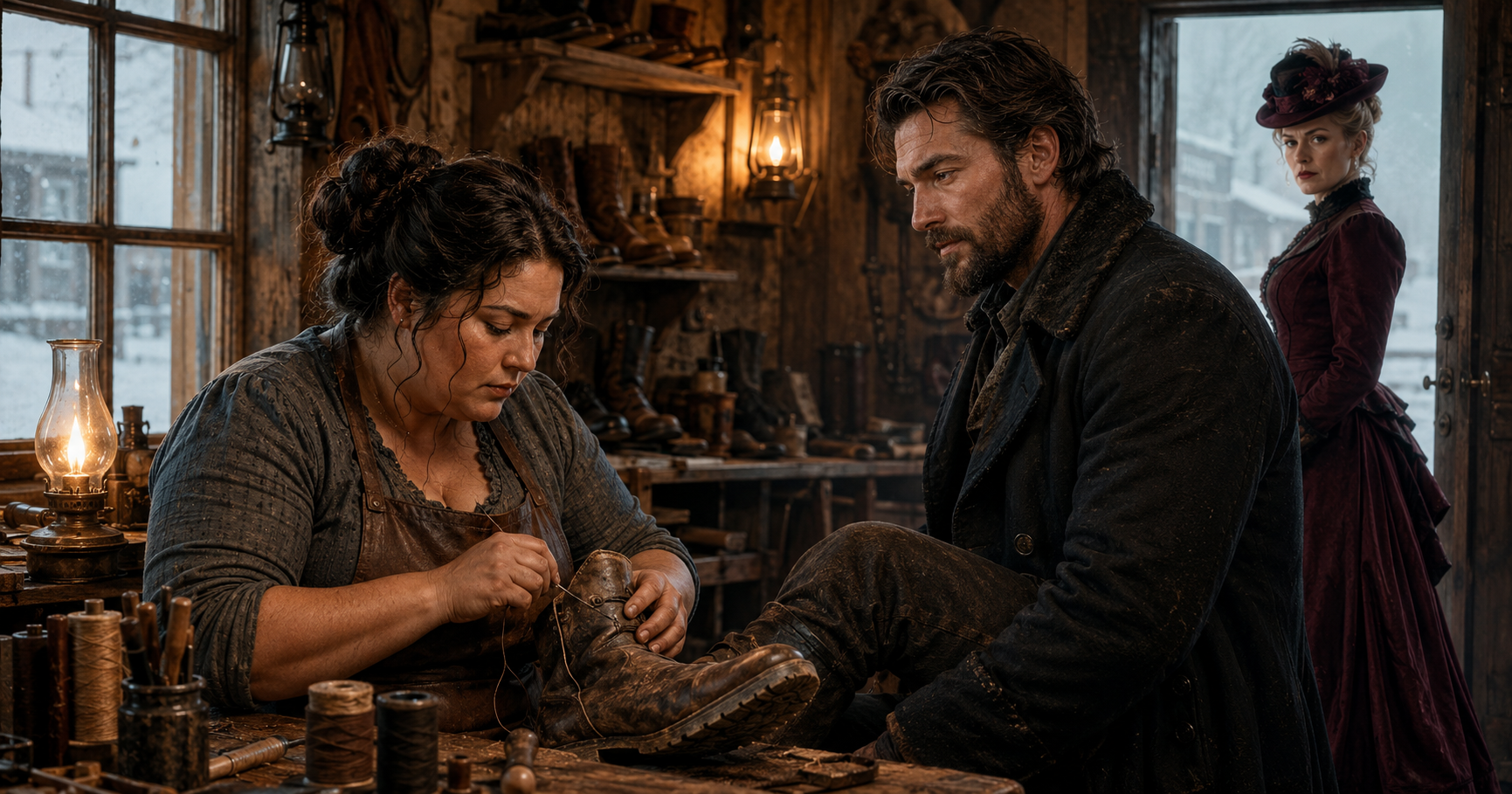
It began the morning Caleb Rusk came down from Wolf Ridge with a ruined boot.
It began when Tessa Marlowe took the torn leather in her hands.
The town had looked past her for thirty years.
Caleb looked once.
And stayed.