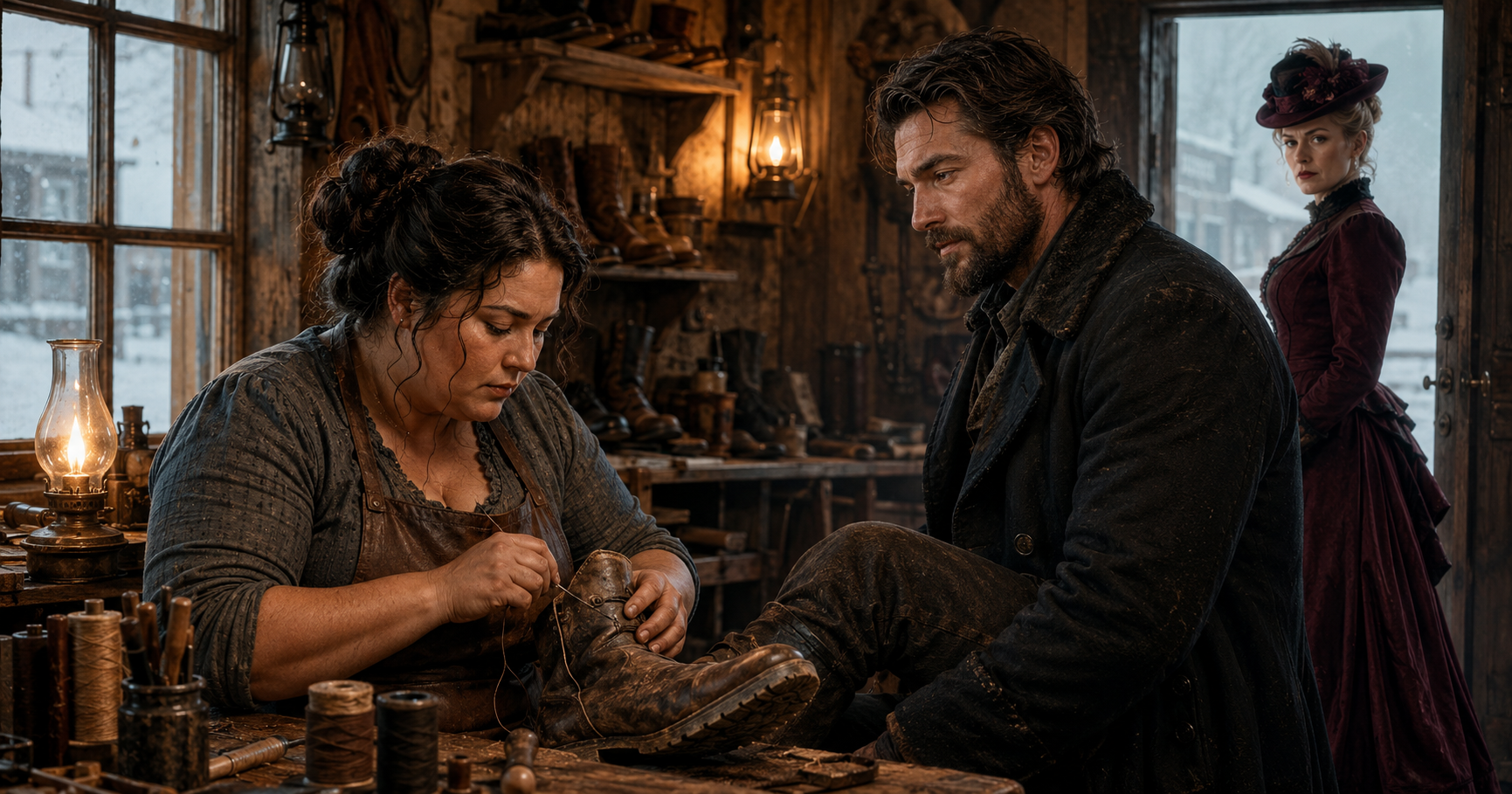
The Silent Man of Wolf Ridge

Every widow in Bramble Ford had tried to marry Caleb Rusk.

Not openly, of course. Women with money preferred to call desperation by better names. They called it concern. They called it hospitality. They called it sending over a pie because “a man alone in the mountains should not be expected to cook for himself.” They called it inviting him to Sunday supper, then wearing pearls at a pine table as though roast chicken were a proposal.

Caleb accepted none of it.

He thanked Mrs. Elowen Price for the blackberry jam and returned the jar washed and empty.

He tipped his hat to Mrs. Charity Bell when she asked whether his cabin needed curtains and said, “The windows are doing fine.”

And when Vivian Warde, the richest widow in the valley, sent a wagon up Wolf Ridge with two hired men, three crates of preserves, a velvet-lined winter coat, and a handwritten invitation to dine at her estate, Caleb sent everything back untouched except the letter.

Across the bottom of the invitation, he had written only four words.

No need. No interest.

By sunset, all of Bramble Ford knew.

By supper, all of Bramble Ford had laughed.

By morning, no one was laughing where Vivian Warde could hear.

Vivian was the kind of woman people smiled at before they feared her. She owned half the grazing leases north of the river, the largest house in town, two teams of matched black horses, and a voice soft enough to make threats sound like manners. Her late husband had left her money. Her father had left her influence. Her own patience had turned both into a weapon.

So when Caleb Rusk refused her, people expected something to break.

No one expected the first crack to appear in Tessa Marlowe’s boot shop.

Tessa was not the sort of woman men looked at twice unless they needed something repaired.

She was broad-shouldered, heavy-hipped, strong-handed, and quiet in a town that mistook quiet for weakness. Her dresses were always clean but never fashionable. Her dark hair was usually pinned too hastily, with loose curls escaping near her ears. She had a round face, a careful gaze, and hands that could stitch torn leather so neatly that ranchers rode ten miles out of their way to pay her.

They trusted her work.

They did not think to trust her.

That was different.

Her shop sat behind Mercer’s Dry Goods in a narrow room that smelled of oil, rain, old leather, and cedar shavings. Her father had built the workbench. Her mother slept behind a curtain in the back room whenever her lungs got bad, which was more often now. Tessa kept a jar beneath the counter for medicine money. The jar was never full enough.

The morning Caleb Rusk came down from Wolf Ridge, the town had frost on its windows and gossip in its teeth.

Tessa heard the bell over the dry goods door ring. She heard Mr. Mercer say, too loudly, “Morning, Mr. Rusk.” She heard the quick hush that followed.

Then the man himself filled the doorway of her workroom.

He was taller than any person had a right to be indoors. Snow clung to the shoulders of his dark coat. His beard was short and rough, his eyes the pale gray of winter creek water, and one of his boots looked like it had survived an argument with a bear and lost.

Tessa looked from the boot to his face.

“Sit,” she said.

Caleb obeyed.

That was the first strange thing.

Men usually tried to explain the damage as if boots had moral failings. Caleb pulled the boot off, set it on her bench, and waited.

Tessa turned it in her hands. “Seam’s split. Heel’s nearly gone. The sole is thirsty. You should have brought this in two months ago.”

“I wasn’t in town two months ago.”

“That poor boot was.”

His eyes changed slightly.

Not a smile.

Almost.

From the front of the store came the bright, polished sound of Vivian Warde’s voice.

“Oh, Mr. Rusk. How fortunate.”

Tessa did not lift her head.

Caleb did not turn.

Vivian appeared in the doorway wearing a wine-colored traveling dress with black gloves and a hat trimmed in feathers. Behind her, half the store pretended not to listen.

“I was told you came down from the ridge,” Vivian said. “Had I known, I would have sent a proper carriage.”

Caleb looked at his damaged boot. “I have a horse.”

“Yes. Of course.” Vivian’s smile remained perfect. “But a man should not always have to do things the hard way.”

Tessa pushed her awl through the leather.

Vivian’s gaze drifted toward her and cooled.

“Tessa, dear, do be careful with Mr. Rusk’s boot. He walks farther than most men. One would hate to see him brought down by careless stitching.”

The awl paused.

Tessa had heard versions of that voice all her life.

Careful, Tessa. That chair might not hold.

Careful, Tessa. There are only three biscuits left.

Careful, Tessa. A woman your size should not stand in front during the church choir.

Always careful.

Always said with a smile.

Caleb turned his head at last. “Do you doubt her work?”

Vivian blinked. “Not at all. I only meant—”

“Then let her work.”

The room went still.

Tessa kept her eyes on the boot, but her fingers tightened around the thread.

Vivian gave a small laugh. “You are very direct.”

“I try to save words.”

“So I’ve heard.”

“Then believe what you heard.”

For the first time in Tessa’s memory, Vivian Warde had no immediate answer.

She left with her smile still intact, but her silence was sharp enough to cut cloth.

Tessa tied the stitch, trimmed the thread, and set the boot down.

“You should not have done that,” she said.

Caleb inspected the repair.

“Done what?”

“Spoken to her that way in front of people.”

“She spoke to you that way in front of people.”

“That is different.”

“No.”

He said it so simply that Tessa looked up.

Caleb put money on the bench. Too much.

“The repair is twenty cents,” she said.

“The repair saved the boot.”

“That is still twenty cents.”

“Then the rest is for saving me from walking home with one foot frozen.”

Tessa almost pushed the coins back. Then her mother coughed behind the curtain. A long, tearing cough that bent the air around it.

Caleb’s gaze moved toward the sound, but he asked no question.

That was the second strange thing.

People in Bramble Ford loved questions when they had no intention of helping.

Tessa took the money.

Caleb stood, pulled on the repaired boot, and tested his weight.

“Good work,” he said.

“I know.”

The words slipped out before she could soften them.

Caleb looked at her again.

This time, the almost-smile became real.

“Yes,” he said. “You do.”

He came back two days later with the other boot.

By then, Vivian had already sent three ladies into Tessa’s shop to discuss Caleb Rusk in voices meant to be overheard.

“He cannot live like a hermit forever.”

“A mountain man needs a respectable woman.”

“Not every kindness is charity.”

Tessa said nothing. She repaired a saddle strap, stitched Mrs. Bell’s glove, and listened to her mother breathe behind the curtain.

When Caleb returned, he brought no gossip with him. Only the second boot, worse than the first.

“You try to destroy these on purpose?” Tessa asked.

“Rocks do most of it.”

“Rocks are innocent. This is neglect.”

“I’ll apologize to the boot.”

“You should.”

He sat while she worked. He did not stare at her body or look around for something cleaner to touch. He watched her hands. He watched how she heated the leather just enough, how she pulled the thread with even pressure, how she pressed the seam flat with the bone handle.

After a while, he said, “Who taught you?”

“My father.”

“Where is he now?”

“Under the old cedar behind the church.”

Caleb lowered his eyes.

Tessa expected the usual apology. The soft, useless kind people gave when grief made them uncomfortable.

Instead, he said, “Mine is above the north ravine. My wife too.”

Tessa’s hand slowed.

The whole town knew Caleb had buried a wife. They used it to explain him, the way people used one fact to avoid learning the rest.

“I’m sorry,” she said.

“She hated town,” he replied. “Would have hated being talked about in it.”

“That must make Bramble Ford difficult.”

“It makes people difficult.”

Tessa could not help it. She laughed once, under her breath.

Behind the curtain, her mother coughed again.

This time, Caleb spoke.

“She needs a doctor.”

“She has had one.”

“Then she needs medicine.”

“She has had some of that too.”

“Not enough.”

Tessa looked up sharply. “You always this bold with strangers?”

“No.”

“Then why with me?”

His answer came slowly, as if he disliked using words before he was sure they were true.

“Because you are tired, and I know what tired looks like when it has stopped asking for permission.”

The room felt suddenly too small.

Tessa returned to the boot.

“Medicine costs money.”

“I have money.”

“That is not an invitation.”

“I know.”

“Do you?”

Caleb leaned forward, elbows on his knees, his large hands loose between them.

“I don’t buy people,” he said. “I don’t rescue people so they owe me. I don’t put a hook in kindness. If you need help and don’t want mine, say so, and I’ll shut my mouth.”

Tessa believed him.

She hated that she believed him.

“My mother needs a full winter course,” she said. “Twelve dollars.”

“I’ll pay.”

“No.”

“You just said—”

“I said what it costs. I did not say you could pay it.”

“Then let me earn the right to help.”

That made her pause.

“Earn it how?”

He looked at the boot in her hands.

“My cabin needs repair. Harnesses. Roof straps. Snow shoes. A pack saddle. Things I have let go too long. Come up when weather clears. Price the work. Charge me full.”

“I do not climb mountains to chase payment.”

“I’ll bring the work down.”

“Then do that.”

He nodded once.

And he did.

For three weeks, Caleb Rusk came down from Wolf Ridge with leatherwork that should have been done years earlier. He brought broken straps, cracked reins, split saddle skirts, and one pair of snowshoes so badly laced that Tessa called them a personal insult.

He paid exactly what she charged.

When she undercharged, he knew.

“That is worth more,” he said one morning.

“It is worth what I say.”

“No. It is worth what the work says. You have been listening to people who want you grateful for crumbs.”

Tessa snapped the thread with her teeth. “You make a habit of saying dangerous things.”

“No. True things.”

“Truth is usually dangerous.”

“Only to liars.”

That afternoon, Vivian Warde walked into the shop.

The room changed around her, as rooms always did. Even dust seemed to settle more politely.

“Tessa,” she said. “I hear Mr. Rusk has become your most faithful customer.”

Tessa kept stitching.

“He breaks things.”

“Yes. Men do.” Vivian smiled. “A clever woman learns which broken things are worth repairing.”

Caleb, who had been standing near the shelf, turned.

Vivian looked at him directly.

“I was disappointed you declined my invitation,” she said. “I had hoped we might discuss the northern water road.”

“There is nothing to discuss.”

“My company could improve the pass.”

“My land is not a pass.”

“It could be. With profit to everyone.”

“No.”

Vivian’s smile thinned. “You refuse very quickly for a man who lives alone.”

“I refuse quicker for people who don’t listen the first time.”

Tessa set the boot down.

Vivian’s gaze moved to her.

“And you,” she said softly, “should be careful what kind of attention you mistake for affection.”

Tessa felt heat crawl up her neck.

Caleb stepped forward.

Tessa lifted one hand.

“No,” she said.

He stopped.

The room held its breath.

Tessa looked at Vivian.

“For years,” Tessa said, “you have walked into this room and spoken as if I were the bench, the lamp, the floor. Something useful. Something broad enough to hold your weight. You may insult me if it brings you comfort. But do not call it advice.”

Vivian’s eyes hardened.

“Do you know what people are saying?”

“Yes.”

“And you don’t mind?”

“I have survived worse than being discussed by people who cannot mend their own buttons.”

The silence after that was not empty. It was crowded with every insult Tessa had swallowed since girlhood.

Vivian drew on her gloves one finger at a time.

“I see,” she said.

“No,” Tessa replied. “I don’t think you do.”

Vivian left.

Caleb said nothing until the door closed.

Then he said, “You did not need me.”

Tessa picked up the boot again.

“No.”

A moment passed.

Then she added, “But I noticed you stopped when I asked.”

Caleb’s voice was low.

“I will always stop when you ask.”

That should not have meant as much as it did.

By the end of winter, Bramble Ford had decided Caleb Rusk was bewitched.

It was the only explanation people liked. A man refusing Vivian Warde could be called stubborn. A man spending his money in Tessa Marlowe’s shop could be called charitable. But a man walking beside Tessa after church, carrying her mother’s medicine basket, listening while she spoke, and looking at her as if the rest of the street had vanished?

That needed a darker explanation.

Vivian provided one.

The letter arrived on a Thursday, folded in thick cream paper and sealed with black wax.

Tessa opened it at the bench.

Her mother, Mara Marlowe, watched from the stove, wrapped in a shawl, color finally returning to her face.

Tessa read the letter once.

Then again.

Caleb, who had come to collect a repaired bridle, saw her expression change.

“What is it?”

Tessa laid the paper flat.

The Warde Holdings Office claimed that the building behind Mercer’s Dry Goods had never belonged to the Marlowe family. According to their records, Tessa’s father had leased the workroom from the Warde estate and had failed to pay rent for six years before his death. With interest, fees, and penalties, Tessa owed one hundred and eighty-seven dollars.

If payment was not made within seven days, the shop would be seized.

Mara made a sound like the beginning of a prayer.

Caleb picked up the paper.

His face did not change, but the air around him did.

“This is a lie,” Tessa said.

“Yes.”

“You don’t know that.”

“I know her.”

Tessa took the letter back.

“My father bought this room from old Mr. Bellamy. Paid in repairs, labor, and cash. There was a paper.”

“Where?”

Tessa looked toward the shelves. Toward the old boxes. Toward the drawers that held twenty years of receipts, patterns, cracked tools, and memories that had no labels.

“I don’t know.”

That was the cruelty of it.

Her father had been careful. Her father had kept things. Her father had believed paper mattered because poor people without paper were called liars.

But after his death, grief had turned the house inside out. Creditors came. Neighbors helped. Things were moved, sold, boxed, burned.

A paper could disappear.

A lie with a seal could grow teeth.

Caleb put his hat on the bench.

“I can pay it.”

“No.”

“Tessa.”

“No.” She looked at him. “If you pay a false debt, it becomes history.”

“Then we fight it.”

“How? Vivian owns the office. Vivian owns the clerk who stamped this. Vivian owns half the men who will be asked to judge it.”

“She does not own you.”

Tessa laughed bitterly.

“Not yet.”

Caleb leaned close, his voice quiet enough that Mara could not hear.

“Tell me what you need.”

Tessa looked down at her hands. Thick fingers. Scarred knuckles. A burn mark on one thumb. Hands made for holding things together.

“I need proof.”

That night, Tessa did not sleep.

She searched every box in the shop. Caleb searched with her, careful with each scrap as if the smallest receipt might carry a pulse. Mara sat by the stove and named places where her husband had hidden important things.

“Under the flour bin.”

Nothing.

“Behind the loose brick.”

Nothing.

“In the hymn book.”

Only a pressed wildflower and a lock of Tessa’s baby hair.

Near midnight, Caleb found an old account book wrapped in oilcloth. Tessa opened it with shaking hands.

It was her father’s repair ledger. Page after page of names, dates, charges, payments. Saddles. Harness. Boots. Trunks. Belts. Hinges. Everything Bramble Ford had brought to Samuel Marlowe when it broke.

Near the back, she found several entries marked Warde Estate.

Harness repair. Fence straps. Coach leather. Winter saddle stitching.

Paid by credit toward property transfer.

Her breath stopped.

“Property transfer,” Caleb said.

Tessa ran her finger beneath the words.

“It proves there was an agreement.”

“But not the deed.”

“No.”

Still, it was something.

By morning, she had more.

Mrs. Ada Bell, who ran the boarding house, remembered the sale because Samuel Marlowe had repaired every chair in her dining room to celebrate. Old Mr. Mercer remembered helping carry the new sign into the shop. Reverend Pike remembered blessing the room because Mara had insisted a workplace deserved blessing as much as a nursery.

But remembering was not paper.

And Vivian Warde had paper.

The hearing was set for Monday.

On Sunday evening, Vivian came alone.

Tessa was oiling a pair of Caleb’s reins when the door opened. Caleb had gone to the north farms to find a man who had witnessed the sale. Mara slept behind the curtain. The stove ticked softly.

Vivian entered in a black wool coat, elegant as a blade.

“You could still avoid embarrassment,” she said.

Tessa did not stand.

“Yours or mine?”

Vivian’s mouth tightened.

“I tried to be generous.”

“You tried to steal my shop.”

“I tried to correct a record.”

“You forged a record.”

Vivian’s eyes flashed.

“Careful.”

There it was again.

Careful.

Tessa rose so suddenly the chair scraped behind her.

“No,” she said. “I have spent my life careful. Careful not to take too much room. Careful not to eat too much. Careful not to speak too loudly. Careful not to make beautiful people uncomfortable by standing where they had to see me. I am done being careful with people who mistake cruelty for breeding.”

Vivian stepped closer.

“You think this is about you?”

Tessa went still.

Vivian smiled then. It was a small, cold thing.

“Caleb Rusk owns the only clean northern water route into three thousand acres of grazing land. My company needs that road. I offered marriage because marriage is cleaner than litigation. He refused. Then he began spending his days here with you.”

The truth settled into the room.

Not jealousy.

Not pride.

Land.

Water.

Power.

Tessa whispered, “You came after my shop to punish him.”

“To teach him consequence.”

“And me?”

Vivian looked her up and down.

“You were the easiest place to press.”

For one second, the words found every old bruise.

Then Tessa smiled.

It surprised both of them.

“You made a mistake,” Tessa said.

Vivian’s face darkened.

“Did I?”

“Yes. You thought soft ground meant weak ground.”

The hearing room was full by nine the next morning.

People came for justice, gossip, fear, or the rare pleasure of watching someone else fall. Judge Alder Crane sat at the front with his spectacles low on his nose and Vivian’s stamped notice on the desk before him.

Vivian sat beside her attorney in dove-gray silk.

Tessa sat alone.

Caleb had not returned.

The whisper moved through the room quickly.

He ran.

He changed his mind.

Maybe Vivian was right.

Tessa heard it all.

She folded her hands and stared forward.

Vivian’s attorney presented the claim smoothly. The Warde estate, he said, had discovered an unpaid lease. The defendant had occupied the property for years without proper settlement. The estate had been patient. The estate had been generous. The estate now sought lawful recovery.

Lawful.

The word made Tessa want to laugh.

When it was her turn, she stood.

“I dispute the debt,” she said.

The attorney smiled. “On what proof?”

Tessa opened her father’s ledger.

“This repair book shows my father was paying toward ownership.”

“Repair notes are not deeds.”

“No. But they are not nothing.”

“They are private scribbles.”

“They are records.”

“Written by your father.”

“Yes,” Tessa said. “A man who had less reason to lie than the woman trying to profit from his death.”

A murmur rolled through the room.

Judge Crane struck his gavel.

The attorney called Tessa emotional.

Tessa called the numbers false.

Mrs. Ada Bell testified. Mr. Mercer testified. Reverend Pike testified. Their memories matched, but memory bent under the pressure of Vivian’s paper.

Then Vivian’s attorney produced the estate ledger.

It was large, red-brown, and stamped with the Warde crest.

Tessa’s stomach sank.

“Here,” the attorney said, “are six years of unpaid rent.”

Judge Crane opened the ledger.

Tessa stared at the book.

Something about it bothered her.

Not the crest.

Not the neat columns.

The binding.

The thread along the spine was dark blue.

Her father had used blue thread for account books because he had bought too much of it once and refused to waste it. He had joked that if the whole town fell apart, his books would be the last thing still holding.

Tessa stepped forward.

“May I see that ledger?”

Vivian’s head turned sharply.

The attorney closed it. “Absolutely not.”

Judge Crane frowned. “Why not?”

“It is estate property.”

“And it has been submitted as evidence.”

Tessa kept her eyes on the spine.

“My father bound that book.”

A stir went through the room.

Vivian stood. “That is absurd.”

Tessa looked at the judge.

“Please.”

Judge Crane hesitated, then nodded.

The attorney handed over the ledger as if passing a snake.

Tessa took it with both hands.

She knew work. She knew repairs. She knew the difference between age and imitation.

The leather was old, but the stamped crest was newer. Pressed over a scuffed place.

She opened the cover.

Inside, the first pages held Warde accounts. The ink had been aged with vinegar or smoke. Too dramatic. Too brown. Her father would have noticed at once.

Tessa turned the book sideways.

There, beneath the inside cover, near the lower seam, was a slight ridge.

A hidden repair.

Her pulse roared in her ears.

“May I open this seam?”

Vivian’s voice cracked like a whip.

“No.”

Everyone looked at her.

For the first time that morning, Vivian had spoken too quickly.

Judge Crane’s expression changed.

“Carefully,” he said.

Tessa pulled the small knife from her apron.

Her hand did not shake.

She slid the blade beneath the inner leather and lifted.

A folded paper slipped out and landed on the table.

No one moved.

Tessa did not touch it.

Judge Crane did.

He unfolded the paper slowly.

His face went pale.

Vivian sat down.

The silence became enormous.

“What is it?” someone whispered.

Tessa looked at the judge.

“Read it.”

Judge Crane swallowed.

Then he read.

It was a bill of sale.

The workroom behind Mercer’s Dry Goods had been transferred from Bellamy Holdings to Samuel and Mara Marlowe fifteen years earlier. Payment had been made in cash, repairs, and labor. The transaction had been witnessed, recorded, and copied for the Warde estate because the estate held the adjacent alley rights.

At the bottom was Samuel Marlowe’s signature.

Mara Marlowe’s signature.

Bellamy’s signature.

And a receiving mark from Vivian Warde’s office.

A sound moved through the room, not quite a gasp, not quite a verdict.

Tessa looked at Vivian.

Vivian looked back with a hatred so naked it was almost honest.

Judge Crane spoke slowly.

“This document appears to invalidate the claim.”

Tessa said, “It appears to prove she knew.”

The room erupted.

At that moment, the courthouse doors opened.

Caleb Rusk stepped inside with mud on his coat, blood on one sleeve from a torn branch, and old Daniel Bellamy limping beside him.

Daniel Bellamy was eighty-two, half-blind, and supposed to be too ill to travel.

Caleb had found him anyway.

The old man lifted one trembling hand.

“I sold that room,” he said. “And I’ll swear it before God or any judge too scared to look at paper.”

Vivian closed her eyes.

The hearing did not end in a clap of thunder.

Real justice rarely arrived that cleanly.

But the claim against Tessa was dismissed. The forged records were seized. Judge Crane ordered an inquiry into Warde Holdings, and once one door opened, others followed. Mrs. Bell asked about her husband’s missing payment. Mr. Mercer asked about alley fees. Three ranchers stood to speak of grazing charges that had doubled after handwritten agreements vanished.

Vivian left before the room was done turning against her.

No one offered her a carriage.

Outside, the snow had softened into rain.

Tessa stood beneath the courthouse awning, holding her father’s bill of sale in both hands.

Caleb came to stand beside her.

“You came back,” she said.

“I said I would.”

“You were late.”

“Yes.”

She looked at the mud on his coat. “You dragged an old man through rain?”

“He insisted on the dragging.”

Despite everything, Tessa laughed.

Caleb looked at her as if the sound had struck something deep in him.

Then he said, “I was afraid.”

That stopped her.

“You?”

He nodded once.

“On the ride back. I thought I might be too late. I thought you might be sitting in that room alone, believing I had left.”

Tessa looked toward the muddy street.

“I did not believe it.”

“Not even a little?”

She was quiet.

“Maybe a little.”

Caleb accepted the truth without flinching.

“I have lived alone a long time,” he said. “Long enough that people made stories out of my silence. I let them. It was easier. But I do not want you guessing what my silence means.”

Tessa turned to him.

“What does it mean?”

“Usually that I am thinking.”

“And now?”

His gaze held hers.

“Now it means I am trying not to ask for something before I have earned the right.”

Tessa’s fingers tightened around the paper.

“What thing?”

Caleb removed his hat.

“I asked you once to let me help. That was practical. I would like to ask something impractical.”

Her heart beat hard.

“Caleb.”

“I would like to court you properly.”

“You are aware half the town thinks you already have.”

“I don’t care what half the town thinks.”

“The other half thinks I trapped you.”

“I care even less about fools.”

She tried not to smile.

“I have work.”

“I know.”

“My mother will interfere.”

“She already does.”

“I am not delicate.”

“I never wanted delicate.”

“I am not small.”

“No,” Caleb said softly. “You are not.”

The words could have been cruel in another mouth.

In his, they sounded like reverence.

Tessa looked down at her hands, then at his. Both scarred. Both rough. Both made for weathering.

“You may court me,” she said. “Slowly.”

Caleb’s face changed.

Not much.

Enough.

“Slowly,” he agreed.

Spring came late to Bramble Ford.

By then, Warde Holdings had lost three lawsuits, two clerks had resigned, and Vivian had gone east “for business,” though no one believed business had anything to do with it.

Tessa kept her shop.

She painted the sign herself.

MARLOWE REPAIR
BOOTS, HARNESS, SADDLES, AND FINE LEATHERWORK

Caleb stood beneath it for a long time.

“Your name looks good up there,” he said.

“It always belonged there.”

“Yes.”

Mara, sitting near the open window with a quilt over her knees, called out, “That may be the first sensible thing a mountain man has said all week.”

Caleb tipped his hat to her.

Tessa laughed again.

In later years, Bramble Ford told the story many ways.

Some said it began when Vivian Warde tried to buy a mountain road with a wedding ring.

Some said it began when Caleb Rusk refused every rich widow in the valley.

Some said it began in court, when a quiet bootmaker opened a false ledger and pulled the truth from under its skin.

But the old people, the ones who remembered the frost on the windows and the gossip in the dry goods store, knew better.

It began the morning Caleb Rusk came down from Wolf Ridge with a ruined boot.

It began when Tessa Marlowe took the torn leather in her hands.

The town had looked past her for thirty years.

Caleb looked once.

And stayed.