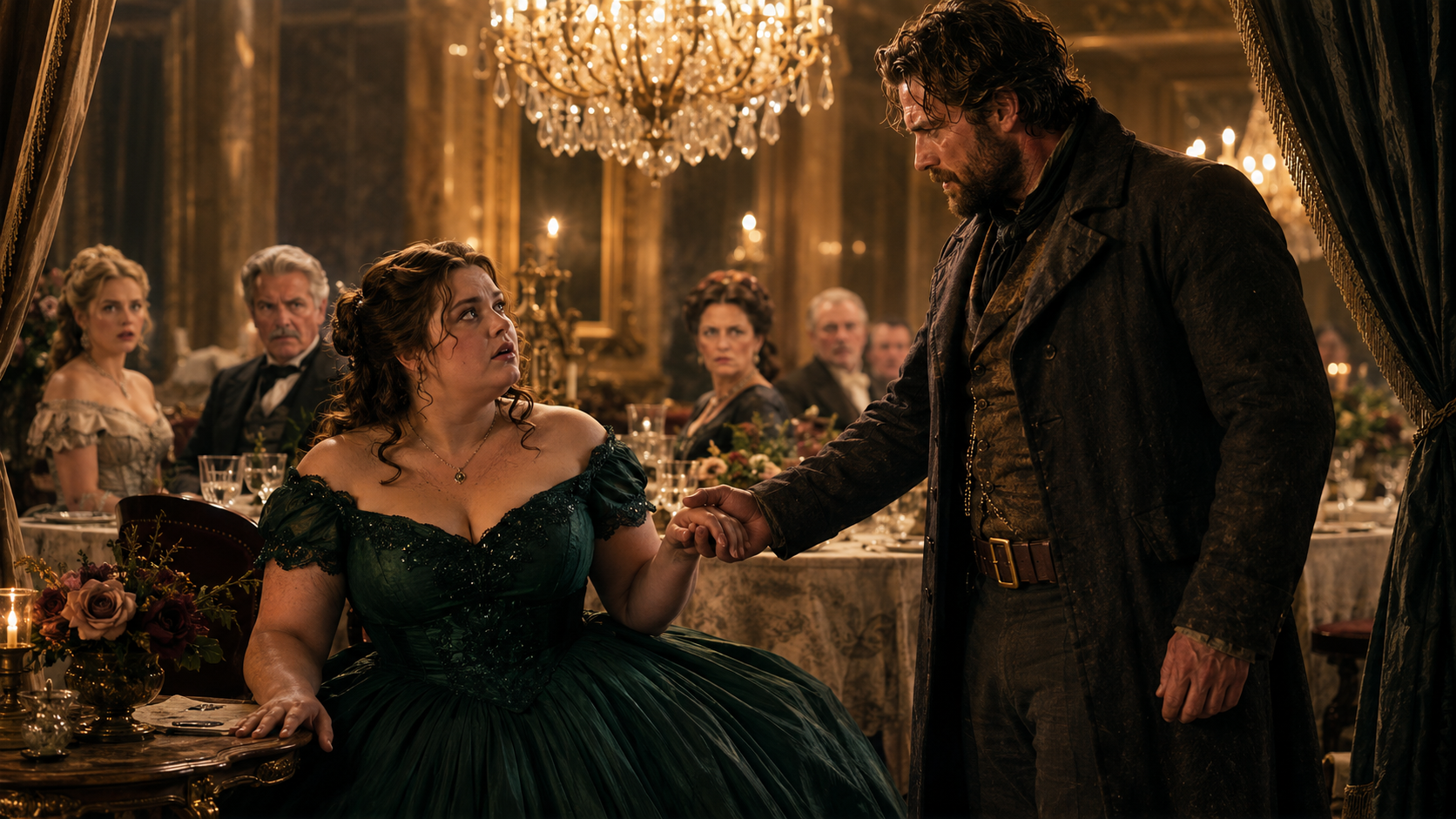
Rowan looked down at him.
“Move.”
Edmund moved.
Rowan took the empty chair that had been reserved beside Rosalie and drew it to the center of the table. The legs scraped across the floor with a sound that made several women flinch. He held the chair for Mara.
“Your place,” he said.
Beatrice leaned close, smiling for the room while whispering poison. “If you sit there, do not expect to sleep under our roof tonight.”
Mara’s heart lurched.
Rowan heard. She knew he heard because his expression became still as ice over deep water.
But he did not answer for her.
He simply waited.
That mattered.
He did not make her defiance another man’s performance. He gave her the choice and bore witness to it.
So Mara sat.
The chair accepted her weight.
It did not crack.
The chandelier did not fall.
The world did not end.
Rowan sat beside her.
Edmund’s mouth tightened. “This is irregular.”
“So is hiding your eldest daughter behind a pillar,” Rowan replied.
Rosalie’s cheeks reddened.
Beatrice lifted her spoon. “Mara, darling, perhaps just broth for you. Mrs. Bell said the dressmaker struggled terribly with your seams this morning, and we would not want another difficulty.”
Several guests heard.
Rosalie coughed into her napkin, but her eyes laughed.
Mara’s hand froze around her spoon.
Old shame rose with practiced efficiency. It knew every hallway inside her. It knew where to press, where to bruise, how to make hunger feel like guilt.
Before shame could finish its work, Rowan reached for the bread basket. He chose the warmest roll, split it open, buttered it generously, and placed it on Mara’s plate. Then he poured her wine and set a spoonful of cream into her soup.
“Eat,” he said.
Beatrice stared.
Rowan did not look at her. “No mountain road was ever crossed by a person trained to vanish.”
Mara stared at the bread.
Then she picked it up and took a bite.
It tasted like terror.
It tasted like rebellion.
Dinner staggered forward after that. Edmund tried to mend the evening with business. He spoke of expansion, rail connections, winter hauling, investors, and the glorious future of Pineford. His voice boomed, but sweat gathered near his collar.
Lionel Crane, the banker’s son from the city, leaned forward. “Our engineers reviewed the proposed cut through Raven Hollow. The blasting can begin before the spring thaw.”
“No,” Rowan said.
Lionel blinked. “Pardon?”
“No.”
Edmund forced a laugh. “Mr. Vale is protective of his ridge. Naturally. But modern enterprise requires courage.”
“Modern enterprise requires knowing what kind of rock you intend to explode.”
Lionel smiled thinly. “Our maps are reliable.”
“Your maps are old.”
Mara looked at her plate.
Her pulse quickened.
She had seen those maps. She had copied the revisions herself after Edmund complained that paying a clerk was wasteful when he had an unmarried daughter with neat handwriting. Raven Hollow had shifted after the flood three years before. Water had eaten beneath the shelf. The surface appeared strong, but below it ran a web of fractures like cracked glass.
If they blasted there, men would die.
Lionel said, “With respect, Mr. Vale, I trust trained engineers over local superstition.”
Mara’s restraint snapped.
“The hollow will not hold,” she said.
Every face turned.
Her mother’s spoon stopped halfway to her mouth.
Mara’s face burned, but the words had escaped and demanded companions.
“The western wall was granite before the flood,” she continued. “After the river changed course, water began cutting beneath the ledge. The recent survey shows shale under the upper shelf. Blasting would shear the ravine open. The grade would be buried, and any crew below it would be crushed.”
Lionel stared as though a chair had delivered a lecture.
Edmund’s eyes bulged. “Mara.”
Rowan turned fully toward her. He did not look amused. He looked intent.
“How do you know that?”
Mara’s hands trembled beneath the table. “Because Father asked me to summarize the survey reports. I do not think he read the summary.”
A few men nearby leaned closer.
Edmund’s voice dropped. “That is enough.”
“No,” Rowan said.
One word.
Edmund stopped.
Rowan’s gaze remained on Mara. “What route would you choose?”
She should have gone silent. She knew that. She knew the price of making her father look foolish in public. But Rowan was not indulging her. He was not rescuing her from embarrassment. He wanted the answer.
Mara reached for a clean napkin. Rowan offered a pencil from inside his coat without a word.
She sketched quickly.
“The upper shelf is longer,” she said, “but it is safer. Build above the old slide path. You would need two additional trestles and drainage culverts here and here. The cost will be higher at the beginning, but the road will survive spring melt. More importantly, the men will survive building it.”