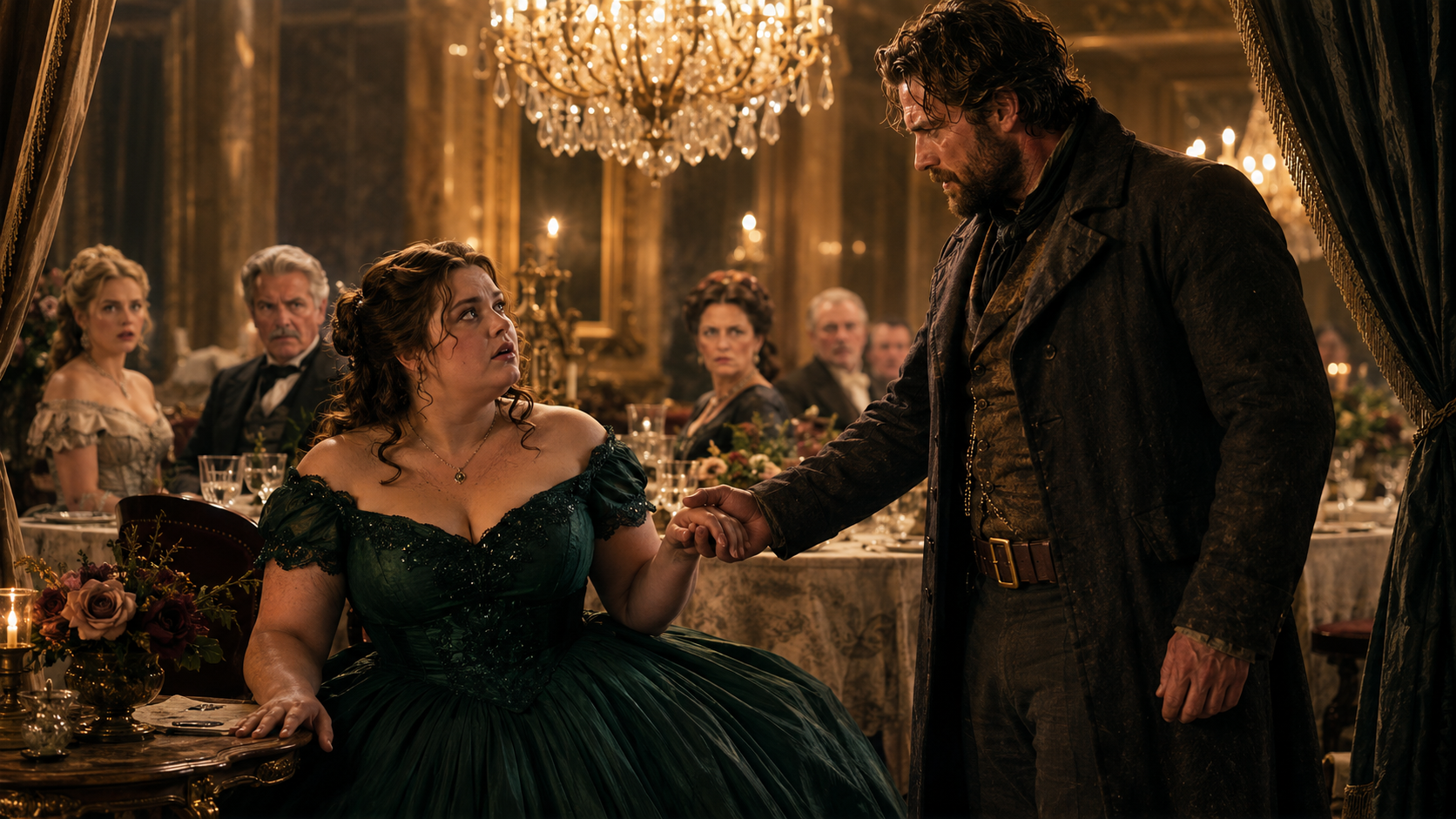
The Side Table Was “Good Enough” for Her — Until the Man From the Ridge Said, “Then It Is Good Enough for Me Too”

Mara Holloway noticed the place card before anyone told her where to sit.

It stood at the very edge of the banquet hall, tucked beside the service doors where waiters slipped in and out with silver trays and steaming platters. The ink was elegant. The insult was not.

Miss Mara Holloway.

Not beside her parents at the family table. Not near her younger sister, who glittered beneath the chandelier like a porcelain angel. Not even among the respectable cousins and business guests.

Mara had been placed at the side table.

The table for extra clerks, distant widows, hired musicians waiting for supper, and anyone too useful to ignore but too inconvenient to display.

Her mother, Beatrice Holloway, smiled as though nothing were wrong.

“Mara, darling,” she said softly, the way a woman speaks when she wants everyone nearby to believe she is kind, “you understand, don’t you? The main table is crowded tonight. Your father’s investors have come from three counties. It would be selfish to make a fuss.”

Mara looked toward the long table beneath the chandelier.

There was an empty chair.

It sat between Beatrice and Mara’s sister, Rosalie, covered in a velvet ribbon as if waiting for royalty.

Mara did not point it out. She had learned years ago that facts were useless when her family preferred lies.

“Of course,” she said.

Beatrice’s eyes lowered briefly to Mara’s waist, then to the dark green gown that had been altered twice and still refused to make her look smaller.

“That shade is forgiving,” her mother said. “Try not to eat too much bread. You know how people talk.”

Mara’s cheeks burned.

Across the hall, Rosalie laughed with a circle of young men. She was pale, slender, golden-haired, and practiced in the art of seeming surprised by admiration. Her gown was champagne silk. Her pearls were their grandmother’s. Her smile was the sort men wrote poems about when they lacked imagination.

Mara had never inspired poems.

She inspired advice.

Stand straighter. Laugh quieter. Choose darker colors. Do not take seconds. Do not dance unless asked, and do not expect to be asked. Do not stand too close to Rosalie in portraits. Do not embarrass the family.

Tonight was the Founders’ Supper, the grandest event Pineford hosted all year. Every merchant, banker, landowner, mine manager, and timber man in the valley had come to the Grand Alder Hotel to praise prosperity while pretending not to smell the debts beneath it.

Mara’s father, Edmund Holloway, owned Holloway Timber, or at least behaved as though he did. He loved public speeches, polished boots, and any man rich enough to be useful. He did not love questions from daughters, especially daughters shaped like Mara.

“Take your seat,” Beatrice murmured. “And smile. No one is mistreating you.”

That was the family rule.

Nothing cruel counted as cruelty if it was done quietly.

So Mara walked to the side table.

The room blurred around her: white linens, crystal glasses, red roses, men in black coats, women whispering behind fans. She sat beside a cracked column where the candlelight did not quite reach. A waiter nearly bumped her chair, apologized, and hurried away with the pained embarrassment people wore when they had witnessed something shameful but lacked the courage to name it.

Mara folded her hands in her lap.

She told herself she was used to this.

She had been used to it at thirteen, when her aunt said she had “a sweet face, if only the rest of her would cooperate.” She had been used to it at sixteen, when her mother ordered a portrait painter to place Rosalie in the center and Mara behind a vase. She had been used to it at twenty-two, when a suitor came to discuss timber contracts with Edmund and left engaged to Rosalie after dinner.

At twenty-seven, Mara should have become immune.

Instead, every humiliation arrived fresh.

The orchestra began a gentle waltz from the balcony. Edmund rose at the main table and lifted his glass.

“My friends,” he declared, “tonight we celebrate not only the founding of Pineford but the bright road ahead. Rail, timber, stone, water — this valley will be opened, improved, and made profitable by men bold enough to act.”

Men applauded.

Mara’s fingers tightened around her napkin.

Bold men, she thought, often called destruction progress because they never stood beneath the falling rock.

For weeks she had copied survey notes from her father’s study. She had read maps until dawn, compared rainfall reports, corrected figures no one asked her to understand. Edmund used her handwriting but dismissed her mind. He let her summarize contracts, calculate hauling costs, and prepare correspondence, then told guests she was “quiet by nature.”

She was not quiet by nature.

She was quiet by training.

A sudden hush rolled through the banquet hall.

It began near the entrance, then spread table by table until even the orchestra faltered.

Mara looked up.

A man stood in the doorway.

He wore no evening coat. His dark wool jacket was travel-stained at the hem, his boots carried the pale dust of mountain roads, and his shoulders seemed too broad for the hotel’s polished frame. Cold air followed him inside. So did silence.

Mara knew him at once.

Rowan Vale.

The man from Blackthorn Ridge.

People in Pineford told stories about him whenever they wanted to sound brave. They called him half-savage, half-king, raised by storms, richer than bankers, rougher than miners, impossible to cheat, impossible to flatter. He owned the northern pass, the safest route through the ridge before winter. He controlled timber roads, mule trails, water rights, and enough old mining claims to make respectable men nervous.

Edmund Holloway had spent two years trying to force a partnership with him.

Beatrice called him unsuitable in public and prayed for his signature in private.

Rosalie had once said she would never dance with a man who smelled of pine smoke and horses.

Now Rosalie sat straighter, eyes bright.

Edmund nearly dropped his glass.

“Mr. Vale!” he called, recovering too quickly. “What an unexpected honor. Had we known you intended to join us, we would have prepared properly.”

Rowan did not answer.

His gaze moved through the room slowly. He saw Edmund’s eager smile. He saw Beatrice’s stiff posture. He saw Rosalie arranging her face into sweetness. He saw the empty chair at the main table. Then his eyes found Mara beside the column.

They stopped there.

Mara looked down.

Men usually looked at her in one of two ways: quickly, then away; or openly, with the rude curiosity reserved for things considered unfortunate. Rowan Vale did neither. He looked as if he had just discovered the only honest object in a room full of polished fraud.

He started walking.

The floorboards answered beneath his boots.

Edmund rushed from the main table. “Mr. Vale, please, come sit with us. We have a place of honor ready. My daughter Rosalie has been especially eager to meet you.”

Rosalie lowered her lashes.

Rowan did not glance at her.

He stopped beside Mara’s chair.

Up close, he carried the clean, sharp scent of snow, leather, cedar smoke, and rain on stone. His face was not handsome in the soft city sense. It was severe, weathered, carved by work and command. His eyes were gray, steady, and far too direct.

“Miss Holloway,” he said.

His voice was low, rough, and clear enough to cross the room.

Mara swallowed. “Mr. Vale.”

“We have not been introduced.”

“No,” she said. “We have not.”

His gaze shifted to the place card beside her plate. Then toward the main table, where the Holloways sat beneath a chandelier bright enough to expose every lie.

Edmund laughed uneasily. “A small seating confusion. These grand dinners are chaos for the staff.”

Rowan looked back at Mara.

“This does not look like confusion.”

The hall froze.

Mara felt panic climb her throat. “It is all right.”

“Is it?”

No one had ever asked her that as if the answer mattered.

She tried to smile. “It is where my family wished me to sit.”

“That is a different answer.”

Beatrice rose from the main table, her smile sharp enough to cut ribbon. “Mr. Vale, forgive Mara. She is sensitive and sometimes dramatic. Please join us. Rosalie has saved you the place beside her.”

Rowan held out his hand.

Not to Rosalie.

Not to Beatrice.

To Mara.

“Miss Holloway,” he said, loud enough for every guest to hear, “would you do me the honor of dining with me tonight?”

A gasp moved through the hall.

Mara stared at his hand. It was large, scarred, and steady. A working hand. A hand that did not seem afraid of public opinion.

“My seat is here,” she whispered.

“I see that.”

“They did not set one for me at the front.”

“Then we will correct their insult.”

“It was not an insult,” she said automatically.

His eyes darkened. “You have learned to protect people who do not protect you.”

The words struck her so deeply she almost stood from shock alone.

At the main table, Beatrice’s expression hardened.

Do not embarrass me, that face said.

Disappear.

Mara had obeyed that face her whole life. She had refused cake. Changed gowns. Left parlors. Folded herself into corners. Apologized for taking up space in rooms where men lied loudly and called it business.

But Rowan’s hand remained waiting.

Not pulling. Not commanding.

Offering.

Mara placed her hand in his.

A murmur rose like wind before a storm.

Rowan’s fingers closed gently. He led her through the hall, and the crowd parted as if he carried a flame. Mara felt every eye on her body, her face, her gown, her hand in his. She wanted to shrink. She wanted to run. She wanted, with a sudden fierceness that startled her, to keep walking.

At the main table, Edmund blocked their path.

“Vale,” he said under his breath, “surely you understand this is a family matter.”

Rowan looked down at him.

“Move.”

Edmund moved.

Rowan took the empty chair that had been reserved beside Rosalie and drew it to the center of the table. The legs scraped across the floor with a sound that made several women flinch. He held the chair for Mara.

“Your place,” he said.

Beatrice leaned close, smiling for the room while whispering poison. “If you sit there, do not expect to sleep under our roof tonight.”

Mara’s heart lurched.

Rowan heard. She knew he heard because his expression became still as ice over deep water.

But he did not answer for her.

He simply waited.

That mattered.

He did not make her defiance another man’s performance. He gave her the choice and bore witness to it.

So Mara sat.

The chair accepted her weight.

It did not crack.

The chandelier did not fall.

The world did not end.

Rowan sat beside her.

Edmund’s mouth tightened. “This is irregular.”

“So is hiding your eldest daughter behind a pillar,” Rowan replied.

Rosalie’s cheeks reddened.

Beatrice lifted her spoon. “Mara, darling, perhaps just broth for you. Mrs. Bell said the dressmaker struggled terribly with your seams this morning, and we would not want another difficulty.”

Several guests heard.

Rosalie coughed into her napkin, but her eyes laughed.

Mara’s hand froze around her spoon.

Old shame rose with practiced efficiency. It knew every hallway inside her. It knew where to press, where to bruise, how to make hunger feel like guilt.

Before shame could finish its work, Rowan reached for the bread basket. He chose the warmest roll, split it open, buttered it generously, and placed it on Mara’s plate. Then he poured her wine and set a spoonful of cream into her soup.

“Eat,” he said.

Beatrice stared.

Rowan did not look at her. “No mountain road was ever crossed by a person trained to vanish.”

Mara stared at the bread.

Then she picked it up and took a bite.

It tasted like terror.

It tasted like rebellion.

Dinner staggered forward after that. Edmund tried to mend the evening with business. He spoke of expansion, rail connections, winter hauling, investors, and the glorious future of Pineford. His voice boomed, but sweat gathered near his collar.

Lionel Crane, the banker’s son from the city, leaned forward. “Our engineers reviewed the proposed cut through Raven Hollow. The blasting can begin before the spring thaw.”

“No,” Rowan said.

Lionel blinked. “Pardon?”

“No.”

Edmund forced a laugh. “Mr. Vale is protective of his ridge. Naturally. But modern enterprise requires courage.”

“Modern enterprise requires knowing what kind of rock you intend to explode.”

Lionel smiled thinly. “Our maps are reliable.”

“Your maps are old.”

Mara looked at her plate.

Her pulse quickened.

She had seen those maps. She had copied the revisions herself after Edmund complained that paying a clerk was wasteful when he had an unmarried daughter with neat handwriting. Raven Hollow had shifted after the flood three years before. Water had eaten beneath the shelf. The surface appeared strong, but below it ran a web of fractures like cracked glass.

If they blasted there, men would die.

Lionel said, “With respect, Mr. Vale, I trust trained engineers over local superstition.”

Mara’s restraint snapped.

“The hollow will not hold,” she said.

Every face turned.

Her mother’s spoon stopped halfway to her mouth.

Mara’s face burned, but the words had escaped and demanded companions.

“The western wall was granite before the flood,” she continued. “After the river changed course, water began cutting beneath the ledge. The recent survey shows shale under the upper shelf. Blasting would shear the ravine open. The grade would be buried, and any crew below it would be crushed.”

Lionel stared as though a chair had delivered a lecture.

Edmund’s eyes bulged. “Mara.”

Rowan turned fully toward her. He did not look amused. He looked intent.

“How do you know that?”

Mara’s hands trembled beneath the table. “Because Father asked me to summarize the survey reports. I do not think he read the summary.”

A few men nearby leaned closer.

Edmund’s voice dropped. “That is enough.”

“No,” Rowan said.

One word.

Edmund stopped.

Rowan’s gaze remained on Mara. “What route would you choose?”

She should have gone silent. She knew that. She knew the price of making her father look foolish in public. But Rowan was not indulging her. He was not rescuing her from embarrassment. He wanted the answer.

Mara reached for a clean napkin. Rowan offered a pencil from inside his coat without a word.

She sketched quickly.

“The upper shelf is longer,” she said, “but it is safer. Build above the old slide path. You would need two additional trestles and drainage culverts here and here. The cost will be higher at the beginning, but the road will survive spring melt. More importantly, the men will survive building it.”

Lionel frowned despite himself. “That route adds weeks.”

“It saves graves.”

The sentence landed hard.

Rowan’s expression changed.

“Miss Holloway,” he said quietly, “did you send an unsigned warning to my foreman in September about the camp below Ash Creek?”

Mara went cold.

Beatrice turned sharply. “What warning?”

Mara looked down.

She had found the danger by accident: a note in the margin of a discarded report, a rainfall table, a planned worker camp below unstable ground. Edmund had ignored it because warning Rowan’s men might weaken his negotiation position. So Mara had written a letter without signing it.

Three days later, a slide destroyed the empty camp.

If the men had slept there, dozens would have died.

“I did not sign it,” she said.

“But you wrote it.”

“I thought someone should know.”

The room seemed to tilt.

Rowan sat back slowly. His eyes did not leave her.

“I have searched for the writer of that letter for two months.”

Edmund’s voice cracked. “You wrote to his men behind my back?”

Mara looked at her father, and for the first time that night, anger burned hotter than shame.

“You knew the slope was unstable.”

“I knew nothing of the kind.”

“You had the same report.”

“I had no obligation to protect Vale’s crew.”

“They were men,” Mara said. “Not bargaining chips.”

Silence took the table.

Rowan rose.

Every whisper died.

“I came tonight,” he said, his voice carrying through the hall, “to thank the person who kept twenty-eight of my workers from being buried alive. I expected to find a surveyor. Maybe a clerk. Maybe an old engineer with a conscience. Instead, I find Miss Mara Holloway seated beside a service door by a family too proud to recognize the sharpest mind under their own roof.”

Mara could not breathe.

Then Rowan bowed to her.

Not a polite nod.

A true bow.

The kind given in public to someone worthy of honor.

“Thank you,” he said.

Mara’s eyes filled before she could stop them.

She had imagined being admired before, in foolish private moments she never confessed to anyone. But she had imagined admiration for beauty, for grace, for being chosen. She had never imagined being honored for being right.

After that, dinner continued, but the old order had cracked. Men who had ignored Mara now asked what she thought of the ridge. Women who had pitied her whispered with new uncertainty. Rosalie drank too much wine and laughed too brightly. Beatrice sat stiff as carved ivory.

When the final course ended, the hall shifted for dancing. Tables were moved aside. Musicians tuned strings. Guests rearranged themselves around the scandal, hungry for the next scene.

Mara slipped into a side corridor.

She needed air.

She needed darkness.

She needed one place where no one’s eyes could reach her.

Tears came before she reached the garden doors. She pressed a hand against her ribs. The corset felt like an iron ring. Her body ached from fear, from attention, from the strange pain of being seen after years of practiced invisibility.

“Mara.”

Her mother’s voice cut through the corridor.

Mara stopped.

Beatrice approached with Rosalie behind her. Away from the crowd, Beatrice’s sweetness vanished. Fury sharpened her face.

“You selfish, vulgar girl,” she hissed.

Mara’s shoulders curled inward from habit. “Mother, please. I only want to go home.”

“Home?” Beatrice seized her arm. “After humiliating your father? After making a spectacle of yourself with that mountain brute? After stuffing yourself at the main table as if manners mean nothing?”

“I did not make a spectacle.”

“You took his hand.”

“He offered it.”

“Because he is using you.” Beatrice’s nails dug through Mara’s sleeve. “Do you not understand? Men like Rowan Vale do not choose women like you. He wanted to embarrass your father, and you made yourself convenient.”

The words found the old wound.

Rosalie stepped forward, tears bright in her eyes. “He did not look at me once because of you. Do you understand that? He was supposed to sit beside me.”

Mara looked at her sister.

“Was he?”

Rosalie flinched as if the question were cruel.

Beatrice tightened her grip. “You will return to the ballroom. You will apologize to your father. You will tell Mr. Vale you misunderstood his attention. Then you will sit quietly until the evening ends.”

A hollow place opened inside Mara.

Because part of her almost obeyed.

Obedience rose like an old reflex. A beaten animal hears its name and comes.

Then a shadow moved at the end of the corridor.

“I suggest you release her.”

Rowan stepped into the lamplight.

Beatrice dropped Mara’s arm.

“This is a private family matter,” she said.

“No,” Rowan replied. “This is what cruelty says when it wants no witnesses.”

Rosalie’s mouth trembled. “Mr. Vale, you do not understand. Mara has always been difficult. She becomes emotional. She misreads kindness.”

“I understand more than you hoped I would.”

Beatrice softened her face like a woman changing masks. “Mr. Vale, you are a man of influence. Surely you see that my daughter is not accustomed to attention. She has never been courted. She may mistake gratitude for something romantic.”

Mara wished the floor would open.

There it was: the secret shame laid bare.

No man had courted her. No one had brought flowers. No one had waited beneath windows or asked her to dance. She had told herself books and maps were better companions than shallow men, but absence still left a shape.

Rowan’s face changed.

Not with pity.

With anger so controlled it frightened her.

“Mrs. Holloway,” he said, “your daughter saved lives because she saw what powerful men refused to see. She spoke truth at a table where cowards lied for profit. If that makes her unsuitable for your society, then your society is poorer than the mining camps you pretend to despise.”

Beatrice recoiled.

Rowan turned to Mara.

His voice softened. “Did she hurt you?”

Mara looked at the creased fabric where her mother’s fingers had gripped her arm.

“No,” she lied.

Rowan did not believe her.

But he respected her answer enough not to expose it.

Instead, he offered his arm.

“The orchestra has started again,” he said. “Will you dance with me?”

Mara stared at him.

“I do not know how.”

“I do.”

“I am not graceful.”

“I did not ask for graceful.”

“People will stare.”

“They already are.”

“My mother will never forgive me.”

His gaze held hers. “Perhaps the question is whether you are ready to stop forgiving her for things she has never regretted.”

That sentence opened something.

Mara looked at Beatrice, trembling with rage. She looked at Rosalie, beautiful and frightened, dependent on applause that could vanish in a moment. Then she looked at Rowan Vale.

For the first time in her life, she did not ask what would make her family less ashamed.

She asked what would make her feel alive.

“Yes,” she said. “I will dance.”

They entered the ballroom together.

The crowd parted again, but this time Mara lifted her head.

When Rowan guided her onto the floor, his hand at her back did not push her smaller. It held her steady. The music rose. He moved, and somehow she followed. At first she counted steps in panic. Then she stopped counting.

The room blurred.

Her skirt swung. Her breath loosened. Her body, so often treated as a burden, became motion.

For one dazzling minute, Mara Holloway was not the large daughter, the hidden daughter, the family embarrassment in dark fabric.

She was a woman dancing in the center of the room while everyone who had dismissed her watched.

Edmund shattered the moment.

“Vale!”

The music faltered.

Edmund pushed through the crowd with Lionel Crane and Mara’s uncle Tobias behind him.

“That is enough,” Edmund barked. “Remove your hands from my daughter.”

Rowan stopped, but he did not release Mara.

Edmund’s face was purple. “You think owning a mountain pass gives you the right to insult my family?”

“No.”

“You think because Mara wrote some foolish letter, you can parade her like a prize?”

Rowan’s voice dropped. “Careful.”

“You be careful,” Edmund snapped. “You need my timber contract as much as I need your pass. Continue this insult, and I take my business elsewhere.”

Lionel Crane went pale.

Rowan noticed.

So did Mara.

A faint smile touched Rowan’s mouth.

“Tell him, Crane.”

Lionel swallowed. “Mr. Holloway—”

“Tell him.”

Edmund turned. “Tell me what?”

Lionel’s voice thinned. “The city consortium no longer holds your principal notes.”

Edmund stared. “What?”

Rowan’s arm remained steady around Mara’s waist.

“Four weeks ago, I purchased the Holloway Timber debt from Crane’s consortium. Last week, I acquired the lien on your mill. Yesterday morning, the deed of trust on your house was transferred to my office.”

Beatrice made a sound like breaking glass.

“You are lying,” Edmund said.

“I rarely need to.”

“You are a road owner.”

“I am many things you failed to count.”

Rowan looked around the ballroom, letting every guest hear him.

“While you borrowed money to host dinners you could not afford, I bought paper. While you used your daughter’s intelligence and called it useless, I read the work that crossed my desk without her name on it. While you risked workers’ lives to strengthen your bargaining position, I bought the debts proving you are not master of this valley. You are a debtor wearing another man’s crown.”

The silence was absolute.

Tobias stepped away from Edmund as if ruin were contagious.

Rowan continued. “I can call the loans by Monday. The mill, the house, the accounts — everything.”

Rosalie began to cry, not delicately, but with open fear as the young men who had circled her all evening backed into the crowd.

Beatrice looked from Edmund to Rowan to Mara.

Then her expression changed with horrifying speed.

The disgust vanished.

Tenderness arranged itself across her face like a costume.

“Mara,” she whispered. “My darling girl.”

Mara went cold.

Beatrice reached for her. “You must help us. Mr. Vale respects you. We all saw it. Tell him family matters. Tell him your father made mistakes, but he loves you. Tell him not to destroy what your grandfather built.”

What your grandfather built.

The words struck Mara strangely.

Her grandfather, Silas Holloway, had died when she was twelve. He was the only person in her family who had never asked her to eat less, speak less, or be grateful for tolerance. He had taken her riding through timber roads, taught her to read contour lines, and told her once that land did not care whether a person looked pretty standing on it.

He had also left rumors.

A disputed parcel.

A missing codicil.

A family argument overheard through locked doors.

Edmund saw her expression. “Beatrice, stop.”

Rowan’s eyes narrowed.

Mara turned to her father. “What did Grandfather build?”

“This is not the time.”

“It seems exactly the time.”

Rowan spoke quietly. “There is something else.”

Mara looked up at him.

For the first time all night, he seemed uncertain.

“I meant to show you privately,” he said. “Not like this.”

He reached inside his coat and withdrew a folded document sealed in oilskin.

Edmund lunged.

Rowan turned his shoulder, blocking him with almost no effort.

The room erupted in whispers.

“What is that?” Mara asked.

Rowan handed it to her.

Edmund’s voice cracked. “That paper is invalid.”

Mara unfolded it with shaking hands.

The legal language was dense, but she had copied enough contracts to understand what mattered.

It was a certified copy of Silas Holloway’s final codicil.

Her eyes moved down the page.

Blackthorn Ridge water rights.

Northern pass easement.

One-third interest in the original Holloway mountain tract.

Left not to Edmund.

Not to Tobias.

Not to Rosalie.

To Mara Elise Holloway, upon her twenty-fifth birthday, held in trust until such time as she demonstrated sufficient knowledge of the land to manage it.

Mara could not breathe.

“I do not understand.”

Rowan’s voice was low. “Your grandfather knew your father would sell the mountain blind. He wanted the land controlled by the child who understood it.”

Mara looked at Edmund. “You hid this from me.”

His face twisted. “You were a girl.”

“I am twenty-seven.”

“You were unmarried. Unprepared.”

“I prepared your surveys.”

“You were not fit to manage—”

“Because I am fat?” Mara asked.

The word cracked across the ballroom.

Beatrice flinched as if the vulgarity mattered more than the theft.

Mara’s voice shook, but it did not break.

“Because I embarrassed you? Because no man wanted me? Because you could use my mind in private but not admit in public that I had one?”

Edmund said nothing.

That was answer enough.

Rowan looked at Mara, not at him.

“The pass your father needs crosses land that is partly yours. I suspected it when I reviewed old boundary filings. After your letter saved my men, I searched harder. The county clerk found the codicil last month.”

Mara’s throat tightened. “Why did you not tell me sooner?”

“Because I wanted proof before I placed hope in your hands.”

Edmund laughed bitterly. “How noble. You mean you wanted leverage.”

Rowan’s face hardened.

“At first, yes.”

The admission shocked the room.

It shocked Mara most.

Rowan turned fully to her.

“I will not lie to you. When I learned he had hidden your inheritance, I intended to use the truth against him. Then I learned you wrote the warning. Then I heard you speak tonight. And when I saw where they seated you, I understood that giving you the paper was not enough. You needed the room to see you receive what was always yours.”

Mara stared at him.

Her mother’s warning had been hanging over her heart all evening: he is using you.

The truth was more complicated.

He had come with a weapon.

But he had placed it in her hands.

“What happens now?” she asked.

Rowan nodded toward the document.

“That depends on you.”

The ballroom waited.

All her life, decisions had been made around Mara as if she were a heavy piece of furniture. Where she sat. What she wore. Whether she ate. Whether she spoke. Whether she was lovable. Whether she was useful.

Now the most powerful people in Pineford stood silent while she held a paper that could change the valley.

Beatrice began to cry, but Mara recognized the sound. It was not sorrow. It was strategy.

“Mara,” her mother pleaded, “think of your sister.”

Mara looked at Rosalie, trembling in her silk gown. Rosalie had been cruel, yes. But she had also been raised inside the same gilded cage, praised only for beauty and terrified of losing the one currency she had been taught to spend.

Mara looked at Edmund, proud and ruined.

At Tobias, already calculating escape.

At Rowan, waiting without command.

Then she looked at the guests, the polished town that had watched her humiliation and called it manners.

“No,” Mara said.

Beatrice staggered. “No?”

“No, I will not beg Mr. Vale to forgive debts I did not create.”

Edmund flushed. “Mara, you will not—”

“I am not finished.”

The words stunned even her.

She straightened. The corset bit into her ribs, but pain no longer meant obedience.

“I will claim what my grandfather left me. Not to ruin Pineford. Not to punish workers for my father’s pride. The mill will remain open. The road will be built through the upper shelf, safely. Wages will be paid through winter.”

Rowan’s eyes warmed.

Mara continued, “But the Holloway house will no longer be pledged against reckless loans. The timber company will be audited. Father will step down from management until the accounts are reviewed. Uncle Tobias will have no authority over company funds.”

Tobias sputtered. “You cannot possibly—”

“I can,” Mara said. “Apparently.”

A ripple moved through the crowd.

Beatrice’s voice sharpened. “And what of us? Your family?”

Mara held her gaze.

Vengeance tempted her.

She imagined Beatrice in a cold cottage, Rosalie sewing for coins, Edmund begging favors from men who once begged him. The fantasy glittered for one breath.

Then she remembered her grandfather teaching her to read the land.

Land does not care whether a person looks pretty standing on it.

It also does not heal when poisoned.

“I will not leave you homeless,” Mara said. “You may remain in the east wing until proper arrangements are made. You will have an allowance, modest and documented. Rosalie may keep her piano and her books. If she wishes to marry, let it be without a false dowry. If she wishes to learn a trade, I will pay for instruction.”

Rosalie looked up through tears, stunned.

Beatrice stared as if mercy were more insulting than revenge.

Edmund’s voice came hoarse. “And me?”

“You will answer the audit honestly. You will repay what you can. And you will never again use my name, my inheritance, or my work without my consent.”

He looked away.

That small motion hurt more than Mara expected.

Even stripped of power, he could not give her remorse.

Rowan touched her elbow gently.

His expression asked a question he would not voice before them.

Are you ready to leave?

Mara looked around the ballroom one last time. The chandeliers still blazed. The roses still perfumed the air. The silver still shone. Nothing had changed, and everything had.

At the edge of the room, beside the service doors, her place card still sat at the side table.

Mara walked to it.

People moved aside.

She picked it up and returned to the main table. With deliberate care, she placed it in the center of the polished wood.

Then she looked at her mother.

“I was never the shame of this family,” Mara said. “I was the witness.”

No one spoke.

Mara turned to Rowan.

“I would like some air.”

His smile was slight, proud, and devastating.

“So would I.”

They walked out together, but Mara did not feel rescued.

She felt accompanied.

Outside, Pineford lay beneath a silver frost. The hotel’s noise softened behind them. A carriage waited near the curb, horses steaming in the cold.

Mara stopped on the steps and took her first full breath of the night.

Then she laughed.

The sound surprised her.

Rowan looked at her. “What is it?”

“I think I just took over a timber company.”

“You did.”

“I do not know how to run one.”

“You know more than the men who nearly blasted a mountain onto their own workers.”

“That is not as comforting as you think.”

He smiled then, truly smiled, and the severity left his face. He looked younger in moonlight. Still dangerous, still mountain-made, but human.

“I have a library at Blackthorn House,” he said. “Maps, ledgers, engineering texts, mining law. You may use it.”

Mara raised an eyebrow. “May I?”

His smile deepened. “That came out badly.”

“Yes, it did.”

“You are welcome to command it.”

“Better.”

He laughed softly.

The sound warmed something in her that had been cold for years.

Then silence settled between them, not suffocating, but full.

Rowan grew serious. “You do not have to come with me tonight. I can send for a lawyer. I can arrange a room at Mrs. Arden’s boardinghouse. Whatever you choose, choose it because it is yours.”

Mara looked toward the Holloway mansion on the hill. Every window would be lit now. Servants would be whispering. Beatrice would be raging. Edmund would be drinking. Rosalie would be crying over a future built for her like a glass cabinet.

Then Mara looked north, toward Blackthorn Ridge.

For years, the mountains had frightened and fascinated her. Their size never apologized. Their slopes did not shrink to comfort anyone. They stood immense and weathered, holding trees, rivers, snow, and silence.

“I would like to see your library,” she said.

Rowan opened the carriage door.

“Then you shall.”

The ride to Blackthorn Ridge took nearly three hours. At first Mara sat stiffly beneath the fur blanket Rowan placed over her knees. The road climbed through pine forest silvered with frost. Below, Pineford dwindled into scattered yellow lights. Above, the stars looked sharp enough to cut skin.

Rowan did not crowd her with talk.

That, too, felt like kindness.

At last Mara asked, “Did my grandfather know you?”

Rowan nodded. “A little. I was seventeen when he found me sleeping in an abandoned line shack. He gave me breakfast instead of calling the sheriff.”

“That sounds like him.”

“He said rich men usually hate land because land refuses flattery.”

Mara smiled. “That definitely sounds like him.”

“He spoke of you once.”

Her heart tightened. “What did he say?”

Rowan watched the road ahead.

“He said his eldest granddaughter had more mountain in her than anyone in the family.”

Mara turned toward the window quickly.

Tears blurred the trees.

For so long she had remembered herself through her mother’s disgust that she had nearly forgotten there were other mirrors.

Blackthorn House appeared near midnight.

It was not the crude cabin Pineford gossip described. It rose from a shelf of stone above a dark alpine lake, built of timber, granite, and glass. Warm light spilled from tall windows. Smoke curled from three chimneys. The house looked less like a mansion than something grown by the mountain itself — sturdy, weathered, impossible to intimidate.

An older woman named Mrs. Arden met them at the door with no visible surprise.

“Miss Holloway,” she said kindly, “there is hot water in the blue room. You look half-frozen and entirely done with nonsense.”

Mara blinked.

Then she laughed again.

Rowan glanced at Mrs. Arden. “She usually likes people.”

“I like this one,” Mrs. Arden said. “She looks as if she might finally make you lose an argument.”

The inside of the house stole Mara’s breath. There were iron lamps, woven rugs, mineral samples, framed maps, and a hearth large enough to stand inside.

But the library stopped her completely.

It rose two stories high.

Books lined every wall. Rolling ladders leaned against carved rails. A huge table dominated the center, covered in surveys, drafting tools, ledgers, and open atlases. Near the fire stood two leather chairs facing each other like they had been waiting for debate.

Mara stepped inside as if entering a chapel.

Rowan remained by the doorway.

“I have wanted a room like this all my life,” she said.

“I thought you might.”

She turned. “You thought?”

His expression softened.

“I hoped.”

The vulnerability in that one word made her chest ache.

That night, behind a locked door in the blue room, Mara removed the corset. The relief was so overwhelming she gripped the bedpost. Her body expanded into breath.

She looked at herself in the mirror: hair loose, arms full, belly soft, hips wide, waist refusing to become what her mother had demanded.

Nothing about her matched the delicate illustrations in fashion books.

But for the first time, Mara wondered whether the mirror had been innocent all along.

Perhaps the cruelty had never been in the glass.

The next morning, she expected regret.

It did not come.

Work came instead.

Lawyers arrived by noon. Surveyors by evening. Over the next weeks, the codicil was validated. Holloway Timber’s accounts were opened. The company was found solvent only because debts had been shuffled like cards in a crooked game. Tobias had stolen funds outright. Lionel Crane’s bank had enabled Edmund’s reckless borrowing, expecting to seize assets after winter.

Rowan could have crushed them all.

Mara chose reconstruction.

Not soft forgiveness.

Not surrender.

Reconstruction.

Tobias was prosecuted when proof of theft became impossible to bury. Lionel returned to the city disgraced. Edmund was removed from control but allowed to advise on old contracts under supervision, which humbled him more than poverty might have. Beatrice remained in the east wing for three months, then moved to a smaller house in town, where she discovered how quickly callers vanished when fortune no longer sat in the parlor.

Rosalie surprised everyone.

The first week, she refused to speak to Mara.

The second, she sent a note with only two words.

I’m sorry.

Mara did not answer at once.

Some apologies are not doors. They are seeds. They require weather.

In December, Rosalie came to Blackthorn House wearing a plain wool coat instead of satin. Her face looked thinner, her eyes less certain.

“I do not know who I am if no one is admiring me,” she confessed beside the library fire.

Mara, who knew something about being misnamed by other people’s eyes, poured tea.

“Then perhaps you can begin there.”

It was not sisterhood restored in an afternoon. Wounds made over decades do not close because someone cries prettily. But it was a beginning, and Mara had decided beginnings mattered.

By spring, the safer route over the upper shelf was approved. No blasting was done in Raven Hollow. Workers were paid through winter. A relief fund was established for widows and injured laborers. Mara opened a reading room in Pineford for girls and working women, stocked with newspapers, scientific journals, novels, maps, and practical manuals.

The town that had watched her humiliation now watched women enter that room with ink on their fingers and questions in their mouths.

Some people still whispered.

Mara learned whispers could not kill a woman who had heard worse at her own dinner table.

As for Rowan Vale, he did not ask her to marry him that night.

Or that month.

He argued with her.

Constantly.

About road grades. About contracts. About whether coffee could reasonably replace breakfast. About whether a library required four copies of the same engineering volume because one had better notes in the margins.

He listened when she was right.

He admitted, with visible suffering, when he was wrong.

And one late May evening, on the cedar balcony overlooking the black lake, he stood beside her while sunset turned the peaks copper.

“I have a question,” he said.

Mara smiled without looking at him. “That sounds dangerous.”

“It is.”

“Business?”

“No.”

She turned.

Rowan Vale, who had faced blizzards, collapsing mines, armed claim jumpers, and Edmund Holloway’s rage without blinking, looked almost nervous.

“I loved you first for your mind,” he said. “Then for your courage. Then for the way every room becomes larger when you stop trying to make yourself small.”

Mara’s throat tightened.

He took a small velvet box from his pocket.

“I do not want to rescue you,” he said. “You have done that yourself. I do not want to own you. I have seen what men become when they mistake ownership for love. I want to build beside you. Fight beside you. Read beside you. Grow old being corrected by you.”

She laughed through tears.

He opened the box.

Inside lay a gold band set with a deep blue stone the color of twilight snow.

“Mara Elise Holloway,” Rowan said, voice rough, “will you marry me?”

She looked at the ring.

Then at the man.

Then at the mountains that had never apologized for taking up space.

“Yes,” she said. “But I will not promise to stop correcting you.”

His smile broke open.

“I was counting on that.”

They married in September, not at the Grand Alder Hotel, but in the meadow below Blackthorn Ridge. Workers, clerks, widows, schoolgirls, servants, surveyors, and a few humbled members of polite society stood together beneath yellow aspens.

Beatrice attended in gray.

She did not cry.

She did not apologize.

But when Mara passed her after the ceremony, Beatrice lowered her eyes.

It was not enough.

But it was something.

Edmund came too, older now, quieter. He stood at the edge of the meadow and watched his eldest daughter marry the man who had exposed him, spared him, and replaced him. After the ceremony, he approached Mara.

For a long moment, he said nothing.

Then he removed his hat.

“Your grandfather would have been proud,” he said.

Mara waited for more.

No full confession came. No miraculous transformation. No perfect ending tied with ribbon.

But his voice broke on the last word.

Mara accepted that as the first honest thing he had given her in years.

“Thank you,” she said.

She did not embrace him.

She did not need to.

That evening, as lanterns glowed in the trees and fiddles played near the lake, Rowan drew Mara into a dance. She moved with more confidence now. Her body had not become smaller. Her hunger had not disappeared. Her mind had not softened. Her waist had not narrowed into acceptability.

She had simply stopped treating herself as a problem to be solved.

Rowan’s hand rested at her back.

“Do you remember the first time we danced?” he asked.

“At the hotel?”

“When your father threatened me in front of two hundred people?”

“When you revealed you owned his debt in front of two hundred people?”

“I thought it went rather well.”

“It was a disaster.”

“A useful disaster.”

She laughed and leaned closer. “I was terrified.”

“I know.”

“I thought you might be using me.”

“I know that too.”

“Were you?”

Rowan’s face sobered.

“At first, I thought justice would be enough. Then I met you properly and realized justice without dignity is only another form of power. I did not want to become another man making choices over your head.”

Mara studied him.

That was why she loved him, she thought. Not because he had arrived like a flawless hero from the mountains and made everything simple. Nothing had been simple. Love never was, not real love. Real love came with truth, restraint, apology, and the daily decision to see another person whole.

“You gave me the paper,” she said.

“You claimed the life.”

The music carried them beneath the aspens.

Far below, Pineford glimmered in the valley, no longer a kingdom ruled by one family’s pride, but a town slowly learning that worth was not measured by waistlines, dowries, surnames, or seats at a table.

And Mara, once hidden beside a service door at a feast meant to erase her, danced beneath the open sky with her head high, her laughter warm, her body strong, her mind free, and her future no longer waiting for permission.

The Side Table Was “Good Enough” for Her — Until the Man From the Ridge Said, “Then It Is Good Enough for Me Too”
THE MOST STUNNING PHOTOS OF DEMI ROSE!