Then whenever the weather looked poor, or good, or like it might change.
One evening, as rain tapped against the workshop windows, he found Mara labeling jars.
“You spelled calendula wrong,” he said.
She did not look up. “You have terrible handwriting and no moral authority.”
He hung his hat by the door.
On her table lay a new sign she had painted herself. No fancy lettering. No gold leaf. Just plain black words on white board.
Mara Voss
Stitching, Dressmaking, Bandages, and Practical Care
Caleb studied it.
“No doctor?”
She capped the ink bottle. “No.”
“No healer?”
“No.”
“What then?”
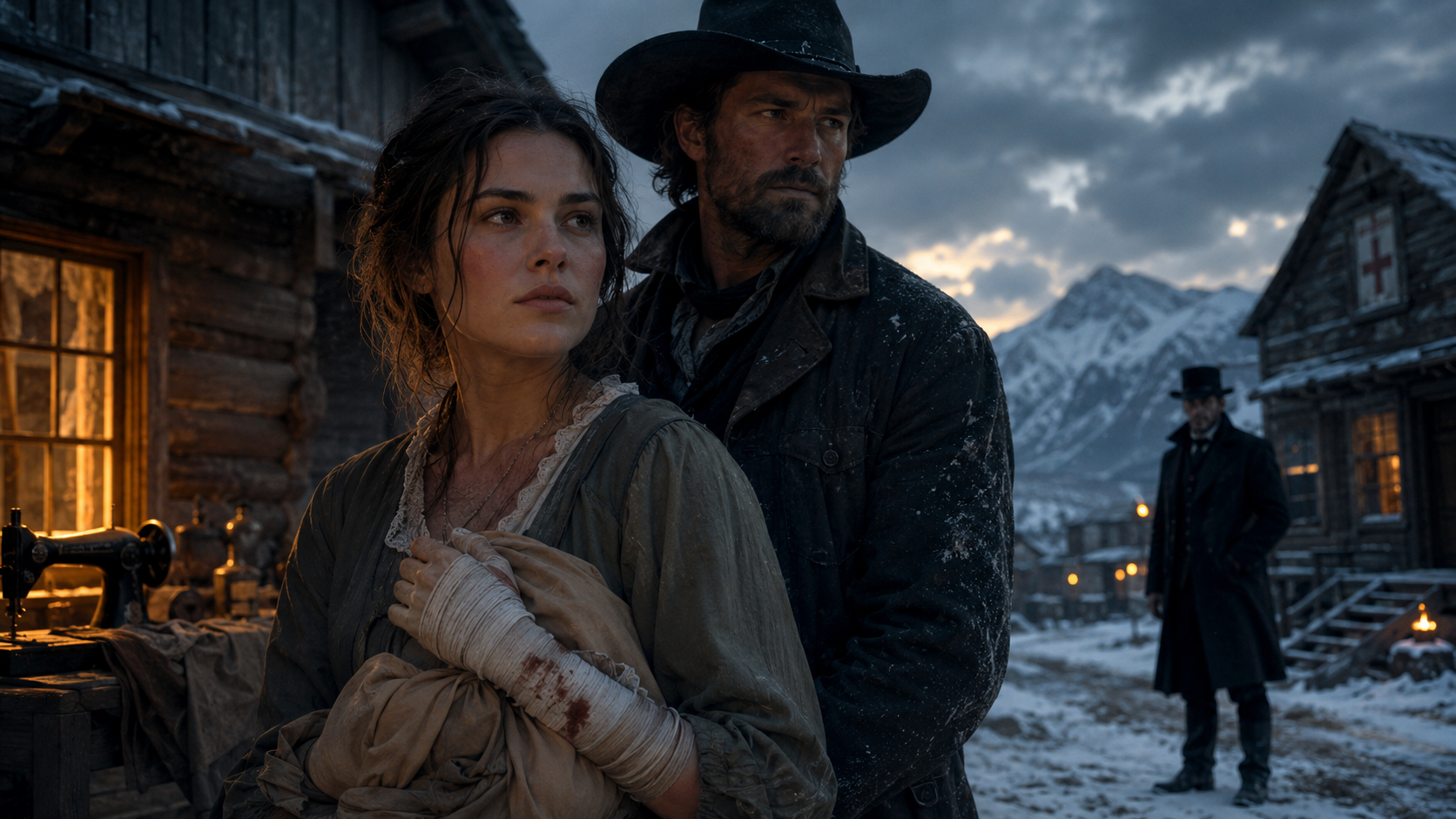
Mara flexed her scarred hands. They ached when storms came. They would always ache. She no longer hated them for telling the truth.
“Someone who looks,” she said.
Caleb’s expression softened in the small, almost invisible way she had learned to read.
“That will do.”
Outside, Raven Creek smelled of wet earth and chimney smoke. The town had not become kind overnight. No town did. There were still whispers. Still sideways glances. Still people who preferred the comfort of old lies because truth required them to remember their own cruelty.
But children crossed the street to wave at Mara now.
Women came through her front door.
The church ladies asked her to mend the altar cloth, and she charged double.
Once, near dusk, a little boy with a scraped knee stared at the pale scars on her hands and asked, “Did a monster do that?”
Mara looked toward the mountain, where Caleb’s horse waited by the rail.
Then she looked at the boy.
“Yes,” she said. “But not the kind you think.”
The boy’s eyes widened.
“Did you kill it?”
Mara knelt, opened her care box, and cleaned the dirt from his knee.
“No,” she said. “I learned its name.”
“What was it?”
She wrapped the bandage neatly.
“Fear.”
The boy considered this with grave seriousness.
“Can fear die?”
Mara tied the bandage and smiled.
“Not all at once.”
Caleb stood in the doorway, hat low, watching the rain.
The boy ran off.
Mara packed away the clean cloths and closed the care box. Her hands hurt. Her heart did too sometimes, in places no salve could reach. But pain was no longer proof that she was cursed. Pain was only a message, and messages could be read.
At the door, Caleb offered his arm.
She looked at it, then at him.
“Are you escorting me, Mr. Rusk?”
“Road is muddy.”
“I crossed worse alone.”
“I know.”
She took his arm anyway.
Together they stepped into the rain, past the workshop window where lamplight glowed warm against the glass, past the street that had once emptied at the sight of her, past the clinic whose sign had been taken down and left leaning against a wall.
Raven Creek watched them pass.
This time, Mara did not lower her eyes.
And this time, when the mountain cowboy walked beside her, no one wondered where the monster was.
They had already seen it.
They had called it doctor.
And Mara Voss, scarred hands and all, had lived long enough to call it by its true name.