Why did the blue powder smell sharp enough to sting the nose?
Why did Mrs. Arden’s daughter faint after helping at the dye pots?
Why did the store remove labels from chemical jars?
Why did Dr. Pike say women worried too much?
Mara’s hands curled inside the bandages.
“I asked him whether the dye could be making people sick,” she said.
Caleb nodded as though a missing piece had clicked into place.
“There it is.”
“What?”
“The reason he needed you to become the disease.”
On the twelfth morning, Caleb unwrapped her hands and said nothing for so long Mara stopped breathing.
“Well?” she demanded.
He turned her palms toward the window.
New skin showed beneath old damage. Pink. Tender. Scarred. Alive.
Mara pressed her mouth shut, but a sound escaped anyway.
Caleb looked up. “Better?”
She nodded.
“Use your voice.”
“Yes,” she said. “Better.”
“Good. Do not mistake better for healed.”
“You ruin every pleasant moment.”
“Pleasant moments are where fools get careless.”
He stood and reached for his coat.
Mara’s stomach tightened. “Where are you going?”
“Town.”
“No.”
He lifted an eyebrow.
“You cannot go to Raven Creek.”
“I need clean cotton, salt, lamp oil, and flour.”
“They will ask about me.”
“They already are.”
Mara rose too fast. The room swayed. “What did you hear?”
Caleb hesitated, which told her more than words.
“Tell me.”
He took his hat from the peg. “Pike says I stole you.”
A laugh broke from her, sharp and humorless. “From what? My own grave?”
“He says you are delirious. Says if I keep you hidden, I put the whole valley at risk.”
“He knows that is a lie.”
“Yes.”
“Then why say it?”
“Because a lie shouted by a doctor sounds like medicine.”
Mara sat back down slowly.
“What will you tell them?”
Caleb opened the door. Cold light cut across the floor.
“That you are alive.”
He returned near sunset with supplies, a split lip, and blood on his collar.
Mara stood from the table so fast the chair scraped backward.
“What happened?”
“Town happened.”
“Sit down.”
“I am fine.”
“Sit down, Caleb.”
The command surprised them both.
He sat.
Mara wet a cloth and dabbed at his lip with hands still clumsy from healing. He allowed it, watching her with an expression she could not read.
“Who hit you?” she asked.
“Sheriff’s brother.”
“Why?”
“He objected to my description of Pike.”
“What description?”
“Fraud.”
Mara pressed the cloth too hard. Caleb winced.
“Good,” she said.
He almost smiled.
Then his eyes moved to the window.
“They are coming,” he said.
The first riders arrived two days later.
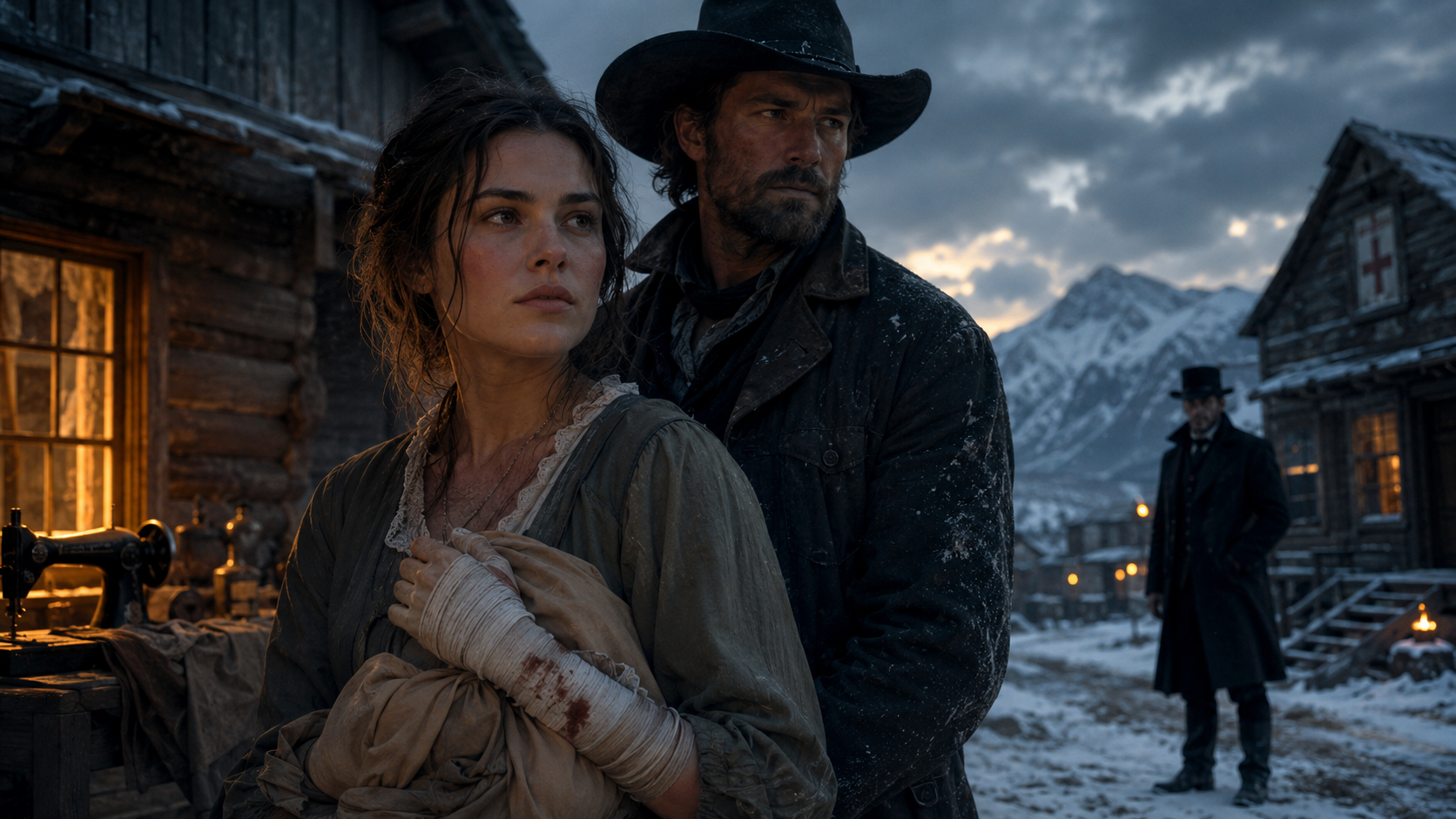
Mara saw them from the porch: six men moving up the trail, dark shapes between the pines. Dr. Ambrose Pike rode at the front on a gray horse, straight-backed and elegant in a black coat too fine for the mountain cold. Behind him came Sheriff Orlan Deeds, two miners, the storekeeper’s son, and Harlan Thatch, who had once brought Mara a torn shirt and stayed too long at her door.
Caleb stepped beside her with the rifle in one hand.
“Inside,” he said.
“No.”
“Mara.”
“No.”
The riders entered the clearing.
Dr. Pike smiled as if he had found a lost lamb.
“Miss Voss,” he called. “Thank heaven you are still with us.”
Mara felt the old fear rise. It knew the shape of his voice. It knew how easily a crowd could become a weapon.
Caleb stood slightly ahead of her.
Pike’s smile thinned. “Rusk. You have interfered in a medical quarantine.”
“You made a quarantine out of ignorance.”
Sheriff Deeds shifted in his saddle. “Doc says she’s contagious.”
“She isn’t,” Caleb replied.
Pike gave a gentle sigh. “You see? This is why dangerous men should not play physician. Miss Voss is confused, vulnerable, and gravely ill. I have come to return her to proper care.”
Mara stepped around Caleb.
Her legs shook.
She stepped anyway.
“I was under your care,” she said. “That was the problem.”
Pike’s eyes flicked to her bandaged hands. “My dear, you are not well enough to understand.”
“I understand perfectly.”
“Mara,” Sheriff Deeds said, not unkindly, “folks are scared.”
“So was I.”
Pike lifted his chin. “Fear is reasonable in the presence of infection.”
Mara began unwrapping one hand.
Caleb said quietly, “You do not have to.”
“Yes,” she said. “I do.”
The cloth fell away.
Cold air touched her scarred palm.
She held it up.
The men stared.
The wounds were not gone, but they were closing. The swelling had faded. Her fingers moved. Her skin, damaged but living, told the truth more plainly than any speech.
Pike’s face tightened.
Mara’s voice shook at first, then grew stronger.
“You told them I was dying. You told them I was dangerous. You told them not to touch me, feed me, hire me, pray beside me, or let me stand in the church. You said it was mercy. But you never examined me.”